26.1.19

Marvel Two-in-One (Under the Surface of The Immortal Hulk #12, with Apologies to Benjamin J. Grimm)


(CAUTION: This post contains SPOILERS for The Immortal Hulk #12, on sale now from Marvel Comics. If you don't want to be spoiled for this issue and, potentially, the next issue, read no further.)

"Or Is He Both?"

It's been the central question since Jack Kirby's cover to The Incredible Hulk (vol. 1) #1 back in May of 1962. It's also the title of the very first issue of Al Ewing & Joe Bennett's masterful revival in 2018's The Immortal Hulk. Of course, the full version of the question bears mentioning: "Is He Man Or Monster Or Is He Both?"

Over the last year, we've seen a lot of intriguing details in the new series. This Hulk appeared at first to be unlike other incarnations we'd seen before. He was prone to vengeance against those who wronged the helpless, such as when he decimated a biker gang to get to the young man who'd killed a 12-year-old girl (and Banner himself) at a gas station convenience store earlier the same day. Furthermore, like the original, grey-skinned Hulk, he only appeared at night, but this time only after Banner himself died.


It was in that first sighting (outside Avengers: No Surrender, natch) that people around our Green Goliath started making interesting comparisons:

It didn't stop there. This vengeful, judgmental monster found he kind of liked the moniker of "Devil Hulk" while in battle with the Avengers. The name recalled a seldom-seen version of the Hulk who was never seen outside the recesses of Banner's mind (in Paul Jenkins' underappreciated run).


This Hulk also had the uncanny ability to remain alive and even control the parts of his body even after being disassembled into several glass jars. Although the Hulk had previously demonstrated fast healing bordering on total invulnerability, doing what Humpty Dumpty couldn't do puts him in a different and highly unusual league.

But most importantly, Ewing's Immortal Hulk has introduced the extradimensional "green door," a gateway to the lowest of hells ruled by a Cthulhuesque being called the One Below All. (The name inspired by its direct opposite, the One Above All, from Ewing's New Ultimates series of recent vintage.) Unable to gain entry to our world alone, it instead wears the souls of the dead like clothes. In its first direct strike against the Hulk, it used the soul of Banner's abusive father, Brian. "Brian" in turn possessed Walter Langkowski, Banner's college roommate who exposed himself to gamma rays and became the superhero known as Sasquatch.
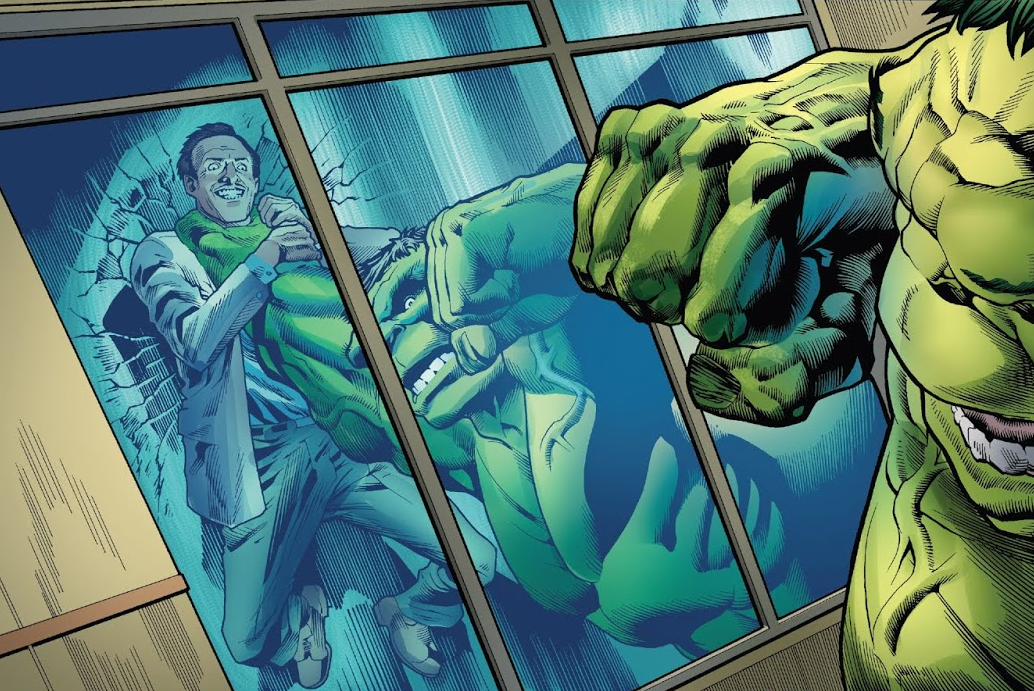

The Hulk's newfound ability to absorb gamma radiation worked to his disadvantage during the battle with Sasquatch. Because the One Below All uses gamma as a medium, draining the energy from Langkowski's body allowed the creature, still wearing Brian's soul, to possess the Hulk. The creature persuaded him to return to Los Diablos Missile Base, where the fateful gamma bomb had originally detonated.
There the Hulk fought "Crusher" Creel, a.k.a. the Absorbing Man, who absorbed the gamma energy from his body--and with it, the One Below All, who appeared very differently to Creel. And when Creel stumbled into the spot where the detonation occurred, the world turned upside down. He and those around him were transported into the hellish domain the One called home.

In this Hell Below Others, the various parties near the event are divided into teams of two, with the Hulk alongside Jackie McGee, the reporter tracking him since issue #1, while Creel is teamed with Eugene Judd, friend to Langkowski, better known as Puck. So far, Langkowski and Carl Burbank, an assassin better known as Bushwacker, are unaccounted for in the "Hulk in Hell" story.


However, most remarkably, Bruce Banner appears separated from the Hulk, bathed in green light upon a high cliff, while his father Brian stands and explains the story of the One Below All. In addition, Ewing narrates a comparative religions study. He burrows into Kabbalist Jewish lore, evoking the unity and duality of God. In fact, the story in issue #10 is titled "Thaumiel," which are the twins of God. In #11 he defines Thaumiel further, explaining that its ruler is Satan, whom, conveniently, Hulk has been compared to since the very first issue of this run.

However, I think those looking for a deeper reading of the text are emphasizing the wrong part of the puzzle, and issue #12, titled "All on That Day" (an ode to Nina Simone's "Sinnerman"?), crystallizes my thinking by keeping the Kabbalist view of Hell but also bringing in the Zurvanite Zoroastrian concepts of the god Ahura Mazda and its opposite, Angra Mainyu, as twin brothers.

Credit where credit's due to Cth on the Hulk Message Board for highlighting this, because in an issue where we get a lot of new history on Bruce's father Brian and his relationship with wife and son, we also get this panel amid Ewing's narrations:


Looking back, the same panel is found on the very first page of issue #11, with different captions:


In a book where the focus is the dysfunctional relationship between father and son, it's hard not to see a panel such as the above as related to the characters' past.

But then, why are there two cribs in the picture in question?

Then another thing hit me when I went for another reread. When Jackie McGee tells the childlike Hulk to put the Devil Hulk back in charge to talk, he has a marked aversion to her characterization of his relationship to Banner:


Through McGee, Ewing seems to be metacritiquing the historical interpretation of the Hulk that's existed since Peter David's revolutionary Incredible Hulk #377, where the two Hulks (to that point) were explained as multiple personalities of Bruce Banner given form by the G-bomb. And the extant personality seems to disagree with that interpretation.

Now why would he do that?

The answer is one I think we've already seen without realizing. It's staring us in the face since the very end of issue #11, in the climactic moment where we see Brian talking to the suspended body of his son in the green light.
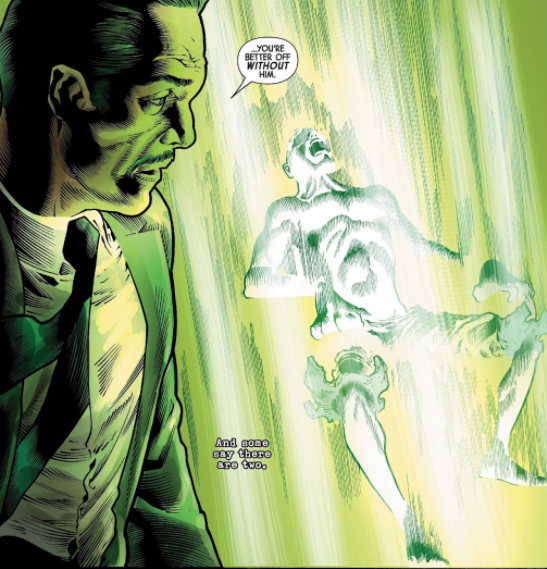

If you think of Hell in the strictest interpretation, it's a place where souls go when they die. So, if the Hulk, or Hulks if you prefer, are mere alters of Bruce Banner, why would they be separate in Hell?

Unless, of course, Bruce Banner and the Hulk have an altogether different relationship than we've been led to believe all of these years.

Unless Bruce Banner and the Hulk are brothers, not alters.

Twin brothers.

Remember that twins aren't an aberration in the Hulk mythos. In Peter David's out-of-continuity novel, What Savage Beast, Betty gave birth to twins named Ross and Brett before Ross died and Brett was kidnapped to be raised in a dystopic future by the Hulk's future self, the Maestro. And in-continuity, Greg Pak wrote of Skaar and Hiro-Kala, the Hulk's twin sons by his alien wife Caiera. And twins, as anyone with a passing familiarity with genetics will say, run in families.


So why haven't we heard anyone talk about Bruce Banner's brother before now? There are a few possibilities. It could be that another son was expected but that he was stillborn. Or perhaps he fell victim to the vanishing twin syndrome, wherein a twin dies in utero and its tissues are reabsorbed, often by the mother or sometimes by the remaining twin.

What if the Hulk were that vanished twin, absorbed back into Bruce, brought to life when the G-bomb struck?

It might even go to great lengths to explain how the Hulk possesses such remarkable healing abilities as he's demonstrated in the body-horrific issue #8. If the Hulk is a vanished twin--fetal tissue reabsorbed into his brother--then fetal tissue has unique properties that developed tissue does not. Hence why many scientists have begun experimentation on stem cells in therapies for treating various genetic diseases. I'm spitballing here, but perhaps the Hulk's healing derives from being, in effect, a mass of super stem cells?

Remember, one thing Ewing also brought up courtesy the Hulk's inner monologue back in issue #9 is the idea that perhaps he wasn't only with Bruce since the G-bomb, or maybe not even since being abused, but even further back in some form:


Put it all together and it sounds like the only remaining questions are just why there's so often a childlike Hulk and a smarter, craftier one.

Oh, and...


We'll see at least a few of the answers in The Immortal Hulk #13, on sale a week and a half from now. But in the meantime, we've got a lot of speculating to do. If the answers are even close to what I've postulated here, well, we're in for a grand old time as Hulk fans.

~G.

17.3.18

The Incredibly Morbid Hulk (Avengers #684 & Immortal Hulk #1, Forecasted)

He's baaaaaaaaaaccccccccccckkkkkkkkkkkkk.

And he's PISSED.

Since the last time I wrote, the Hulk--my favorite fictional character, as you should know if you've been following me for any length--largely remained dead since Marvel had him killed in their publicity stunt masquerading as event series, Civil War II, in mid-2016.


The series was written by Brian Michael Bendis, a writer whose work I've at times enjoyed (Alias, Daredevil, Ultimate Spider-Man--the first 50-ish issues) and other times loathed (gobs of Avengers and X-Men of varying flavors; Secret Invasion; Guardians of the Galaxy). As I've said before, his characterization of Banner and the Hulk just leave me cold, and each time I have to read something he wrote about them, I cringe at the total lack of knowledge of and utter disgust for them he seems to possess. I know not everyone holds Bruce Banner and his monstrous id in the same high regard as I, but dammit, do people who seem to outright hate him need to be so obvious about it?

The only thing more disgusting than the way in which Marvel chose to kill the Hulk is the way in which they've teased, time and again, his "resurrection." It's true that you knew they would never let him stay dead, but really, they tease by having the Uncanny Avengers fight a version of him apparently raised by the Hand and wearing tatami that still lets his green skin peek out around the edges? Not content with that, Banner's body is then turned over to Captain America, who at the time was a deep cover Hydra agent, his memories rewritten by the Cosmic Cube as part of a revenge scheme by the Red Skull. (Say that five times fast, I dare you!) Of course, Captain America Hydra turns the corpse over to Arnim Zola, who programs him to return to life just long enough to shred through Cap's heroic opposition like a sickle through chaff.

So of course, primed by these three "deaths," the new Hulk status quo is that he's--wait for it--immortal, and each time he's died, he was just destined to come back. That's the premise of the new series by Al Ewing and Joe Bennett, coming in June to a comic shop near you, called--yup--The Immortal Hulk. (Interview at link.) And Marvel is previewing this new take in their 16-part weekly series, Avengers: No Surrender, of which issue #684 is now on sale.

31.7.16

Not My Batman V. Not My Superman


I didn't like Man of Steel.

I'm not talking about the 1986 DC Comics miniseries by John Byrne, which is, to the contrary, revelatory in nature. That book brought Superman singlehandedly into the modern era and paved the way for hundreds of terrific tales. (It's also, as I pointed out before, the starting point for my own Superman collection, recently begun anew with the resurrection of the Post-Crisis iteration of the character.)

Rather, I'm talking about Zack Snyder's 2013 film that endeavored to reintroduce Krypton's Last Son to modern audiences. I liked the trailers and I even was excited enough to attend a midnight screening of the movie. I started out really enjoying the scenes that took place on Krypton, displaying the conflict between Superman's father Jor-El (Russell Crowe) and General Zod (Michael Shannon). But the Superman of this narrative contrasts starkly with the version I know and have enjoyed for the last few decades. Gone was the optimism that's often encircled the character, replaced by cynicism at best and pervasive xenophobia at worst. (I shouldn't have been surprised, as executive producer Christopher Nolan always was more at home in Gotham than Metropolis.) Add in enough property devastation to make even Michael Bay blush, and I might have considerable pause. But then--then--give Superman, the very same guy who always, always finds a way to win, an unwinnable situation where the narrative forces him to kill Zod. I checked out like Mark Waid (a writer whose work on Superman: Birthright and other tales I enjoyed).

So when DC announced the "sequel" to Man of Steel would be a battle with the Darkknight Detective himself, as a pitstop between the original and a Justice League movie, I should've known better. When I saw the film back in March, I dismissed it as an unmitigated disaster that got so, so much wrong about both lead characters as well as the villains of the piece. Batman (Ben Affleck) saw everything in terms of absolute good or absolute evil and was a frequent accessory to murder (with the bat-brands on criminals he caught serving as, essentially, a death sentence). Superman (HEnry Cavill) was a man of few words, and those he did say he growled in ways more accustomed to Batman. Lex Luthor Jr. (Jesse Eisenberg, horrendously miscast) was just a lunatic. And Doomsday could fly, shoot heat rays out of his eyes, and explode over and over again like a bomb because, well, I'm not quite sure why. The narrative was a mess, the characters were a mess, and by the time Superman died in the final battle, I was nauseatingly numb.


Of course, like a fool I decided I absolutely needed to watch the "Ultimate Cut" released on July 19. Could the additional 30 minutes of footage turn my opinion of the film around? Putting aside the fact that an R-rated version of a Superman movie shouldn't even by rights exist, I watched.

The verdict? Although the film is still deeply flawed and especially wrongheaded in its treatment of Superman, the Ultimate Cut is a leap forward when compared to its theatrical predecessor.

Others have given more thorough reviews of the films as a set, so I won't go into much detail. The strongest bit re-inserted into this film is the lengths to which Luthor went to manipulate the characters, from Superman and Batman on down to Senator Finch (Holly Hunter), Wallace Keefe (Scoot McNairy) and Kahina Ziri (Wunmi Mosaku), the latter of whom has the most expanded role. What could have been believed as too many coincidences in the theatrical version is spelled out as Luthor's machinations in this version. Granted, very few of the additional scenes actually involve Eisenberg's Luthor himself, so there's an even greater disconnect between the actor's portrayal and what we know the character has done. But putting forth the idea that Luthor knew who Batman and Superman really were from the beginning puts everything in perspective, just as making him direct prisoners to kill other prisoners with bat-symbols exonerates Batman in a way, and makes the opening sequence and the bullet sub-plot have a more sensible connection to Superman.

However, there are things besides Luthor that remain problematic or become even more so as result of the added footage. Batman's visions of an "Apokoliptic" future and the cameos of all Justice League members still stick out like sore thumbs. The explosion at the Capitol Building gets a bit of a tradeoff, as we find out Keefe's wheelchair was lined with lead which prevented Superman from seeing the bomb. However, nothing in this film or Man of Steel shows why Luthor would have any knowledge of this particular weakness of Superman's. (Filmmaking 101: Set 'em up and knock 'em down.) And Snyder really, really doubled down on the bleakness and carnage of the prior film's denouement, using it to form his basis of this one.


The biggest problems of the movie are still, sadly, the biggest problems. Batman still reacts nuttily toward Superman's exclamation that they're going to kill Martha, and Doomsday is still a big gray deus ex machina meant to give all three protagonists something to punch and hit since Luthor's body can't take that kind of punishment. But what was worst of all was the entire sub-plot making Superman out to be some kind of god being worshiped by the people of the world. True, he never actively encouraged any of them, but he never discouraged them, either. Snyder takes pains to dismantle the myth, at least in Batman's eyes, by making him see that he's not a god--that he's just a man, in the "Martha" scene, and then impresses it upon everyone else in the story by having Doomsday kill him at the end. He can die just like the rest of us! O, sad day!

This is all well and good, of course, so long as you don't consider that, in order for Superman to appear in Justice League, he's going to need to be restored to life. And, if you think the huddled masses were going ga-ga over Superman before, just wait until they see that Christ parallel in action! The very direction of the narrative decimates any statement Snyder (or screenwriters Terrio and Goyer) attempts to make.

So, Batman v. Superman: Dawn of Justice has a better version in the Ultimate Cut; however, there's still much to overcome. Seeing this cut gives me a little hope in Justice League. Maybe, at the very least, they'll resurrect Superman with the ability to smile, laugh, and see the best in people? After all, Henry Cavill has really looked the part in these last two films, and I know from films like The Man From U.N.C.L.E. that he's got charisma to spare. So why not let him, you know, actually use it?

Stranger things...

~G.

18.7.16

A Delusional Flashback: The Hulk Is Dead, Long Live...John Byrne's Hulk?

I thought it might be a good time to throw a new spotlight on another time the Hulk was threatened with death...by acclaimed writer/artist John Byrne!

If you haven't read the below articles, well...they're new to you!

John Byrne & The Hulk That Might Have Been (Part 1 | Part 2 | Part 3 | Part 4 | Post-Script)


Delusional Honesty will return later this week, with a long-delayed review of Batman V. Superman: Dawn of Justice.

~G.

10.7.16

The Physicist Has No Purple Pants: Marvel's Hulk-Sized Problems (2 of 2)

(Updated thanks to an eagle-eyed Facebook friend. Thanks, GG!)

When last we left our intrepid blogger, I was constructing a narrative by which I proved that there's a great, big target on the Hulk's green butt, put there by Marvel's powers-that-be and set to have the bull's-eye hit on Wednesday, July 13th, only 3 short days from now, in the pages of Marvel's Civil War II #3. Now, get ready to go beyond the actual event, into what the Hulk's death means for the world of Marvel Comics and its creators, for you the fans, and for the entire doomed comics industry.

(Whoops. Did I just say "doomed"? Heh-heh.)

While I've been taking the time to write these new chapters, I hope you've familiarized yourself with Totally Awesome Hulk #7-8, both now on sale, the latter of them since I published part one. As writer Greg Pak stated himself, the books mark his return to writing Bruce Banner. What he didn't say--but which is patently obvious from reading the eighth issue in particular--is that these stories are intended as a final look back at our favorite physicist, since his next appearance in Civil War II will end with an arrow through his [insert whatever part of Banner's anatomy you want].


4.7.16

O Death, Where Is Thy...Smash??!? (1 of 2)

(EDITED 7/8 thanks to Cth at The Incredible Hulk Message Board!)

It's been about a year since my last post on Marvel's Green Goliath. Those of you who have followed me for any considerable time know the Hulk is my favorite comics character. Hence, I'm a bit territorial when it comes to big events surrounding Big Green. And when I'm displeased, I'm known to write pieces like those dissecting the runs of Jason Aaron and Mark Waid.

Up to now, I've been staying eerily quiet about Totally Awesome Hulk. That ends today.


I've got much more to get into than Totally Awesome Hulk by itself, so I'll try to be brief. For Greg Pak--one of my very favorite Hulk writers, his name spoken in the same breath as Len Wein, Bill Mantlo & Peter David--to have a comeback would ordinarily be a cause for celebration. At the same time, there was apprehension, for what writer successfully returns to the book on which he made his mark? Even Peter David couldn't make lightning strike twice, leaving not even a year into his second tenure. It was true that this time, Pak was making his own creation, Amadeus Cho, into a brand new Hulk, in a move that I previously stated echoed Bill Mantlo's original plans before he handed the book to John Byrne. Some at the time called it a Gary Stu situation (look it up) beyond all others. Me, I went along for the ride, as Pak had earned much goodwill in his prior five-year run.

20.6.16

Of Spider-Clones and Supermen: Why "Superman: Rebirth" Is the New "Clone Saga"

Ever since hearing that DC Comics was going to kill off the "New 52" Superman and replace him with the recently-returned "Pre-Crisis" version who disappeared nearly 5 years ago, something's been scratching at the back of my head. And now that we're three full issues into the Pre-Crisis Superman taking over for NuSupes, I can finally put my finger on the feeling. It's one I last had about two decades ago.


For anyone having read Spider-Man comics between 1994 and 1996, you're of course familiar with the much-maligned "Clone Saga." For those not in the know, there was a time shortly after DC's "Death of Superman" storyline where editors pushed their talent to manufacture similar, event-based storylines to drive then-record sales figures ever higher. No idea was too silly when Marvel went looking for their own Spidey-centric tale. (Such events have only gotten more grandiose, but I digress.)

So writer Terry Kavanagh dusted off The Amazing Spider-Man #150, coda to a storyline wherein the villainous Jackal cloned both Spidey himself and his alter ego's late girlfriend, Gwen Stacy. Spidey threw away a report on whether he was really the clone because of, essentially, a gut instinct. The question became, "What if the Spider-Man fans had been reading since 1975 was really the Spider-Clone?" Writers like John Marc DeMatteis (one of my idols) became inspired, and suddenly the dead clone nobody thought twice about returned to life--and a co-starring role in all of Marvel's Spider-Man series for the better part of two years. He became Ben Reilly (so named after Peter Parker's uncle Ben, with his last name the same as Aunt May's maiden name Reilly) and Spider-Man's life would never be the same again!

I read the Clone Saga when it originally came out. One of my friends in the fledgling days of Internet fandom--the inimitable DRILLN0T--helped me write "The Spider-Man/Jackal Dossier," an ungodly tome that consolidated and promulgated fan theories and unresolved facets of the storyline. So yes, I'm kind of well-versed in the storyline and count it as one of the high points of my collecting.

What's that all have to do with Superman: Rebirth? It's funny you should ask...

31.5.16

Just When I Thought I Was Out... (DCU Rebirth SPOILERS!)

Hey, y'all.

Remember when I said that both DC and Marvel Comics had catastrophically screwed the pooch when it came to handling their greatest super-heroes and super-villains?  (The most recent spate of comments started here with a discussion of Secret Wars and Convergence and continued over here with some talk about Superman: Lois & Clark.)

Yeah, Marvel's still doing it. I think right now I'm about the most opposite-of-excited as I've been for Marvel in a long, long while. Maybe ever! And it's something that's well reflected in my current buying habits. In my Discount Comic Book Service order for the month of May, I've only ordered nine ongoing Marvel titles--and five of those are in the Spider-Man family of books! I'm only reading what I enjoy, but even the current crop is subject to elimination. (And no, Steve Rogers: Captain America isn't doing the company any favors in my eyes, although certainly I'd be more apt to judge after we see more than just the first chapter.)

But DC? This last week returned a skosh of the goodwill they squandered over the last year. And the next several weeks will either validate that early feeling or maybe just sour me the rest of the way.


Of course, I'm talking about DC Universe Rebirth #1, the book that officially pulls back the curtain on the DCU of old and turns the trickle of old DCU carryovers into a veritable flood. Sure, a few characters like Batman and Green Lantern kept the majority of their continuity thanks to writers with long-term projects (Grant Morrison on the former, Rebirth scribe Geoff Johns on the latter). But it wasn't until Convergence with its undoing of Crisis On Infinite Earths that the ripple effect began in earnest.


12.3.16

Post-Crisis (Superman)

[I've been a bad, bad blogger over the last few months. Here's hoping I can start making my lack of regular posts up to everybody and bring back some regular readers in 2016. Sound good to you? Good! --GMM]
Maybe the single book I was happiest about in 2015. Happy irony!
When last I wrote, I was having a little crisis regarding my comic book buying habits. I developed a severe lack of faith in the output of the Big Two in 2015, exacerbated by line-wide events like Convergence at DC Comics and Secret Wars (what, again?) at Marvel.

Looking at some articles out there from not only fans but also some retailers, it appears I'm not alone in my trepidation. One thing the market hates is uncertainty, and in 2015 the Big Two gave it to retailers and readers alike in spades. With a spate of regular series, retailers can base their orders on their regular customers and their buying habits, forecasting here and there for "new" series based on the performance of other, similar books. With a two-month-long event like Convergence, there's a degree more of uncertainty because the entire regular lineup is replaced by forty two-issue miniseries anchored by a 9-issue event series. And because Marvel must take every idea DC has and shoot it full of Gamma Rays to do it "better," they anchored a staggering 42 miniseries of indeterminate length (upon early solicitations), as well as several issues of 10 ongoing series, to their own 9, then 10-issue event series.

So, to recap: we've got big event miniseries, which usually sell gangbusters. But what happens when you tie them to countless miniseries instead of the traditional issues of ongoing series? Remember the theory to using events and crossovers in the first place: namely, to prop up flagging sales of series by tying them--unnecessarily, even--to said event. But how do retailers even begin to determine orders when juggling an event with a whole bunch of new #1 issues for series of unknown length, with no real corollaries to existing series? Danger, Will Robinson! Danger! Danger!

4.7.15

Convergence (Or, an Essay on My Changing Comic Buying Habits)

...and no, this time I don't mean DC's Convergence event that ran through their June and July-dated books this year. But, then again, that's not a bad place to begin...

Convergence #0 variant cover by Adam Hughes...just because I like it!
Historically speaking, my comic book buying habits have been rather crazy. And when I began ordering from Discount Comic Book Service in 2006 was when that habit kicked up another few notches. With astonishing 40% discounts across the Big Two and sizable discounts for the other companies, I could afford more than under my local comics retailer's discount.

29.6.15

Stop Me If You've Heard This One Before...

Welcome back, my friends, to the show that ends only while life gets in the way...let's see if we can get the ball rolling and keep it going for more than a post every 6 months, yeah?

And I'm starting with a post about the Hulk.

 
No, no, no! Not that Hulk! This one:

Image courtesy ComicBook.com
The Totally Awesome Hulk is one of the titles announced for the post-Secret Wars Marvel Universe this fall. And while traditional Hulk fans may look at the above promo artwork with apprehension if not outright disgust, there's a silver lining in the creative team.

Returning to the Hulk series (well, a Hulk series) after nearly four years away is "Planet Hulk" & World War Hulk scribe Greg Pak. Joining him is Liberty Meadows and Shanna's cartoonist par excellance Frank Cho. (While Frank himself has worked on a few Hulk stories under writer Jeph Loeb, this series will mark his first regular work on the character.)

I've heard a lot of "wait and see" statements, and a few more people on my Facebook feed have sworn the new series off altogether. In case you can't tell from the above illo by Cho, the protagonist of the new series won't be Bruce Banner. Like Loeb's series before, Totally Awesome Hulk will star a brand new gamma-powered man-monster. Unlike Banner, however, this new Hulk will revel in his new identity--which won't exactly sit well with the other heroes in the Marvel U.

Part of the stated allure of the new series will be the mystery of what's happened to the original green goliath. Although certainly I can't imagine he'll be gone for long.

Speculation's run rampant as to the identity of the new Hulk, although the smart money's on Pak's very own creation, Amadeus Cho, a.k.a. Mastermind Excello, who became an on-again, off-again sidekick of sorts to Banner and Hulk during his prior tenure. Adding more fuel to the fire is Pak's involvement in the currently-running Planet Hulk series as architect of the origin of the various Hulk-like characters therein.

But what everyone's overlooking is the fact that one Hulk writer wanted to do something very similar before. One who certainly has earned his place among the top Hulk scribes of all time. One who also had a 5-1/2 year run on the character.

That writer? Bill Mantlo.

It's no secret that Greg Pak cites Mantlo as his primary inspiration for nearly everything he's done with the character over the years. What might be a secret to everyone out there is the direction in which Mantlo wanted to go when he neared the conclusion of his run. Per Peter Sanderson's "The Big Switch" article from Amazing Heroes magazine in 1985:
[Wrapping up the Crossroads storyline] we were faced with the question, 'Okay, at the end of this, what happens?' We bring the Hulk back, it's clear we've come full circle, and more or less he's right back to where he was when I picked him up. My notion was I could go two ways: I could either bring him right back to where he was. or I was going to create an entirely new Hulk, a Hulk super-hero, who looked glorious, physically handsome, and would be a guardian of the Earth.
Of course, Mantlo's mind got made up for him when John Byrne stepped forward with the desire to tell the Hulk's adventures, resulting in a whole-house creative team swap I've previously covered. Plus, well, how long could a "new Hulk" have survived in the mid-1980s?

Still, it's very, very interesting we're on the cusp of a book featuring an all-new Hulk by a writer inspired by a classic Hulk writer who wanted to do something eerily similar.

With this being my first post back, I'm long on inspiration but woefully short on conclusions. As Joel Hodgson used to ask regularly: "What d'you think, sirs?"

~G.

24.4.14

Γ (An Open Letter to Mark Waid)

Mark,

Long time no talk! You probably don't remember me. We talked in Pittsburgh, back at the old ExpoMart. Early on a Friday, absolutely nobody was waiting to talk to you. You signed some Flash comics for me including the introduction of villain du jour Cobalt Blue, the evil twin brother of Barry Allen. You suggested that Cobalt Blue wasn't, strictly speaking, a retconned-in character, because nothing in Barry's history outright stated he wasn't a twin.

One of my favorite Flash storylines. Don't judge. (Art by Steve Lightle.)
What you didn't know and what didn't even matter back then is that I am, was, and probably ever shall be a fan of that green goliath called the Incredible Hulk.

So, maybe I didn't take it so well the other day when the following showed up on your Twitter feed after what I'm sure was a frustrating time at Wondercon:
Now, I'm not about to take you to task over the above comment, which has incensed more than a few Hulk fans who are on my Twitter feed, or who friended me on Facebook, or who hang out on the Hulk Message Board with me, or who read this very blog.

About as angry as most Hulk fans I've talked to lately. Art by Mahmud Asrar.

I've been reading the Hulk's adventures for over thirty years, since I wasn't quite three years old. Long enough to be set in my ways, surely, right? Well, consider that I turned three in 1982 and that my first issue was Incredible Hulk #272, wherein Bruce Banner's personality became ascendant for the first long-term period in the character's existence. Consider that since my very first exposure to the character, he's never really stayed with one status quo for more than a few years at best, and you'll easily understand why I'm very, very comfortable with the concept of change.

You're one of my favorite writers, Mark. "The Return of Barry Allen" is one of my all-time favorite stories. I told Brian Augustyn how much I enjoyed "Chain Lightning" and "Dark Flash" when I saw him here in Arizona a few years ago. I loved Empire and look forward to seeing more of that world after your recent announcement. Captain America, JLA, Amazing Spider-Man, and even Ka-Zar? Terrific! Kingdom Come? Revolutionary! And nobody's brought Daredevil out from Frank Miller's shadow like you. (J.M. DeMatteis and Karl Kesel tried it, but the world just wasn't ready.)

So you, Mark, writing my favorite character? "Bliss" didn't sound like too strong a word, especially when considering the series had really and truly lost something with the departure of Greg Pak, the book's best voice since the departure of Peter David. Sure I was sad to see the book relaunched for the second time in two years, but it went along with the whole "Marvel NOW!" program and legitimately seemed like a new direction. "Hulk destroys, Banner builds"? Who doesn't love the dichotomy?

Waid's journey into Hulkdom begins. Art by Leinil Yu.
Something I didn't like about the run immediately preceding--without even getting into the story--was the constant artistic Armageddon going on. I know I said I liked change, but I prefer consistency in art. I grumble and I grouse that today there are seldom any unbroken artistic runs like in the sixties and seventies, and never at the Big Two. (Ironically, Hulk has been home to not one but two great, long art runs, by Herb Trimpe and Sal Buscema.) Generally, though, the more consistent the look, the more I'm willing to forgive.

So we had Leinil Yu, whom I've always wanted to see take the regular Hulk gig (since Wolverine #145). And then we had Walt Simonson (ditto, since Rampaging Hulk magazine). Then we had Matteo Scalera, the "new guy" with 4 generally good issues right out of the gate...before we ran smack into what must've been a mountain of Dreaded Deadline Doom. Kim Jacinto; Mahmud Asrar; Clay Mann; Miguel Sepulveda; Jheremy Raapack; Tom Grummett; Joe Bennett.

I know you don't have any control when the Doom hits, Mark, but let me tell you, nothing kills momentum like artistic inconsistency--even among artists whose work I casually enjoy. It honestly felt like nobody cared about the book since about the halfway point of "Agent of T.I.M.E." Each issue marked time (yes, please groan) until the relaunch.

So what was I expecting out of Hulk, the new series that started last week? I saw Mark Bagley's name and immediately connected the dots to his unbroken or nearly-unbroken runs on Amazing Spider-Man, Thunderbolts, Ultimate Spider-Man, New Warriors, and Justice League of America. Nothing says "consistency" like adding "Bags" to a project.

Story-wise, that's something different. Since the seventies, more casual fans have identified more with the mute Hulk of the live-action TV show. A mute or near-mute Hulk carried over into both the 2003 and 2008 films as well as Marvel's The Avengers. While it works well enough because of the character's physicality, the Hulk's near-muteness can be a real detriment to the comic book page, working best when hidden behind prose more purple than the Hulk's pants (e.g. Bill Mantlo's "Crossroads" stories) and worst when the Hulk becomes an incredible cipher (e.g. Bruce Jones's horror take of the early 2000s).

The segue into the relaunch. Art by Joe Bennett.

The Hulk is Bruce Banner's rampaging id, yes. Everything Banner represses sublimates into the Hulk, true. But the Hulk works better with a brutish personality, whether it's the craftiness of the Grey Hulk; the canny savagery of the World Breaker; or the unique blend of childlike innocence and blind rage that was the Savage Hulk. (Very few, it seems, can write the latter well anymore, alas.)

When you stray too much from a Hulk who is capable of articulating his rage at being bound to Banner--either by saying "Banner keeps Hulk locked in dark place!" or by imbibing so much booze before dawn that it leaves Banner incapacitated until his next change at dusk--you lose something about the character. The Hulk becomes less a character and more a mindless weapon to aim.

I don't feel that Banner's character development must come at the expense of the Hulk's. However, it seems that's what we've gotten lately. True, from the looks of last week's Hulk #1, you might just be priming us for a reversal of fortune for which I'd be ever so grateful.

I'm anxious, very anxious, at the questions posed between last month's Indestructible Hulk #20 and this issue. How can the Hulk's healing factor be so severely curtailed by two mere bullets? (Clever way to make the Hulk "indestructible" no more.) Who could have infiltrated a S.H.I.E.L.D. facility to make the hit, and why? Could one of Banner's own team be to blame? What does that frightening last page mean for the Banner/Hulk paradigm you've established? How will the physicist we know and love return to normal? And might we still have to worry about Banner's "insurance policy" he worked out with Matt Murdock?

Where the answers begin (we hope). Art by Jerome Opena.

So, you've got a whole lot of questions to answer. Hopefully a smarter Hulk is part of the answer. After all, a Hulk that doesn't talk--much if at all--is an invention of a television producer who by and large looked down at the comics medium. Comics shouldn't be beholden to that portrayal. Comics are, well, comics. So reach higher. Do more.

And for god's sake, "Hulk knows how to con-joo-gate stupid verbs! Hulk is not stupid!" Truth: As was frequently the case during Bill Mantlo's earliest issues as Greenskin's scribe, those around him underestimated the Hulk time and again. Just because the Hulk spoke like a caveman, that didn't mean he was as dumb as one.*

(* - With apologies to the Geico cavemen.)

With a character that's been through as many iterations as the Hulk has over the last 52 years, you're always going to do something that disagrees with part of the readership. You've just got to find balance--between Banner's intelligence and the Hulk's savagery; between loquaciousness and taciturnity; and between what you want to write and what the readers want to read.

Excelsior!

~G.

11.3.14

Rebirth of a Delusion (Of Lanterns & Things)

Did you miss me?

Yes, it's been a hectic year--buying a home tends to add a whole lot of complications to a perfectly productive life. You've still seen me lurking around Facebook and Twitter, and I've even taken up co-hosting duties alongside Ragin' Rick Hansen and Captivatin' Karl Fink on The Incredible Hulkcast starting with Episode 28. But now, I hope to be back to where it all started, right here at Delusional Honesty. Because honestly, if nobody's posting a thing here, why the heck do I even keep this site around?

So, think of this as the rebirth of delusions, or maybe the rebirth of honesty. Whatever sounds better.

And, like any decent column of mine should, we begin with a green character.

But no, not that green character.

What?!?

Allow me to explain.

Everybody remembers when "The New 52" started, right? It's been about 2-1/2 years now and many of you are probably wondering why that moniker even still matters. (Meanwhile Marvel Comics is on their second "Marvel NOW!" campaign, entitled, appropriately enough, "All-New Marvel NOW!" Insert groans and sighs if you wish, but at least they didn't reboot continuity as a sacrifice to the elder gods of Burbank, California. Ahem.)

Anyway, one of the books that relaunched during "The New 52" that wasn't quite relaunched as much as the others--am I still making sense?--was Geoff Johns' perennial favorite, Green Lantern, the book on which he'd worked nonstop since late 2004. Johns seized the reins of a series that was a very modest seller, and in one month more than doubled circulation. He raised a middling book to the top of the heap where, after a fashion, it's remained ever since. Not just that, but the book has spawned an increasing number of spin-off series, becoming one of DC Comics' largest franchises, right up there with the Superman, Batman, and Justice League corners of their universe. (Hooray, he says sarcastically, for diversity in the marketplace.)

Be afraid. Be very afraid.
 The series and its spin-offs have flourished in spite of Johns' and DC's own Icarus moment. Yes, I'm talking about the much-maligned, overlong, banal Green Lantern film of 2011. You remember, it was the one that was supposed to be the start of a franchise that didn't have "bat" or "super" somewhere in the title. Instead it was a tragic misfire that tried to cram too many incredible concepts into two hours, and ended up exactly that--not credible--in the eyes of theatergoers everywhere. With a budget of some $200 million US, ol' GL racked up an embarrassing domestic box office total of some $116 million and a foreign B.O. total of $103 million. (Unsurprisingly, a sequel is stuck in development hell.)

I've had a long, off-and-on association with the Green Lantern character. It began in late 1984, courtesy writer Len Wein and artist Dave Gibbons, as well as a little comic shop in East Liverpool, Ohio, where my father bought me the book. In the story--which to this day invites comparison to Denny O'Neil and Luke McDonnell's deconstruction of Iron Man the previous year at Marvel--Green Lantern Hal Jordan has quit the Green Lantern Corps, and the Guardians of the Universe--they who lead the Lanterns--have assigned another Earthman, John Stewart, to fill the ring, er, suit.


It was the era of Super Friends: The Legendary Super Powers Show on ABC-TV, and Super Powers also meant a series of limited series by comics legend Jack "King" Kirby. It also meant a line of action figures made by Kenner Toys, each of which included a mini-comic starring the same hero as was in the package. There were even tie-ins like hot chocolate. I'm relatively certain that one of those tie-ins--I'm thinking the figures--had a special offer for 3-month subscriptions to a few choice DC titles. That's how I learned about the Legion of Super-Heroes, and that's also how I began following Green Lantern in earnest.

Maybe it wasn't the best time to come aboard the series, what with John Stewart learning what it meant to be a Green Lantern all over again, and Hal Jordan trying his best to get back to the Corps. (Much later I bought the Green Lantern/Green Arrow trade paperbacks and learn of Stewart's first outing as a GL.) Still, there was something inherently interesting enough about the characters that I renewed with another 12-month subscription as the long, slow countdown to issue #200 began. (By "countdown" I mean it literally, as each issue's title literally counted down, beginning with #194's "5.")

The series changed hands from Wein and Gibbons to Steve Englehart and Joe Staton, but the stories kept their cosmic bent, featuring such key GL concepts and characters as Star Sapphire, the Predator, Katma Tui, the ring's yellow impurity, and more. During the crossovers with the Crisis on Infinite Earths limited series (which I wasn't even reading then), I even saw Guy Gardner get a GL ring for the first time!

Alas, right after the 200th issue, with the book's name officially changing to The Green Lantern Corps even though Hal had regained his ring, I was no longer interested. (Funnily enough, my subscription ended the month before, with #199.) In fact, I was no longer interested in DC at all, and would remain so until I rediscovered Firestorm, whom I remembered from the Super Friends cartoon. (And you can read all about my obsession with the character starting here. See how we all tie things together at Delusional Honesty?)

So, how did I pick up Green Lantern all over again? And how exactly does the answer lead to the horrendous pile of trade paperbacks I've had stacked in my library room?


Well, now that would be like skipping to the end, wouldn't it?

See you next time!

~G.


13.4.13

Life Is Buddha-Ful: Jon Haward Talks TALES OF THE BUDDHA

Did everyone forget about me over here? I've had a lot happening. New home, promotion at work, new 60" HDTV and all-region Blu-Ray player to lure me away. (Anybody seen that glorious new transfer of what we Yanks know as Hammer Films' Horror of Dracula?) And there's this Hulk thing I'm still working on, so, yeah.

But you don't want to hear about any of that. You want to hear about the Buddha. You want to hear about the time he drank twice-passed reindeer urine to get high, or the time he lost a duel against Hercules and ended up having to complete his 10 tasks, including cleaning crap from the Aegean stables.


What's that? You thought the Buddha preached peace, enlightenment, and purity of body?

As the Brits would say, "Bugger that!" I'm talking about the Tales of the Buddha (Before He Got Enlightened), a strip that began life in the U.K. underground comic Northern Lightz and is now being collected--along with some brand-new strips and pin-ups--in Renegade Arts Entertainment's new graphic novel collection of the same name.

I had the insane pleasure of reading the collection, sans bonus material, courtesy the iTunes store ($4.99). Writer Alan Grant (most famous for Judge Dredd and some Batman stories in Detective Comics) has partnered with artist Jon Haward and colorist Jamie Grant to bring the Buddha's adventures to print, and it's been a real hoot. So of course, with the print edition finally on its way in June, I couldn't resist shooting Haward, who's one of my Twitter pals, some questions about his career and about the project.


Haward is no stranger to the comics medium, having grown up reading the work of many greats. "Basically I grew up loving cartoon art in Mad and Cracked, [and artists like] Robert Crumb [and] U.K. comic artists Hunt Emerson, Ken Reid, R.T. Nixon, [and] Leo Baxingdale.," he says.

Although U.S. success has sadly eluded him, he's been quite popular in the U.K. He broke into the business in 1990, filling in for regular series artist David Pugh on the Dan Dare strip in Eagle, and never looked back. British fans have enjoyed his work in 2000 A.D., Thunderbirds Are Go, Teenage Mutant Ninja Turtles, Biker Mice From Mars, and an incredible five-year run on the now-defunct Marvel U.K.'s Spectacular Spider-Man series. (Out of 32 stories, we Yanks have only seen one of those tales on these shores!) He's won Bronze Ippy awards for his work on Classical Comics' Macbeth and The Tempest, both adaptations of Shakespeare's famous plays, so he's in no way confined to traditional comics fare.


And on the other hand, there's his humor work, which has spanned such unusually-titled U.K. publications as Shit the Dog, Smut, Toxic Pie, Wasted, and the one in which the foul-mouthed, booze-swilling, womanizing Buddha made his debut, the aforementioned Northern Lightz.

Buddha had its genesis as a one-off tale in the comic series, then edited by Grant. "Alan and I had fun working on short funny stories for Northern Lightz and I told him I would be keen to work on a new character. Alan came up with a two-page Buddha story which made me laugh out loud, still does. The intention was that the strip would be a 3-panel gag strip appearing on different pages [of the comic]. I didn't know this so I drew the panels as a regular two-page strip. Once it appeared both Alan and I wanted to do more...as they say, the rest is history."


Haward greatly enjoys the collaborative process with Grant in Buddha. "Alan writes the scripts. Sometimes I'd ask if we could do certain characters like Hercules, Jason [of "Jason and the Argonauts" fame], Alexander the Great, Cleo, etc." After he received the completed scripts, he would improvise his own ideas into the finished art: "I'd read the script [and] add extra little gags in the panels like the sign on the Jonah Whale, 'Don't call him Moby.'" He credits his love for the cartoonists of his youth for his sensibilities and offers the following advice: "The secret for a great humor story should be the art should be as funny as the gag line. When Buddha is in Mexico he's asked if he would like donkey sex, so I drew a camp donkey with Madonna bra and stockings. (Laughter.) So the line and the art combine to hopefully make you laugh."

Laughter is just what Haward and his collaborators are counting on to overcome the work's air of sacrilege. "It's humor, satire. Buddhists embrace laughter and Buddha as a young man was a prince who sampled all forms of pleasure. If I found the work totally offensive I wouldn't draw it. The work actually makes me laught a lot and has been a good tonic for me over the years. If you are very religious and with a low threshold for adult humor don't buy the book. But if you're open-minded and enjoyed Ted, The Life of Brian, Milk and Cheese, Mr. Natural, Preacher, Lobo, Carry On Cleo...dare I say Benny Hill, you'll enjoy our book."


And if you look at the above list of films, TV series, and other comics that Haward suggests echo the brand of humor found in Buddha, well, the off-beat humor is just what he believes should lure fans to his work. "It's different [and there's] nothing else out there that looks like it, with the borders [and] the 'Buddhaful' coloring. it's satire, spoofing everything from gods to rock stars to princes. He travels through time so he can meet basically anyone on his path to find enlightenment."

Part of the allure of the new edition are the new works therein, which seize upon that very conceit of meeting anybody. "The extra stories in the printed edition are where Buddha helps out Santa and where [he] meets Prince Harry. Both funny strips, and yes, Prince Harry is naked! (Laughter.)" The new works aren't just contained to stories: "Also there will be new pin-ups by Duncan Fegredo, John Ross, Alan Craddock, Simon Williams, Nigel Dobbyn, Jim Stewart, Dave Alexander, [and] Gibson Quarter," giving fans their money's worth.


Unfortunately, further projects are on hold while Haward deals with some health issues. Hopefully, however, he and his collaborators will have other projects at or above the quality level of Buddha. (Who knew the Buddha could make me laugh so hard I cried?)


Do me a favor, do Alan and Jon and Jamie a favor, and order Tales of the Buddha (Before He Got Enlightened). It's in this month's PREVIEWS catalog from Diamond under order code APR131223. If you order from my preferred comic shop, Discount Comic Book Service, you get a 30% discount off the regular price of $14.99USD!


14.12.12

Do You Think I'm Being Unfair?

Fellas and dames,

I have recently been selling my stuff on eBay. Someone bid on one of my items, then sent the following 3 days after winning:
i must say that i was excited to bid n this item however, after looking closely at the ad, you stated that the item has dents on it and I CANNOT PURCHASE THAT LIKE THAT. I collect these things and display them and i cannot display something like that i am sorry. could you cancel the transaction, i cannot pay for this sorry.
-deadbeatbidder (name changed to protect the guilty)
 What would you do? I'm awfully close to replying thusly:
 Hello,

I was initially happy to see you bidding on this item. However, after seeing your completely ignorant response, I can see it is very clear that you did not examine my pictures nor the auction text carefully before bidding.

Nothing has changed in the description since you bid on the item. The only thing that's changed is your attitude. If you didn't want the item as-is, you shouldn't have bid. A bid is a legal contract. I have canceled bids for people before, but they made it clear their bid was an accident. They also asked me, politely, before the auction had been completed--not 3 days after while I have the item packed and awaiting payment. You're shouting at me (CAPS) showing neither politeness nor respect.

If you want someone to be angry with, be angry at yourself for not reading or examining my auction description or pictures more closely, or not contacting me before the auction closed. If you don't want the item, complete your responsibility to me and to eBay, and then resell the item. If you refuse to pay, I will initiate non-paying bidder procedures ASAP.

For more information on eBay's policies on bidding and canceling a bid, please see http://pages.ebay.com/help/buy/questions/retract-bid.html

Have a great day,

-hulksmash!
What do you think, sirs? Am I being too tough on Monsieur Deadbeat?

~G.

9.12.12

Indestructible Hulks & Marvel, Nowish

Well, now.

It's been a few months since I've been around these parts. For those of you with Twitter, you know I've still been as active in my fandom as ever; I just haven't been able to blog on account of a whole host of realtime issues. The Hulk book is still forthcoming, I promise. In fact, with this very blog post, I really have to watch what I say about at least one series I want to review because its release has totally thrown a spanner into the works of the final essay I've left to write.

Am I making sense?

So. Let's get on with it, shall we? What have I been reading during the last couple of months?


INDESTRUCTIBLE HULK #1 (Marvel, $3.99) - It's true that Marvel seems to be caught in a cycle of perpetually relaunching some of their characters, and the Hulk is one of their biggest targets. It started with "Planet Hulk" in 2006 and continued through the Red Hulk launch in 2008, the re-renumbering of Incredible Hulk in 2009, the introduction of the Hulk family in the transformed Incredible Hulks series in 2010, and finally last year's rebranding courtesy Jason Aaron. As part of the "Marvel NOW!" initiative, our favorite Jolly Green Giant has once again had his series restarted, written by Eisner and Harvey Award-winning writer Mark Waid, no less!

Let's get this out of the way right now: I love Mark Waid. He's written several of my favorite comics storylines, including "The Return of Barry Allen" early in his Flash run; "Chain Lightning" and the "Dark Flash" stories late in same; "Unthinkable" and "Hereafter" in Fantastic Four; "Man and Superman" in JLA; too many Captain America stories to count; "Urban Jungle" in Ka-Zar; and, well, you get the idea. In my top ten comics writers of all time, easily. Have I mentioned yet what miracles he's worked in making me enjoy the perennially-dark Daredevil by embracing a lighter mood? No? Corrected!

So far--and I realize we're only one issue into his and Leinil Yu's run--I remain optimistic, but can't help but feel we've moved a dozen steps backward. While it's an inspired choice to have Bruce Banner accept that he and the Hulk aren't going to be rid of each other anytime soon, and while there's a germ of an interesting idea having him set up shop with the same spy organization that once was complicit in exiling him into space, there's honestly precious little here we haven't seen done better elsewhere. We saw Banner using his incredible intellect on a regular basis during the final two years of Greg Pak's run, and Lord knows how many times we've seen him bring the Hulk's strength to a big think-tank organization. (The Pantheon, anyone?)

Then there's ol' Greenskin himself. Last month, Jason Aaron gave us a fully articulate behemoth who briefly swapped places with Banner due to the old stimulus of anger before giving way to a more well-balanced behemoth. Now, Waid seems to be fully embracing anger as a trigger, which no one's really done with any regularity since 1982. Not only that, but this first story only gave us a mute misanthrope rather than the "nobody's fool" incarnation of recent memory. If Kelly Sue DeConnick's Avengers Assemble and Jonathan Hickman's Avengers are any indication, it's very likely we're seeing the full-fledged return of the savage, child-like Hulk to the Marvel Universe.

And I'd be perfectly fine with that, if not for the fact that blessed few writers actually have a knack for the character since his exeunt from virtually the entire Marvel line in 1982. Being a fan of the "classic" Marvel tropes, I'd think Waid would fit among that number, but he's stated in an interview that he's "still having a hard time pinning down an exact 'voice' for Hulk," which doesn't exactly inspire confidence seeing how he's likely more than a few issues along in his scripting efforts. And when one of Marvel's best writers has a tough time with a character's voice, well, gulp!

Waid does have plenty of time to prove me wrong. With the so-far mute Hulk, though, I'm reminded of another relatively recent writer's run--that of Bruce Jones. Spy stuff? Check. Mute Hulk? Check. Boring as hell and wildly inconsistent with what came before? Check and mate. I'm hoping that, unlike Jones, Waid remembers, as Pak and David and even Jason Aaron did, that the Hulk has his own needs and desires. Even in his childlike incarnation--the one Marvel seems intent to foist upon the reading public as result of his scene-stealing appearance in the Avengers film--he has been underestimated in terms of cunning and yes, intellect. And those are aspects that have been lost in the shuffle, atrophied from years of disuse.

Buy it. Read it. Just don't expect to be blown out of the water quite yet.


On the other hand, there's Jeff Parker, Carlo Pagulayan, and Wellinton Alves's RED SHE-HULK #60 (Marvel, $2.99). Three months in, I'm enraptured by the narrative they're constructing in which Betty Ross has been desperately trying to avert a future that seems to already be happening. Parker has smartly begun reintroducing elements of Jonathan Hickman and Dustin Weaver's landmark SHIELD series, which is interesting because of Waid's tying the original Hulk to the modern version of same. It's also nice to see Parker keeping Machine Man in the mix, since he was in the Red Hulk's series ever since the "Hulk of Arabia" arc some months ago. Pagulayan and Alves's styles mesh well enough, and I'm hoping they're able to keep the series consistent for a while yet, as having two artists working concurrently on each issue beats trading off artists between arcs.

That conclusion to issue #60 does raise some interesting questions. Without spoiling anything, hey, it's not like we didn't see the same thing happen to Jen Walters before (in the late Steve Gerber's opus, "The Cosmic Squish Principle"). I'm just curious as to why it's happened, and what it means for Betty in the immediate future. If you haven't tried this book yet, please, please, please do.


It's been a while since I predicted this series' status quo change, but it's better late than never. THUNDERBOLTS #1 (Marvel, $2.99) gives General Thad "Thunderbolt" Ross a chance to share the spotlight with a team of Marvel's nastiest assassins and killers that's, perhaps ironically, named after himself. The seeds for this group, if the cover's any judge, were planted during Jeph Loeb and Ian Churchill's "Code Red" storyline in Hulk, with some of the extra stuff courtesy the recent "Circle of Four" arc. Writer Daniel Way sets up the story interestingly enough, framing the "pilot" as a conversation between Ross and the Punisher while intermittently flashing back to the incidents wherein he "drafted" the other team members. True, Ross no longer seems to be in hiding like he was in Jeff Parker's series, but it's too early to tell whether that's a good or bad thing. (I like having the Red Hulks' identities be secret to the world at large, as a counterpoint to the green Hulks.)

By far the most surprising thing about this first issue is the identity of the member that isn't on the cover. She's a Hulk foe from way back, and could be just the wild card the new Thunderbolts need. Kudos to Daniel Way. (Just please, please, please don't use the origin Peter David gave her.)

I've said it before, and I'll say it again: The weak link in this series is the horrendously average artwork of Steve Dillon. He works well on a "street-level" series like Punisher; not so much with a book filled with super-powered characters, one of whom is built like a brick outhouse. The book just doesn't have the visual "pop" it should, and a more dynamic artist would be tremendously appreciated, the sooner the better.

Still, this is a quality read and I'm anxious to see this group get together and kick some ass.


Alas, I've saved the best for last. THE AMAZING SPIDER-MAN #699 (Marvel, $3.99) has surpassed my every expectation. The final arc, "Dying Wish," has everything that I want out of a Spider-Man story: Life-and-death stakes, challenges that cut to the core of Peter Parker's character, insidious villainy, stupendous suspense, and that trademark humor. If you missed the last issue, please run, don't walk, to your local retailer. You can even catch it digitally on ComiXology if you like. If you miss this story, you're missing great comics.

Writer Dan Slott has been seeding this storyline since The Amazing Spider-Man #600 back in 2009. Doctor Octopus has been dying, his all-too-human body slowly breaking down because he's taken too much punishment at the hands of super-powered individuals. His schemes have steadily escalated, until now where he's finally in possession of a super-powered body that will help him show the world who's boss. Unfortunately, that body is our hero's! That's right, Otto Octavius has transferred his consciousness into Peter Parker's body, which means our hero's mind is in a body that is failing him by the hour. Not only that, but Peter-as-Ock's trapped in an underwater prison under armed guard! It can't end this way...can it?

Slott and artist Humberto Ramos bring their "A"-game to this Spider-saga, due to end in The Amazing Spider-Man #700 in just a few weeks' time. The whys and wherefores behind Ock's scheme become crystal clear in this story. Not only that, but the ending and the cliffhanger bring to mind the sagas of yesteryear that we just don't see in comics anymore. You know the kind I'm talking about, because I've written about them before. There's a feeling of momentum building toward the conclusion, rather than something new beginning like in just about every other anniversary issue Marvel and DC put out these days. Let's make no mistake: I want that book, and I want it now. Kudos to Dan Slott and the Spidey team supreme for making me feel that way.

That's enough from me tonight. What d'you think, sirs?

~G.