Ever since hearing that DC Comics was going to kill off the "New 52" Superman and replace him with the recently-returned "Pre-Crisis" version who disappeared nearly 5 years ago, something's been scratching at the back of my head. And now that we're three full issues into the Pre-Crisis Superman taking over for NuSupes, I can finally put my finger on the feeling. It's one I last had about two decades ago.
For anyone having read Spider-Man comics between 1994 and 1996, you're of course familiar with the much-maligned "Clone Saga." For those not in the know, there was a time shortly after DC's "Death of Superman" storyline where editors pushed their talent to manufacture similar, event-based storylines to drive then-record sales figures ever higher. No idea was too silly when Marvel went looking for their own Spidey-centric tale. (Such events have only gotten more grandiose, but I digress.)
So writer Terry Kavanagh dusted off The Amazing Spider-Man #150, coda to a storyline wherein the villainous Jackal cloned both Spidey himself and his alter ego's late girlfriend, Gwen Stacy. Spidey threw away a report on whether he was really the clone because of, essentially, a gut instinct. The question became, "What if the Spider-Man fans had been reading since 1975 was really the Spider-Clone?" Writers like John Marc DeMatteis (one of my idols) became inspired, and suddenly the dead clone nobody thought twice about returned to life--and a co-starring role in all of Marvel's Spider-Man series for the better part of two years. He became Ben Reilly (so named after Peter Parker's uncle Ben, with his last name the same as Aunt May's maiden name Reilly) and Spider-Man's life would never be the same again!
I read the Clone Saga when it originally came out. One of my friends in the fledgling days of Internet fandom--the inimitable DRILLN0T--helped me write "The Spider-Man/Jackal Dossier," an ungodly tome that consolidated and promulgated fan theories and unresolved facets of the storyline. So yes, I'm kind of well-versed in the storyline and count it as one of the high points of my collecting.
What's that all have to do with Superman: Rebirth? It's funny you should ask...
Showing posts with label DC. Show all posts
31.5.16
Just When I Thought I Was Out... (DCU Rebirth SPOILERS!)
Hey, y'all.
Remember when I said that both DC and Marvel Comics had catastrophically screwed the pooch when it came to handling their greatest super-heroes and super-villains? (The most recent spate of comments started here with a discussion of Secret Wars and Convergence and continued over here with some talk about Superman: Lois & Clark.)
Yeah, Marvel's still doing it. I think right now I'm about the most opposite-of-excited as I've been for Marvel in a long, long while. Maybe ever! And it's something that's well reflected in my current buying habits. In my Discount Comic Book Service order for the month of May, I've only ordered nine ongoing Marvel titles--and five of those are in the Spider-Man family of books! I'm only reading what I enjoy, but even the current crop is subject to elimination. (And no, Steve Rogers: Captain America isn't doing the company any favors in my eyes, although certainly I'd be more apt to judge after we see more than just the first chapter.)
But DC? This last week returned a skosh of the goodwill they squandered over the last year. And the next several weeks will either validate that early feeling or maybe just sour me the rest of the way.
Of course, I'm talking about DC Universe Rebirth #1, the book that officially pulls back the curtain on the DCU of old and turns the trickle of old DCU carryovers into a veritable flood. Sure, a few characters like Batman and Green Lantern kept the majority of their continuity thanks to writers with long-term projects (Grant Morrison on the former, Rebirth scribe Geoff Johns on the latter). But it wasn't until Convergence with its undoing of Crisis On Infinite Earths that the ripple effect began in earnest.
Remember when I said that both DC and Marvel Comics had catastrophically screwed the pooch when it came to handling their greatest super-heroes and super-villains? (The most recent spate of comments started here with a discussion of Secret Wars and Convergence and continued over here with some talk about Superman: Lois & Clark.)
Yeah, Marvel's still doing it. I think right now I'm about the most opposite-of-excited as I've been for Marvel in a long, long while. Maybe ever! And it's something that's well reflected in my current buying habits. In my Discount Comic Book Service order for the month of May, I've only ordered nine ongoing Marvel titles--and five of those are in the Spider-Man family of books! I'm only reading what I enjoy, but even the current crop is subject to elimination. (And no, Steve Rogers: Captain America isn't doing the company any favors in my eyes, although certainly I'd be more apt to judge after we see more than just the first chapter.)
But DC? This last week returned a skosh of the goodwill they squandered over the last year. And the next several weeks will either validate that early feeling or maybe just sour me the rest of the way.
Keywords
Alan Moore,
Batman,
commentary,
controversy,
Crisis on Infinite Earths,
Dark Knight Returns,
DC,
DC Comics,
DC Rebirth,
Flashpoint,
Geoff Johns,
Infinite Crisis,
New 52,
Superman,
Watchmen
12.3.16
Post-Crisis (Superman)
[I've been a bad, bad blogger over the last few months. Here's hoping I can start making my lack of regular posts up to everybody and bring back some regular readers in 2016. Sound good to you? Good! --GMM]
When last I wrote, I was having a little crisis regarding my comic book buying habits. I developed a severe lack of faith in the output of the Big Two in 2015, exacerbated by line-wide events like Convergence at DC Comics and Secret Wars (what, again?) at Marvel.
Looking at some articles out there from not only fans but also some retailers, it appears I'm not alone in my trepidation. One thing the market hates is uncertainty, and in 2015 the Big Two gave it to retailers and readers alike in spades. With a spate of regular series, retailers can base their orders on their regular customers and their buying habits, forecasting here and there for "new" series based on the performance of other, similar books. With a two-month-long event like Convergence, there's a degree more of uncertainty because the entire regular lineup is replaced by forty two-issue miniseries anchored by a 9-issue event series. And because Marvel must take every idea DC has and shoot it full of Gamma Rays to do it "better," they anchored a staggering 42 miniseries of indeterminate length (upon early solicitations), as well as several issues of 10 ongoing series, to their own 9, then 10-issue event series.
So, to recap: we've got big event miniseries, which usually sell gangbusters. But what happens when you tie them to countless miniseries instead of the traditional issues of ongoing series? Remember the theory to using events and crossovers in the first place: namely, to prop up flagging sales of series by tying them--unnecessarily, even--to said event. But how do retailers even begin to determine orders when juggling an event with a whole bunch of new #1 issues for series of unknown length, with no real corollaries to existing series? Danger, Will Robinson! Danger! Danger!
![]() |
| Maybe the single book I was happiest about in 2015. Happy irony! |
Looking at some articles out there from not only fans but also some retailers, it appears I'm not alone in my trepidation. One thing the market hates is uncertainty, and in 2015 the Big Two gave it to retailers and readers alike in spades. With a spate of regular series, retailers can base their orders on their regular customers and their buying habits, forecasting here and there for "new" series based on the performance of other, similar books. With a two-month-long event like Convergence, there's a degree more of uncertainty because the entire regular lineup is replaced by forty two-issue miniseries anchored by a 9-issue event series. And because Marvel must take every idea DC has and shoot it full of Gamma Rays to do it "better," they anchored a staggering 42 miniseries of indeterminate length (upon early solicitations), as well as several issues of 10 ongoing series, to their own 9, then 10-issue event series.
So, to recap: we've got big event miniseries, which usually sell gangbusters. But what happens when you tie them to countless miniseries instead of the traditional issues of ongoing series? Remember the theory to using events and crossovers in the first place: namely, to prop up flagging sales of series by tying them--unnecessarily, even--to said event. But how do retailers even begin to determine orders when juggling an event with a whole bunch of new #1 issues for series of unknown length, with no real corollaries to existing series? Danger, Will Robinson! Danger! Danger!
4.7.15
Convergence (Or, an Essay on My Changing Comic Buying Habits)
...and no, this time I don't mean DC's Convergence event that ran through their June and July-dated books this year. But, then again, that's not a bad place to begin...
Historically speaking, my comic book buying habits have been rather crazy. And when I began ordering from Discount Comic Book Service in 2006 was when that habit kicked up another few notches. With astonishing 40% discounts across the Big Two and sizable discounts for the other companies, I could afford more than under my local comics retailer's discount.
![]() |
| Convergence #0 variant cover by Adam Hughes...just because I like it! |
18.2.11
Storm Warning 4: Back at the Beginning (At Last!)
Here we are again! After a nearly two-week hiatus from posting about DC's resident Nuclear Man (that nasty fourth Superman movie notwithstanding), I'm journeying back to the mid-1990s. That may not be when the books in question came out, but it's when I finally rummaged through the back-issue bins at a few different stores--mostly the late, largely unlamented Mr. Jake's Funny Books in Rochester, PA, and another store whose name I don't recall, right on McKnight Road in front of Ross Park Mall. Strangely there's also a connection to where I currently live, since my father went on a trip to Arizona and bought me the majority of Firestorm's first series as well as the backup stories in The Flash at a shop I still frequent today, All About Books & Comics. Ah, but that's pretense, and the time for such is passed. Now, it's time to talk about the work of Firestorm's co-creator, Marvel and DC vet turned Hollywood guy, Gerry Conway!
In some ways it feels bizarre to talk about Gerry Conway as the second Firestorm writer I read, but it's true. I may have a tremendous affection for John Ostrander's tenure, and I enjoyed the constant forward momentum in learning about the true nature of Firestorm. However, there's something to be said for a status quo, and Conway created the foundations without which Ostrander wouldn't have been able to do such richly textured work. And with that in mind, may I say hot damn, these early Firestorm stories are fun!
Firestorm's early stories are so self-contained that outside of a handful of issues of The Flash featuring Professor Zoom (a tale for another blog entirely) they're the earliest DC Comics I care to own. Conway and his artist, longtime Marvel madman Allen Milgrom, do a terrific job with ol' Flamehead's origin in the first issue, setting up the origins of the first few villains he'd fight in Multiplex (#2) and Killer Frost (#3). The dynamic of the first five stories is interesting because while Ronnie Raymond remembers Firestorm, Professor Stein only knows of his involvement as one half of Firestorm while merged. When they fission, Stein suffers from amnesia. Ronnie is so self-absorbed about all the good they're doing as Firestorm that he neglects telling him, and so the Professor's life gets flushed ever deeper down the toilet.
The series starts off on decent enough footing, being pretty much a "Spider-Man" riff for DC. (In fact, more than once Firestorm has been called a Marvel character who makes his home at DC. Being a Marvel geek first and foremost, that could well explain my attraction to him.) Conway gave the characters quite the inversion, with Ronnie Raymond being a high school jock where Peter Parker was a bookworm. The Flash Thompson to his Peter was Cliff Carmichael, an intellectual who learned to fight from being beaten down--again, an inversion of the Spider-Man paradigm. Rounding out the supporting cast were Ronnie's girlfriend, Doreen Day; his father, Ed; and his principal, Wallace Hapgood. It's interesting that, with the exception of the Hyena, Firestorm's friends all come from Ronnie's life while his enemies come from Professor Stein's.
It's a shame after such interesting beginnings, then, that the "DC Explosion" (referring to an influx of talent and new titles in the mid-1970s) so quickly became the "DC Implosion" during which many, many titles were canceled in a short period due to economic downturn and rising paper costs. Firestorm the Nuclear Man was canceled abruptly at issue #5, after the introduction of the Hyena (#4) and the return of Multiplex (#5). A sixth issue was already nearly complete by the time the cancellation news came down, featuring the introduction of another new villain, Typhoon, and can be read right here online. The sixth issue's cover just turned up recently, and according to an interview with Gerry Conway, the never-written seventh issue's villain, "The Reptile Man," actually got recycled and became the Batman villain, Killer Croc. (There's a DC trivia bit for you!)
The series wasn't quickly forgotten, and soon Firestorm appeared alongside Superman in DC Comics Presents #17 (the company's answer to Marvel Team-Up). A few months later, Superman sponsored the Nuclear Man for membership in the Justice League of America with #179 of that series. Both these appearances, of course, were written by Firestorm co-creator Gerry Conway. Firestorm continued as a member of the Justice League (but I confess I only own #179). A few months later still, he made his grand reappearance in a regular feature all his own--that is, as the second feature in The Flash between issues 289 and 304. The series began by solving the worst crisis in the series' early run, having Ronnie reveal the secret of Firestorm to Professor Stein, which smartly also brought any readers who hadn't read the first series up to date. The stories continued in eight-page increments, illustrated by the likes of George Perez, Jim Starlin, Denys Cowan, and Pat Broderick. Aside from Stein learning his secret identity, the books are worthwhile only for the reworked first appearance of Typhoon (in #294-296) and the second Hyena story (#301-304), which established her identity as Ronnie's girlfriend's sister, Summer Day.
More noteworthy than these plot points was Firestorm's increased popularity, which enabled Conway and artist Broderick to re-launch a regular series, this time titled The Fury of Firestorm, the Nuclear Man, with its first issue cover-dated June of 1982. This is the series that really made me enjoy Pat Broderick's art. His style was very dynamic and provided just the right amount of detail. Gerry Conway was really having fun with the stories, too, introducing one player in the first issue who'd come to mean a lot to Firestorm to this day: Lorraine Reilly, daughter of Senator Walter Reilly. Upon meeting Firestorm, she develops quite the crush on him, which is made more interesting by the fact that she's in college while Ronnie is in high school--not to mention Ronnie already has a girlfriend in Doreen.
I'd really love to go in-depth on Conway's tenure on the book, but with several entries left to go, I'm afraid I'll have to give everyone the highlight reel. Here are a few storylines and ideas that are high points of The Fury of Firestorm up through the time John Ostrander took over:
Next: An in-depth examination of Firestorm's appearances between the end of his second regular series and the beginning of his third. Yes, friends, that means Extreme Justice, The Power Company, and something about a Green Lantern robot. Stay tuned!
~G.
![]() |
| Firestorm the Nuclear Man vol. 1 #1, March 1978. Cover by Allen Milgrom. |
In some ways it feels bizarre to talk about Gerry Conway as the second Firestorm writer I read, but it's true. I may have a tremendous affection for John Ostrander's tenure, and I enjoyed the constant forward momentum in learning about the true nature of Firestorm. However, there's something to be said for a status quo, and Conway created the foundations without which Ostrander wouldn't have been able to do such richly textured work. And with that in mind, may I say hot damn, these early Firestorm stories are fun!
Firestorm's early stories are so self-contained that outside of a handful of issues of The Flash featuring Professor Zoom (a tale for another blog entirely) they're the earliest DC Comics I care to own. Conway and his artist, longtime Marvel madman Allen Milgrom, do a terrific job with ol' Flamehead's origin in the first issue, setting up the origins of the first few villains he'd fight in Multiplex (#2) and Killer Frost (#3). The dynamic of the first five stories is interesting because while Ronnie Raymond remembers Firestorm, Professor Stein only knows of his involvement as one half of Firestorm while merged. When they fission, Stein suffers from amnesia. Ronnie is so self-absorbed about all the good they're doing as Firestorm that he neglects telling him, and so the Professor's life gets flushed ever deeper down the toilet.
![]() |
| The introduction of the longest-tenured Firestorm villain, Killer Frost. Cover by Allen Milgrom. |
The series starts off on decent enough footing, being pretty much a "Spider-Man" riff for DC. (In fact, more than once Firestorm has been called a Marvel character who makes his home at DC. Being a Marvel geek first and foremost, that could well explain my attraction to him.) Conway gave the characters quite the inversion, with Ronnie Raymond being a high school jock where Peter Parker was a bookworm. The Flash Thompson to his Peter was Cliff Carmichael, an intellectual who learned to fight from being beaten down--again, an inversion of the Spider-Man paradigm. Rounding out the supporting cast were Ronnie's girlfriend, Doreen Day; his father, Ed; and his principal, Wallace Hapgood. It's interesting that, with the exception of the Hyena, Firestorm's friends all come from Ronnie's life while his enemies come from Professor Stein's.
It's a shame after such interesting beginnings, then, that the "DC Explosion" (referring to an influx of talent and new titles in the mid-1970s) so quickly became the "DC Implosion" during which many, many titles were canceled in a short period due to economic downturn and rising paper costs. Firestorm the Nuclear Man was canceled abruptly at issue #5, after the introduction of the Hyena (#4) and the return of Multiplex (#5). A sixth issue was already nearly complete by the time the cancellation news came down, featuring the introduction of another new villain, Typhoon, and can be read right here online. The sixth issue's cover just turned up recently, and according to an interview with Gerry Conway, the never-written seventh issue's villain, "The Reptile Man," actually got recycled and became the Batman villain, Killer Croc. (There's a DC trivia bit for you!)
![]() |
| Firestorm lends the Flash a hand. From The Flash #293, cover by George Perez. |
The series wasn't quickly forgotten, and soon Firestorm appeared alongside Superman in DC Comics Presents #17 (the company's answer to Marvel Team-Up). A few months later, Superman sponsored the Nuclear Man for membership in the Justice League of America with #179 of that series. Both these appearances, of course, were written by Firestorm co-creator Gerry Conway. Firestorm continued as a member of the Justice League (but I confess I only own #179). A few months later still, he made his grand reappearance in a regular feature all his own--that is, as the second feature in The Flash between issues 289 and 304. The series began by solving the worst crisis in the series' early run, having Ronnie reveal the secret of Firestorm to Professor Stein, which smartly also brought any readers who hadn't read the first series up to date. The stories continued in eight-page increments, illustrated by the likes of George Perez, Jim Starlin, Denys Cowan, and Pat Broderick. Aside from Stein learning his secret identity, the books are worthwhile only for the reworked first appearance of Typhoon (in #294-296) and the second Hyena story (#301-304), which established her identity as Ronnie's girlfriend's sister, Summer Day.
![]() |
| Firestorm graduates to his second series. Cover by Pat Broderick & Dick Giordano. |
More noteworthy than these plot points was Firestorm's increased popularity, which enabled Conway and artist Broderick to re-launch a regular series, this time titled The Fury of Firestorm, the Nuclear Man, with its first issue cover-dated June of 1982. This is the series that really made me enjoy Pat Broderick's art. His style was very dynamic and provided just the right amount of detail. Gerry Conway was really having fun with the stories, too, introducing one player in the first issue who'd come to mean a lot to Firestorm to this day: Lorraine Reilly, daughter of Senator Walter Reilly. Upon meeting Firestorm, she develops quite the crush on him, which is made more interesting by the fact that she's in college while Ronnie is in high school--not to mention Ronnie already has a girlfriend in Doreen.
I'd really love to go in-depth on Conway's tenure on the book, but with several entries left to go, I'm afraid I'll have to give everyone the highlight reel. Here are a few storylines and ideas that are high points of The Fury of Firestorm up through the time John Ostrander took over:
- Fury of Firestorm #7: The first appearance of the super-villainess Plastique, who for a brief time was Mrs. Captain Atom, is chiefly noteworthy for the way Firestorm gets out of the predicament on the cover. I'll say this: never have Firestorm's atomic restructuring powers been put to better use! File this one under "seen to be believed."
- Fury of Firestorm #10-13: After the first few issues of the series, Conway and Broderick really kicked in high gear with this four-part storyline. The Hyena never enjoyed such exposure before or since. The idea of were-hyenas is pretty out there, even for Firestorm, but this storyline made it work so well, it's not surprising nobody stepped up and put the Hyena in the spotlight since. Summer Day's back in town, along with the doctor who "cured" her of the curse of the Hyena, Dr. Jivan Shi...but then, why is the Hyena prowling around? The arc hits all the major bases and even has Firestorm suffering from the curse at one point, which must be seen to be believed. The cliffhanger from #12 into #13 is ridiculous fun. This multi-part storyline is a true underappreciated gem.
- Fury of Firestorm #14-18 & Annual #1: Did someone say "underappreciated"? Whereas the last arc was just a good Firestorm story, this storyline is, simply put, the most important Firestorm story since the origin, with ripples that echo down to Stuart Moore's Firestorm tales from the 2004 series. There's so much payoff from longstanding plot nuggets, like the full story of the Shine family and how it relates to the Raymond family; the introduction of Henry Hewitt and his recruitment of Multiplex in a scheme to take down Firestorm; and most importantly, the development of Lorraine Reilly through her metamorphosis into Firehawk. Sadly, artist Pat Broderick took his leave of the series midway through this arc, but classic artist George Tuska would fill in ably before the debut of new series artist Rafael Kayanan. With inker Rodin Rodriguez staying on board for the duration, the transition went smoothly.
- Fury of Firestorm #20-21, 33-36: I group these two storylines together because they have similaries, in their co-star status for Firehawk, and the villain shared in both is Killer Frost. It's true, the first Killer Frost perishes in the first storyline and a new one replaces her in the second, but these are overall two very powerful arcs. Add in the superhero soap caused by the Firestorm/Firehawk relationship, and it's all terrific. The only weak link in the run here is in the latter issues, with Rafael Kayanan's pencils totally lost behind Alan Kupperberg's strong inking style. (Thankfully Ian Akin & Brian Garvey came aboard shortly thereafter, making Kayanan's art look strong as ever.)
- Fury of Firestorm #40: Graduation day arrives for Ronnie Raymond, and with it a longstanding subplot comes to a head. Does the merger really stop when Ronnie and the Professor fission? If so, then how did a C+ student like Ronnie ace all his final exams? A fun little story with an ingenious solution that gets the nuclear hero closer to that move to Pittsburgh.
- Fury of Firestorm #45-47 & Blue Devil #23: Multiplex returns with a team of Firestorm's greatest nemeses. It's a good thing Blue Devil's on the case too! A good little story with artwork by George Tuska and new regular artist Joe Brozowski.
- Fury of Firestorm #50: In the last tale illustrated by the amazing Rafael Kayanan, a number of long-running sub-plots come to a head, including the reasons behind the resolution of a lawsuit against ol' Flamehead by Felicity Smoak, the woman who becomes Mrs. Ed Raymond in this issue. (Yes, it's pretty close to being just what you think.) Behind the Denys Cowan cover with the ugly, plain new series logo lurks another solid story that addresses Ronnie's father's past and his intriguing connection with the World War II hero, Captain X. Plus, something happens with Cliff Carmichael that really puts him in his place.
Next: An in-depth examination of Firestorm's appearances between the end of his second regular series and the beginning of his third. Yes, friends, that means Extreme Justice, The Power Company, and something about a Green Lantern robot. Stay tuned!
~G.
2.2.11
Storm Warning 3: Just When I Thought I Was Out...

So, I was out.
Oh, not out of comics, mind you--my habit has remained firmly in place, more or less, since 1982--but rather, 1989 through 1992 really are my "Marvel Zombie" years. Aside from my first real dipping in the "indie" comic pool with NOW Comics' Fright Night (adapting the film of the same name, following the two leads after), these years were filled with nothing but Marvel books. On the plus side, I learned to really pay attention to the credits in the interim, largely due to the artistry of Todd McFarlane and the hubbub surrounding his leaving Amazing Spider-Man for a Spidey book all his own in 1990. It wouldn't be until late 1992 when I came back to the DC fold. You all know the event, I'm sure: the death of Superman!
However, Firestorm was noticeably absent from the big funeral scenes. Why?
Not important, not important. But instead of following up, I read more Superman. And then some of Batman. And Green Lantern. And The Flash. And The Spectre (which I very much want to address in a future blog). Like it or don't, the big speculator boom of the early 1990s, together with DC's event-oriented storytelling, made me a DC fan for real--moreso than the countless Millennium tie-ins did a few years before. (Curiously, their over-reliance on events I don't really care about is making me drop book after book I used to enjoy nowadays. How's that for irony?)
But yes, this blog is about Firestorm--at least it is today--and that means I eventually found my way back to ol' 'Stormy. I'm not really sure, but I think I came back in the fold in late 1994. At the time, I was buying comics out in Boardman, Ohio, at Rainbow Comics & Cards. (Another place I'm not sure is even there anymore.) I remember buying the Advance Comics catalog--one of Previews' competitors, I'm sure--and one month the DC previews showed Extreme Justice #4, one of the Justice League of America spin-offs from those days. And Firestorm was back.
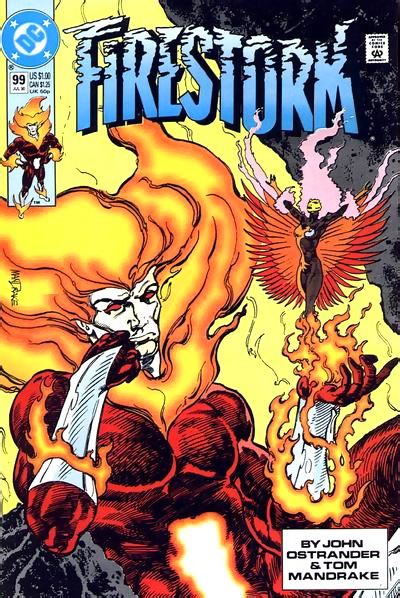
So the next few months--from the announcement of the book for pre-orders, on through the appearance of the actual book--were a firestorm (pun intended) of activity from me. (To this point, I'd only bought four back issues of Firestorm: the first issue from '78, the first issue from '82, and issues 51 and 52 because Firestorm fought some giant reptilian monster in them. Ironically, the latter informed my knowledge of Eddie Slick, the Sand Demon from my last entry.) I don't quite remember the order in which I assembled the majority of my Firestorm collection, but it occurs to me I started by picking up the remainder of John Ostrander's run; in fact, I remember buying back issues at New Dimension Comics in Cranberry Township. Specifically, I picked up the Svarozhich arc from #82-85 early on, as well as the finale, the triple-sized #100. I'd buy most of the rest at that same shop, with an excursion to Eide's Entertainment in downtown Pittsburgh to fill in the final gaps. As I remember buying those earliest, I'll review the end run before tracing everything back to the original Gerry Conway run in my fourth entry.
During the Invasion! crossover, one of the alien Dominators detonated a Gene Bomb, isolated from the human metagene, whose catastrophic effects were felt by every super-powered human on Earth. In Firestorm's case, his nuclear powers blazed out of control and resulted in many deaths before the Gene Bomb's effects were negated. Traumatized, Firestorm then refused to come out, and any attempt by Ron or Mikhail to initiate the merger would cause both of them intense pain. This unfortunate event was shown in #82, when in trying to save Lorraine "Firehawk" Reilly from the second Killer Frost, Ron ended up having to save her himself.
There would be no time to rest, however, as during the time Firestorm spent in Russia, Red Shadows, a branch of the K.G.B., secured a sample of the hero's DNA and used it to create a clone, codenamed Svarozhich ("destructive fire"). Devoid of humanity, the entity cut a swath of destruction until Serafina was able to talk to Firestorm and stay merged long enough to deal with it. However, Svarozhich turned the tables and made Ron and Mikhail fission, in so doing allowing the duo to meet for the first time, face-to-face on the streets of Russia. He also said he now possessed the "Soul of Fire." Hmm...
Unfortunately for them, Ron and Mikhail couldn't understand each other outside the Matrix (Mikhail only spoke Russian), so they had to rely on Serafina as a psychic interpreter. Upon meeting Gregori Eilovotich Rasputin ("perhaps" the Mad Monk of Russian legend; actually a substitute for John Constantine), the final pieces of who and more importantly what Firestorm was finally came together. In "Soul of Fire," Ostrander framed the improbability of Ron and Martin having survived a nuclear explosion and become Firestorm in the same vein as Alan Moore framed Alec Holland's absurd resurrection as Swamp Thing five years earlier in Saga of Swamp Thing #21's "The Anatomy Lesson." Without directly aping, he established that Firestorm's origin was truly the advent of a new Fire Elemental, as Swamp Thing's was the introduction of an Earth Elemental. The Matrix enveloped Ron Raymond, but it was Martin Stein who was the intended recipient of the elemental force! This was about the time where today I would say, "Mind=blown." How much sense it made to have Stein's mind as the template for the "new" Firestorm of issues #65 onward!
Firestorm #85 marks the maturation of the core concept of the character in a genre that is largely resistant to change, so I'm not altogether surprised when "purists" of the character condemn this period in the character's history. However, for something that according to Ostrander wasn't planned at the time of the "new" Firestorm's introduction twenty issues before, the new status quo of Firestorm as Fire Elemental fit like a glove. Along the way we did lose another key conceit of the original series in that, to create the new Elemental, Ron and Mikhail had to give up their individual identities and be entirely subsumed in Firestorm's new persona. It wouldn't be until the finale in #100 that we saw Ron or Mikhail again.
Over the next dozen-plus issues, the new Firestorm, in a totally new and altogether unrecognizable design by artists Tom Grindberg and Tom Mandrake, would find himself wrapped up in environmental issues, vacillating between his care for humanity and his elemental natures that would see the Earth wiped clean from pollutants (and evil corporations like Sunderland, in another echo of Moore's Swamp Thing). This conflict exploded in the "Elemental War" storyline, where just as Firestorm decided he was "humanity's friend," environmental activist Mai Miyazaki became Naiad, a new Water Elemental who teamed with the Air Elemental, Red Tornado, against humanity. To end the conflict, Firestorm allied himself with the Swamp Thing. This arc, in issues #90-93, was a visually arresting tour de force which was done a disservice on newsprint. I'd really like to see this arc--and much of Firestorm, to be honest--in a deluxe format. Someday, someway!
After an story (#94) in which Lorraine Reilly told Martin Stein of his connection with Firestorm (who saved the day, "Lassie"-style, when Martin found himself under fire from the Killer Frost), Firestorm journeyed back to East Africa, where Swamp Thing had previously revealed that his actions in #77-79 had made a hell out of paradise. He encountered Shango and other representatives from the Orishas, the African pantheon of gods, and became embroiled in their conflict against the Orish-Nla, their shadowy opposites. Although the conflict was resolved successfully, out of that war, those shadows gave birth to Shadowstorm, a negative-image opposite to Firestorm who unfortunately wouldn't have anything resembling a "final battle" with his progenitor. (I've heard stories that John Ostrander planned for the two to battle after #100, but after the book's cancellation, a version of the storyline instead saw print as the "Quantum Quest" in Captain Atom #54-57. The story also guest-starred Rasputin educating Atom about his place as another kind of elemental. The story--which I won't review here--could have been so, so much better with Firestorm than it was without. Especially with Mandrake on art duties.)
Did you think that the final metamorphosis of Firestorm was passed? Au contraire, mon frere!
The ramp-up to the final, hundredth issue actually has its roots two years hence in issue #76, the last battle between Firestorm and Brimstone, the gigantic creature who was first seen in the Ostrander-plotted Legends miniseries (that led to his getting the Firestorm gig in the first place, natch). The techno-seed that contained Brimstone's essence found its way into Earth's sun, and the creature was reborn in the most catastrophic place possible. Maser, a superhuman working for the Institute for Metahuman Studies in Pittsburgh, discovered Brimstone alive in the sun, and the duty fell to Martin Stein to find a solution. The problem with just sending Firestorm to the sun was that, issues prior, Firestorm tried to exit Earth's atmosphere and nearly died, finding that as one of the planet's elementals, his life force was tied to it. (Presumably as the "nuclear man" iteration of older times, he wasn't quite so tied to the planet, which explained his off-Earth excursions with the Justice League, especially Crisis on Infinite Earths. Can anyone else come up with a better explanation?)
Martin's plan tied into the fact that, as established in "Soul of Fire," he was to have been the original host to the Fire Elemental. In his words: "I propose we use one of these craft, equip it with oxygen tanks...and a quantity of explosives. Firehawk and Firestorm then supply sufficient thrust to put it--and me--into orbit. We detonate the explosive, ending my and Firestorm's lives...and hopefully, re-creating us both into a new Firestorm...who is then free to journey to the sun. In theory, anyway." Before Firestorm "died," however, he released his component halves, powerless, and they reunited with their families. Svarozhich then helped Martin complete the plan. The theory worked; not only did Svarozhich, possessed of the Fire Elemental, perish as it broke Earth's atmosphere and Martin become the new Firestorm, but Martin-as-Firestorm regained all his lost memories. This new Firestorm then defeated Brimstone, but found himself sucked into a singularity and into a "new universe" where he could not find a way home. He thanked the Earth-mother, Maya, for the experience and went off to parts unknown while Ron Raymond explored a new life with Lorraine, and Mikhail reunited with his wife Nina. One thing was sure: although he was nowhere near, they were sure Firestorm still lived!
I may have made a tiny tactical error in reading Firestorm #100 before issues #86-99, but that doesn't diminish my opinion of the final issue. The issue in many ways brought the saga of Firestorm full circle, summing up everything the character had come to mean since his introduction and tying up the plot thread that had been the through-line of Ostrander's entire tenure, summed up by Lorraine in the final story: "Funny, here they spend all kinds of money trying to determine if powers make one a hero. And the definitive answer [Martin Stein] is walking around on two feet...and most people never noticed him." Although for the longest time, Ron Raymond was the focus of the Firestorm series because his personality was ascendant, Martin was no less a hero, and with this issue he had his chance to prove just that. Interestingly, as the early Conway period would prove to be about the maturation of Ron Raymond, the Ostrander run framed the entire series as the maturation of the Firestorm entity, culminating in the eradication of the original dual-personality Firestorm and the coronation of Martin Stein as the "one, true" Firestorm. Not until the final issue was Ostrander done with his changes, which definitively established the Conway years as the character's larval stage, and the vast majority of his own tenure, kickstarted by the arc in #62-65, as his puberty. In "Soul of Fire," the "new" Firestorm may look different--certainly more like an adult as opposed to the garish costume seen before--but he wasn't fully mature until Martin took control. Even now, I'm awed at how well the whole story fits together, with organic change built upon organic change. Even if you don't like the finished product of Martin-as-Firestorm, you have to admire the method by which Ostrander slowly yet drastically changed the character.
As you can tell, the Ostrander run of Firestorm is one of my favorite comic eras of all time, and the letter columns in those last few dozen issues are filled with the opinions of the foremost letterhacks of the period, such as Jan C. Childress, "Uncle" Elvis Orten, T.M. Maple, and Charles J. Sperling, whose deep opinions speak to the high quality of the creators' efforts. It's entirely fitting that Ostrander's lasting legacy with the Firestorm character, for better or for worse, is the introduction of the Matrix. It has been used in nearly every Firestorm story or pitch that has been put forth since 1990, by subsequent writers like Joe Kelly, Mike Carey, Dan Jolley, Stuart Moore, and current Firestorm co-writer in Brightest Day, Geoff Johns. That alone speaks to the durability of Ostrander's concepts.
Next: Back to the beginning with Gerry Conway and friends.
~G.
25.1.11
Storm Warning 2: The Only Constant Is Change!
The Greek philosopher Heraclitus gave this article its title, and it couldn't be more appropriate for this era of Firestorm, the Nuclear Man. I mentioned in the last segment how I came on board this title at a fortuitous time, the last half-dozen issues of the "old" status quo of two men, Ron Raymond and Martin Stein, combining to form the titular hero. From issue #65 until the series finale in #100, through the character's other incarnations in JLA and the third Firestorm series, straight on through to Brightest Day, the focus has been sharply removed from the men and centered on the idea of the "Firestorm Matrix"--but I'm getting very sharply ahead of myself.

Regardless of the corner box, this issue was drawn by underappreciated DC and Marvel '70s artist Ross Andru. This issue was released in that period before I really paid attention to creator credits, but Andru's art stands as unique amid the capable-and-not-much-more efforts of Joe Brozowski. It also jump-started the new era of Firestorm quite ably, and John Ostrander's skilled script put forth a mystery, front-and-center: who is the new Firestorm? As result of last issue's climactic finale,Ron had initiated the fusion into Firestorm with Mikhail Denisovitch Arkadin, a Russian whose active metagene (DC's analogue to Marvel's mutants) made him something like a Human Torch. Martin, suffering from a brain tumor and apparently near death, could be somewhere in the new configuration, or he might be dead. The twists didn't stop there, as upon fusion, both Ron and Mikhail were "stuck" in Firestorm's head--and Firestorm himself didn't seem to have any personality except for his own. He was an amnesiac, operating his powers instinctively. Was Firestorm asserting his own personality somehow? So many questions, so few answers.
Looking back, of course, the answer to the questions above becomes so apparent it's a wonder I didn't put two and two together immediately--then again, I was young so I can be excused. (Can't I?) Without getting completely in-depth in my reviews--I don't want to carry this bit on too long--I want to at least put forth how I felt about reading these books before I quit. (Say whaaaaaa?) I remember being interested in the plights of Ron Raymond and Mikhail Arkadin as they encountered threats from both the U.S. and Russia, as well as dealt with being thrown together as passengers in this new Firestorm entity. The character of Zastrow, the Russian who found Mikhail in the first place in #62, became of increasing importance as he unearthed another Russian superhuman, the mustachioed Stalnoivolk, to face the new Firestorm.
Meanwhile, Firestorm suffered through the Millennium crossover, and in my personal comics collecting career, I crossed over from the newsstand (The Book End at the Northern Lights Shopping Center in Baden, PA--now defunct!) to an actual comic shop (Bill & Walt's Hobby Shop at North Hills Village in Pittsburgh--still around today in some form, but no longer carrying comics!). I daresay it was the dawn of the golden age of comics of my youth.
One of the book's strengths was that Firestorm was getting to know himself just as we, the readers, were. It was also fascinating how the book had so suddenly captured a worldly flavor, with half its action taking place behind the Iron Curtain. (Remember, these books were released in 1988, when Communism hadn't yet fallen in Russia!) A particular source of fun was the Russians' attempt to discover what linked Ron with Firestorm in the U.S. even as the K.G.B. tried to find out what linked Firestorm with Mikhail. Along the way, readers met Mikhail's extended family, from his wife and children, to his brothers, to their children. Serafina Arkadin, Mikhail's niece, was leader of a team of Russian super-teens called Soyuz. They battled the alien Zuggernaut alongside Firestorm, and later, Serafina would help in unveiling perhaps the biggest piece of Ostrander's ongoing Firestorm mystery (later).
Through this range of issues, Joe Brozowski. the series' capable artist, was "replaced" by J.J. Birch, who had a style more reminiscent of mid-80s Keith Giffen. He brought us the story in which, thanks to a time-traveling former university professor calling himself the Flying Dutchman of Time, Firestorm's astral self was able to watch the entire development of all his component selves--a good way of catching the character up on his own history. A few issues later, once Joe Brozowski had "taken back" the artistic reins, editor Denny O'Neil revealed that Birch was really a pseudonym for Brozowski himself, who had wanted to try out a new style. Unsurprisingly, some parts of the new style carried through into Brozowski's post-Birch period, much for the better.
In issues #74-75, the latter of which would probably be a "big anniversary blowout" today, Firestorm came another step closer to fulfilling Ostrander's ultimate promise when he encountered a "sand demon" out in the Nevada desert. The story echoed Annual #5, where Firestorm made his last stand against the world's governments in that same desert. Since nobody had found what had become of Martin Stein to that point, and a great physical similarity existed between the Sand Demon and Stein, upon sight Ron believed the creature to be Stein! The truth was revealed over the second issue--that the Sand Demon was really Eddie Slick, a crooked wrestling promoter that Firestorm had previously encountered in Firestorm #51-52. Still, the mystery of Martin Stein's whereabouts were smartly not far from a resolution.
Since the first time Ed Raymond met the "new" Firestorm, he noticed a striking similarity in manner to Stein. Using his newspaperman instincts, he operated under the supposition that Stein had never died, and his research led him to a facility in Nevada where an older gentleman with amnesia was kept. After defeating the Sand Demon, Ron went with his father and stepmother to the facility where they found Martin, alive and well. The doctor on staff revealed more details--that every once in a while, Martin would lapse into a coma, later to awaken as if nothing happened. These episodes coincided, no doubt, with the Firestorm merger, with Stein's mind as the template for the new iteration. In fact, the next issue showed Martin subconsciously initiating the change when the villain Brimstone appeared at the facility. However, only Martin's mind was involved in the Firestorm Matrix at the time, and not his body, which would lead to further developments.
Also at this time, as consequence of there being a new Firestorm who only existed when Ron and Mikhail initiated the fusion, the new Nuclear Man questioned his existence. It was an intriguing bit of philosophy that Ostrander generated that would be a harbinger of the next major status quo shift (in the next eventual installment). Here was a character who couldn't even have a life outside his existence as Firestorm, who only lived to beat the bad guys! Right after the returns of Martin Stein and Brimstone, this plot point bore fruit in the "Eden" arc of #77-79. Ron accompanied his father to Africa, where he saw firsthand the hunger and desperation endured by the area's inhabitants. Determined to do something good, Ron and Mikhail initiate the merger, and Firestorm uses his abilities to transmute matter to make a paradise in the middle of the desolation. Soon, he finds that "no good deed goes unpunished," as cartels move to seize the paradise. Amid the fiery carnage, somehow Jama, one of the African men who has befriended Ron, finds himself merged into the Firestorm Matrix and a new, bestial Firestorm emerges with pieces of four men in the mix!
The status quo only lasted through #79, where Jama died, but the question arose how another could be brought into the Firestorm Matrix. Further, the question couldn't be avoided any longer: What exactly is Firestorm? How powerful can he truly be? What could happen of his newfound desire for independence, for a life? Unfortunately, I couldn't be bothered to stick around for the answers at this time. The Invasion! crossover hit the DC line the next month, and my supreme disinterest led to my promptly removing virtually every DC title from my pull list, a trend that wasn't reversed until the death of some guy named Superman in 1992. Interestingly, longtime Firestorm artist Joe Brozowski also took his leave with #79. It wouldn't be until quite a few years later that 'Stormy and I would again cross paths...
And that, my friends, is a tale for another entry of "Storm Warning," coming your way soon.
~G.
19.1.11
Storm Warning 1: Musings on My Favorite DC Hero
I really was going to start blogging today about my aborted attempt at joining the hallowed ranks of Marveldom from 2003; however, I've decided to forgo that particular discussion in favor of switching party lines from Marvel to DC. It strikes me that I haven't given enough love to other comic companies, so now begins the turnaround. (Just one of my many mini-resolutions I had for you, dear readers!)
Many of you may know my first exposure to comics came with the 1977-1982 CBS live-action TV show, "The Incredible Hulk," as well as the 1981-1986 cartoon, "Spider-Man and His Amazing Friends" and the accompanying "The Incredible Hulk" toon. However, I also remember watching "Super Powers" on ABC in the mid-eighties. I may have read one or two issues of DC Comics Presents or Green Lantern, and I had a few trial subscriptions to Batman and GL through 1985, but it wasn't until after my exposure to "Super Powers" that I really "got" DC. And the lion's share of the blame for my getting into DC was this guy right here:

That's right: "Super Powers" brought me in contact with Firestorm, the Nuclear Man! I remember enjoying the dynamic involved with the character, and upon later reflection, I don't think it's a coincidence I enjoy the character nearly as much as my favorite Marvel character, the Hulk. Both characters have a strong duality about them, with Dr. Robert Bruce Banner transforming in times of stress into the Hulk, while Ron (I refuse to call him "Ronnie") Raymond and Professor Martin Stein combine to form the heroic nuclear hero, Firestorm. I think it was that two-in-one dynamic that engaged my interest, and it was different than Banner and Hulk in that both Stein and Raymond were conscious, with the former as a "talking head" in the latter's mind. The character had other dualities as well, with Ron as a "jock" while Martin was clearly an intellectual; Ron younger and a student while Martin was older, a teacher. (And, as would be shown later, Ron's strained relationship with his own father eventually transformed their relationship into something more along the lines of father-son. But leave us not digress.)
I remember getting the Firestorm action figure from the Kenner "Super Powers Collection," with its mini-comic, which must have been in 1985, but then I didn't rush out right away and buy a Firestorm comic book. That didn't happen until I happened upon Ryan's News in downtown Columbiana, OH in early 1987, where I found two issues at once: The Fury of Firestorm #60 and 61, by John Ostrander (then making miracles happen as writer of DC's hit, Suicide Squad) and Joe Brozowski. Although I didn't know it then, the copy of #61 I bought that day would become a minor collector's item because it was the "Superman Comics" variant of that issue. (A few weeks later, I would find the other cover to #61 at another shop. It was my first--though far from my last--dealing with a "variant cover," something common today but certainly far more of an oddity then.)
In retrospect, I was very lucky to have come on board the book just then, as Ostrander was about to give the book the mother of all overhauls! Since the character's creation in 1978 by Gerry Conway and Al Milgrom, the series had always been about the trials and tribulations of Ron and Martin, but that was all about to change. (I've previously written about the status quo change in my first-ever Internet column, "Crusty Comic Cavalcade," several years back, but that article is lost to antiquity.) Conway had been replaced only a half-dozen issues before by Ostrander, who wasted no time attacking some of the core conceits of the series, like why must Ron and Martin always get along? and the big one, what happens to Firestorm if one of 'em is, well, dying? That last one, I later discovered when I rounded up the early part of the Firestorm series, was a nugget inserted by outgoing writer Conway in #53 (although whether it was at the behest of Ostrander or something altogether different, well, who can say?).
The storyline that was trickling through #60-61 and went full bore with #62 revolved around Martin Stein's recent diagnosis of an inoperable brain tumor, whose growth would quickly impact his ability to successfully function within the "Firestorm Matrix." It was the first domino to fall in what would become a succession of status quo changes that really wouldn't stop until the book's 1990 cancellation, and would remain a fixture of the character from 1987 until today with Firestorm's appearances in Brightest Day. In some ways, John Ostrander made changes to the character, largely unheralded at the time, that were as influential in the series as Alan Moore's were to Swamp Thing a few years earlier. Although Ostrander's changes to Firestorm took longer to effect (the key revelation didn't occur until #85, two-and-a-half years into his tenure, whereas Moore's second issue contained the virtual sum total of his changes in one wham, bam, thank you ma'am moment), they changed the entire way later writers and this fan thought of the character, much like Moore.
So, what do people do when they find out they're living on borrowed time? For many, the answer would be to do things they haven't done before--to check off those things on their personal lists. For a select few, the struggle becomes how best to make a difference, and that's how it is for Martin, who talks with Ron about his mortality. They don't know how or even if there will still be a Firestorm as the tumor grows, so they nobly try to achieve what Superman attempted in the then-recent film, Superman IV: The Quest For Peace, only with notably different, and probably more realistic, consequences. Firestorm wants to rid the world of nuclear weapons, so what does everyone do? They paint him as a vigilante, a criminal in the eyes of the whole world, and heroes and villains from Captain Atom, to the Justice League, to the Suicide Squad, to a new Russian super-being called Pozhar try to stop him, following orders from their governments.
As the battles escalate, Stein's health deteriorates, and the dual hero tries unsuccessfully to find refuge in the Nevada desert. Pozhar and Firestorm have an intense fight, and Firestorm ruptures the Russian's suit, reducing him to a flaming skeleton. The United States and the USSR are sending in their nukes to finish off our hero once and for all. Firestorm has a seizure and separates into his component halves, who have only moments to do something before disaster strikes. Pozhar, afraid for himself as well as seeing his foe's mortality, suggests the three of them try and form Firestorm so they can escape and survive. They concentrate just as a nuclear warhead detonates. There is a tremendous explosion, which then falls in upon itself as the army watches, stunned. It collapses into the form of a man--a thin, tall, wiry man wearing a blank stare and a familiar red-and-yellow costume, with a mane of flame in place of hair. This is the new Firestorm.
Keep in mind, while this storyline--all told, taking place through Firestorm, the Nuclear Man #62-64 and Annual #5--introduced a "new" Firestorm, it was only the first of several major changes to take place over coming years. And it's those changes I'll be addressing in the next entry as I continue my own personal musings about DC's most unique hero. (And since I'm bringing my musings to you in the order in which I read the books, my views on the early issues are still forthcoming, so fear not.)
Read more of Storm Warnings: Part 2 / Part 3 / Part 4 / Part 5 / Part 6 / Part 7
~G.
Many of you may know my first exposure to comics came with the 1977-1982 CBS live-action TV show, "The Incredible Hulk," as well as the 1981-1986 cartoon, "Spider-Man and His Amazing Friends" and the accompanying "The Incredible Hulk" toon. However, I also remember watching "Super Powers" on ABC in the mid-eighties. I may have read one or two issues of DC Comics Presents or Green Lantern, and I had a few trial subscriptions to Batman and GL through 1985, but it wasn't until after my exposure to "Super Powers" that I really "got" DC. And the lion's share of the blame for my getting into DC was this guy right here:
That's right: "Super Powers" brought me in contact with Firestorm, the Nuclear Man! I remember enjoying the dynamic involved with the character, and upon later reflection, I don't think it's a coincidence I enjoy the character nearly as much as my favorite Marvel character, the Hulk. Both characters have a strong duality about them, with Dr. Robert Bruce Banner transforming in times of stress into the Hulk, while Ron (I refuse to call him "Ronnie") Raymond and Professor Martin Stein combine to form the heroic nuclear hero, Firestorm. I think it was that two-in-one dynamic that engaged my interest, and it was different than Banner and Hulk in that both Stein and Raymond were conscious, with the former as a "talking head" in the latter's mind. The character had other dualities as well, with Ron as a "jock" while Martin was clearly an intellectual; Ron younger and a student while Martin was older, a teacher. (And, as would be shown later, Ron's strained relationship with his own father eventually transformed their relationship into something more along the lines of father-son. But leave us not digress.)
I remember getting the Firestorm action figure from the Kenner "Super Powers Collection," with its mini-comic, which must have been in 1985, but then I didn't rush out right away and buy a Firestorm comic book. That didn't happen until I happened upon Ryan's News in downtown Columbiana, OH in early 1987, where I found two issues at once: The Fury of Firestorm #60 and 61, by John Ostrander (then making miracles happen as writer of DC's hit, Suicide Squad) and Joe Brozowski. Although I didn't know it then, the copy of #61 I bought that day would become a minor collector's item because it was the "Superman Comics" variant of that issue. (A few weeks later, I would find the other cover to #61 at another shop. It was my first--though far from my last--dealing with a "variant cover," something common today but certainly far more of an oddity then.)
In retrospect, I was very lucky to have come on board the book just then, as Ostrander was about to give the book the mother of all overhauls! Since the character's creation in 1978 by Gerry Conway and Al Milgrom, the series had always been about the trials and tribulations of Ron and Martin, but that was all about to change. (I've previously written about the status quo change in my first-ever Internet column, "Crusty Comic Cavalcade," several years back, but that article is lost to antiquity.) Conway had been replaced only a half-dozen issues before by Ostrander, who wasted no time attacking some of the core conceits of the series, like why must Ron and Martin always get along? and the big one, what happens to Firestorm if one of 'em is, well, dying? That last one, I later discovered when I rounded up the early part of the Firestorm series, was a nugget inserted by outgoing writer Conway in #53 (although whether it was at the behest of Ostrander or something altogether different, well, who can say?).
The storyline that was trickling through #60-61 and went full bore with #62 revolved around Martin Stein's recent diagnosis of an inoperable brain tumor, whose growth would quickly impact his ability to successfully function within the "Firestorm Matrix." It was the first domino to fall in what would become a succession of status quo changes that really wouldn't stop until the book's 1990 cancellation, and would remain a fixture of the character from 1987 until today with Firestorm's appearances in Brightest Day. In some ways, John Ostrander made changes to the character, largely unheralded at the time, that were as influential in the series as Alan Moore's were to Swamp Thing a few years earlier. Although Ostrander's changes to Firestorm took longer to effect (the key revelation didn't occur until #85, two-and-a-half years into his tenure, whereas Moore's second issue contained the virtual sum total of his changes in one wham, bam, thank you ma'am moment), they changed the entire way later writers and this fan thought of the character, much like Moore.
So, what do people do when they find out they're living on borrowed time? For many, the answer would be to do things they haven't done before--to check off those things on their personal lists. For a select few, the struggle becomes how best to make a difference, and that's how it is for Martin, who talks with Ron about his mortality. They don't know how or even if there will still be a Firestorm as the tumor grows, so they nobly try to achieve what Superman attempted in the then-recent film, Superman IV: The Quest For Peace, only with notably different, and probably more realistic, consequences. Firestorm wants to rid the world of nuclear weapons, so what does everyone do? They paint him as a vigilante, a criminal in the eyes of the whole world, and heroes and villains from Captain Atom, to the Justice League, to the Suicide Squad, to a new Russian super-being called Pozhar try to stop him, following orders from their governments.
As the battles escalate, Stein's health deteriorates, and the dual hero tries unsuccessfully to find refuge in the Nevada desert. Pozhar and Firestorm have an intense fight, and Firestorm ruptures the Russian's suit, reducing him to a flaming skeleton. The United States and the USSR are sending in their nukes to finish off our hero once and for all. Firestorm has a seizure and separates into his component halves, who have only moments to do something before disaster strikes. Pozhar, afraid for himself as well as seeing his foe's mortality, suggests the three of them try and form Firestorm so they can escape and survive. They concentrate just as a nuclear warhead detonates. There is a tremendous explosion, which then falls in upon itself as the army watches, stunned. It collapses into the form of a man--a thin, tall, wiry man wearing a blank stare and a familiar red-and-yellow costume, with a mane of flame in place of hair. This is the new Firestorm.
Keep in mind, while this storyline--all told, taking place through Firestorm, the Nuclear Man #62-64 and Annual #5--introduced a "new" Firestorm, it was only the first of several major changes to take place over coming years. And it's those changes I'll be addressing in the next entry as I continue my own personal musings about DC's most unique hero. (And since I'm bringing my musings to you in the order in which I read the books, my views on the early issues are still forthcoming, so fear not.)
Read more of Storm Warnings: Part 2 / Part 3 / Part 4 / Part 5 / Part 6 / Part 7
~G.
Subscribe to:
Posts (Atom)