(DCnU Continuity Series: Part 1 | Part 2 | Part 3 | Part 4 | Part 5)
Welcome back, comics compatriots!
Springing forth from the September relaunch of DC Comics like Athena busting out fully-formed from Zeus' noggin, here's yet another in a series of discussions of various facets of the comics medium. This is the third part of my very complex discussion of comics continuity.
In the first part, I discussed the development of Marvel Comics' shared universe and DC's development of their Multiverse.
In the second, I addressed how DC's attention to combining all their universes into one "New Earth" during
Crisis on Infinite Earths actually created logistical problems that grew to rival any inconsistencies with the previous "Multiverse" system. I don't think it's overstating the case to suggest
Crisis gave birth to the continuity-obsessed comics culture of the present day. And that brings us to this section, where I'll explore continuity gone wild.
 |
| Silly season begins at DC: Tim Truman's Hawkworld. |
Out of the
Crisis, several characters' histories were "rebooted"--which is to say their prior histories were to be ignored as if they had never occurred. While writer Marv Wolfman intended for the conclusion of
Crisis to result in a "new," composite DC Universe whose history we would see unfurl from that point forward, the editorial regime headed by Jenette Kahn, Dick Giordano and Paul Levitz nixed the idea. (More on this point as we race to the conclusion of this series!) Only Superman, Wonder Woman and the Justice League really enjoyed true "reboots," while the vast majority of the DC line pushed forward as before. Never mind that Superman had just appeared in an issue of
Hawkman only a few months before, for Superman was just being introduced to the city of Metropolis over in
Man of Steel. Nevermind that Wonder Woman had been fighting crime since the forties, for that was really Hippolyta, Diana of Themyscira's mother. And please, oh please oh please oh please, don't get me started about the hideous mess DC made when they relaunched Hawkman's continuity with
Hawkworld in 1990!
On top of that, by very virtue of there being only one Earth when previously there were many, all kinds of bits of history were reshuffled. Earth-2's heroes, the Justice Society of America, were now part of the history of this new Earth, but neither Superman nor Batman were their contemporaries. (Wonder Woman? See above.) And most certainly, Batman and Catwoman never married and never had a daughter, Helena Wayne, that became the Huntress. Although there would be a Huntress, her origin was dramatically rewritten. Power Girl? Now, there was a question that wouldn't definitively be resolved until
Infinite Crisis in 2005.
 |
| Retconning 101: The revised origin of the Swamp Thing by Alan Moore. |
Hand in hand with the concept of a "reboot" or "relaunch" is the "retcon," short for "retroactive continuity," wherein previously established facts are changed. In-story facts can be changed to facilitate new stories being told (as you'll see in my explanations of certain Spider-Man storylines below) or to resolve apparent discrepancies in continuity that have arisen for any number of reasons (as you'll see in the below story about Superboy and the Legion of Super-Heroes). Some retcons only added "previously-unknown" details that cast a character's present in new light, such as when Alan Moore posited that the Swamp Thing was only a plant creature that thought it was Alec Holland (in "The Anatomy Lesson," from
Saga of the Swamp Thing #21), or when Barry Allen, the second Flash, was revealed to have a twin brother (Cobalt Blue, as revealed in
The Life Story of the Flash and
Flash [vol. 2] #144). Other stories used retcons to substantially alter characters' histories, or eliminate them altogether, such as the aforementioned
Crisis on Infinite Earths. As you can imagine, retconning, no matter how well done, has come to have a negative connotation and it's easy to understand why. Retcons, retcons, everywhere!
With all that DC had done in the previous fifty years, the current generation of DC's writers took it upon themselves to stitch together a continuity that was utterly fractured by the company's own hand. And the more they drew attention to the problems they created, the worse in turn those problems became. I mentioned the relationship between Superboy and the Legion of Super-Heroes in my last post. This relationship became an easy target because, well, in post-Crisis continuity, Clark Kent never became Superboy!
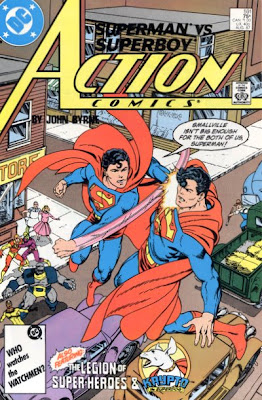 |
| "If there was never a Superboy, who the hell is fighting Superman?" |
To address the issue--perhaps the earliest incidence of continuity porn to spin out of
Crisis--John Byrne and Paul Levitz concocted a byzantine plot whereby the Legion's arch-enemy, the Time Trapper, created a "pocket universe" and populated it with Earth and Krypton. (Told in
Action Comics #591,
Superman #8 and
Legion of Super-Heroes #37-38, 1987.) He then manipulated events that resulted in Superboy's creation, and whenever the Legion traveled to the past, it was really the Trapper's pocket universe they visited. The explanation gets loopier from there, with every plot contrivance underscoring the fact the story wasn't being told because somebody thought it would make a good story, but rather, because they needed
some explanation in place! (A few months later, the same pocket universe would give birth to the first post-Crisis iteration of General Zod and his fellow criminals, as well as a "good" Lex Luthor who sent his creation Matrix, imprinted with the mental engrams of that universe's Lana Lang, to Earth. There, Matrix became the first post-Crisis Supergirl, who fell in love with Lex Luthor's clone, merged with the post-Crisis Linda Danvers, and eventually became an angel. But, I'm digressing!)
Eventually, DC's continuity problems continued to grow, which led to ever more drastic measures to "fix" them. The first major, whole-house attempt was Dan Jurgens'
Zero Hour: A Crisis in Time, which endeavored to fix not only
Crisis but also an earlier summer crossover,
Armageddon 2001, whose ending had been mishandled after fans figured out the ending months ahead of release. A time-traveling villain named Extant acted as servant for hero-gone-bad Hal Jordan, Earth's second Green Lantern, who took ever more drastic measures to bring back his hometown Coast City, which had been decimated in the "Reign of the Supermen" storyline the previous year. The series, which started at issue #4 and "counted down" toward the finale in the aptly-numbered #0, ended in a drastic re-ordering of time that was supposed to magically fix everything that came before. They even included a fold-out timeline that included events from the distant past to the far future to prove their point that everything was nearly addressed!
 |
| Everything ends, and begins again. Zero Hour: A Crisis in Time #1. |
It wasn't, of course, but in the meantime, we got a quasi-reboot with a month full of special issues of every DC title, all numbered #0 and their covers printed with metallic ink highlights. Some new series arrived, the most noteworthy of which was
Starman under the aegis of James Robinson and Tony Harris. Meanwhile the Legion of Super-Heroes was relaunched with all evidence of Superboy's involvement in their origins erased, while the biggest change to Batman was re-establishing that his parents' killer was a nameless crook (and not Joe Chill, a fact true in both pre-Crisis continuity and in the post-Crisis "Batman: Year Two").
At the same time as DC dealt with their second big event centered around a "Crisis," Marvel initiated perhaps the most notorious example of using continuity as a weapon. To attempt to follow DC's lead with such events as "The Death of Superman" and "Knightfall," they concocted (there's that word again!) a storyline in which a clone of Spider-Man, who'd appeared in a series of stories in the seventies, had never died. The character, who renamed himself Ben Reilly (itself a continuity nugget, combining Spidey's uncle's first name with his aunt's maiden name), went on the road for many years but came back when he heard of Aunt May's sudden illness. His return between 1994-1996 also prompted the return of the villain that created him, the nefarious Jackal, who brought with him a host of half-baked clones including one of Gwen Stacy, Spidey's lost love. All along the way, the writers constantly refuted previous stories about the clones, bridging the gaps outside the Spider-Man group of titles.
 |
| Silly season begins at Marvel: The Spider-Clone returns. |
In theory, the clone's return was meant to be a return to form for Spider-Man, who was seen as increasingly alienated from his fanbase by virtue of his marriage to Mary Jane Watson, then a successful supermodel. Marvel re-characterized Peter Parker as a "dark" character, and even a villain, in the hopes that Ben Reilly would be accepted as the one, true Spider-Man. They even exploited a decades-old plot point whereby Peter could be the clone, and Ben the real one. Peter left New York with a pregnant Mary Jane, and Ben Reilly became a Spider-Man who lost track of which heroes and villains he knew from the point his memories diverged from Peter's. Eventually Marvel opened up an even bigger can of worms by resurrecting Mendel Stromm and Norman Osborn to solve the narrative, kill off Ben, and restore Peter as the one, true Spider-Man. (Don't worry--Marvel would again try, more successfully, to divest themselves of the Spider-marriage. Keep reading.)
Worse, once the "Clone Saga" was complete, writer Roger Stern returned to Spider-Man to rewrite years of continuity since he left the book, with the express aim of providing the "real" identity of the Hobgoblin. He'd already been unmasked years before as Daily Bugle reporter Ned Leeds, but that didn't stop Stern from reopening a dead case and providing his own answer to the puzzle as he originally intended. The three-issue series,
Spider-Man: Hobgoblin Lives, contained references to back issues on the back covers, a sure-fire sign that continuity had been taken too far. And, of course, Stern revealed the Hobgoblin to be one of his own creations who hadn't been seen for over a decade. And an evil twin! Le sigh.
 |
| The book that led to the revival of the Multive--um, Hypertime: Kingdom Come. |
Back at DC, writer Mark Waid and artist Alex Ross'
Kingdom Come told a dystopic version of events from DC's future. The four-issue series, published in 1996, continued a special-event line of comics called "Elseworlds," which weren't tales from alternate realities because, well, alternate realities didn't exist anymore at DC, right? Still, on the strength of the storyline, Waid helmed another event series in 1999,
The Kingdom, as a sequel of sorts, during which he revealed that the Multiverse was alive and well and part of a concept now called "Hypertime." Hypertime supposed that reality was like a river whose paths could randomly converge and diverge, allowing for different versions of Superman or any other character to coexist or team up as circumstances dictated. It also encompassed the original Multiverse plus all the Elseworlds realities. Most notably, Waid used the Hypertime concept himself at great length during the end of his tenure on
The Flash when Walter West, the Flash of an alternate reality, briefly took the place of the mainstream DC Flash, Wallace West. For a while, there was talk of Grant Morrison using the concepts introduced in
The Kingdom in a new crossover event to be called
Hypercrisis, but the project was shelved.
Writer Kurt Busiek, who rose to prominence through his work on the revolutionary
Marvels project with Alex Ross, was that unique breed of writer who endeavored in ways similar to Roy Thomas to link Marvel's past with its present. He never met a continuity reference he didn't like, and if there's one man who embodies the essence of "continuity gone wild" for better or worse, 'tis he.
Marvels was filled with references both in the story itself, or in poses of characters, or really, any old thing. They may not have been intrusive to the degree they were in others' work, but there they were all the same. Busiek's intense detail toward continuity minutiae became a driving force behind two of his most well-known projects:
Avengers Forever, itself a scrutinous examination of Avengers continuity through the eyes of villain Kang the Conqueror; and the DC/Marvel co-publication
JLA/Avengers, itself rummaging through years of unusual continuity to tell a story that spanned the full length of both teams' histories. While demonstrating Busiek's obsessive attention to detail, both series were impenetrable to all but the most fervent fans.
 |
| Continuity pr0n for Earth's Mightiest Heroes. |
DC's own answer to Kurt Busiek hit the ground running as writer of niche book
Stars and S.T.R.I.P.E. and co-writer of James Robinson's
JSA revival. In some ways, Geoff Johns could make Busiek look positively amateur by comparison. He sifted through years of complex continuity to return Hawkman from permanent "damaged goods" status in
JSA and his own book. He's worked on various "event series" including
Day of Judgment,
Identity Crisis,
Green Lantern: Rebirth,
Infinite Crisis,
Final Crisis,
Flash: Rebirth,
Blackest Night,
Brightest Day and the currently-running
Flashpoint. Each of the company's recent event series has been predicated on older continuity for maximum effect, from Brad Meltzer's
Identity Crisis' reworking of the JLA's "Satellite Era" to
Infinite Crisis as direct sequel to
Crisis on Infinite Earths, to Grant Morrison's
Final Crisis as a love letter to Jack Kirby's "Fourth World" tales, to
Blackest Night as an ultimate extension of decades of "Green Lantern" mythos.
Infinite Crisis in particular poked fun of the conventions of intense scrutiny of continuity when in its
Secret Files & Origins special, writer Marv Wolfman revealed that since
Crisis on Infinite Earths, Superboy-Prime punched at the walls of reality from the "paradise" he shared with Earth-2's Superman and Lois, with each punch causing disruptions to continuity. Those disruptions included the resurrection of Jason Todd (Robin II), the changing origins of Superman, and the various incarnations of Hawkman and the Legion of Super-Heroes. If there was an apparent continuity mistake, DC could say that Superboy-Prime made it that way. (And when he was released during
Infinite Crisis, he continued the trend of messing everything up. Rimshot!)
Infinite Crisis also brought back the Multiverse in a big way, and for enthusiasts of that brand of storytelling, writer Johns "revealed" (using quotes because it was his own made-up history, not from prior precedent) that legacy characters like the Kyle Rayner Green Lantern and the Jason Rusch Firestorm were really the heroes from another, heretofore unknown Earth ("Earth-8") that was merged into the "new Earth" during the original
Crisis on Infinite Earths. Yes, the writers just
had to cater to the original spirit of the Crisis-that-was. But Johns kept pushing the envelope further...
 |
| Did someone mention "continuity pr0n"? Geoff Johns goes overboard with the Legion. |
His work on
Final Crisis: Legion of 3 Worlds in particular was hugely evocative of the continuity-heavy stories that
Crisis on Infinite Earths spawned, relying on the reader's knowledge of three distinct alternate versions of the Legion of Super-Heroes to assist in comprehension of the narrative (not to mention the returns of several non-Legion characters). Johns catered to his artist, George Perez of 1985's
Crisis fame, allowing him to draw dozens or even hundreds of characters in incredible detail such as Perez has become well-known for doing. Lovers of DC's often labyrinthine continuity gobbled the series up, but it often left more casual fans cold--as did, for that matter,
Final Crisis itself.
Not to be outdone, Marvel has done some selective continuity editing of their own, almost establishing a sort of "anti-continuity" with Spider-Man's infamous "One More Day" storyline. In it, Spider-Man made a deal with Mephisto, Marvel's representation of the devil, to save his aunt from certain death and to ensure his identity (revealed to the world in a then-recent storyline) became a secret again. Suddenly and without explanation, Spidey's marriage to Mary Jane was edited out of continuity. So ingrained into fans' minds was the idea that
some additional explanation was required, that the fans were
owed the details as to exactly what changes were made in history to arrive at this point. They couldn't simply accept that "they never got married" because, well, what about Mary Jane's pregnancy during the "Clone Saga"? Didn't that mean their beloved hero was having sex out of wedlock and thus was immoral and unclean? (They seemed to gloss over that part where
Spidey made a deal with a bad guy, satanic or otherwise.) The "mystery" went on for nearly a hundred issues until only the points directly raised by "One More Day" were addressed, and no more, in "One Moment in Time." Of course, since then, they've moved on, content to never, ever address the finer points of Spidey's relationship with MJ again.
 |
| 1st rule of Spidey continuity: You don't talk about Spidey continuity. |
Continuity continues to prove a slippery slope, a double-edged sword, a (insert cliche of your choice here). I get the desire to make order out of the chaos, and to show that more or less, fictional realities have similar physical rules to our own. However, the more changes that are done, the less "real" the reality of the comics becomes. Also, continuity creates an insular subdivision of fandom, so engrossed in the "reality" of the characters that they will cry foul on any deviations from previously established events. (Really, the mentality that gave birth to the concept of the "No-Prize," writ large.) Ultimately, one may even see an expansive continuity as one more reason that comic circulation has slowly dwindled, as fewer and fewer people can make sense of these universes the bigger companies have created.
Was DC in danger of collapsing under its own weight when they announced the grand reboot that spins out of the
Flashpoint miniseries this month? That's a good and fair question, but it'll have to wait until my fourth and final part of this little (heh) essay.
Next: Grand Guignol
(DCnU Continuity Series: Part 1 | Part 2 | Part 3 | Part 4 | Part 5)
~G.


