Ever since hearing that DC Comics was going to kill off the "New 52" Superman and replace him with the recently-returned "Pre-Crisis" version who disappeared nearly 5 years ago, something's been scratching at the back of my head. And now that we're three full issues into the Pre-Crisis Superman taking over for NuSupes, I can finally put my finger on the feeling. It's one I last had about two decades ago.
For anyone having read Spider-Man comics between 1994 and 1996, you're of course familiar with the much-maligned "Clone Saga." For those not in the know, there was a time shortly after DC's "Death of Superman" storyline where editors pushed their talent to manufacture similar, event-based storylines to drive then-record sales figures ever higher. No idea was too silly when Marvel went looking for their own Spidey-centric tale. (Such events have only gotten more grandiose, but I digress.)
So writer Terry Kavanagh dusted off The Amazing Spider-Man #150, coda to a storyline wherein the villainous Jackal cloned both Spidey himself and his alter ego's late girlfriend, Gwen Stacy. Spidey threw away a report on whether he was really the clone because of, essentially, a gut instinct. The question became, "What if the Spider-Man fans had been reading since 1975 was really the Spider-Clone?" Writers like John Marc DeMatteis (one of my idols) became inspired, and suddenly the dead clone nobody thought twice about returned to life--and a co-starring role in all of Marvel's Spider-Man series for the better part of two years. He became Ben Reilly (so named after Peter Parker's uncle Ben, with his last name the same as Aunt May's maiden name Reilly) and Spider-Man's life would never be the same again!
I read the Clone Saga when it originally came out. One of my friends in the fledgling days of Internet fandom--the inimitable DRILLN0T--helped me write "The Spider-Man/Jackal Dossier," an ungodly tome that consolidated and promulgated fan theories and unresolved facets of the storyline. So yes, I'm kind of well-versed in the storyline and count it as one of the high points of my collecting.
What's that all have to do with Superman: Rebirth? It's funny you should ask...
Showing posts with label Spider-Man. Show all posts
9.12.12
Indestructible Hulks & Marvel, Nowish
Well, now.
It's been a few months since I've been around these parts. For those of you with Twitter, you know I've still been as active in my fandom as ever; I just haven't been able to blog on account of a whole host of realtime issues. The Hulk book is still forthcoming, I promise. In fact, with this very blog post, I really have to watch what I say about at least one series I want to review because its release has totally thrown a spanner into the works of the final essay I've left to write.
Am I making sense?
So. Let's get on with it, shall we? What have I been reading during the last couple of months?
INDESTRUCTIBLE HULK #1 (Marvel, $3.99) - It's true that Marvel seems to be caught in a cycle of perpetually relaunching some of their characters, and the Hulk is one of their biggest targets. It started with "Planet Hulk" in 2006 and continued through the Red Hulk launch in 2008, the re-renumbering of Incredible Hulk in 2009, the introduction of the Hulk family in the transformed Incredible Hulks series in 2010, and finally last year's rebranding courtesy Jason Aaron. As part of the "Marvel NOW!" initiative, our favorite Jolly Green Giant has once again had his series restarted, written by Eisner and Harvey Award-winning writer Mark Waid, no less!
Let's get this out of the way right now: I love Mark Waid. He's written several of my favorite comics storylines, including "The Return of Barry Allen" early in his Flash run; "Chain Lightning" and the "Dark Flash" stories late in same; "Unthinkable" and "Hereafter" in Fantastic Four; "Man and Superman" in JLA; too many Captain America stories to count; "Urban Jungle" in Ka-Zar; and, well, you get the idea. In my top ten comics writers of all time, easily. Have I mentioned yet what miracles he's worked in making me enjoy the perennially-dark Daredevil by embracing a lighter mood? No? Corrected!
So far--and I realize we're only one issue into his and Leinil Yu's run--I remain optimistic, but can't help but feel we've moved a dozen steps backward. While it's an inspired choice to have Bruce Banner accept that he and the Hulk aren't going to be rid of each other anytime soon, and while there's a germ of an interesting idea having him set up shop with the same spy organization that once was complicit in exiling him into space, there's honestly precious little here we haven't seen done better elsewhere. We saw Banner using his incredible intellect on a regular basis during the final two years of Greg Pak's run, and Lord knows how many times we've seen him bring the Hulk's strength to a big think-tank organization. (The Pantheon, anyone?)
Then there's ol' Greenskin himself. Last month, Jason Aaron gave us a fully articulate behemoth who briefly swapped places with Banner due to the old stimulus of anger before giving way to a more well-balanced behemoth. Now, Waid seems to be fully embracing anger as a trigger, which no one's really done with any regularity since 1982. Not only that, but this first story only gave us a mute misanthrope rather than the "nobody's fool" incarnation of recent memory. If Kelly Sue DeConnick's Avengers Assemble and Jonathan Hickman's Avengers are any indication, it's very likely we're seeing the full-fledged return of the savage, child-like Hulk to the Marvel Universe.
And I'd be perfectly fine with that, if not for the fact that blessed few writers actually have a knack for the character since his exeunt from virtually the entire Marvel line in 1982. Being a fan of the "classic" Marvel tropes, I'd think Waid would fit among that number, but he's stated in an interview that he's "still having a hard time pinning down an exact 'voice' for Hulk," which doesn't exactly inspire confidence seeing how he's likely more than a few issues along in his scripting efforts. And when one of Marvel's best writers has a tough time with a character's voice, well, gulp!
Waid does have plenty of time to prove me wrong. With the so-far mute Hulk, though, I'm reminded of another relatively recent writer's run--that of Bruce Jones. Spy stuff? Check. Mute Hulk? Check. Boring as hell and wildly inconsistent with what came before? Check and mate. I'm hoping that, unlike Jones, Waid remembers, as Pak and David and even Jason Aaron did, that the Hulk has his own needs and desires. Even in his childlike incarnation--the one Marvel seems intent to foist upon the reading public as result of his scene-stealing appearance in the Avengers film--he has been underestimated in terms of cunning and yes, intellect. And those are aspects that have been lost in the shuffle, atrophied from years of disuse.
Buy it. Read it. Just don't expect to be blown out of the water quite yet.
On the other hand, there's Jeff Parker, Carlo Pagulayan, and Wellinton Alves's RED SHE-HULK #60 (Marvel, $2.99). Three months in, I'm enraptured by the narrative they're constructing in which Betty Ross has been desperately trying to avert a future that seems to already be happening. Parker has smartly begun reintroducing elements of Jonathan Hickman and Dustin Weaver's landmark SHIELD series, which is interesting because of Waid's tying the original Hulk to the modern version of same. It's also nice to see Parker keeping Machine Man in the mix, since he was in the Red Hulk's series ever since the "Hulk of Arabia" arc some months ago. Pagulayan and Alves's styles mesh well enough, and I'm hoping they're able to keep the series consistent for a while yet, as having two artists working concurrently on each issue beats trading off artists between arcs.
That conclusion to issue #60 does raise some interesting questions. Without spoiling anything, hey, it's not like we didn't see the same thing happen to Jen Walters before (in the late Steve Gerber's opus, "The Cosmic Squish Principle"). I'm just curious as to why it's happened, and what it means for Betty in the immediate future. If you haven't tried this book yet, please, please, please do.
It's been a while since I predicted this series' status quo change, but it's better late than never. THUNDERBOLTS #1 (Marvel, $2.99) gives General Thad "Thunderbolt" Ross a chance to share the spotlight with a team of Marvel's nastiest assassins and killers that's, perhaps ironically, named after himself. The seeds for this group, if the cover's any judge, were planted during Jeph Loeb and Ian Churchill's "Code Red" storyline in Hulk, with some of the extra stuff courtesy the recent "Circle of Four" arc. Writer Daniel Way sets up the story interestingly enough, framing the "pilot" as a conversation between Ross and the Punisher while intermittently flashing back to the incidents wherein he "drafted" the other team members. True, Ross no longer seems to be in hiding like he was in Jeff Parker's series, but it's too early to tell whether that's a good or bad thing. (I like having the Red Hulks' identities be secret to the world at large, as a counterpoint to the green Hulks.)
By far the most surprising thing about this first issue is the identity of the member that isn't on the cover. She's a Hulk foe from way back, and could be just the wild card the new Thunderbolts need. Kudos to Daniel Way. (Just please, please, please don't use the origin Peter David gave her.)
I've said it before, and I'll say it again: The weak link in this series is the horrendously average artwork of Steve Dillon. He works well on a "street-level" series like Punisher; not so much with a book filled with super-powered characters, one of whom is built like a brick outhouse. The book just doesn't have the visual "pop" it should, and a more dynamic artist would be tremendously appreciated, the sooner the better.
Still, this is a quality read and I'm anxious to see this group get together and kick some ass.
Alas, I've saved the best for last. THE AMAZING SPIDER-MAN #699 (Marvel, $3.99) has surpassed my every expectation. The final arc, "Dying Wish," has everything that I want out of a Spider-Man story: Life-and-death stakes, challenges that cut to the core of Peter Parker's character, insidious villainy, stupendous suspense, and that trademark humor. If you missed the last issue, please run, don't walk, to your local retailer. You can even catch it digitally on ComiXology if you like. If you miss this story, you're missing great comics.
Writer Dan Slott has been seeding this storyline since The Amazing Spider-Man #600 back in 2009. Doctor Octopus has been dying, his all-too-human body slowly breaking down because he's taken too much punishment at the hands of super-powered individuals. His schemes have steadily escalated, until now where he's finally in possession of a super-powered body that will help him show the world who's boss. Unfortunately, that body is our hero's! That's right, Otto Octavius has transferred his consciousness into Peter Parker's body, which means our hero's mind is in a body that is failing him by the hour. Not only that, but Peter-as-Ock's trapped in an underwater prison under armed guard! It can't end this way...can it?
Slott and artist Humberto Ramos bring their "A"-game to this Spider-saga, due to end in The Amazing Spider-Man #700 in just a few weeks' time. The whys and wherefores behind Ock's scheme become crystal clear in this story. Not only that, but the ending and the cliffhanger bring to mind the sagas of yesteryear that we just don't see in comics anymore. You know the kind I'm talking about, because I've written about them before. There's a feeling of momentum building toward the conclusion, rather than something new beginning like in just about every other anniversary issue Marvel and DC put out these days. Let's make no mistake: I want that book, and I want it now. Kudos to Dan Slott and the Spidey team supreme for making me feel that way.
That's enough from me tonight. What d'you think, sirs?
~G.
22.6.12
Why Spider-Man Vs. Spawn Must Happen (An Open Letter to Axel Alonso & Todd McFarlane)
(Special note: Any fans or creators wishing to re-post or share this note may do so with the conditions that I am credited as its sole original writer and that my website, DelusionalHonesty.com, be linked from your posting.)
Dear Axel & Todd:
As you are both well aware, 2012 marks an important time in the "lives" of your companies' most enduring characters. Spider-Man was created by Stan Lee and Steve Ditko 50 years ago in the burgeoning days of of Marvel Comics with its eye toward more realistic super-heroes. Todd, you created Spawn 20 years ago during the explosion of creator-owned sentiment that was Image Comics' raison d'etre. Since then, both characters have enjoyed significant success, be it Spawn's HBO series or the 1997 movie; or Spider-Man's various animated series and 70s live-action TV series and movies throughout the last decade. Spawn #220 recently hit comic shops everywhere, celebrating the 20th anniversary, and in August, Marvel will release Amazing Spider-Man #692, which does the same for his 50th.
Although I know it's far, far too late to do it this year, I think you should really put your heads together and produce what we all know would be the premier comics--nay, pop culture event of 2013.
Spider-Man Vs. Spawn.
While 2012 marked the anniversaries I outlined above, 2013 will be the 25th anniversary of Todd's first work on Spider-Man, a character whom I daresay he changed forever by infusing his unique sensibilities into his design. I imagine, during the 43 issues Todd drew between 1988 and his exit from Marvel in 1991, he turned many a teenage boy (or girl!) into a devoted Spidey fan for life. There's not a creator working on Spider-Man today who doesn't owe something to Todd's work. If you don't believe me, just look at the character's bigger, buggier eyes and the mess of webbing from head to toe and spitting forth from his web-shooters. Arguably, there are two truly huge names among Spider-Man artists. One is Steve Ditko; I hope I don't have to tell you the other.
Spawn started out terrifically in the your hands, Todd. You soon ceded your artistic designs to Greg Capullo, who paved the way for Angel Medina even as you lent the writing reins to your colleague Brian Holguin, who then passed the torch to others. In spite of all this, you've always returned to the character and shown a heartfelt passion for Al Simmons, Terry and Wanda Fitzgerald, little Cyan, and even Malebolgia, Violator, Angela, Cagliostro and others introduced during the early part of the series. Jim Downing, the new Spawn, has continued to develop since his introduction, growing on fans who miss Al most fervently.
In spite of your immense and consistent popularity with comic fandom, I respectfully offer that it's important to reconnect with your roots. There are entire generations of younger comics fans who don't know the enthusiasm with which we fans who were around in the late 80s and early 90s grabbed the newest issue of Amazing Spider-Man or your Spider-Man. There are younger people--a few generations of them by now--who are only familiar with your work as Spawn's creator, or as the guy who bought Mark McGwire's baseball, or the guy who directed a music video or formed a video game studio with Curt Schilling and R.A. Salvatore. Only because of Marvel Comics' relentless graphic novel program do many even know you once, long ago, drew Spider-Man.
Axel, you've done some terrific things in your decade-long career with Marvel Comics. You stepped in when Joe Quesada renovated the company and drove such unique efforts as Peter Milligan and Mike Allred's X-Statix as well as J. Michael Straczynski's Amazing Spider-Man and Bruce Jones's Incredible Hulk. You've also brought various crime writers to Marvel, and helped to start the MAX mature readers label. In short, you've taken chances with Marvel's properties just as often as you've put out crowd-pleasing fare such as the current line-wide event, Avengers Vs. X-Men.
Marvel Comics and Image Comics have both had their share of successful inter-company crossovers, but Marvel hasn't stuck its feet in the water since the deal with Top Cow which produced books like Darkness/Hulk (which reunited Dale Keown with Marvel and the character with whom he was most often affiliated) and Cyberforce/X-Men (ditto for Marc Silvestri). The last crossover Marvel did with any other company was 2008's Magdalena/Daredevil.
Todd, you've been stingier in letting anyone else play with Spawn, letting him briefly pal around with Batman in a duo of one-shots, one of which you illustrated while comics legend Frank Miller wrote it. It wasn't bad, but at the same time, I don't believe it ages particularly well, nor do I think fans were as enthusiastic about a crossover with a character you rarely drew (in Mike W. Barr's excellent Batman: Year Two) as they would have been about a story involving a character you--let's be honest--revolutionized. And there was another Batman/Spawn project brewing, but there has to be one damned good reason why it never happened.
It's the perfect time for the drought to end on both your sides, and you know it.
While Batman and Spawn certainly have certain characteristics in common, it would no doubt be fascinating from a character point of view to bring Spawn into conflict with Spider-Man, a character who is his polar opposite: a hero of the daylight hours who fights with a web and a quip instead of a creature of darkness who uses chains and hellfire. It certainly wouldn't hurt to have the whole thing drawn by the man who, with the exception of a cover for the Ultimate Spider-Man #100 Project, hasn't drawn the character that put him on the map for two decades.
You know also that the project would entice the reading public--fans both old and new--like nothing that Marvel, Image or any other company has created since the formation of Image itself. And I'd imagine such a project would require the largest available canvas. Give the project the gravitas it deserves, not as a mini-series with an inevitable graphic novel collection at the end of the tunnel, but as a Treasury-sized spectacular like the super-project Superman Vs. the Amazing Spider-Man and all their ilk. 64 pages? 80? 100? Doesn't matter. Precious few projects have debuted in this superlative format in recent years, and fewer still have actually deserved it. Not only would comic readers get to see Todd McFarlane drawing Spider-Man again, swinging alongside his own creation for the first time ever; but they'd also see it in a large format actually befitting the event!
I'd also make one final recommendation to sweeten the pot. Everyone knows that you, Todd, have championed creators' rights since you left Marvel. Axel, I know that you and Joe Quesada have worked to establish the good name of Marvel through your works with the Hero Initiative charity. I would suggest the project be created in tandem with the Hero Initiative, with a significant amount of the profits going to the program and the creators it helps. Maybe you don't even have to go that far; maybe if each of Todd's art pages were auctioned off for the Initiative, like the covers contributed to the various "100 Projects" year in and out, that would be a blessing in itself. Put some space in the back and let various "indie" creators draw pin-ups of Spidey/Spawn or their own creations in the back. Make the project all about creators' rights, about benefiting those in need. Work out the reprint rights for subsequent printings and ensure this project is the gift that keeps giving, while you're at it.
Who would write this gem? It's one thing worth discussing. Certainly Marvel elite writer Brian Michael Bendis has the "cred" to script such a gig. He's earned it through working on Spawn and his cast in Hellspawn and Sam & Twitch as well as Marvel's in Ultimate Spider-Man and now the super-project Spider-Men. Certainly another name I'd put up there in an instant would be regular Amazing Spider-Man writer Dan Slott, who knows his way around web-head and could certainly bring well-textured life to a project that needs big action, spot-on characterization and big action set pieces. On the other hand, there's dark horse candidate J.M. DeMatteis, whose work shows both humor and psychological complexity and who does exceptionally well with the duality of good and evil.
You can play fast and loose with the concept, too. If you think it's worthwhile to take a trip back in time, to when Spidey was still married to Mary Jane like in the Michelinie/McFarlane originals, so be it. If you want to use Al Simmons instead of Jim Downing, so be it! If you want to involve Venom and swap his symbiote with Spawn's K7 Leetha, make yourselves happy! If you'd rather have it take place in the here and now, I completely understand that desire, as well.
I've made my thoughts known, gentlemen. It's time to make your voices heard. Whether or not you like this idea, or even see it, I think there can be no overstating the potential good a Spider-Man Vs. Spawn project can do for the industry.
Thanks for reading,
Gary M. Miller
30.11.11
New Blood: Morbius and the Vampire Genre (2) (Connecting Marvel to...Twilight?)
Welcome back! This segment is the second in a two-part article spotlighting Marvel's very own resident Living Vampire, Dr. Michael Morbius! A Nobel Prize-winning biochemist, Morbius suffered from a rare blood disease whose cure instead transformed him into a creature of the night with an insane thirst for blood.
In the previous segment, I reviewed Morbius' appearances from his 1971 introduction in The Amazing Spider-Man through his two solo series as protagonist, and finally his cure in early 1980, again in one of Spider-Man's series. But of course, as they say, you can't keep a good vampire down!
![]() |
| The prodigal vampire returns. Cover by Jackson Guice. |
After Todd McFarlane brought him back in a pair of issues of Spider-Man, Marvel took another look at their horror characters. With the new Ghost Rider title gaining success, the administration sought to build an imprint around the character and supernatural concepts. Hence, the "Midnight Sons" were born, and Morbius became a charter member of the loose grouping that also included Ghost Rider teaming with original Ghost Rider Johnny Blaze as Spirits of Vengeance; Tomb of Dracula alums Blade, Frank Drake and Hannibal King as Nightstalkers; and a group of supernatural investigators tracking down evil pages from the cursed book, the Darkhold.
![]() |
| The Midnight Sons rise, and with them was Morbius. Cover by Ron Wagner. |
Eventually, the series went off the rails, with Kaminski replaced by Gregory Wright due to disagreements with artist Wagner (who left shortly after). From the end of the first year, Morbius was involved in crossover after crossover--including "Siege of Darkness" across the entire "Midnight Sons" line--that robbed the series of any momentum. Not-ready-for-prime-time artists like Isaac Cordova and Nick Napolitano mired the series down as Wright kept telling stories of the demon blood and characters derived from it.
| The series was mired in too many crossovers for its second year. |
During the last half-year of the series, Marvel passed Morbius to writer Lisa Trusiani, a writer whose main claim to fame to that point had been the company's licensed Barbie comic. Drawn by Craig Gilmore, an unknown, rough-around-the-edges artist, the series just kept sinking. The stories degenerated into an unintelligible mess, with Martine coming back from the dead...or was that really her? Gilmore left a few issues before the series mercifully faded away with issue #32.
Shortly following the conclusion of Morbius' solo series, the character debuted on the small screen during the second season of the 1994 Spider-Man animated series on Fox. Voiced by character actor Nick Jameson, Morbius was recast as a college student like Peter Parker, who experimented with vampire bats and found himself transformed into a vampire-like creature. Since the censors didn't allow vampires to feast on necks, this vampire's fangs were useless; rather, this Morbius fed on "plasma" using suckers on his hands. He appeared in seasons two and four, during which he interacted with Spider-Man, Blade, and the Vampire Queen Mirium, who intended to use the Neogenic Recombinator technology that created Morbius to create a race of vampires.
![]() |
| Without a series of his own, Morbius reverted to type. Cover by Romita Jr. |
In the absence of a regular title, suddenly Morbius reverted to his previous characterization as Spider-Man villain with Peter Parker: Spider-Man #77-80 under writer Howard Mackie and artists Claudio Castellini and John Romita Jr. He popped up in Don McGregor and Brian Hagan's Blade limited series, canceled just three issues into its run of six.
Once again Marvel employed Morbius' sometime ability to transform other characters into vampires. In Peter Parker: Spider-Man #7-8, he bit the vampire hunter Blade. The unique enzymes in his saliva reacted with the hunter's already-unique physiology, transforming him into a "Daywalker" and in so doing aligning the character more closely with his recent movie depiction. At the time, early buzz surrounding the Blade movie sequel had Morbius as its primary villain, but that idea was nixed in later versions of the script, and Morbius remains unseen in live-action.
After a few years' absence, Morbius returned in Marc Guggenheim and Howard Chaykin's Blade series (#7, Mar. 2007), having signed the Superhuman Registration Act during Marvel's Civil War and allied himself with S.H.I.E.L.D. to try to apprehend the hunter. Later, he appeared as part of S.H.I.E.L.D.'s A.R.M.O.R. unit during Fred Van Lente and Kev Walker's Marvel Zombies 3 and 4 series, first captured by his other-dimensional, zombie-infected analogue, and later as head of a new group of Midnight Sons that included Daimon Hellstrom, Topaz and Werewolf By Night. After that, he and the Werewolf retreated under New York City, where they and the Man-Thing found a "disassembled" Punisher and rebuilt him as Franken-Castle (Punisher #11, Jan, 2010).
![]() |
| Morbius soon became a hero of sorts, again. Cover by Greg Land. |
When last seen, Morbius took a blood sample from Spider-Man to work on a cure for the Werewolf in Amazing Spider-Man #622 (Apr. 2010) before perplexingly allying himself with Dr. Octopus against Spidey (Amazing Spider-Man #642, Nov. 2010). He's currently appearing again, in Dennis Hopeless and Juan Doe's Legion of Monsters limited series, starring as the apparent leader of a team that includes the Werewolf, the Living Mummy, the Manphibian and Elsa Bloodstone--virtually the same team as co-starred alongside Franken-Castle in Punisher. And fans reading The Amazing Spider-Man may have seen a familiar face during "Spider-Island"...!
Over the years, the character of Morbius may have struggled. Certain writers wisely emphasized the fact that Morbius was a scientifically-created vampire, while others have treated him like just another vampire character. Sometimes he's been able to spawn other vampires like himself, while at other times we're told that's patently impossible.
Still, the other traditional tropes of vampirism in fiction have remained with him. Like many other vampire protagonists (and antagonists, for that matter), he reviles what he is and wishes he didn't have to ingest human blood to survive. His addiction to blood compares favorably to any traditional human addiction to alcohol, or drugs, or sex. The difference with Morbius is that due to the nature of his condition, we're told without that blood as sustenance he will die.
![]() |
| Morbius with the new Legion of Monsters. Art by Juan Doe. |
A major asset to Morbius' ongoing characterization is the fact he is a biochemist, and as such, he is well equipped to identify the various symptoms of his condition and effect potential cures. He creates formulas to temporarily make himself appear human. He tries to manufacture artificial blood. He looks after his fellow monsters' medical needs. Often, he considers the curses of other monsters like himself in scientific terms. Sometimes that outlook is an asset; sometimes, not so much.
What is most important about Morbius is that he is really the first popular vampire protagonist in literature. His power set and appearance follow that of the traditional vampire, unlike Dell's "New Dracula." And virtually every other do-gooder vampire out there who angsted about his condition--from Andrew Bennett of I...Vampire!, to Nick Knight of Forever Knight, to Angel of Buffy the Vampire Slayer, to Edward Cullen of Twilight fame and many more--can ultimately trace that lineage back to Marvel's leading Living Vampire.
![]() |
| The premier vampire anti-hero? Art by Dave Cockrum. |
And just think: we might not have had a Morbius had Stan Lee agreed to Roy Thomas' idea for Spidey to fight Dracula way back in 1971...
Yeah, take that, Vampirella.
~G.
SUGGESTED READING:
- Marvel Zombies 3
- Marvel Zombies 4
- Punisher: Franken-Castle
- Rise of the Midnight Sons (Out-of-Print)
- Spider-Man: The Gauntlet, Vol. 3 - Vulture & Morbius
- Spider-Man: The Next Chapter Vol. 2 (Coming Soon)
27.11.11
New Blood: Morbius and the Vampire Genre (1)
A quick note about the article you're about to read: It was originally prepared for inclusion at Comic Book Revolution's site during the month of October. Unfortunately, due to some scheduling issues, it didn't surface there. Fortunately for you, dear reader, it's now available to read on this very site! Part two of this two-part retrospective will be available very, very soon, followed by an entry on "I...Vampire!", DC's 1980s supernatural series, with special contributions by original series talent! In the meantime, enjoy this trip down memory lane...
In today's age of vampire protagonists, it's difficult to imagine a time when vampires were always the "bad guys." It's even harder to wrap one's head around the idea that comic books were forerunners of the trend. And just consider that, for the longest time, vampires and the living dead were forbidden by the Comics Code Authority!
Impossible? No!
This October, we're all about things that go bump in the night, and that means bringing up unusual facts like these. So of course, we've gotta discuss...Dell Comics' Dracula!
While this article may be about a certain living vampire, I must first note this three-issue wonder. While vampires were forbidden throughout the sixties, apparently heroes that experiment with bat blood, gain certain vampiric abilities, and go out in public dressed in a bat costume are just hunky-dory. He didn't have fangs. He didn't suck blood. He was just...a little batty. Three issues, and best forgotten.
A few years later, when the Comics Code Authority relaxed their restrictions on depictions of the living dead, Marvel Comics rushed in to capitalize. According to Marvel Masterworks: The Amazing Spider-Man Vol. 11, writer Roy Thomas originally wanted Spider-Man to face the "#1 bloodsucker of all time," Dracula. However, editor-in-chief Stan Lee voiced opposition, preferring Roy and artist Gil Kane to offer up an original, villainous character.
Enter Dr. Michael Morbius, a Nobel Prize-winning Greek biochemist with an incurable blood disorder. With his friend Nikos and lover Martine, he tried to produce a cure using extracts derived from vampire bats. That cure may have rid him of the disease, but left his skin chalk-white, his bones hollow, his fangs sharp, and his body thirsty for fresh blood! Hence the good doctor became Morbius, the Living Vampire!
With an origin tale that evoked the classic scenes aboard the Demeter in Stoker's Dracula, Thomas and Kane brought Morbius into the Marvel Universe in The Amazing Spider-Man #101-102 (Oct.-Nov. 1971), in the middle of a storyline where the web-slinger had briefly grown four extra arms. It was almost easy to pity the scientist-cum-vampire. In trying to cure his own illness, he made his situation much worse.
In a cursory way, his nature compared him favorably to another of my favorite characters, Dr. Robert Bruce Banner and his alter-ego, the Hulk. Both men were scientists whose work led to drastically unforeseen consequences. Both men's alter-egos could be construed as evil. Both men really, truly wanted a cure but couldn't get it.
At first, Morbius stuck around as Spider-Man's antagonist throughout the aforementioned story and a few issues of Marvel Team-Up (#3-4, Jul.-Sept. 1972) wherein he sought a cure with assist from a colleague he kidnapped. The story introduced, briefly, the idea that Morbius could create others like himself--something, like Morbius' reaction to daylight, writers could never keep straight.
However, Marvel soon saw an opportunity to develop the character further when they created a series of black-and-white magazines. Vampire Tales debuted in August 1973, and featured the first in a multi-part story with the Living Vampire as protagonist. The stories by Don McGregor emphasized Gothic horror, teaming Morbius with Amanda Saint, a young woman pursued by the Demon-Fire death cult. Art by Pablo Marcos, Rich Buckler, Tom Sutton and Mike Vosburg was wonderfully atmospheric, with ink washes and other techniques that gave the tales a gravitas unseen in the color comics. The creators took Morbius' plight very seriously, prominently displaying that, without that meddling Spider-Man, Morbius really could hold his own. Following the Demon-Fire cult arc by McGregor, Doug Moench and Sonny Trinidad came aboard for the final duo of tales before the series folded with its eleventh issue in 1975.
Speaking of color comics, the powers-that-be at Marvel must have been impressed with the sales figures of the early black-and-white magazines, for it wasn't long before Morbius headlined one of Marvel's many anthology comics. With Man-Thing gone to his own series the previous month, Fear #20 arrived in February 1974 with a new star. Whereas the magazine told true horror tales, the comic told tales with a more scientific bent, including the saga of the Caretakers, a race of long-lived aliens who believed humanity to be on the verge of extinction due to impending nuclear war. To that end, they undertook Project: Second Genesis to create a new race of humanity. Mike Friedrich, Steve Gerber and Doug Moench all wrote the story at different turns, and the inconsistency doomed the series. Similarly, the series had a new artist nearly every issue. Not even a young P. Craig Russell could stick around.
Moench and artist Frank Robbins stayed together a few issues, during which monster hunter Simon Stroud migrated from the Man-Wolf's stories in Creatures on the Loose to fight the vampire. Perhaps due to the absence of the freshly-canceled Vampire Tales, Moench picked up that series' horror flavor in a tale featuring demonic entities and more "living vampires." Unfortunately, the book again fell victim to inconsistency with then-untested writer Bill Mantlo and more guest artists, and issue 31 would be its last--also in 1975, a few months after the magazine's finale.
Without a solo book to call his own, the vampire who'd broken out in two books returned to villain status following guest appearances as part of the Legion of Monsters (Marvel Premiere #28) and alongside the Thing (Marvel Two-in-One #15). He again plagued Spider-Man, first alongside the Man-Wolf (Giant-Size Super-Heroes #1) and later by himself in the newly-minted Peter Parker, the Spectacular Spider-Man (#7-8, with a reprint of Marvel Team-Up #3 in issue #6). A few years later, without any further appearances, Morbius returned in issue #38, where former Fear writer Mantlo promptly cured him in an incident involving Spider-Man's radioactive blood and a bolt of lightning.
Morbius would appear irregularly over the next few years. In David Kraft and Mike Vosburg's Savage She-Hulk series (#12-14, Jan.-Mar. 1981), he appeared in court to defend himself against crimes committed while he was a vampire. At the same time, he battled a psychological addiction to blood cultivated during that period. As part of a team consisting of Bruce Banner and Walter Langkowski, he consulted with Reed Richards when his wife Sue suffered complications during her second pregnancy (Fantastic Four #266-268, May-Jul. 1984). And in West Coast Avengers #5-6 (Feb.-Mar. 1986) he encountered the team while trying to cure Jack Russell, the Werewolf By Night, and referred the team to the race of Cat People to assist in solving a problem with Tigra, one of their members.
But a character like Morbius couldn't stay "normal" for long. In the second segment, coming soon, I'll turn my attention to the Living Vampire's 1989 return, his time in the "Midnight Sons," and the time he nearly became a star on the Silver Screen!
Join us, won't you?
~G.
SUGGESTED READING:
In today's age of vampire protagonists, it's difficult to imagine a time when vampires were always the "bad guys." It's even harder to wrap one's head around the idea that comic books were forerunners of the trend. And just consider that, for the longest time, vampires and the living dead were forbidden by the Comics Code Authority!
Impossible? No!
This October, we're all about things that go bump in the night, and that means bringing up unusual facts like these. So of course, we've gotta discuss...Dell Comics' Dracula!
| Take a few deep breaths and stop laughing. |
While this article may be about a certain living vampire, I must first note this three-issue wonder. While vampires were forbidden throughout the sixties, apparently heroes that experiment with bat blood, gain certain vampiric abilities, and go out in public dressed in a bat costume are just hunky-dory. He didn't have fangs. He didn't suck blood. He was just...a little batty. Three issues, and best forgotten.
A few years later, when the Comics Code Authority relaxed their restrictions on depictions of the living dead, Marvel Comics rushed in to capitalize. According to Marvel Masterworks: The Amazing Spider-Man Vol. 11, writer Roy Thomas originally wanted Spider-Man to face the "#1 bloodsucker of all time," Dracula. However, editor-in-chief Stan Lee voiced opposition, preferring Roy and artist Gil Kane to offer up an original, villainous character.
![]() |
| Now this is more like it. The Amazing Spider-Man #101. Cover by Gil Kane. |
Enter Dr. Michael Morbius, a Nobel Prize-winning Greek biochemist with an incurable blood disorder. With his friend Nikos and lover Martine, he tried to produce a cure using extracts derived from vampire bats. That cure may have rid him of the disease, but left his skin chalk-white, his bones hollow, his fangs sharp, and his body thirsty for fresh blood! Hence the good doctor became Morbius, the Living Vampire!
With an origin tale that evoked the classic scenes aboard the Demeter in Stoker's Dracula, Thomas and Kane brought Morbius into the Marvel Universe in The Amazing Spider-Man #101-102 (Oct.-Nov. 1971), in the middle of a storyline where the web-slinger had briefly grown four extra arms. It was almost easy to pity the scientist-cum-vampire. In trying to cure his own illness, he made his situation much worse.
In a cursory way, his nature compared him favorably to another of my favorite characters, Dr. Robert Bruce Banner and his alter-ego, the Hulk. Both men were scientists whose work led to drastically unforeseen consequences. Both men's alter-egos could be construed as evil. Both men really, truly wanted a cure but couldn't get it.
![]() |
| Morbius's 2nd appearance: Marvel Team-Up #3. Cover by Gil Kane. |
At first, Morbius stuck around as Spider-Man's antagonist throughout the aforementioned story and a few issues of Marvel Team-Up (#3-4, Jul.-Sept. 1972) wherein he sought a cure with assist from a colleague he kidnapped. The story introduced, briefly, the idea that Morbius could create others like himself--something, like Morbius' reaction to daylight, writers could never keep straight.
However, Marvel soon saw an opportunity to develop the character further when they created a series of black-and-white magazines. Vampire Tales debuted in August 1973, and featured the first in a multi-part story with the Living Vampire as protagonist. The stories by Don McGregor emphasized Gothic horror, teaming Morbius with Amanda Saint, a young woman pursued by the Demon-Fire death cult. Art by Pablo Marcos, Rich Buckler, Tom Sutton and Mike Vosburg was wonderfully atmospheric, with ink washes and other techniques that gave the tales a gravitas unseen in the color comics. The creators took Morbius' plight very seriously, prominently displaying that, without that meddling Spider-Man, Morbius really could hold his own. Following the Demon-Fire cult arc by McGregor, Doug Moench and Sonny Trinidad came aboard for the final duo of tales before the series folded with its eleventh issue in 1975.
![]() |
| Morbius moonlights in the B&W mag Vampire Tales. Cover by Luis Dominguez. |
Speaking of color comics, the powers-that-be at Marvel must have been impressed with the sales figures of the early black-and-white magazines, for it wasn't long before Morbius headlined one of Marvel's many anthology comics. With Man-Thing gone to his own series the previous month, Fear #20 arrived in February 1974 with a new star. Whereas the magazine told true horror tales, the comic told tales with a more scientific bent, including the saga of the Caretakers, a race of long-lived aliens who believed humanity to be on the verge of extinction due to impending nuclear war. To that end, they undertook Project: Second Genesis to create a new race of humanity. Mike Friedrich, Steve Gerber and Doug Moench all wrote the story at different turns, and the inconsistency doomed the series. Similarly, the series had a new artist nearly every issue. Not even a young P. Craig Russell could stick around.
Moench and artist Frank Robbins stayed together a few issues, during which monster hunter Simon Stroud migrated from the Man-Wolf's stories in Creatures on the Loose to fight the vampire. Perhaps due to the absence of the freshly-canceled Vampire Tales, Moench picked up that series' horror flavor in a tale featuring demonic entities and more "living vampires." Unfortunately, the book again fell victim to inconsistency with then-untested writer Bill Mantlo and more guest artists, and issue 31 would be its last--also in 1975, a few months after the magazine's finale.
![]() |
| Whereas Vampire Tales was about the horror, Fear emphasized sci-fi. |
Without a solo book to call his own, the vampire who'd broken out in two books returned to villain status following guest appearances as part of the Legion of Monsters (Marvel Premiere #28) and alongside the Thing (Marvel Two-in-One #15). He again plagued Spider-Man, first alongside the Man-Wolf (Giant-Size Super-Heroes #1) and later by himself in the newly-minted Peter Parker, the Spectacular Spider-Man (#7-8, with a reprint of Marvel Team-Up #3 in issue #6). A few years later, without any further appearances, Morbius returned in issue #38, where former Fear writer Mantlo promptly cured him in an incident involving Spider-Man's radioactive blood and a bolt of lightning.
Morbius would appear irregularly over the next few years. In David Kraft and Mike Vosburg's Savage She-Hulk series (#12-14, Jan.-Mar. 1981), he appeared in court to defend himself against crimes committed while he was a vampire. At the same time, he battled a psychological addiction to blood cultivated during that period. As part of a team consisting of Bruce Banner and Walter Langkowski, he consulted with Reed Richards when his wife Sue suffered complications during her second pregnancy (Fantastic Four #266-268, May-Jul. 1984). And in West Coast Avengers #5-6 (Feb.-Mar. 1986) he encountered the team while trying to cure Jack Russell, the Werewolf By Night, and referred the team to the race of Cat People to assist in solving a problem with Tigra, one of their members.
![]() |
| Morbius: Cured at last! Cover by Allen Milgrom. |
But a character like Morbius couldn't stay "normal" for long. In the second segment, coming soon, I'll turn my attention to the Living Vampire's 1989 return, his time in the "Midnight Sons," and the time he nearly became a star on the Silver Screen!
Join us, won't you?
~G.
SUGGESTED READING:
- Essential Peter Parker, the Spectacular Spider-Man Vols. 1-2
- Essential Savage She-Hulk Vol. 1
- Marvel Masterworks: The Amazing Spider-Man Vol. 11
- Marvel Masterworks: Marvel Team-Up Vol. 1
- Vampire Tales, Vols. 1-3
7.11.11
Kaine, Take 2: The Spectacular Psychoses of Spider-Man
This year at New York Comic Con, Marvel Comics announced a new series featuring the Scarlet Spider. The hero's name is synonymous with an era that many Spider-Man fans would rather forget: The Clone Saga! That's right, it was a wild and wooly era when the clone of Spider-Man, birthed in a lab under direction of the villainous Jackal, returned after learning Aunt May was dying. Taking the name Ben Reilly, after his uncle's first name and his aunt's maiden name, he spent five long years on the road, learning about himself and divorcing himself from the name "Peter Parker," but he couldn't resist the pull of family.
All the gory details are available in the tenth and eleventh episodes of The Spectacular Spider-Cast, now or soon available for download on iTunes and on the podcast website. In addition, Marvel is currently rereleasing the entire Clone Saga in graphic novel format, with eight volumes currently produced, and at least two more on the way. Search Amazon.com for "The Complete Clone Saga Epic" and "The Complete Ben Reilly Epic."
We won't know for sure who the new Scarlet Spider is until the release of this week's Marvel Point One, which contains several stories including a preview for this new series. With that in mind, let the rampant speculation on his identity begin. If you don't want to know, go no further!
One of the most intriguing aspects of the Clone Saga was the introduction of an assassin called Kaine. His body hideously disfigured, he hid behind a black mask with streaks of webbing, as well as a tattered pink cloak. When he learned Reilly was in New York, he dropped everything to pursue him. He also found himself plagued by visions of Mary Jane, Peter's wife, dead and abandoned on the street. Who could this man be, and how could he have such close ties to Spider-Man and his clone?
Eventually, Kaine stood revealed as the Jackal's first, failed clone of Spider-Man. Abandoned by his creator, he had mutated to be bigger and stronger than the original Spider-Man. His adhesive abilities changed, allowing him to leave a web-shaped brand on the side of his victims' faces, and his spider-sense became uncanny psychic visions. Having no claim to Peter's life, scarred from a degeneration factor inherent in almost all Warren's clones, he left to live the life of a mercenary.
He and Reilly had crossed paths many times since then, including in Salt Lake City, Utah, where Reilly met girlfriend Janine Godbe and Kaine framed him for the murder of police detective Louise Kennedy. That debacle would form the basis for Spider-Man: The Lost Years, as well as for the arrest of Peter Parker in Amazing Spider-Man #400 and his subsequent trial.
When tests "confirmed" that Ben Reilly was "the one, true Spider-Man," it became clear Kaine had always harbored this belief. He wanted his "perfect" brother to succeed in the role of Spider-Man, and having Reilly, whom he saw as the "original" Peter Parker, return was the worst thing that could happen. Hence, Kaine had dogged Reilly ever since he first left New York, and attacked him soon after his return there. He hadn't counted on the wrong man being arrested, but so great was his hatred for Reilly that he nearly jeopardized Peter's secret in the courtroom before admitting culpability for the murder.
The rest of Kaine's life during the Clone Saga was a blur. He tried to stop the Jackal's mad schemes during "Maximum Clonage" but the clone called Spidercide stabbed him through the chest. He lay dormant in a clone casket until rescued by representatives of the Great Game, a war between superbeings sponsored by wealthy individuals. He soon grew tired of having been recruited into the game, and disappeared, only to surface later in one final series of battles with Reilly, who had by that time become Spider-Man.
Shortly before Reilly's death, Kaine tipped off Janine to his whereabouts. Reilly believed Janine dead as result of Kaine's previous machinations, and was blindsided by her return. They both were ambushed by Kaine, who sought their deaths but relented after seeing their love for each other. He and Janine then both surrendered to authorities.
Ben Reilly died in battle with the original Green Goblin, degenerating into dust which marked him as the true clone. Kaine escaped from prison soon afterward, and reappeared during the "Who Was Ben Reilly?" storyline, stalking Raptor, a colleague of Reilly's who mutated himself into a human/dinosaur hybrid and blamed the change on Reilly. After a fierce battle between Spider-Man, Raptor and himself, Kaine killed Raptor and fled. Eventually, the Kravinoff family captured Kaine during their scheme to return their patriarch, Kraven the Hunter, to life. Kaine masqueraded as Peter, and the family sacrificed him to revivify Kraven. Believed dead, Kaine was buried, only to rise from the grave as a new Tarantula, whom the Jackal mutated into a huge spider-like creature and drafted into his ranks right before the "Spider Island" storyline.
Now, as result of "Spider-Island," Kaine has been cured of all previous afflictions including, it seems, his clone degeneration factor. For some reason, he's not six feet four inches and built like a brick outhouse anymore. For the first time since the day he emerged from one of the Jackal's clone caskets, he looks like Peter Parker. A long-haired Peter, but Peter nonetheless.
And because New York isn't big enough for two Spider-Men, Kaine is taking his show on the road beginning in the "Spider Island" epilogue, The Amazing Spider-Man #673, on sale now. And you can bet that he'll be the guy behind the mask in Christopher Yost and Ryan Stegman's brand-new Scarlet Spider series.
The Scarlet Spider will be doing his share of wandering, which keeps in line with the original Scarlet Spider, Ben Reilly. Kaine will obviously be out for a share of redemption for all the dastardly things he's done in the past, both to the late Ben and to many others. I sincerely hope Chris Yost remembers the character's rich history and complex psychology, and that Ryan Stegman ably illustrates this "twisted" Spider-Man.
How twisted could it get? I'm thrilled you asked!
We start with an intellectually intriguing angle: Kaine is taking on the costumed identity of the man who, for five long years, he really, really wanted to kill. I don't think that point should be lost on the creators. Does that screw him up? That's a good question. Thank God there's an easy answer, if they want to go that way.
Yes, it's true that Kaine hated Ben Reilly. But it's also true that thanks to the Jackal's machinations, he falsely believed Reilly was the real Spider-Man when in fact he was another clone like him. How does that revelation strike him? Especially when you consider that Kaine can't ever make up for his actions because Ben is dead? Does taking on the Scarlet Spider identity become a form of penance, a way of paying back Ben since he can't tell him "I'm sorry" in person?
Let's also not forget that Kaine, unlike Peter and Ben, has been a very, very bad man since the Jackal kicked him out. He's been an assassin. He's killed people. He's clearly shown underworld ties. He's made decisions that Peter Parker just plain wouldn't. He's not Peter, and he's not Ben; he's the anti-Spidey. Look at what he's done to Doctor Octopus, to the Grim Hunter, to Louise Kennedy, to Raptor. These actions shouldn't be forgotten. It isn't about "wallopin' websnappers"; this Spider-Man is mean. Let's see how he got that way, and his attempts to deal with how different he's become from Peter Parker, the man with whom he shares all his memories up to the moment of cloning.
And yes, we have that "redemption" angle on the table. After the events of "Spider Island," he's cured of being the Tarantula, and it would also appear he's cured from the clone degeneration that's caused him such intense pain over the years since his creation. What effect will that nugget of an idea have on him? Surely he won't turn all "sunshine and rainbows." He can't, else it would defeat the purpose of even having another Spider-Man out there wandering the country.
Kaine probably still has underworld connections in some parts of the U.S., but come to think of it, they wouldn't recognize him anymore. He's not scarred anymore, nor is he wearing the garish pink-and-black costume we first saw him in. In fact, looking like he is--just like Peter, only long-haired and scruffy--he's a dead ringer for "road warrior" Ben Reilly. And we know how much baggage he carried over the years. So, who will he be: Kaine "Parker," or Ben Reilly?
When all else fails, the Scarlet Spider creators should ask themselves one important question whilst travailing their own path: "W.W.J.M.D.D.?" ("What Would J. Marc DeMatteis Do?") After all, the man who gave us the most psychologically complex Clone Saga stories must have been doing something right, if we're still talking about Kaine all these years later...
![]() |
| Kaine, by Ryan Stegman, artist of Scarlet Spider! From NYCC '11. |
~G.
(Recommended Reading: Spider-Man: The Complete Clone Saga Epic Vols. 1-3; Spider-Man: Return of the Black Cat; Spider-Man: Grim Hunt; Spectacular Spider-Man #231; Sensational Spider-Man #2; Amazing Spider-Man #409, 666-673; Spider-Man #66; Spider-Man: Redemption #1-4; Spider-Island: The Deadly Foes of Spider-Man #1.)
17.8.11
DCnU: Comic Books Are Really, Really Great (For Continuity P0rn!) (3)
(DCnU Continuity Series: Part 1 | Part 2 | Part 3 | Part 4 | Part 5)
Welcome back, comics compatriots!
Springing forth from the September relaunch of DC Comics like Athena busting out fully-formed from Zeus' noggin, here's yet another in a series of discussions of various facets of the comics medium. This is the third part of my very complex discussion of comics continuity. In the first part, I discussed the development of Marvel Comics' shared universe and DC's development of their Multiverse. In the second, I addressed how DC's attention to combining all their universes into one "New Earth" during Crisis on Infinite Earths actually created logistical problems that grew to rival any inconsistencies with the previous "Multiverse" system. I don't think it's overstating the case to suggest Crisis gave birth to the continuity-obsessed comics culture of the present day. And that brings us to this section, where I'll explore continuity gone wild.
Out of the Crisis, several characters' histories were "rebooted"--which is to say their prior histories were to be ignored as if they had never occurred. While writer Marv Wolfman intended for the conclusion of Crisis to result in a "new," composite DC Universe whose history we would see unfurl from that point forward, the editorial regime headed by Jenette Kahn, Dick Giordano and Paul Levitz nixed the idea. (More on this point as we race to the conclusion of this series!) Only Superman, Wonder Woman and the Justice League really enjoyed true "reboots," while the vast majority of the DC line pushed forward as before. Never mind that Superman had just appeared in an issue of Hawkman only a few months before, for Superman was just being introduced to the city of Metropolis over in Man of Steel. Nevermind that Wonder Woman had been fighting crime since the forties, for that was really Hippolyta, Diana of Themyscira's mother. And please, oh please oh please oh please, don't get me started about the hideous mess DC made when they relaunched Hawkman's continuity with Hawkworld in 1990!
On top of that, by very virtue of there being only one Earth when previously there were many, all kinds of bits of history were reshuffled. Earth-2's heroes, the Justice Society of America, were now part of the history of this new Earth, but neither Superman nor Batman were their contemporaries. (Wonder Woman? See above.) And most certainly, Batman and Catwoman never married and never had a daughter, Helena Wayne, that became the Huntress. Although there would be a Huntress, her origin was dramatically rewritten. Power Girl? Now, there was a question that wouldn't definitively be resolved until Infinite Crisis in 2005.
Hand in hand with the concept of a "reboot" or "relaunch" is the "retcon," short for "retroactive continuity," wherein previously established facts are changed. In-story facts can be changed to facilitate new stories being told (as you'll see in my explanations of certain Spider-Man storylines below) or to resolve apparent discrepancies in continuity that have arisen for any number of reasons (as you'll see in the below story about Superboy and the Legion of Super-Heroes). Some retcons only added "previously-unknown" details that cast a character's present in new light, such as when Alan Moore posited that the Swamp Thing was only a plant creature that thought it was Alec Holland (in "The Anatomy Lesson," from Saga of the Swamp Thing #21), or when Barry Allen, the second Flash, was revealed to have a twin brother (Cobalt Blue, as revealed in The Life Story of the Flash and Flash [vol. 2] #144). Other stories used retcons to substantially alter characters' histories, or eliminate them altogether, such as the aforementioned Crisis on Infinite Earths. As you can imagine, retconning, no matter how well done, has come to have a negative connotation and it's easy to understand why. Retcons, retcons, everywhere!
With all that DC had done in the previous fifty years, the current generation of DC's writers took it upon themselves to stitch together a continuity that was utterly fractured by the company's own hand. And the more they drew attention to the problems they created, the worse in turn those problems became. I mentioned the relationship between Superboy and the Legion of Super-Heroes in my last post. This relationship became an easy target because, well, in post-Crisis continuity, Clark Kent never became Superboy!
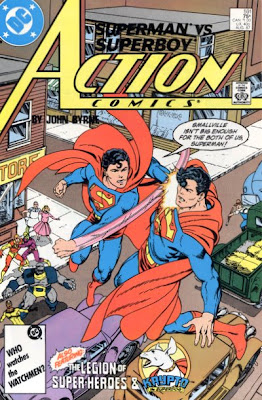
To address the issue--perhaps the earliest incidence of continuity porn to spin out of Crisis--John Byrne and Paul Levitz concocted a byzantine plot whereby the Legion's arch-enemy, the Time Trapper, created a "pocket universe" and populated it with Earth and Krypton. (Told in Action Comics #591, Superman #8 and Legion of Super-Heroes #37-38, 1987.) He then manipulated events that resulted in Superboy's creation, and whenever the Legion traveled to the past, it was really the Trapper's pocket universe they visited. The explanation gets loopier from there, with every plot contrivance underscoring the fact the story wasn't being told because somebody thought it would make a good story, but rather, because they needed some explanation in place! (A few months later, the same pocket universe would give birth to the first post-Crisis iteration of General Zod and his fellow criminals, as well as a "good" Lex Luthor who sent his creation Matrix, imprinted with the mental engrams of that universe's Lana Lang, to Earth. There, Matrix became the first post-Crisis Supergirl, who fell in love with Lex Luthor's clone, merged with the post-Crisis Linda Danvers, and eventually became an angel. But, I'm digressing!)
Eventually, DC's continuity problems continued to grow, which led to ever more drastic measures to "fix" them. The first major, whole-house attempt was Dan Jurgens' Zero Hour: A Crisis in Time, which endeavored to fix not only Crisis but also an earlier summer crossover, Armageddon 2001, whose ending had been mishandled after fans figured out the ending months ahead of release. A time-traveling villain named Extant acted as servant for hero-gone-bad Hal Jordan, Earth's second Green Lantern, who took ever more drastic measures to bring back his hometown Coast City, which had been decimated in the "Reign of the Supermen" storyline the previous year. The series, which started at issue #4 and "counted down" toward the finale in the aptly-numbered #0, ended in a drastic re-ordering of time that was supposed to magically fix everything that came before. They even included a fold-out timeline that included events from the distant past to the far future to prove their point that everything was nearly addressed!
It wasn't, of course, but in the meantime, we got a quasi-reboot with a month full of special issues of every DC title, all numbered #0 and their covers printed with metallic ink highlights. Some new series arrived, the most noteworthy of which was Starman under the aegis of James Robinson and Tony Harris. Meanwhile the Legion of Super-Heroes was relaunched with all evidence of Superboy's involvement in their origins erased, while the biggest change to Batman was re-establishing that his parents' killer was a nameless crook (and not Joe Chill, a fact true in both pre-Crisis continuity and in the post-Crisis "Batman: Year Two").
At the same time as DC dealt with their second big event centered around a "Crisis," Marvel initiated perhaps the most notorious example of using continuity as a weapon. To attempt to follow DC's lead with such events as "The Death of Superman" and "Knightfall," they concocted (there's that word again!) a storyline in which a clone of Spider-Man, who'd appeared in a series of stories in the seventies, had never died. The character, who renamed himself Ben Reilly (itself a continuity nugget, combining Spidey's uncle's first name with his aunt's maiden name), went on the road for many years but came back when he heard of Aunt May's sudden illness. His return between 1994-1996 also prompted the return of the villain that created him, the nefarious Jackal, who brought with him a host of half-baked clones including one of Gwen Stacy, Spidey's lost love. All along the way, the writers constantly refuted previous stories about the clones, bridging the gaps outside the Spider-Man group of titles.
In theory, the clone's return was meant to be a return to form for Spider-Man, who was seen as increasingly alienated from his fanbase by virtue of his marriage to Mary Jane Watson, then a successful supermodel. Marvel re-characterized Peter Parker as a "dark" character, and even a villain, in the hopes that Ben Reilly would be accepted as the one, true Spider-Man. They even exploited a decades-old plot point whereby Peter could be the clone, and Ben the real one. Peter left New York with a pregnant Mary Jane, and Ben Reilly became a Spider-Man who lost track of which heroes and villains he knew from the point his memories diverged from Peter's. Eventually Marvel opened up an even bigger can of worms by resurrecting Mendel Stromm and Norman Osborn to solve the narrative, kill off Ben, and restore Peter as the one, true Spider-Man. (Don't worry--Marvel would again try, more successfully, to divest themselves of the Spider-marriage. Keep reading.)
Worse, once the "Clone Saga" was complete, writer Roger Stern returned to Spider-Man to rewrite years of continuity since he left the book, with the express aim of providing the "real" identity of the Hobgoblin. He'd already been unmasked years before as Daily Bugle reporter Ned Leeds, but that didn't stop Stern from reopening a dead case and providing his own answer to the puzzle as he originally intended. The three-issue series, Spider-Man: Hobgoblin Lives, contained references to back issues on the back covers, a sure-fire sign that continuity had been taken too far. And, of course, Stern revealed the Hobgoblin to be one of his own creations who hadn't been seen for over a decade. And an evil twin! Le sigh.
Back at DC, writer Mark Waid and artist Alex Ross' Kingdom Come told a dystopic version of events from DC's future. The four-issue series, published in 1996, continued a special-event line of comics called "Elseworlds," which weren't tales from alternate realities because, well, alternate realities didn't exist anymore at DC, right? Still, on the strength of the storyline, Waid helmed another event series in 1999, The Kingdom, as a sequel of sorts, during which he revealed that the Multiverse was alive and well and part of a concept now called "Hypertime." Hypertime supposed that reality was like a river whose paths could randomly converge and diverge, allowing for different versions of Superman or any other character to coexist or team up as circumstances dictated. It also encompassed the original Multiverse plus all the Elseworlds realities. Most notably, Waid used the Hypertime concept himself at great length during the end of his tenure on The Flash when Walter West, the Flash of an alternate reality, briefly took the place of the mainstream DC Flash, Wallace West. For a while, there was talk of Grant Morrison using the concepts introduced in The Kingdom in a new crossover event to be called Hypercrisis, but the project was shelved.
Writer Kurt Busiek, who rose to prominence through his work on the revolutionary Marvels project with Alex Ross, was that unique breed of writer who endeavored in ways similar to Roy Thomas to link Marvel's past with its present. He never met a continuity reference he didn't like, and if there's one man who embodies the essence of "continuity gone wild" for better or worse, 'tis he. Marvels was filled with references both in the story itself, or in poses of characters, or really, any old thing. They may not have been intrusive to the degree they were in others' work, but there they were all the same. Busiek's intense detail toward continuity minutiae became a driving force behind two of his most well-known projects: Avengers Forever, itself a scrutinous examination of Avengers continuity through the eyes of villain Kang the Conqueror; and the DC/Marvel co-publication JLA/Avengers, itself rummaging through years of unusual continuity to tell a story that spanned the full length of both teams' histories. While demonstrating Busiek's obsessive attention to detail, both series were impenetrable to all but the most fervent fans.
DC's own answer to Kurt Busiek hit the ground running as writer of niche book Stars and S.T.R.I.P.E. and co-writer of James Robinson's JSA revival. In some ways, Geoff Johns could make Busiek look positively amateur by comparison. He sifted through years of complex continuity to return Hawkman from permanent "damaged goods" status in JSA and his own book. He's worked on various "event series" including Day of Judgment, Identity Crisis, Green Lantern: Rebirth, Infinite Crisis, Final Crisis, Flash: Rebirth, Blackest Night, Brightest Day and the currently-running Flashpoint. Each of the company's recent event series has been predicated on older continuity for maximum effect, from Brad Meltzer's Identity Crisis' reworking of the JLA's "Satellite Era" to Infinite Crisis as direct sequel to Crisis on Infinite Earths, to Grant Morrison's Final Crisis as a love letter to Jack Kirby's "Fourth World" tales, to Blackest Night as an ultimate extension of decades of "Green Lantern" mythos.
Infinite Crisis in particular poked fun of the conventions of intense scrutiny of continuity when in its Secret Files & Origins special, writer Marv Wolfman revealed that since Crisis on Infinite Earths, Superboy-Prime punched at the walls of reality from the "paradise" he shared with Earth-2's Superman and Lois, with each punch causing disruptions to continuity. Those disruptions included the resurrection of Jason Todd (Robin II), the changing origins of Superman, and the various incarnations of Hawkman and the Legion of Super-Heroes. If there was an apparent continuity mistake, DC could say that Superboy-Prime made it that way. (And when he was released during Infinite Crisis, he continued the trend of messing everything up. Rimshot!)
Infinite Crisis also brought back the Multiverse in a big way, and for enthusiasts of that brand of storytelling, writer Johns "revealed" (using quotes because it was his own made-up history, not from prior precedent) that legacy characters like the Kyle Rayner Green Lantern and the Jason Rusch Firestorm were really the heroes from another, heretofore unknown Earth ("Earth-8") that was merged into the "new Earth" during the original Crisis on Infinite Earths. Yes, the writers just had to cater to the original spirit of the Crisis-that-was. But Johns kept pushing the envelope further...
His work on Final Crisis: Legion of 3 Worlds in particular was hugely evocative of the continuity-heavy stories that Crisis on Infinite Earths spawned, relying on the reader's knowledge of three distinct alternate versions of the Legion of Super-Heroes to assist in comprehension of the narrative (not to mention the returns of several non-Legion characters). Johns catered to his artist, George Perez of 1985's Crisis fame, allowing him to draw dozens or even hundreds of characters in incredible detail such as Perez has become well-known for doing. Lovers of DC's often labyrinthine continuity gobbled the series up, but it often left more casual fans cold--as did, for that matter, Final Crisis itself.
Not to be outdone, Marvel has done some selective continuity editing of their own, almost establishing a sort of "anti-continuity" with Spider-Man's infamous "One More Day" storyline. In it, Spider-Man made a deal with Mephisto, Marvel's representation of the devil, to save his aunt from certain death and to ensure his identity (revealed to the world in a then-recent storyline) became a secret again. Suddenly and without explanation, Spidey's marriage to Mary Jane was edited out of continuity. So ingrained into fans' minds was the idea that some additional explanation was required, that the fans were owed the details as to exactly what changes were made in history to arrive at this point. They couldn't simply accept that "they never got married" because, well, what about Mary Jane's pregnancy during the "Clone Saga"? Didn't that mean their beloved hero was having sex out of wedlock and thus was immoral and unclean? (They seemed to gloss over that part where Spidey made a deal with a bad guy, satanic or otherwise.) The "mystery" went on for nearly a hundred issues until only the points directly raised by "One More Day" were addressed, and no more, in "One Moment in Time." Of course, since then, they've moved on, content to never, ever address the finer points of Spidey's relationship with MJ again.
Continuity continues to prove a slippery slope, a double-edged sword, a (insert cliche of your choice here). I get the desire to make order out of the chaos, and to show that more or less, fictional realities have similar physical rules to our own. However, the more changes that are done, the less "real" the reality of the comics becomes. Also, continuity creates an insular subdivision of fandom, so engrossed in the "reality" of the characters that they will cry foul on any deviations from previously established events. (Really, the mentality that gave birth to the concept of the "No-Prize," writ large.) Ultimately, one may even see an expansive continuity as one more reason that comic circulation has slowly dwindled, as fewer and fewer people can make sense of these universes the bigger companies have created.
Was DC in danger of collapsing under its own weight when they announced the grand reboot that spins out of the Flashpoint miniseries this month? That's a good and fair question, but it'll have to wait until my fourth and final part of this little (heh) essay.
Next: Grand Guignol
(DCnU Continuity Series: Part 1 | Part 2 | Part 3 | Part 4 | Part 5)
~G.
Welcome back, comics compatriots!
Springing forth from the September relaunch of DC Comics like Athena busting out fully-formed from Zeus' noggin, here's yet another in a series of discussions of various facets of the comics medium. This is the third part of my very complex discussion of comics continuity. In the first part, I discussed the development of Marvel Comics' shared universe and DC's development of their Multiverse. In the second, I addressed how DC's attention to combining all their universes into one "New Earth" during Crisis on Infinite Earths actually created logistical problems that grew to rival any inconsistencies with the previous "Multiverse" system. I don't think it's overstating the case to suggest Crisis gave birth to the continuity-obsessed comics culture of the present day. And that brings us to this section, where I'll explore continuity gone wild.
![]() |
| Silly season begins at DC: Tim Truman's Hawkworld. |
On top of that, by very virtue of there being only one Earth when previously there were many, all kinds of bits of history were reshuffled. Earth-2's heroes, the Justice Society of America, were now part of the history of this new Earth, but neither Superman nor Batman were their contemporaries. (Wonder Woman? See above.) And most certainly, Batman and Catwoman never married and never had a daughter, Helena Wayne, that became the Huntress. Although there would be a Huntress, her origin was dramatically rewritten. Power Girl? Now, there was a question that wouldn't definitively be resolved until Infinite Crisis in 2005.
![]() |
| Retconning 101: The revised origin of the Swamp Thing by Alan Moore. |
With all that DC had done in the previous fifty years, the current generation of DC's writers took it upon themselves to stitch together a continuity that was utterly fractured by the company's own hand. And the more they drew attention to the problems they created, the worse in turn those problems became. I mentioned the relationship between Superboy and the Legion of Super-Heroes in my last post. This relationship became an easy target because, well, in post-Crisis continuity, Clark Kent never became Superboy!
![]() |
| "If there was never a Superboy, who the hell is fighting Superman?" |
Eventually, DC's continuity problems continued to grow, which led to ever more drastic measures to "fix" them. The first major, whole-house attempt was Dan Jurgens' Zero Hour: A Crisis in Time, which endeavored to fix not only Crisis but also an earlier summer crossover, Armageddon 2001, whose ending had been mishandled after fans figured out the ending months ahead of release. A time-traveling villain named Extant acted as servant for hero-gone-bad Hal Jordan, Earth's second Green Lantern, who took ever more drastic measures to bring back his hometown Coast City, which had been decimated in the "Reign of the Supermen" storyline the previous year. The series, which started at issue #4 and "counted down" toward the finale in the aptly-numbered #0, ended in a drastic re-ordering of time that was supposed to magically fix everything that came before. They even included a fold-out timeline that included events from the distant past to the far future to prove their point that everything was nearly addressed!
![]() |
| Everything ends, and begins again. Zero Hour: A Crisis in Time #1. |
At the same time as DC dealt with their second big event centered around a "Crisis," Marvel initiated perhaps the most notorious example of using continuity as a weapon. To attempt to follow DC's lead with such events as "The Death of Superman" and "Knightfall," they concocted (there's that word again!) a storyline in which a clone of Spider-Man, who'd appeared in a series of stories in the seventies, had never died. The character, who renamed himself Ben Reilly (itself a continuity nugget, combining Spidey's uncle's first name with his aunt's maiden name), went on the road for many years but came back when he heard of Aunt May's sudden illness. His return between 1994-1996 also prompted the return of the villain that created him, the nefarious Jackal, who brought with him a host of half-baked clones including one of Gwen Stacy, Spidey's lost love. All along the way, the writers constantly refuted previous stories about the clones, bridging the gaps outside the Spider-Man group of titles.
![]() |
| Silly season begins at Marvel: The Spider-Clone returns. |
Worse, once the "Clone Saga" was complete, writer Roger Stern returned to Spider-Man to rewrite years of continuity since he left the book, with the express aim of providing the "real" identity of the Hobgoblin. He'd already been unmasked years before as Daily Bugle reporter Ned Leeds, but that didn't stop Stern from reopening a dead case and providing his own answer to the puzzle as he originally intended. The three-issue series, Spider-Man: Hobgoblin Lives, contained references to back issues on the back covers, a sure-fire sign that continuity had been taken too far. And, of course, Stern revealed the Hobgoblin to be one of his own creations who hadn't been seen for over a decade. And an evil twin! Le sigh.
![]() |
| The book that led to the revival of the Multive--um, Hypertime: Kingdom Come. |
Writer Kurt Busiek, who rose to prominence through his work on the revolutionary Marvels project with Alex Ross, was that unique breed of writer who endeavored in ways similar to Roy Thomas to link Marvel's past with its present. He never met a continuity reference he didn't like, and if there's one man who embodies the essence of "continuity gone wild" for better or worse, 'tis he. Marvels was filled with references both in the story itself, or in poses of characters, or really, any old thing. They may not have been intrusive to the degree they were in others' work, but there they were all the same. Busiek's intense detail toward continuity minutiae became a driving force behind two of his most well-known projects: Avengers Forever, itself a scrutinous examination of Avengers continuity through the eyes of villain Kang the Conqueror; and the DC/Marvel co-publication JLA/Avengers, itself rummaging through years of unusual continuity to tell a story that spanned the full length of both teams' histories. While demonstrating Busiek's obsessive attention to detail, both series were impenetrable to all but the most fervent fans.
![]() |
| Continuity pr0n for Earth's Mightiest Heroes. |
Infinite Crisis in particular poked fun of the conventions of intense scrutiny of continuity when in its Secret Files & Origins special, writer Marv Wolfman revealed that since Crisis on Infinite Earths, Superboy-Prime punched at the walls of reality from the "paradise" he shared with Earth-2's Superman and Lois, with each punch causing disruptions to continuity. Those disruptions included the resurrection of Jason Todd (Robin II), the changing origins of Superman, and the various incarnations of Hawkman and the Legion of Super-Heroes. If there was an apparent continuity mistake, DC could say that Superboy-Prime made it that way. (And when he was released during Infinite Crisis, he continued the trend of messing everything up. Rimshot!)
Infinite Crisis also brought back the Multiverse in a big way, and for enthusiasts of that brand of storytelling, writer Johns "revealed" (using quotes because it was his own made-up history, not from prior precedent) that legacy characters like the Kyle Rayner Green Lantern and the Jason Rusch Firestorm were really the heroes from another, heretofore unknown Earth ("Earth-8") that was merged into the "new Earth" during the original Crisis on Infinite Earths. Yes, the writers just had to cater to the original spirit of the Crisis-that-was. But Johns kept pushing the envelope further...
![]() |
| Did someone mention "continuity pr0n"? Geoff Johns goes overboard with the Legion. |
Not to be outdone, Marvel has done some selective continuity editing of their own, almost establishing a sort of "anti-continuity" with Spider-Man's infamous "One More Day" storyline. In it, Spider-Man made a deal with Mephisto, Marvel's representation of the devil, to save his aunt from certain death and to ensure his identity (revealed to the world in a then-recent storyline) became a secret again. Suddenly and without explanation, Spidey's marriage to Mary Jane was edited out of continuity. So ingrained into fans' minds was the idea that some additional explanation was required, that the fans were owed the details as to exactly what changes were made in history to arrive at this point. They couldn't simply accept that "they never got married" because, well, what about Mary Jane's pregnancy during the "Clone Saga"? Didn't that mean their beloved hero was having sex out of wedlock and thus was immoral and unclean? (They seemed to gloss over that part where Spidey made a deal with a bad guy, satanic or otherwise.) The "mystery" went on for nearly a hundred issues until only the points directly raised by "One More Day" were addressed, and no more, in "One Moment in Time." Of course, since then, they've moved on, content to never, ever address the finer points of Spidey's relationship with MJ again.
![]() |
| 1st rule of Spidey continuity: You don't talk about Spidey continuity. |
Was DC in danger of collapsing under its own weight when they announced the grand reboot that spins out of the Flashpoint miniseries this month? That's a good and fair question, but it'll have to wait until my fourth and final part of this little (heh) essay.
Next: Grand Guignol
(DCnU Continuity Series: Part 1 | Part 2 | Part 3 | Part 4 | Part 5)
~G.
Subscribe to:
Posts (Atom)


