Showing posts with label Marvel. Show all posts

8.8.22

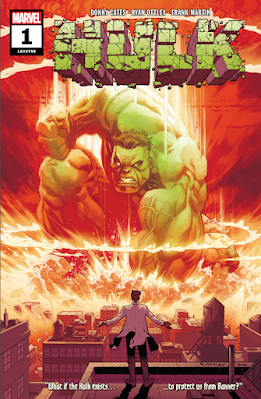
The Cycle of Violence: Why Can't Marvel Stop Abusing the Hulk?

[This post contains SPOILERS for Hulk (2021 Series) #1-7, Hulk Vs. Thor: Banner of War #1, and Thor (2020 Series) #25-26, all available now from your local comics retailer or via Comixology.] 

Welcome back, Hulk fans!

Some of you may have heard me voice my distaste for the recently-begun Hulk series by writer Donny Cates and artist Ryan Ottley. I'm not alone, either; there are many out there who feel let down following the absolutely incredible, 50-issue Immortal Hulk run written by Al Ewing.

I mean, on the surface, who wouldn't feel that way? Ewing's Hulk was dense and literate, showing the gradual rebuilding of Bruce Banner after coming back from death. He brought back the multiple personality elements of the Hulk, including not only the childlike Savage Hulk, but also the crafty Joe Fixit (although trapped in Banner's body for most of the run) and Paul Jenkins' contribution to the mythos, the aptly-named Devil Hulk. He made the Devil Hulk the glue desperately trying to hold Banner together in the aftermath of trauma before finally killing him off. And after that, it was Joe Fixit's turn in the spotlight, to build a bond with his "brother," the child Hulk, whom he previously never liked, even resented. Together, they rescued Banner, the missing part of their "system," from the Below Place in a showdown with the Leader, his arch-enemy bonded with his dead father's soul. In making peace with the Leader, he also made peace with the memory of his dead father once and for all.

Surely, after such weighty matters and a reunion of the primary members of the system, we thought Al Ewing would stick around a while and show us what the working system of Banner, the child Hulk and a cosmically-powered Joe Fixit in a Hulk form could really do, right? Alas, Ewing's Immortal Hulk now stands as a mere transition period, although one with a panoply of tools for a subsequent writer to employ.

17.3.18

The Incredibly Morbid Hulk (Avengers #684 & Immortal Hulk #1, Forecasted)

He's baaaaaaaaaaccccccccccckkkkkkkkkkkkk.

And he's PISSED.

Since the last time I wrote, the Hulk--my favorite fictional character, as you should know if you've been following me for any length--largely remained dead since Marvel had him killed in their publicity stunt masquerading as event series, Civil War II, in mid-2016.


The series was written by Brian Michael Bendis, a writer whose work I've at times enjoyed (Alias, Daredevil, Ultimate Spider-Man--the first 50-ish issues) and other times loathed (gobs of Avengers and X-Men of varying flavors; Secret Invasion; Guardians of the Galaxy). As I've said before, his characterization of Banner and the Hulk just leave me cold, and each time I have to read something he wrote about them, I cringe at the total lack of knowledge of and utter disgust for them he seems to possess. I know not everyone holds Bruce Banner and his monstrous id in the same high regard as I, but dammit, do people who seem to outright hate him need to be so obvious about it?

The only thing more disgusting than the way in which Marvel chose to kill the Hulk is the way in which they've teased, time and again, his "resurrection." It's true that you knew they would never let him stay dead, but really, they tease by having the Uncanny Avengers fight a version of him apparently raised by the Hand and wearing tatami that still lets his green skin peek out around the edges? Not content with that, Banner's body is then turned over to Captain America, who at the time was a deep cover Hydra agent, his memories rewritten by the Cosmic Cube as part of a revenge scheme by the Red Skull. (Say that five times fast, I dare you!) Of course, Captain America Hydra turns the corpse over to Arnim Zola, who programs him to return to life just long enough to shred through Cap's heroic opposition like a sickle through chaff.

So of course, primed by these three "deaths," the new Hulk status quo is that he's--wait for it--immortal, and each time he's died, he was just destined to come back. That's the premise of the new series by Al Ewing and Joe Bennett, coming in June to a comic shop near you, called--yup--The Immortal Hulk. (Interview at link.) And Marvel is previewing this new take in their 16-part weekly series, Avengers: No Surrender, of which issue #684 is now on sale.

18.7.16

A Delusional Flashback: The Hulk Is Dead, Long Live...John Byrne's Hulk?

I thought it might be a good time to throw a new spotlight on another time the Hulk was threatened with death...by acclaimed writer/artist John Byrne!

If you haven't read the below articles, well...they're new to you!

John Byrne & The Hulk That Might Have Been (Part 1 | Part 2 | Part 3 | Part 4 | Post-Script)


Delusional Honesty will return later this week, with a long-delayed review of Batman V. Superman: Dawn of Justice.

~G.

10.7.16

The Physicist Has No Purple Pants: Marvel's Hulk-Sized Problems (2 of 2)

(Updated thanks to an eagle-eyed Facebook friend. Thanks, GG!)

When last we left our intrepid blogger, I was constructing a narrative by which I proved that there's a great, big target on the Hulk's green butt, put there by Marvel's powers-that-be and set to have the bull's-eye hit on Wednesday, July 13th, only 3 short days from now, in the pages of Marvel's Civil War II #3. Now, get ready to go beyond the actual event, into what the Hulk's death means for the world of Marvel Comics and its creators, for you the fans, and for the entire doomed comics industry.

(Whoops. Did I just say "doomed"? Heh-heh.)

While I've been taking the time to write these new chapters, I hope you've familiarized yourself with Totally Awesome Hulk #7-8, both now on sale, the latter of them since I published part one. As writer Greg Pak stated himself, the books mark his return to writing Bruce Banner. What he didn't say--but which is patently obvious from reading the eighth issue in particular--is that these stories are intended as a final look back at our favorite physicist, since his next appearance in Civil War II will end with an arrow through his [insert whatever part of Banner's anatomy you want].


4.7.16

O Death, Where Is Thy...Smash??!? (1 of 2)

(EDITED 7/8 thanks to Cth at The Incredible Hulk Message Board!)

It's been about a year since my last post on Marvel's Green Goliath. Those of you who have followed me for any considerable time know the Hulk is my favorite comics character. Hence, I'm a bit territorial when it comes to big events surrounding Big Green. And when I'm displeased, I'm known to write pieces like those dissecting the runs of Jason Aaron and Mark Waid.

Up to now, I've been staying eerily quiet about Totally Awesome Hulk. That ends today.


I've got much more to get into than Totally Awesome Hulk by itself, so I'll try to be brief. For Greg Pak--one of my very favorite Hulk writers, his name spoken in the same breath as Len Wein, Bill Mantlo & Peter David--to have a comeback would ordinarily be a cause for celebration. At the same time, there was apprehension, for what writer successfully returns to the book on which he made his mark? Even Peter David couldn't make lightning strike twice, leaving not even a year into his second tenure. It was true that this time, Pak was making his own creation, Amadeus Cho, into a brand new Hulk, in a move that I previously stated echoed Bill Mantlo's original plans before he handed the book to John Byrne. Some at the time called it a Gary Stu situation (look it up) beyond all others. Me, I went along for the ride, as Pak had earned much goodwill in his prior five-year run.

20.6.16

Of Spider-Clones and Supermen: Why "Superman: Rebirth" Is the New "Clone Saga"

Ever since hearing that DC Comics was going to kill off the "New 52" Superman and replace him with the recently-returned "Pre-Crisis" version who disappeared nearly 5 years ago, something's been scratching at the back of my head. And now that we're three full issues into the Pre-Crisis Superman taking over for NuSupes, I can finally put my finger on the feeling. It's one I last had about two decades ago.


For anyone having read Spider-Man comics between 1994 and 1996, you're of course familiar with the much-maligned "Clone Saga." For those not in the know, there was a time shortly after DC's "Death of Superman" storyline where editors pushed their talent to manufacture similar, event-based storylines to drive then-record sales figures ever higher. No idea was too silly when Marvel went looking for their own Spidey-centric tale. (Such events have only gotten more grandiose, but I digress.)

So writer Terry Kavanagh dusted off The Amazing Spider-Man #150, coda to a storyline wherein the villainous Jackal cloned both Spidey himself and his alter ego's late girlfriend, Gwen Stacy. Spidey threw away a report on whether he was really the clone because of, essentially, a gut instinct. The question became, "What if the Spider-Man fans had been reading since 1975 was really the Spider-Clone?" Writers like John Marc DeMatteis (one of my idols) became inspired, and suddenly the dead clone nobody thought twice about returned to life--and a co-starring role in all of Marvel's Spider-Man series for the better part of two years. He became Ben Reilly (so named after Peter Parker's uncle Ben, with his last name the same as Aunt May's maiden name Reilly) and Spider-Man's life would never be the same again!

I read the Clone Saga when it originally came out. One of my friends in the fledgling days of Internet fandom--the inimitable DRILLN0T--helped me write "The Spider-Man/Jackal Dossier," an ungodly tome that consolidated and promulgated fan theories and unresolved facets of the storyline. So yes, I'm kind of well-versed in the storyline and count it as one of the high points of my collecting.

What's that all have to do with Superman: Rebirth? It's funny you should ask...

12.3.16

Post-Crisis (Superman)

[I've been a bad, bad blogger over the last few months. Here's hoping I can start making my lack of regular posts up to everybody and bring back some regular readers in 2016. Sound good to you? Good! --GMM]
Maybe the single book I was happiest about in 2015. Happy irony!
When last I wrote, I was having a little crisis regarding my comic book buying habits. I developed a severe lack of faith in the output of the Big Two in 2015, exacerbated by line-wide events like Convergence at DC Comics and Secret Wars (what, again?) at Marvel.

Looking at some articles out there from not only fans but also some retailers, it appears I'm not alone in my trepidation. One thing the market hates is uncertainty, and in 2015 the Big Two gave it to retailers and readers alike in spades. With a spate of regular series, retailers can base their orders on their regular customers and their buying habits, forecasting here and there for "new" series based on the performance of other, similar books. With a two-month-long event like Convergence, there's a degree more of uncertainty because the entire regular lineup is replaced by forty two-issue miniseries anchored by a 9-issue event series. And because Marvel must take every idea DC has and shoot it full of Gamma Rays to do it "better," they anchored a staggering 42 miniseries of indeterminate length (upon early solicitations), as well as several issues of 10 ongoing series, to their own 9, then 10-issue event series.

So, to recap: we've got big event miniseries, which usually sell gangbusters. But what happens when you tie them to countless miniseries instead of the traditional issues of ongoing series? Remember the theory to using events and crossovers in the first place: namely, to prop up flagging sales of series by tying them--unnecessarily, even--to said event. But how do retailers even begin to determine orders when juggling an event with a whole bunch of new #1 issues for series of unknown length, with no real corollaries to existing series? Danger, Will Robinson! Danger! Danger!

22.6.12

Why Spider-Man Vs. Spawn Must Happen (An Open Letter to Axel Alonso & Todd McFarlane)

(Special note: Any fans or creators wishing to re-post or share this note may do so with the conditions that I am credited as its sole original writer and that my website, DelusionalHonesty.com, be linked from your posting.)

Dear Axel & Todd:

As you are both well aware, 2012 marks an important time in the "lives" of your companies' most enduring characters. Spider-Man was created by Stan Lee and Steve Ditko 50 years ago in the burgeoning days of of Marvel Comics with its eye toward more realistic super-heroes. Todd, you created Spawn 20 years ago during the explosion of creator-owned sentiment that was Image Comics' raison d'etre. Since then, both characters have enjoyed significant success, be it Spawn's HBO series or the 1997 movie; or Spider-Man's various animated series and 70s live-action TV series and movies throughout the last decade. Spawn #220 recently hit comic shops everywhere, celebrating the 20th anniversary, and in August, Marvel will release Amazing Spider-Man #692, which does the same for his 50th.

Although I know it's far, far too late to do it this year, I think you should really put your heads together and produce what we all know would be the premier comics--nay, pop culture event of 2013.

Spider-Man Vs. Spawn.


While 2012 marked the anniversaries I outlined above, 2013 will be the 25th anniversary of Todd's first work on Spider-Man, a character whom I daresay he changed forever by infusing his unique sensibilities into his design. I imagine, during the 43 issues Todd drew between 1988 and his exit from Marvel in 1991, he turned many a teenage boy (or girl!) into a devoted Spidey fan for life. There's not a creator working on Spider-Man today who doesn't owe something to Todd's work. If you don't believe me, just look at the character's bigger, buggier eyes and the mess of webbing from head to toe and spitting forth from his web-shooters. Arguably, there are two truly huge names among Spider-Man artists. One is Steve Ditko; I hope I don't have to tell you the other.

Spawn started out terrifically in the your hands, Todd. You soon ceded your artistic designs to Greg Capullo, who paved the way for Angel Medina even as you lent the writing reins to your colleague Brian Holguin, who then passed the torch to others. In spite of all this, you've always returned to the character and shown a heartfelt passion for Al Simmons, Terry and Wanda Fitzgerald, little Cyan, and even Malebolgia, Violator, Angela, Cagliostro and others introduced during the early part of the series. Jim Downing, the new Spawn, has continued to develop since his introduction, growing on fans who miss Al most fervently.

In spite of your immense and consistent popularity with comic fandom, I respectfully offer that it's important to reconnect with your roots. There are entire generations of younger comics fans who don't know the enthusiasm with which we fans who were around in the late 80s and early 90s grabbed the newest issue of Amazing Spider-Man or your Spider-Man. There are younger people--a few generations of them by now--who are only familiar with your work as Spawn's creator, or as the guy who bought Mark McGwire's baseball, or the guy who directed a music video or formed a video game studio with Curt Schilling and R.A. Salvatore. Only because of Marvel Comics' relentless graphic novel program do many even know you once, long ago, drew Spider-Man.


Axel, you've done some terrific things in your decade-long career with Marvel Comics. You stepped in when Joe Quesada renovated the company and drove such unique efforts as Peter Milligan and Mike Allred's X-Statix as well as J. Michael Straczynski's Amazing Spider-Man and Bruce Jones's Incredible Hulk. You've also brought various crime writers to Marvel, and helped to start the MAX mature readers label. In short, you've taken chances with Marvel's properties just as often as you've put out crowd-pleasing fare such as the current line-wide event, Avengers Vs. X-Men.

Marvel Comics and Image Comics have both had their share of successful inter-company crossovers, but Marvel hasn't stuck its feet in the water since the deal with Top Cow which produced books like Darkness/Hulk (which reunited Dale Keown with Marvel and the character with whom he was most often affiliated) and Cyberforce/X-Men (ditto for Marc Silvestri). The last crossover Marvel did with any other company was 2008's Magdalena/Daredevil.

Todd, you've been stingier in letting anyone else play with Spawn, letting him briefly pal around with Batman in a duo of one-shots, one of which you illustrated while comics legend Frank Miller wrote it. It wasn't bad, but at the same time, I don't believe it ages particularly well, nor do I think fans were as enthusiastic about a crossover with a character you rarely drew (in Mike W. Barr's excellent Batman: Year Two) as they would have been about a story involving a character you--let's be honest--revolutionized. And there was another Batman/Spawn project brewing, but there has to be one damned good reason why it never happened.

It's the perfect time for the drought to end on both your sides, and you know it.


While Batman and Spawn certainly have certain characteristics in common, it would no doubt be fascinating from a character point of view to bring Spawn into conflict with Spider-Man, a character who is his polar opposite: a hero of the daylight hours who fights with a web and a quip instead of a creature of darkness who uses chains and hellfire. It certainly wouldn't hurt to have the whole thing drawn by the man who, with the exception of a cover for the Ultimate Spider-Man #100 Project, hasn't drawn the character that put him on the map for two decades.

You know also that the project would entice the reading public--fans both old and new--like nothing that Marvel, Image or any other company has created since the formation of Image itself. And I'd imagine such a project would require the largest available canvas. Give the project the gravitas it deserves, not as a mini-series with an inevitable graphic novel collection at the end of the tunnel, but as a Treasury-sized spectacular like the super-project Superman Vs. the Amazing Spider-Man and all their ilk. 64 pages? 80? 100? Doesn't matter. Precious few projects have debuted in this superlative format in recent years, and fewer still have actually deserved it. Not only would comic readers get to see Todd McFarlane drawing Spider-Man again, swinging alongside his own creation for the first time ever; but they'd also see it in a large format actually befitting the event!

I'd also make one final recommendation to sweeten the pot. Everyone knows that you, Todd, have championed creators' rights since you left Marvel. Axel, I know that you and Joe Quesada have worked to establish the good name of Marvel through your works with the Hero Initiative charity. I would suggest the project be created in tandem with the Hero Initiative, with a significant amount of the profits going to the program and the creators it helps. Maybe you don't even have to go that far; maybe if each of Todd's art pages were auctioned off for the Initiative, like the covers contributed to the various "100 Projects" year in and out, that would be a blessing in itself. Put some space in the back and let various "indie" creators draw pin-ups of Spidey/Spawn or their own creations in the back. Make the project all about creators' rights, about benefiting those in need. Work out the reprint rights for subsequent printings and ensure this project is the gift that keeps giving, while you're at it.


Who would write this gem? It's one thing worth discussing. Certainly Marvel elite writer Brian Michael Bendis has the "cred" to script such a gig. He's earned it through working on Spawn and his cast in Hellspawn and Sam & Twitch as well as Marvel's in Ultimate Spider-Man and now the super-project Spider-Men. Certainly another name I'd put up there in an instant would be regular Amazing Spider-Man writer Dan Slott, who knows his way around web-head and could certainly bring well-textured life to a project that needs big action, spot-on characterization and big action set pieces. On the other hand, there's dark horse candidate J.M. DeMatteis, whose work shows both humor and psychological complexity and who does exceptionally well with the duality of good and evil.

You can play fast and loose with the concept, too. If you think it's worthwhile to take a trip back in time, to when Spidey was still married to Mary Jane like in the Michelinie/McFarlane originals, so be it. If you want to use Al Simmons instead of Jim Downing, so be it! If you want to involve Venom and swap his symbiote with Spawn's K7 Leetha, make yourselves happy! If you'd rather have it take place in the here and now, I completely understand that desire, as well.

I've made my thoughts known, gentlemen. It's time to make your voices heard. Whether or not you like this idea, or even see it, I think there can be no overstating the potential good a Spider-Man Vs. Spawn project can do for the industry.


Thanks for reading,

Gary M. Miller

23.3.12

The Hulk Is 50. Join Me In An Incredible Celebration!

No doubt by now you've seen the graphic on the last few issues of The Amazing Spider-Man. Large as life, with a stylish, instantly recognizable pose straight from the great John Romita Sr. Fifty years of Spider-Man. He's fifty! Just like the Fantastic Four was fifty last year! It's certainly shaping up to be a banner year for the amazing one, with the new Sony Pictures film helmed by Marc Webb, as well as Dan Slott and Stefano Caselli's "Ends of the Earth" event beginning this week. And yet, for all the celebrating, I can't help but feel somebody's getting left out. Is his green skin a sign of envy toward Marvel's resident wall-crawler? Or is skin color immaterial, and he's just getting...angry about it?


That's right, Hulk fans: 2012 marks the fiftieth anniversary of the creation of our favorite hero, too! "Is He Man or Monster or...Is He BOTH?" intoned Stan Lee on the cover copy of the first issue, cover-dated May of 1962. All these years later, such is the central theme for the character still. He's gone through countless incarnations, from the original, brutish gray incarnation who only stuck around for the first issue; to the green-skinned counterpart who gradually lost his intelligence, resulting in the version which non-comics fans know best; to the Merged Hulk who was a staple of comics in the nineties; to the savvy, planet-conquering gladiator who was the centerpiece of Marvel's 2007 event "World War Hulk"; and far, far beyond. Ol' Greenskin has entertained generations of comics fans, and after fifty years of doing just that, he's earned a celebration as grand as any super-hero in existence.

And yet, all we hear from Marvel is that the Avengers have their own feature film this year, and yes, that Hulk character's a part of it. We had a comic book series that was nearly to its 650th issue, but the company had to cancel relaunch it with a new first issue late last year. That series has been woefully inconsistent and, I feel, isn't truly capturing the power and majesty of the Hulk. Nobody's mentioning the Hulk as having been created fifty years ago, and nobody appears to be lining up special projects, variant covers, or anything of the like commemorating the event. Nobody's embracing the character's rich history.

This is the part where I come in and tell you to spread the word. Copy the above graphic I've designed. Bend it, shape it, any way you want it. You've got the power. Stick it on your website or blog. Put it in your Twitter or Facebook profile. And please, link back here if you can. Raise awareness that Bug-Eyes can't hog all Hulk's glory, because Hulk is the strongest one there is!

Even if Marvel doesn't do anything about the incredible one's golden anniversary, that doesn't mean someone won't. Like, y'know, me.

Many of you have been wondering why I haven't been around as much lately. Why haven't I been entertaining everyone with new articles for this blog a few times a week like I did pretty much all last year? Had the G-Man finally run out of things to talk about?

Quite the opposite, mes amis.

Yours truly has been writing. And writing. And writing some more--but not, as you'd imagine, for this blog. I've got a huge project in the works and I've been aching to share it with all of you. I've wanted to complete enough of it that I can't turn back, to be confident in my own abilities and what I'm writing, before officially announcing the project.

You guys (and gals) all know me as a veritable font of historical knowledge when it comes to the Hulk. I've been a fan for many, many years. I've read the comics and books, I've seen the movies and TV series, I've played the video games and bought the toys. I know people, and I know all kinds of stories. I know what might have been and what nearly was. And Lord knows, I have opinions about the last fifty years of stories. There are stories I love that very few others enjoy, and there are some highly-praised tales I don't give a damn about. Of course there are others I agree are real gems, and still others, real stinkers.

The most comprehensive guide to the world of the incredible Hulk hasn't been published yet...but you can bet that it's being written right now. Part history lesson, part literary criticism, it's going to knock you off your feet with all the force of a Gamma Bomb detonation. Whether you're a dyed-in-the-wool Hulk fan from way back, or someone who's only picked up on the importance of the character since you've been reading this very blog, this book is designed for you.

Need more reasons to pick up this book when it finally arrives? How about the original interviews I'm conducting for it? As of this writing, I've been talking to comics pros like Tom Brevoort, Steve Englehart, Glenn Greenberg, Paul Jenkins, Erik Larsen, Al Milgrom, Greg Pak, and Daniel Way--and that's just the beginning. (Yes, Twitter and Formspring count...and more creators are TBA!) Where possible, I'll be bringing you the behind-the-scenes stories, the might-have-beens--everything that was and wasn't.

Meanwhile, if you've got ideas you want to see in this book, reply here! Although I'm well past the halfway point in writing, and I've got plans to cover all the important bits of Hulk history, I figure there's always a chance I'll have missed something and you guys'll remind me. I'm just trying to head off that possibility.

Similarly, if you're a creator who hasn't yet been contacted, and wish to contribute, then reply here or send me a message at delusionalhonesty [at] gmail [dot] com.

More information as it becomes available, my friends. The current plan is to release the book on the Amazon Kindle, with a limited print edition. The book will be fully researched, fully sourced, and totally unauthorized in order to bring you, the Hulk's fans, a once-in-a-lifetime event.

Join me in wishing the Hulk a happy 50th.

~G.

10.1.12

Looking Back, Looking Forward: Defenders #2 & Dead Man's Run #1, Reviewed

I had a great time at last weekend's Amazing Arizona Comic-Con, and can't wait to show everyone the photos and sketches from the event! Meantime, let's dig in and review one of last week's Marvel books (Defenders #2) followed by an advance review of Aspen's thrilling new miniseries, Dead Man's Run, whose first issue hits stores on January 18!


DEFENDERS #2 - Marvel Comics, $3.99
By Matt Fraction, Terry Dodson, Rachel Dodson & Sonia Oback

They say confession's good for the soul. Very well, then. I have this to confess: Defenders isn't the Non-Team™ of the past, which I loved. Two issues in, that much is abundantly clear.

On paper, all the hallmarks of the team's previous iterations are here: We've got Doctor Strange at the core of the group, aided by Namor the Sub-Mariner and the Silver Surfer. The Hulk even appeared in the first issue to provide the team's new raison d'etre (only to speak some horrendously un-Hulkish dialogue and leap away). Replacing the often-gruff Hulk on the team is his (ex?) wife, Betty Ross, having become the Red She-Hulk, whom Marvel's finest still can't manage to name with remote originality. Also aboard because it seems Strange can't be bothered to remember his martial arts training or whip up some teleportation spells is Daniel Rand'kai, the chop-socky Iron Fist, who's rich enough to ride everyone around in a private jet. And on this first adventure, they attempt to stop the Black Hulk, a remnant from the Fear Itself series, but are diverted by several wonderfully Silver Age-y concepts tossed in a blender. Prester John, wielder of the Evil Eye, now leads a group of the High Evolutionary's New Men to prepare for the creature's coming to Wundagore Mountain and the mystical treasure that awaits there.

All the while, I can't help but feel we've been through it all before.

Certainly Matt Fraction writes a great Iron Fist, as he co-wrote his series with Ed Brubaker some years ago. Certainly too there are enough madcap concepts to make Defenders go forward for a long, long time. Certainly the pieces of a "good" Defenders team are here in body. Unfortunately, the team is bereft of the soul that made it a moderate hit in its seventies incarnation.

Part of the trouble was glimpsed last month, when Strange enjoyed a fling with a co-ed who wore Clea's tights. (Okay, maybe not literally, but try looking at their designs and not imagining Doc's ex.) The Silver Surfer's more alien than he's been in some time (and is an absolute non-factor in this second tale). Namor's, well, his typical pompous self. The less said about the Hulk's cameo, the better. And instead of the sword-wielding Valkyrie and the millionaire playboy Nighthawk, we've got the Red She-Hulk (who now has an unusual transformation mechanism--after we were told she could change at will during "Heart of the Monster") and Iron Fist. (Okay, Danny's kind of an upgrade, you might argue, but man, Kyle Richmond was that team's heart.)

Also distracting--but terribly indulgent to all the "hardcore fans" out there-- are the little blurbs at the bottom of every story page. They either hint at upcoming storylines for this book, or are meaningless throwaway lines designed to pander to the base that's been reading for years. ("Werewolf By Night Nurse," I'm looking at you.) It's not the seventies anymore, and we shouldn't act like it is.

The only things that leave this book remotely enjoyable are the absolutely loony adventures the like of which Brian Michael Bendis wouldn't even touch, and the wonderfully stylish artwork of the Dodsons, who've been gone from the corners of the Marvel Universe I frequent for too long. Really, I'm hoping the series kicks up another few notches next month. The MacGuffin has been revealed, and the biggest battle of the series so far has begun. Will those two key points be enough to save this latest Defenders series from extinction?

Quick Verdict: Skip It.


DEAD MAN'S RUN #1 - Aspen Comics, $3.50
By Greg Pak, Tony Parker & David Curiel
Created by Ben Roberts

What a difference an issue makes!

Okay, it's true: I enjoyed Dead Man's Run #0 back in October. Ben Roberts' high-concept of a "jailbreak from Hell" was enticing, and that first story set up enough of the groundwork for me to be intrigued at what was coming next. All the while as I read the story, centered around Captain Frank Romero's descent into the realm for which he was a mere prison guard, I wondered how the events would play into the actual six-issue miniseries when it finally began. I knew that Sam Tinker, only briefly involved in the zero issue's events, would grow into the protagonist role, and that something would likely happen to his sister.

And yet, here I was, surprised at how much I outright loved Dead Man's Run #1 this month.

As Sam descends into the realm of the prison, I was immediately struck by the book's claustrophobic feel. It should feel that way, with the walls closing in, and an increasing sensation that there is no escape. Tony Parker succeeds in bringing writer Greg Pak's visions to uncanny life here, whether those visions include the reality of the outside world or the stark terror of the jailhouse's walls. His layouts are spot-on, and David Curiel appropriately uses colors to shift the tone--bright at the beginning, muted and haunting as time goes on.

I'm anxious to see what Pak has in store for Sam and Captain Romero, and that's in no small part due to the savvy pacing of the last issue and this one. The script is terrifically accessible, clearly defining the main characters in this insane world. Romero and Sam have a terrific conflict between them, and I'm sure it'll only grow when we finally discover what exactly has become of Sam's sister Juniper. And the jail itself, with its prisoners, guards, and their various abilities, is delightfully eerie, blending the best bits of the places Sam's supposed to be.

The only weak link in this entire episode comes early, when Pak suddenly flashes back to a time in Sam and Juniper's childhood. While it's perfectly all right to give a brief flashback--especially given the circumstance during which it arises--it's not drawn or colored any differently from the rest of the book. Aside from this quick faux pas, the narrative never falters and only grows more engaging with each page.

Quick Verdict: Buy It. This is a vision of Hell well worth the journey.

~G.

26.12.11

"Green and red. Very Christmassy." (Hulk #45-46; Incredible Hulk #3 Reviews.)

"Christmassy"? Well, the colors are. The books themselves...read the following, then make your judgments. This time, I'll be covering a few Hulk books, and then next time we'll stray off the beaten path and look at some books you don't usually see around here. Everyone ready?

INCREDIBLE HULK #3 - Marvel Comics, $3.99
By Jason Aaron, "Marc Silvestri" & Sunny Gho

First things first: If you're looking for clues to how man was separated from monster, you'll find the first inklings outside of scribe Jason Aaron's preview tale in Fear Itself #7 here. You'll find Aaron touching on Bruce Banner's past with his abusive father, and you'll find a mad scientist can turn a whole lot more than a couple of wild boars into gamma mutates. What you won't find here is any sign that Bruce Banner is anything but a bottom-scraping sonuvabitch. And that, as in the previous issue, is where Aaron really loses this reader. Establishing that the Hulk sees Banner as evil for keeping him locked away inside himself is one thing; showing that Banner's going way, way off the deep end and actually committing--let's not fool ourselves--evil deeds is something altogether different.

This issue, artist Marc Silvestri, fresh off a stay in the hospital for an injured ankle, returns to full penciler duties just in time for his grand exit...or does he? Certainly this issue no other artist's work can easily be seen, unlike last issue with Billy Tan and Whilce Portacio all too visible. However, that doesn't mean there weren't other artists making sure Silvestri made his tight deadline. Silvestri himself receives credit for "line art," but his studio, Top Cow, receives a "special thanks" credit (hence my using Silvestri's name in quotes above). It's quite obvious the difference in credits is a direct response to last issue's "monster mash" of eleven credited artists. While the package holds together better than last month, and in places the art is incredibly dynamic, it's definitely best for all concerned that a new and hopefully more reliable artist takes over next issue.

As mentioned before, Banner takes his turn at being "Dr. Moreau" further this month, sending his "Boar Brothers" 26 and 27 to the Hulk's recent hideout. A battle ensues, Hulk smashes, and then Amanda Von Doom and her super-secret organization are oh so happy because the battle has made Hulk do exactly what they wanted him to do last month. "Asunder" has felt by-the-numbers in its depiction of both the Hulk and Von Doom. Hulk is at peace, someone comes around to smash it all away, and the Hulk decides to go do some more smashing to smash those who smashed his chance at non-smashiness. The only new thing Aaron and Silvestri offer--and really, "new" isn't the word--is that the Hulk's smashing this time seems to set off seismic waves of force in the surrounding areas. At the very least, the ending of this story makes it clear Aaron is cutting to the heart of the conflict, setting man against monster on a very real playing field. That counts for something, I suppose.

I said earlier that this issue does contain a few hints about how the Hulk and Banner came to be separate beings this time. The answer--at least, as I see it--casts some serious doubt on whether that's really Banner we're seeing, with the mania and the unkempt hair and the brain tumor the size of a walnut. It casts equal doubt on whether that's really the Hulk. Aside from the "newborn" allusion, why would both Banner and the Hulk be shaved bald upon their separation? What's more, who would have the technology to separate man from monster--and why would Banner use a lab that seems to be set up in much the same way as the one in which he underwent his supernatural divorce?

There's still not enough to recommend this storyline or this new series after this third part of "Asunder." I've outgrown my revulsion at the second chapter, but still, I really think Aaron might be doing irreparable harm to the character of Bruce Banner. (No easy feat for one who has already been established as killing his own father and suffering from lifelong psychological trauma.) Maybe former Hulk writer Greg Pak bears some of the burden, as this storyline seems to explore some of his dialogue in which Banner postulated the Hulk was created to save the world from his own incredible intellect. Although I believe Pak later expressed through Banner that his idea was only clever tomfoolery, the fact we're now dealing with such a storyline now indicates some people just don't know how to take jokes.

Quick Rating: Skip It.


HULK #45 & 46 - Marvel Comics, $2.99
By Jeff Parker, Patch Zircher & Rachelle Rosenberg

On the other hand, Jeff Parker has, with the help of artists Gabriel Hardman and Patch Zircher, made Hulk into one of the best books Marvel publishes. If you're reading this, Jeff? I totally hate you for it. Use your talents for the Up Side of the Schwartz and give us a go on Robert Bruce Banner soon, yes? (You're invited, too, Patch. Rachelle? Anytime!)

This month's pair of issues successfully resolve the five-part "Hulk of Arabia" arc, in which "Thunderbolt" Ross, joined by Machine Man, finally gets to the bottom of Dagan Shah's insidious plans to carve out a niche for himself and his followers in the middle of the desert. Unsurprisingly, the storyline pretty much ends as it was choreographed by Steve Rogers and his merry band of Secret Avengers some issues ago, but Parker and Zircher manage to still pull off some surprises, including Shah's very cosmic origin story.

Most interesting are two key details. Parker uses Machine Man's presence to subtly examine Ross' own complex relationship with another artificial lifeform, his Gamma Base liaison Annie. The subtext is there in every question Ross asks, and I can't wait until her next appearance so we can see how ol "Thunderbolt" applies what he's learned. Parker's also made some salient points about Ross' status as a Hulk in this tale, and he has used Shah as his mouthpiece through which to do so. Specifically, Ross does rely on the public perception of who and what a Hulk is. Jeph Loeb used this point without stating it, such as when the Red Hulk only roared as he smashed through the SHIELD Helicarrier so as not to betray his true, strategic aims to Iron Man. Parker has made the point that Ross' hulking form hides his keen strategic mind--a mind which very likely has been sharpened by the mixture of gamma and cosmic rays involved in his mutation. It's this important distinction that separates Ross from Banner. Say what you like about Banner's Hulk: "Strategy" is not a word that involves itself easily.

The more I see Patch Zircher's artwork on this book, the more I feel he's right at home drawing monsters smashing things. He's asked to stretch his artistic muscles particularly in #45, with Dagan Shah's unusual origin, and he acquits himself very well. Rachelle Rosenberg matches his pace, using one palette for the more reality-based scenes and another for the otherworldly realms Red Hulk and Machine Man visit as they discover the rest of the story. It goes without saying that I really want to see this team work together again, and soon.

"Hulk of Arabia" spices up Parker's series with an international flavor, laying the groundwork for future encounters with Shah and others in the area. It also marks time by providing yet another encounter between the Red Hulk and General Fortean, and keeps Ross checked in with the other heroes in the Marvel Universe. It's fascinating that while the original Hulk gets more insular, this new Hulk gains vast exposure among the biggest super-heroes. While I still lament the fact there's a Hulk book out there that doesn't feature Robert Bruce Banner, I can't argue that this isn't one fine book month in and out.

But yeah, Parker, Up Side, Schwartz, green Hulk, yesterday.

Quick Verdict: Read It.

~G.

13.12.11

11th-Hour Pak Attack: Astonishing X-Men & Red Skull: Incarnate

Greetings, gents. Due to illness--and developments with my "real job"--and yeah, there's that book I've begun writing--I haven't been around to post any reviews! It's about time I got back to it, here, and that means reviewing not one, but two new books by one of Marvel's best & brightest.

As everyone knows, although I'm a "Hulk guy" at heart, that's never stopped me from picking up countless other Marvel books, plus DC books, Image, and some other indie press publications. Send me something (at delusionalhonesty [at] gmail [dot] com) and I'll do my level best to review it in a timely manner. That brings us to a series I haven't picked up in quite some time, since just after the departure of Buffy and Angel writer Joss Whedon.

Yes, kids, it's Astonishing X-Men #44.


Caveat lector: I have been well-read on those mutant folk. At one time, I had an X-collection the envy of most X-fans. Full run of Uncanny X-Men if you include the first four Essential volumes? Check. Full runs of X-Men, New Mutants, X-Force, Cable, Wolverine, and a gajillion other series, regular and limited? Check. About the only series I didn't own that was X-related was Deadpool. But, aside from Peter David's X-Factor, they lost me when the X-folk relocated to San Francisco. And I even drifted away from X-Factor some time ago. For me, X-Men was a light that burned bright, borne from looking at far too many long boxes of quarter books, and then extinguished itself rather quickly.


As part of "Regenesis," the latest rebranding of the X-Men titles, writer Greg Pak and artist Mike McKone have come aboard Astonishing X-Men to tell a three-part tale. The creative shuffle is the latest in a long line for the book, which since Whedon's departure has been a showcase for Marvel's most popular talent--or at the very least, writers itching to tell an X-tale they can't fit anywhere else on the schedule.

And what of "Exalted," the storyline that begins here in this issue? It's...well, an intriguing puzzle, so far.

Scott Summers, the mutant called Cyclops, has been recovering from injuries incurred recently. He remains at Utopia, the San Francisco Bay area base of the X-Men, while the half of the team headed by Wolverine left to reopen the old Westchester school. Physically, he's fit; however, mentally is another story, as he demonstrates by using his optic blasts to decimate the facility's locker room. And then, Storm shows up--looking exactly as she did in the Claremont/Windsor-Smith era of the eighties, white mohawk and all. A glorious battle ensues, unique for its depiction of Cyclops' abilities...and then, as they go together toward parts unknown, that's when the weird gets weirder.

It's interesting that Pak and artist McKone go for the nostalgia value of a mohawked Storm as an entry point into this storyline, and then up the ante with the provocative cover image. Fans who weren't around in the eighties may be intrigued, and I hope they are, because Storm's change in appearance is only the gateway into the storyline set to unfold. The script charges full-steam ahead, never really stopping to let you breathe, a feeling only exacerbated by McKone's clean storytelling and topped off with Rachelle Rosenberg's exciting palette of colors.

I'm increasingly intrigued by the world into which Cyclops & co. are dropped in Astonishing X-Men #44. It's true, some fans may feel a bit flummoxed, especially those who haven't followed the merry mutants' adventures in some time. Still, I've always liked the stoic Scott Summers, and to follow him through an unusual adventure in the spirit of Judd Winick's Exiles is something of a treat. While by no means perfect--the ending is no doubt disorienting--"Exalted" is off to a good start. Read It.


As for the other book on this week's delayed-review list, Red Skull: Incarnate #5, it wraps up the origin of Johann Schmidt, the Rote Schädel (that's "Red Skull" to the non-German-speakers) with the same frightening flourish as writer Greg Pak concluded the origin of the villain who could be seen as the Skull's opposite in Magneto: Testament a few years prior.

Pak, this time joined by artist Mirko Colak, brings the tale of Schmidt full circle with--ironically enough--a plot to kill Hitler when he comes to discipline Ernst Röhm at a Munich hotel. Schmidt, his friend Dieter in tow, constructs a simple plan and goes through the motions, chillingly, to get that which he feels he deserves. The plot is an exercise in cold calculation, a hallmark of the later Red Skull. What's most incredible about this final adventure is how it's all based in stark reality--as has the entire series been--with no masks, no costumes, only human beings carrying out their own cultivated evil designs.

The minimalist script, together with the low-key, yet no less powerful artwork by Colak and colorist Matthew Wilson, really brings a powerful close to the Skull's first adventure. If you haven't picked up this book in the single issues--if this review gets you on board only too late--then do yourself a big favor and pre-order the graphic novel collection of this series. If you've been following all along or you just want a taste of the Skull's evil unfettered by Captain America, then I have two words about Red Skull: Incarnate #5: Buy It.

Next: More Hulkish reviews.

~G.

30.11.11

New Blood: Morbius and the Vampire Genre (2) (Connecting Marvel to...Twilight?)


Welcome back! This segment is the second in a two-part article spotlighting Marvel's very own resident Living Vampire, Dr. Michael Morbius! A Nobel Prize-winning biochemist, Morbius suffered from a rare blood disease whose cure instead transformed him into a creature of the night with an insane thirst for blood.

In the previous segment, I reviewed Morbius' appearances from his 1971 introduction in The Amazing Spider-Man through his two solo series as protagonist, and finally his cure in early 1980, again in one of Spider-Man's series. But of course, as they say, you can't keep a good vampire down!

The prodigal vampire returns. Cover by Jackson Guice.
In Roy Thomas and Jackson Guice's Dr. Strange, Sorcerer Supreme #10-18, Marie Laveau, Voodoo Queen of New Orleans, was aging in the absence of real vampires to feed her unnatural appetite. (This story occurred during the brief period where vampires were eliminated from the Marvel Universe, in the wake of the "Montesi Formula" storyline in Doctor Strange #59-62, Jun.-Dec. 1983.) She abducted Morbius and restored him to discover if his blood could act as substitute, only to find it could not. The Living Vampire escaped and briefly took up residence with Strange and his allies, who couldn't prevent the negation of the original spell.

After Todd McFarlane brought him back in a pair of issues of Spider-Man, Marvel took another look at their horror characters. With the new Ghost Rider title gaining success, the administration sought to build an imprint around the character and supernatural concepts. Hence, the "Midnight Sons" were born, and Morbius became a charter member of the loose grouping that also included Ghost Rider teaming with original Ghost Rider Johnny Blaze as Spirits of Vengeance; Tomb of Dracula alums Blade, Frank Drake and Hannibal King as Nightstalkers; and a group of supernatural investigators tracking down evil pages from the cursed book, the Darkhold.

The Midnight Sons rise, and with them was Morbius. Cover by Ron Wagner.
In the new series by writer Len Kaminski and artist Ron Wagner, Morbius ingested demon blood and found he could now transform between human and vampire selves. After encountering Ghost Rider and allies and suffering the loss of his former love Martine, he vowed he would now only drink the blood of the guilty. He spawned another vampire in assassin Vic Slaughter, and encountered villains like Dr. Paine and Nightmare.

Eventually, the series went off the rails, with Kaminski replaced by Gregory Wright due to disagreements with artist Wagner (who left shortly after). From the end of the first year, Morbius was involved in crossover after crossover--including "Siege of Darkness" across the entire "Midnight Sons" line--that robbed the series of any momentum. Not-ready-for-prime-time artists like Isaac Cordova and Nick Napolitano mired the series down as Wright kept telling stories of the demon blood and characters derived from it.

The series was mired in too many crossovers for its second year.

During the last half-year of the series, Marvel passed Morbius to writer Lisa Trusiani, a writer whose main claim to fame to that point had been the company's licensed Barbie comic. Drawn by Craig Gilmore, an unknown, rough-around-the-edges artist, the series just kept sinking. The stories degenerated into an unintelligible mess, with Martine coming back from the dead...or was that really her? Gilmore left a few issues before the series mercifully faded away with issue #32.

Shortly following the conclusion of Morbius' solo series, the character debuted on the small screen during the second season of the 1994 Spider-Man animated series on Fox. Voiced by character actor Nick Jameson, Morbius was recast as a college student like Peter Parker, who experimented with vampire bats and found himself transformed into a vampire-like creature. Since the censors didn't allow vampires to feast on necks, this vampire's fangs were useless; rather, this Morbius fed on "plasma" using suckers on his hands. He appeared in seasons two and four, during which he interacted with Spider-Man, Blade, and the Vampire Queen Mirium, who intended to use the Neogenic Recombinator technology that created Morbius to create a race of vampires.

Without a series of his own, Morbius reverted to type. Cover by Romita Jr.

In the absence of a regular title, suddenly Morbius reverted to his previous characterization as Spider-Man villain with Peter Parker: Spider-Man #77-80 under writer Howard Mackie and artists Claudio Castellini and John Romita Jr. He popped up in Don McGregor and Brian Hagan's Blade limited series, canceled just three issues into its run of six.

Once again Marvel employed Morbius' sometime ability to transform other characters into vampires. In Peter Parker: Spider-Man #7-8, he bit the vampire hunter Blade. The unique enzymes in his saliva reacted with the hunter's already-unique physiology, transforming him into a "Daywalker" and in so doing aligning the character more closely with his recent movie depiction. At the time, early buzz surrounding the Blade movie sequel had Morbius as its primary villain, but that idea was nixed in later versions of the script, and Morbius remains unseen in live-action.

After a few years' absence, Morbius returned in Marc Guggenheim and Howard Chaykin's Blade series (#7, Mar. 2007), having signed the Superhuman Registration Act during Marvel's Civil War and allied himself with S.H.I.E.L.D. to try to apprehend the hunter. Later, he appeared as part of S.H.I.E.L.D.'s A.R.M.O.R. unit during Fred Van Lente and Kev Walker's Marvel Zombies 3 and 4 series, first captured by his other-dimensional, zombie-infected analogue, and later as head of a new group of Midnight Sons that included Daimon Hellstrom, Topaz and Werewolf By Night. After that, he and the Werewolf retreated under New York City, where they and the Man-Thing found a "disassembled" Punisher and rebuilt him as Franken-Castle (Punisher #11, Jan, 2010).

Morbius soon became a hero of sorts, again. Cover by Greg Land.

When last seen, Morbius took a blood sample from Spider-Man to work on a cure for the Werewolf in Amazing Spider-Man #622 (Apr. 2010) before perplexingly allying himself with Dr. Octopus against Spidey (Amazing Spider-Man #642, Nov. 2010). He's currently appearing again, in Dennis Hopeless and Juan Doe's Legion of Monsters limited series, starring as the apparent leader of a team that includes the Werewolf, the Living Mummy, the Manphibian and Elsa Bloodstone--virtually the same team as co-starred alongside Franken-Castle in Punisher. And fans reading The Amazing Spider-Man may have seen a familiar face during "Spider-Island"...!

Over the years, the character of Morbius may have struggled. Certain writers wisely emphasized the fact that Morbius was a scientifically-created vampire, while others have treated him like just another vampire character. Sometimes he's been able to spawn other vampires like himself, while at other times we're told that's patently impossible.

Still, the other traditional tropes of vampirism in fiction have remained with him. Like many other vampire protagonists (and antagonists, for that matter), he reviles what he is and wishes he didn't have to ingest human blood to survive. His addiction to blood compares favorably to any traditional human addiction to alcohol, or drugs, or sex. The difference with Morbius is that due to the nature of his condition, we're told without that blood as sustenance he will die.

Morbius with the new Legion of Monsters. Art by Juan Doe.

A major asset to Morbius' ongoing characterization is the fact he is a biochemist, and as such, he is well equipped to identify the various symptoms of his condition and effect potential cures. He creates formulas to temporarily make himself appear human. He tries to manufacture artificial blood. He looks after his fellow monsters' medical needs. Often, he considers the curses of other monsters like himself in scientific terms. Sometimes that outlook is an asset; sometimes, not so much.

What is most important about Morbius is that he is really the first popular vampire protagonist in literature. His power set and appearance follow that of the traditional vampire, unlike Dell's "New Dracula." And virtually every other do-gooder vampire out there who angsted about his condition--from Andrew Bennett of I...Vampire!, to Nick Knight of Forever Knight, to Angel of Buffy the Vampire Slayer, to Edward Cullen of Twilight fame and many more--can ultimately trace that lineage back to Marvel's leading Living Vampire.

The premier vampire anti-hero? Art by Dave Cockrum.

And just think: we might not have had a Morbius had Stan Lee agreed to Roy Thomas' idea for Spidey to fight Dracula way back in 1971...

Yeah, take that, Vampirella.

~G.

SUGGESTED READING:
  • Marvel Zombies 3
  • Marvel Zombies 4
  • Punisher: Franken-Castle
  • Rise of the Midnight Sons (Out-of-Print)
  • Spider-Man: The Gauntlet, Vol. 3 - Vulture & Morbius
  • Spider-Man: The Next Chapter Vol. 2 (Coming Soon)

27.11.11

New Blood: Morbius and the Vampire Genre (1)

A quick note about the article you're about to read: It was originally prepared for inclusion at Comic Book Revolution's site during the month of October. Unfortunately, due to some scheduling issues, it didn't surface there. Fortunately for you, dear reader, it's now available to read on this very site! Part two of this two-part retrospective will be available very, very soon, followed by an entry on "I...Vampire!", DC's 1980s supernatural series, with special contributions by original series talent! In the meantime, enjoy this trip down memory lane...

In today's age of vampire protagonists, it's difficult to imagine a time when vampires were always the "bad guys." It's even harder to wrap one's head around the idea that comic books were forerunners of the trend. And just consider that, for the longest time, vampires and the living dead were forbidden by the Comics Code Authority!

Impossible? No!

This October, we're all about things that go bump in the night, and that means bringing up unusual facts like these. So of course, we've gotta discuss...Dell Comics' Dracula!

Take a few deep breaths and stop laughing.

While this article may be about a certain living vampire, I must first note this three-issue wonder. While vampires were forbidden throughout the sixties, apparently heroes that experiment with bat blood, gain certain vampiric abilities, and go out in public dressed in a bat costume are just hunky-dory. He didn't have fangs. He didn't suck blood. He was just...a little batty. Three issues, and best forgotten.

A few years later, when the Comics Code Authority relaxed their restrictions on depictions of the living dead, Marvel Comics rushed in to capitalize. According to Marvel Masterworks: The Amazing Spider-Man Vol. 11, writer Roy Thomas originally wanted Spider-Man to face the "#1 bloodsucker of all time," Dracula. However, editor-in-chief Stan Lee voiced opposition, preferring Roy and artist Gil Kane to offer up an original, villainous character.

Now this is more like it. The Amazing Spider-Man #101. Cover by Gil Kane.

Enter Dr. Michael Morbius, a Nobel Prize-winning Greek biochemist with an incurable blood disorder. With his friend Nikos and lover Martine, he tried to produce a cure using extracts derived from vampire bats. That cure may have rid him of the disease, but left his skin chalk-white, his bones hollow, his fangs sharp, and his body thirsty for fresh blood! Hence the good doctor became Morbius, the Living Vampire!

With an origin tale that evoked the classic scenes aboard the Demeter in Stoker's Dracula, Thomas and Kane brought Morbius into the Marvel Universe in The Amazing Spider-Man #101-102 (Oct.-Nov. 1971), in the middle of a storyline where the web-slinger had briefly grown four extra arms. It was almost easy to pity the scientist-cum-vampire. In trying to cure his own illness, he made his situation much worse.

In a cursory way, his nature compared him favorably to another of my favorite characters, Dr. Robert Bruce Banner and his alter-ego, the Hulk. Both men were scientists whose work led to drastically unforeseen consequences. Both men's alter-egos could be construed as evil. Both men really, truly wanted a cure but couldn't get it.

Morbius's 2nd appearance: Marvel Team-Up #3. Cover by Gil Kane.

At first, Morbius stuck around as Spider-Man's antagonist throughout the aforementioned story and a few issues of Marvel Team-Up (#3-4, Jul.-Sept. 1972) wherein he sought a cure with assist from a colleague he kidnapped. The story introduced, briefly, the idea that Morbius could create others like himself--something, like Morbius' reaction to daylight, writers could never keep straight.

However, Marvel soon saw an opportunity to develop the character further when they created a series of black-and-white magazines. Vampire Tales debuted in August 1973, and featured the first in a multi-part story with the Living Vampire as protagonist. The stories by Don McGregor emphasized Gothic horror, teaming Morbius with Amanda Saint, a young woman pursued by the Demon-Fire death cult. Art by Pablo Marcos, Rich Buckler, Tom Sutton and Mike Vosburg was wonderfully atmospheric, with ink washes and other techniques that gave the tales a gravitas unseen in the color comics. The creators took Morbius' plight very seriously, prominently displaying that, without that meddling Spider-Man, Morbius really could hold his own. Following the Demon-Fire cult arc by McGregor, Doug Moench and Sonny Trinidad came aboard for the final duo of tales before the series folded with its eleventh issue in 1975.

Morbius moonlights in the B&W mag Vampire Tales. Cover by Luis Dominguez.

Speaking of color comics, the powers-that-be at Marvel must have been impressed with the sales figures of the early black-and-white magazines, for it wasn't long before Morbius headlined one of Marvel's many anthology comics. With Man-Thing gone to his own series the previous month, Fear #20 arrived in February 1974 with a new star. Whereas the magazine told true horror tales, the comic told tales with a more scientific bent, including the saga of the Caretakers, a race of long-lived aliens who believed humanity to be on the verge of extinction due to impending nuclear war. To that end, they undertook Project: Second Genesis to create a new race of humanity. Mike Friedrich, Steve Gerber and Doug Moench all wrote the story at different turns, and the inconsistency doomed the series. Similarly, the series had a new artist nearly every issue. Not even a young P. Craig Russell could stick around.

Moench and artist Frank Robbins stayed together a few issues, during which monster hunter Simon Stroud migrated from the Man-Wolf's stories in Creatures on the Loose to fight the vampire. Perhaps due to the absence of the freshly-canceled Vampire Tales, Moench picked up that series' horror flavor in a tale featuring demonic entities and more "living vampires." Unfortunately, the book again fell victim to inconsistency with then-untested writer Bill Mantlo and more guest artists, and issue 31 would be its last--also in 1975, a few months after the magazine's finale.

Whereas Vampire Tales was about the horror, Fear emphasized sci-fi.

Without a solo book to call his own, the vampire who'd broken out in two books returned to villain status following guest appearances as part of the Legion of Monsters (Marvel Premiere #28) and alongside the Thing (Marvel Two-in-One #15). He again plagued Spider-Man, first alongside the Man-Wolf (Giant-Size Super-Heroes #1) and later by himself in the newly-minted Peter Parker, the Spectacular Spider-Man (#7-8, with a reprint of Marvel Team-Up #3 in issue #6). A few years later, without any further appearances, Morbius returned in issue #38, where former Fear writer Mantlo promptly cured him in an incident involving Spider-Man's radioactive blood and a bolt of lightning.

Morbius would appear irregularly over the next few years. In David Kraft and Mike Vosburg's Savage She-Hulk series (#12-14, Jan.-Mar. 1981), he appeared in court to defend himself against crimes committed while he was a vampire. At the same time, he battled a psychological addiction to blood cultivated during that period. As part of a team consisting of Bruce Banner and Walter Langkowski, he consulted with Reed Richards when his wife Sue suffered complications during her second pregnancy (Fantastic Four #266-268, May-Jul. 1984). And in West Coast Avengers #5-6 (Feb.-Mar. 1986) he encountered the team while trying to cure Jack Russell, the Werewolf By Night, and referred the team to the race of Cat People to assist in solving a problem with Tigra, one of their members.

Morbius: Cured at last! Cover by Allen Milgrom.

But a character like Morbius couldn't stay "normal" for long. In the second segment, coming soon, I'll turn my attention to the Living Vampire's 1989 return, his time in the "Midnight Sons," and the time he nearly became a star on the Silver Screen!

Join us, won't you?

~G.

SUGGESTED READING:
  • Essential Peter Parker, the Spectacular Spider-Man Vols. 1-2
  • Essential Savage She-Hulk Vol. 1
  • Marvel Masterworks: The Amazing Spider-Man Vol. 11
  • Marvel Masterworks: Marvel Team-Up Vol. 1
  • Vampire Tales, Vols. 1-3

14.11.11

Future Reviews: Comic Book Comics, Incredible Hulk & Marvel Point One

Last time, I reviewed a bunch of comics that had already been released for many weeks. This time, I'll review one of last week's Marvel comics, plus not one but two books you'll find in this week's releases at your local comic shop. Thanks go out to the inimitable Fred Van Lente for providing Comic Book Comics for review, and to Comixology for messing up and letting fandom assembled see Incredible Hulk a whole week early.

Now, in order of release...

MARVEL POINT ONE - Marvel Comics, $5.99
By Ed Brubaker, Jeph Loeb, David Lapham, Chris Yost, Fred Van Lente, Matt Fraction, Brian Michael Bendis, Javier Pulido, Ed McGuinness, Dexter Vines, Roberto De La Torre, Ryan Stegman, Michael Babinski, Salvador Larroca, Terry & Rachel Dodson, Bryan Hitch & Paul Neary

This special one-shot was conceived to give a preview of all kinds of titles and events that Marvel will be bringing to its line in 2012. It's named "Point One" to capitalize on their program of the same name, whereby they produce special new-reader-friendly issues of their series at a lower price point. This edition, while reader-friendly, is at a decidedly unfriendly price point. I hear, however, that due to Marvel shipping double the initial number of copies ordered by retailers, this book can be bought on the cheap at most shops.

Let's take this puppy down in order, shall we?

1.11.11

Hulk & Switch; Or, Using a Name Artist As Sales Gimmick

Howdy, folks.

There's regrettable news coming from Marvel today. Hot on the heels of January 2012's solicitation that clearly named Whilce Portacio as artist on Marvel's Incredible Hulk relaunch with issue #4 comes the semi-official word courtesy Top Cow editor Filip Sablik (click for link) that Marc Silvestri has not only left the title with its third issue, but also that he was only ever contracted to draw the first three issues of the series.


Is this what Marvel Comics has come to? Using a "big name" artist as a prop to temporarily push sales numbers for a new series higher? Already they released eight variant covers of the book in question, so it's like piling gimmick upon gimmick. (If only they used that "Still $2.99" gimmick. That's one I could get on board with.)

Obviously, Marvel is hoping that readers will be engaged enough by Jason Aaron's stories that they'll stick around regardless of a drastic artistic shift. If the first issue is any judge, Hulk fandom is now divided in the same way as Banner and Hulk are now separate beings. With Banner taking on an unfavorable comparison to H.G. Wells' Dr. Moreau, it's difficult to argue the character still has any sympathy. We'll see if the second issue improves matters.

I miss the days when good stories sold comics.

~G.