Showing posts with label Brightest Day. Show all posts

25.8.11

DCnU: The New Continuity - Crisis Of Infinite Events (4)

(DCnU Continuity Series:  Part 1 | Part 2 | Part 3 | Part 4 | Part 5)


This article is the fourth in a series analyzing a concept that has been one of the major underpinnings of comic books since Stan and Jack decided to have each series in their new line of Marvel Comics build on the others before. Here, I'm going to transition from the continuity craziness of the nineties...to the continuity craziness of the 2000s. And you'll see special attention paid to crossover events, a throughline from the last few entries. We're running a bit long, so within the next few days I promise to bring it all home with how DC Comics' "New 52" figures into the mix.

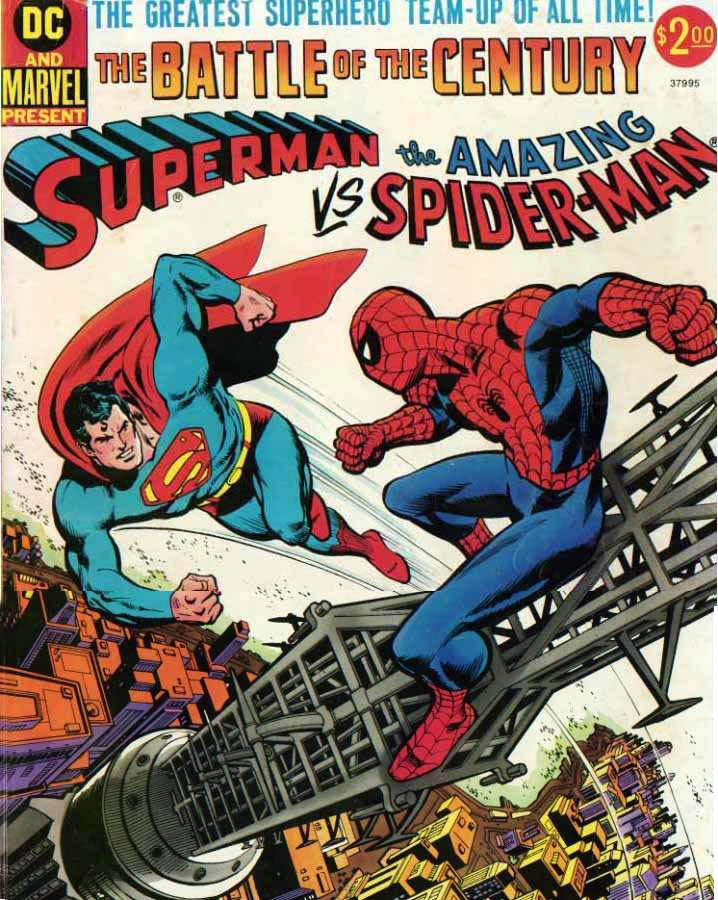
Before the sixties, comics stories only rarely referenced each other, but with a new breed of comic came a new breed of comics fan interested in seeing how disparate elements in the universe connected. While Marvel developed their own, at first tightly-knit continuity, DC experimented with alternate realities across which their adventures took place. In the seventies, when comics' direct market took shape, the shared universe concepts especially took root as did a more fan-centric atmosphere. This was the age of the Omniverse fanzine and the Superman Vs. The Amazing Spider-Man tabloid-size crossover. The crossovers between companies stopped in the eighties, with companies finding value in having their own characters all team-up in line-wide events that haven't stopped to this day. In Crisis on Infinite Earths DC sought to do away with their Multiverse concept in favor of a streamlined, more "realistic" lineup, but only created more problems that would plague them for decades.

26.5.11

Storm Warning 7: Shadowstorm Was a Wuss, Dude (Blackest Night/Brightest Day)

Are we all here? I'm sure you were all beginning to worry...

Welcome back, my friends, to the show that never ends. I know it's been a long time since the previous installment of this series, but sometimes, that's the way things go. I always intended to come back at the conclusion of Brightest Day and summarize my thoughts on the most recent iteration of everyone's favorite nuclear hero. In the previous segment, I took you through the death of Ronald Raymond, the introduction of Jason Rusch, and the return of Professor Martin Stein to a prominent role in the Firestorm matrix. This time out, we're picking up Firestorm's activities in two fixed-length series, Blackest Night (2009's runaway hit "event" series by DC) and its direct continuation, Brightest Day (which just finished a few weeks ago).

Black Lantern Firestorm. Original design by Ethan Van Sciver.

It's worth noting early on that Geoff Johns is a master of DC Comics' long and varied history. He began his career as production assistant to Richard Donner (yes, that Superman director-guy) and soon started writing for DC on books like Stars and S.T.R.I.P.E. and JSA. After briefly sojourning down the street at Marvel, he returned to DC where he's been ever since, having written Flash (both Wally West, in the wake of longtime scribe Mark Waid), Green Lantern, Teen Titans, and several "event" series like Infinite Crisis, 52, and the two series I'm about to discuss here. And, back in 2003, he pitched a Firestorm revival that interestingly fused Ron Raymond with his "brainy ex-girlfriend," a take that was tabled in favor of Mike Carey and Lewis LaRosa's version (which I touched upon a few episodes ago). Perhaps that version was a conscious or unconscious inspiration for the latter-day merging of Jason Rusch and Gehenna that opened Blackest Night.

The crossover that set in motion everything about Firestorm that continues to date is to a vast degree a Green Lantern story that spilled over to the rest of the DC Universe. Everyone who's familiar with DC lore knows the Lanterns' oath: "In brightest day, in blackest night..." and Johns parlayed the oath into a prophecy of sorts. Not only that, he took the previously-established Star Sapphires and Yellow Lanterns and wrapped them with the Green Lanterns into a color spectrum of powered beings. In the lead-up to Blackest Night Johns introduced the other corps to both explode the Green Lantern brand and set the stage for the massive storyline to come. You don't need to know the gory details for the purposes of this article. Just know that an old Green Lantern enemy, Nekron, captured the Anti-Monitor (the big bad from 1985's Crisis on Infinite Earths) and used him to establish a beachhead of power in this reality in the form of a Black Lantern whose rings infected dead bodies and reanimated them, using their memories to draw in the living and generate more power. When the rings and lantern were sufficiently powered, Nekron would again rise. Easy peasy?

Firestorm, surrounded by his oldest foes all as Black Lanterns.

For the components of Firestorm--Jason Rusch, Gehenna Hewitt and Martin Stein--the return of the dead obviously spelled the return of Ron Raymond. Meeting at Ron's grave in Pittsburgh, they discussed Ron while the rain fell and plants mysteriously died. The rings came later in the first issue, and with them, Ron came back as a Black Lantern Firestorm. In the next issue, he appeared in a Black Lantern version of the Justice League who battled Green Lantern Hal Jordan and the Flash (Barry Allen). The third issue (which features a stunning Firestorm-centric variant cover by Ethan Van Sciver) would easily be the most essential to Firestorm fans for its momentous events. Jason and Gehenna quarreled over her thoughts on starting a family, which Jason "overheard" while they were merged as Firestorm. Jason thought they were too young to be having such ideas, and Gehenna countered by suggesting they no longer be Firestorm anymore. (Be careful what you wish for, Gen.)

Summoned by an emergency signal at the Justice League's Washington, DC headquarters, Jason and Gehenna arrived as Firestorm and talked with Mera, Aquaman's wife, about the emerging chaos. Green Lantern, Flash, Atom and a group of Indigo Lanterns arrived and compared notes about the Black Lanterns before the BL League arrived. Then, BL Firestorm fissioned his counterpart, removing Jason and Gehenna. He merged with Jason, who watched in horror as "Ron" turned his girlfriend to salt, killing her. The strength of his emotions for Gehenna powered the lantern considerably.

In the fourth issue, Jason gained control over BL Firestorm to warn Flash to evacuate the Earth, but soon "Ron" reasserted himself. Jason remained trapped within BL Firestorm for virtually the rest of the story, through the return of Nekron, the introduction of a "rainbow corps" of Lanterns and the White Lantern Entity, and the revelation that life in the DC Universe originated on Earth. Finally, the heroes formed a "White Lantern Corps" and defeated Nekron by using the rings to resurrect a number of characters, from Nekron's herald Black Hand, to the Anti-Monitor, to several heroes and villains including Firestorm, now comprised of Ron Raymond and Jason Rusch.

Firestorm and the Atom, together! Art by Ivan Reis, from Brightest Day #2.

The new status quo of all the resurrected characters became the thrust of the next series, the 24-issue Brightest Day. Was there a method to the White Lantern's madness? Who, if any of those resurrected, would become the Guardian of Life? Would the heroes and villains permanently be returned to life, or was it a temporary situation? As in Blackest Night, there's much more to this story than just Firestorm's involvement, but I'll only discuss the portions germane to our guy(s).

Brightest Day began for Firestorm with the wake of Gehenna Hewitt, attended by Professor Stein, Ray Palmer (the Atom), Jason Rusch, and members of Jason's family. Ron didn't attend the funeral, missing appointments to file paperwork with the Justice League to renew his legal status in favor of partying with friends at Pittsburgh University. He also no longer remembered anything that happened after his death at the hands of the Shadow Thief (which meant he didn't remember meeting Jason). Arriving at the wake, Ron talked with Jason but a shouting match erupted, resulting in merging into Firestorm--a Firestorm who could not fission!

At Pittsburgh University, Professors Stein and Palmer met to diagnose the problem, and Palmer reduced in size to infiltrate the matrix and discover the source of Firestorm's new instability. He caused an explosion that successfully fissioned them, and Ron and Jason awoke in the hospital, where Stein made it imperative that they remain separate. Ron, who actually did remember some of what had happened when the Black Lantern possessed him, found himself haunted by a salt effigy of Gehenna. Similarly, a disembodied voice nagged at Jason before a crane nearby turned into bubble gum, prompting a disaster that caused him to again become Firestorm. With a hungover Ron in control, the hero vomited a black ichor on someone he saved from the disaster. Ron apologized to Jason and admits he remembered when BL Firestorm killed Gehenna, even as they reached the conclusion something else was in the matrix with them.

Firestorm learns his final (?) fate. Cover to Brightest Day #10.

Ron and Jason went to the Professor, then, who ominously hinted at a "third and final stage of Firestorm." Before he could elaborate, the White Lantern entity showed them its wisdom: "You need to study," it told Ronald, while it told Jason "You need to get your head out of the books." It told them they needed to learn from each other so they could stop "him"--the mysterious third being in the matrix. During a series of tests back at Pittsburgh University, Professor Stein put forth his theory that the Jason/Ron merger made Firestorm more powerful, but also more unstable. In a bit of retroactive continuity, Stein told Firestorm that his original experiments aimed at finding the spark that led to the Big Bang, and that's what Firestorm is: the universe's cosmic reset button. And the more agitated Ron and Jason become, the more likely the Big Bang would again occur, This is all the third entity needs to know to break free, fissioning Firestorm and rendering the Professor unconscious before standing revealed as the Black Lantern Firestorm, henceforth called Deathstorm.

Deathstorm wasted no time in drawing Professor Stein into itself along with Jason's father Alvin before finding its way, Firestorm in tow, to Star City and the White Lantern. It infected the lantern to be able to lift it so that it might bring it to its new master, who also said that Deathstorm must bring him/it an army and stop the Entity's replacement from being chosen. To that end, the creature recreated Black Lantern duplicates of all those the Entity resurrected, and left. Firestorm traveled to the JLA Watchtower in hopes that scientists Dr. Mid-Nite and Atom might help stabilize the matrix, while Deathstorm toys with Stein and Alvin Rusch, tempting them to kill themselves in hopes his threat would perish. Anger got the better of Jason and Ron, however, causing an explosion that left them as Firestorm in an apparent black void. Did they end the universe?

Ah! That classic logo! A terrific cover for Brightest Day #16.

Not so fast! Shedding some proverbial light on the subject, Ron found they were amid a swarm of Shadow Demons, which meant they did not end the universe, but instead had been transported to another one: the Anti-Matter Universe, home of the Anti-Monitor and the Weaponers of Qward. After briefly intervening in a battle between some Green Lanterns, Sinestro and the Weaponers, Firestorm finally found Deathstorm, the Black Lantern Corps, and their master...the Anti-Monitor.

Now, everything to this point in Brightest Day was a prologue. We had solid character development and an interesting throughline that proved Firestorm was among the most important characters in the series, but in issue #22, he finally took the spotlight in an epic battle with the Anti-Monitor. It's a true masterpiece in virtually every sense of the word and one that all Firestorm fans should read. Ron and Jason finally work together to save all life--as well as their "fathers"--from the clutches of ultimate evil and death. Unfortunately, while Firestorm was able to save the White Lantern and destroy the Black Lanterns, he was not able to save Martin Stein, who sacrificed himself to save Ron and Jason from Deathstorm's transmuting power. Turned into salt the same as Gehenna, he bequeathed his final wishes to the two men, "knowing" that Jason would be a better partner to Ron than he was. His life now returned, Firestorm found himself transported to the Star City forest, where Deadman demanded the Lantern, and the Lantern wished to be given to him.

Gary Frank illustrates the final battle between Firestorm & Anti-Monitor.

The final two issues really have very little to do with Firestorm, his story all but fulfilled in the previous story. All of the resurrected united at the Star City forest, where Deadman told them they were there to combat the "dark avatar," in actuality the Swamp Thing, the former Earth elemental whose body was possessed by the power of the Black Lantern. The five key heroes--Firestorm, Aquaman, Hawkman, Hawkgirl, and the Martian Manhunter--all transformed into elementals to form a last line of defense until the Entity's replacement could assume his role. Under a tree in that forest was--miraculously--the body of Alec Holland, the man whose consciousness had been imprinted upon the Green to become the original Swamp Thing. Now, Holland literally became the Swamp Thing and combined with the elementals to banish the dark avatar. At the end of the battle, most of the elementals returned to their normal forms and went their separate ways.

Ominously, as the main Brightest Day saga ended, a new era dawned for Ron and Jason. Upon examining some tests designed by the Professor, Jason found that the Anti-Monitor's blasts had caused a change in the Firestorm matrix, beginning a countdown to the detonation they all feared. That's where we leave our heroes until their next appearance.

The new merger, as previously glimpsed in Firestorm #9-13, was similar to the Jason/Professor merger of Stuart Moore's run in that it combined elements of both the "new era" (Jason) with the "classic era" (Ron) in hopes of pulling both new and old fans along--a smart move. This time, however, Firestorm returned to being about the "dumb jock" fused with the "intellectual" that fell in line with the original Conway/Milgrom iteration, getting away from the "dual intellectual" bit of Moore/Igle vintage. Only this time, due to popular demand, DC forsook one type of comic book minority (the fifty or sixty-something Stein) for another (the black Jason). They even went so far as to kill Martin Stein--my favorite character in the mythos--and with his parting words Geoff Johns and Brightest Day co-writer Peter J. Tomasi hit fans over the head with how much better a partner Jason would be than he was. It was one powerful line of dialogue for its sheer wrongheadedness, a moment where it felt less like the character saying the words and more like the writers forcing them in.

Deathstorm! Cover by David Finch.

Instead of getting a "voice of experience" in the dynamic, we now have two guys who are similar enough in age whose key differences are in intelligence and skin color. (Is anyone other than Kurt Busiek really going to call Ron Raymond "experienced"?) In selecting a Jason/Ron merger, Johns and Tomasi established a racial dynamic--or, at the very least, a stereotypical one where Jason functioned as the "angry black man" and Ron as a similarly intolerant white man who found themselves at odds, sharing the body and power of Firestorm. (It's not the first time such a dynamic has been used--anyone remember that Blaxploitation film, "The Thing With Two Heads"?) The point was even made explicit by Deathstorm in one of his early non-appearances.

I do enjoy the dramatic tension of having Ron and Jason at odds, and I do want it sticking around, but it goes without saying I want the racial undercurrent to be curtailed. The light antagonism is a plot point that didn't gain much traction in previous Firestorm series, with perhaps its strongest showings in John Ostrander's first issues (wherein Ron and the Professor were at odds over the ban on superheroes during the Legends crossover) and early in Dan Jolley's tenure, where Jason got to pick his partners in the matrix.

In some ways, the infighting between Ron and Jason highlights a key distinction and an evolution in Firestorm that I'd love to explore in deeper detail. Subtextually, the original relationship between Martin Stein and Ron Raymond was always depicted as one between a father and son, with Martin as the father that Ed Raymond couldn't be. Johns and Tomasi made that relationship explicit with Stein's death, while the entire Brightest Day arc functioned to establish a different dynamic between Ron and Jason Rusch. Since the Professor mentored them both, one can easily read the characters' antagonism and their very relationship as being between brothers--moreover, brothers who have experienced the loss of their "father." An intriguing shift, to be sure, and one that I hope DC will investigate in issues to come.

Deathstorm, Deathstorm, Deathstorm. More by Ivan Reis.

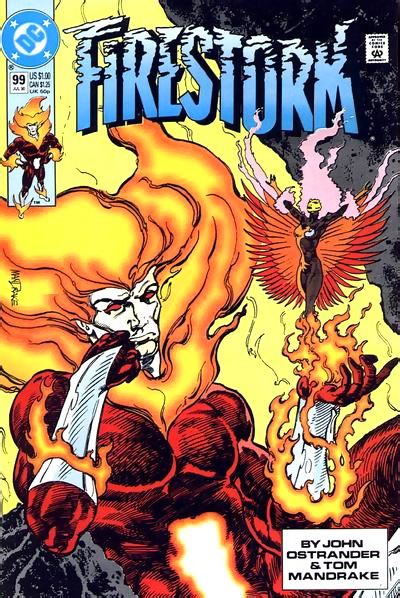
As far as villains go, Deathstorm seems like another "dark mirror" character in a long line, which is interesting since Firestorm already had one in Shadowstorm. It's true, he's all but forgotten--didn't he die in Captain Atom?--but since when did that ever stop a character from returning? While Shadowstorm was often too straight-faced, too stoic, too eeeeeeevil, Deathstorm was too often off in the other direction, with his deliberately horrible "surfer dude" dialect. I hear he'll be back, but I'm not so sure I like that prospect.

So, where are we heading from here? I keep hearing September will be rife with new first issues and it's obviously when the new Aquaman (by Geoff Johns & Ivan Reis) and Hawkman (by James Robinson & Rags Morales) series will debut. However, DC's made definite plans for Firestorm as well, and I wonder if we won't see a brand-new Firestorm #1 in September as well. At the very least, we should soon see him in a book like Justice League of America or somewhere his new, post-Brightest Day status quo can be explored. Who could be writing the book, if Firestorm returns to a solo series? I don't know, but you can bet that you'll see an interview with the new guy (or girl) either here, courtesy me, or at FirestormFan.com, courtesy Shag, that site's owner. I'm feeling good about this.

~G.

7.4.11

Quick Reviews: Age of X, Brightest Day, Fear Itself, Herc, Skaar

Howdy, heroes!

I'm going to be adding some features in weeks to come and this is one of them. Some of you wonder what I read outside of the adventures of the Hulk and Spider-Man. You'll also be seeing some special indie features (one's coming very soon--sorry about the delay!). If you have any suggestions, or if you're a creator looking to get your own project out there, contact me at delusionalhonesty [at] gmail [dot] com & give me some lead time. I'd be happy to take a look!

Meantime, let's start with one of last week's holdouts and continue on to some of this week's highlights. Fair warning: some of my reviews may contain SPOILERS, so read with care. My reviews will be summed up with four main classifications you can easily make sense of: Buy It (highly recommended), Read It (recommended), Skip It (unless it's a light week...), Burn It (a very special kind of hell).


Age of X Universe #1 (of 2) - Marvel Comics, $3.99
By Si Spurrier, Khoi Pham, Tom Palmer & Sonia Oback

Back during the "Age of Apocalypse" storyline, there was a two-issue limited series, X Universe, that explored the lives of the human superheroes amid the background of the greater AoA arc. Of course, with the current Age of X arc conjuring memories of that epic storyline, why wouldn't Marvel try to echo that success with a story of a team of Avengers in this alternate reality? I'm not following Age of X, only this two-part series, so I can't speak for the quality of the remainder of the event. Si Spurrier offers up a script where the Avengers are government hunters of mutants under the direction of the man who is our Marvel Universe's Punisher.

The characters in the story overwhelmingly reminded me of the Millar/Hitch "Ultimates," with a few changes in the lineup. The story makes it clear these aren't people who are comfortable working together. It's interesting if unnerving to see Captain America taking orders instead of giving them. The rest of the team is twisted in different ways, with the most jarring changes to the Hulk and Iron Man. We're supposed to bring the mainstream Marvel Universe's characterizations to the table as comparison here, but for me the whole picture never gels. I'm anxious to see if the next issue resolves or compounds my worries. This story may work well in the Age of X scheme, but by itself I'm unimpressed.

The Verdict: Skip It.


Brightest Day #23 (of 24) - DC Comics, $2.99
By Geoff Johns, Peter Tomasi, Ivan Reis & Joe Prado

Over the last year since Blackest Night ended and Brightest Day began, there have been hints that the major players were all symbols of elemental concepts DC has flirted with since the mid-1980s and the heyday of Alan Moore's Swamp Thing. How fitting is it, then, that in the same issue where Johns and Tomasi bring the elemental undercurrent to the surface, they also return DC's original elemental--although in a very strange role? When you read the previous 22 issues altogether, you realize the elemental context was there all along, and to their credit, the creators bring the disparate elements together here in time for the big finale in two weeks' time. I am anxious to see the future plans for the elementals assembled in this issue, but don't exactly think a Primal Force revival is in the cards. However, with so many other characters having been embroiled in the main Brightest Day series (Hawk, Dove especially), I do wonder about their roles henceforth.

With Johns' and Tomasi's script hitting its stride and bringing out all the elements that have been thoroughly seeded throughout all of the previous issues, I'm happy to say that artists Ivan Reis and Joe Prado have brought their artistic "A"-game to this issue. The elemental designs of the five main characters are well-done. Although I certainly wish to see them all restored to their previous looks in this saga, there's a definite purpose to the heroes all looking as they do. Their villain, the Black Lantern avatar, is also appropriately horrifying.

This issue continues to tie up all the loose ends of the main storyline while clearly ramping up to the next major status quo, with an Aquaman series already announced and, unless I miss my guess, a Swamp Thing series also in the cards. Based on the last page of this issue, however, I'm a bit puzzled how DC plans to integrate the character's Moore-renovated origin. Alas, time will tell.

The Verdict: Buy It!


Fear Itself #1 (of 7) - Marvel Comics, $3.99
By Matt Fraction, Stuart Immonen & Laura Martin

Marvel's annual major event has begun, or rather, their annual line-wide crossover events have returned, as last year they divided their efforts in several "mini-events" of varying success. They've brought their current darling writer Matt Fraction (Invincible Iron Man, Thor, Casanova) together with terrific art talent Stuart Immonen (Ultimate Spider-Man, Nextwave, New Avengers) and one of the best colorists in the business, Laura Martin (Astonishing X-Men, New Avengers). They've created an incredible amount of incentive variant covers (including my favorite, by Paolo Rivera, above). The story ostensibly concerns a blending of recent plot elements from Fraction's Thor and Ed Brubaker's Captain America, heralding the arrival of the heretofore-unseen Norse God of Fear and the transformation of the Red Skull's daughter into its avatar, Skadi, possessed of a mystical hammer akin to Thor's. And the heroes of Earth tremble.

Fear Itself is obviously set to mainly appeal to Captain America and Thor fans, and the reasons are obvious: after all, movies featuring both characters hit movie screens this summer. So far, Thor and Steve Rogers are the key focus, with the centerpiece being a formulaic father-son smiting between Odin and Thor that's really been done many, many times before and more tactfully. It's all set-up, this first issue, establishing the relationships between the primary protagonists and antagonists. It's well done enough, and very well-illustrated by Immonen and Martin, but set-up it remains.

I'm anxious to see what occurs next month with the arrival of "The Worthy," don't get me wrong. (And yes, according to previews, one of those Worthy is one of my favorite characters, so I'll be watching with a very, very critical eye.) Right now, it's just another ramp-up to another major storyline that we've seen a million times before. And if you like that kind of thing, well, here's another one. The story still has plenty of room to improve in future issues, and knowing how terrific many of Fraction's stories have been in the past (I'm looking at you, Invincible Iron Man: World's Most Wanted) I'm definitely hopeful. You can bet I'll be watching this one as it develops, and bringing the latest to you.

The Verdict: Read It.


Herc #1 - Marvel Comics, $3.99
By Greg Pak, Fred Van Lente, Neil Edwards, Scott Hanna & Jesus Aburtov

Hercules has certainly had an interesting year thus far, between the epic five-part miniseries Chaos War which stripped him of his godlike powers in his and the other Marvel heroes' clash with the Chaos King, and his guest appearances in the storyline's aftermath in The Incredible Hulks. Greg Pak and Fred Van Lente have chosen to return to Hercules in this new regular series, this time without his partner from the previous series, Amadeus Cho. This time out, Hercules must rely on his wits and an arsenal of unusual weapons to combat evil on the streets of New York City.

I was prepared for something different than what Pak and Van Lente offered in the previous series, but I'm not sure if I ever imagined something like this. The overt comedic tone that made the original Incredible Hercules series so endearing is largely absent, replaced by a grittiness that represents an incredible shift in tone I'm not sure I enjoy yet. Certainly the creators make it clear that Herc is a very different series than its predecessor, setting up the status quo in this issue, with Hercules adjusting to life being powerless, and getting a new job along the way. Now in a lower strength tier, Hercules fights similarly lesser-powered enemies, with the one at this story's end an interesting first pick.

Despite my reservations about the story, I have no such reservations about Neil Edwards' terrific artwork. The entire book is lushly rendered, from Edwards' pencils, to Hanna's inks, on through to newcomer Jesus Aburtov's colors. The entire package is capped off with a well-deserved "Hercules Saga" feature, which encapsulates Herc's history in eight pages. Time will tell if Pak and Van Lente can catch lightning in a bottle twice, but I'm willing to stay aboard for a while longer.

The Verdict: Read It.


Skaar: King of the Savage Land #1 (of 5) - Marvel Comics, $2.99
By Rob Williams, Brian Ching, Rick Ketcham & Guru-eFX

In the wake of "Planet Savage," the recent Incredible Hulks arc set in the Savage Land, the Hulk's savage son has remained among Ka-Zar, Shanna, and the other inhabitants of Marvel's Antarctic jungle, and now stars in his own miniseries by Marvel newcomers Rob Williams (Cla$$war, Shadowland: Ghost Rider) and Brian Ching (Incredible Hulks: Dark Son). The story appears poised to investigate the origins of the Savage Land, with Skaar encountering at least one Marvel mainstay from the 1970s.

The storyline follows a few tracks, one of which includes Skaar in his exploration of his new home, another which centers on Ka-Zar's quarrel with the Savage Land's Council of Tribes, and yet another about a strange force with knowledge of the area's origins. Conspicuously absent from the storyline are all of the Warbound, who were left with Skaar at the end of last week's Incredible Hulks #625. Williams has a good feel for action and introduces all the characters well, providing some interesting moments between Skaar and Shanna (who didn't appear in "Planet Savage").  The set pieces, including Skaar's quarrels with two dinosaurs, are terrifically designed and pulled off with flourish by Brian Ching, whose work here is brighter and freer than in "Dark Son."

While the story has many of the right elements for a story set in the Savage Land, I'm still not altogether sold on Skaar by Williams. Conceptually he has a firm handle on Skaar as a young character who, due to his strength and upbringing on Sakaar, often charges into situations he doesn't fully understand. However, much of Skaar's dialogue doesn't seem to fit, with only occasional snark that seemed to flow so easily under his creator, Greg Pak. But that's really a small gripe in an overall very solid debut issue, and I look forward to the next issue's imbroglio.

The Verdict: Buy It!

~G.

2.2.11

Storm Warning 3: Just When I Thought I Was Out...


So, I was out.

Oh, not out of comics, mind you--my habit has remained firmly in place, more or less, since 1982--but rather, 1989 through 1992 really are my "Marvel Zombie" years. Aside from my first real dipping in the "indie" comic pool with NOW Comics' Fright Night (adapting the film of the same name, following the two leads after), these years were filled with nothing but Marvel books. On the plus side, I learned to really pay attention to the credits in the interim, largely due to the artistry of Todd McFarlane and the hubbub surrounding his leaving Amazing Spider-Man for a Spidey book all his own in 1990. It wouldn't be until late 1992 when I came back to the DC fold. You all know the event, I'm sure: the death of Superman!

However, Firestorm was noticeably absent from the big funeral scenes. Why?

Not important, not important. But instead of following up, I read more Superman. And then some of Batman. And Green Lantern. And The Flash. And The Spectre (which I very much want to address in a future blog). Like it or don't, the big speculator boom of the early 1990s, together with DC's event-oriented storytelling, made me a DC fan for real--moreso than the countless Millennium tie-ins did a few years before. (Curiously, their over-reliance on events I don't really care about is making me drop book after book I used to enjoy nowadays. How's that for irony?)

But yes, this blog is about Firestorm--at least it is today--and that means I eventually found my way back to ol' 'Stormy. I'm not really sure, but I think I came back in the fold in late 1994. At the time, I was buying comics out in Boardman, Ohio, at Rainbow Comics & Cards. (Another place I'm not sure is even there anymore.) I remember buying the Advance Comics catalog--one of Previews' competitors, I'm sure--and one month the DC previews showed Extreme Justice #4, one of the Justice League of America spin-offs from those days. And Firestorm was back.

So the next few months--from the announcement of the book for pre-orders, on through the appearance of the actual book--were a firestorm (pun intended) of activity from me. (To this point, I'd only bought four back issues of Firestorm: the first issue from '78, the first issue from '82, and issues 51 and 52 because Firestorm fought some giant reptilian monster in them. Ironically, the latter informed my knowledge of Eddie Slick, the Sand Demon from my last entry.) I don't quite remember the order in which I assembled the majority of my Firestorm collection, but it occurs to me I started by picking up the remainder of John Ostrander's run; in fact, I remember buying back issues at New Dimension Comics in Cranberry Township. Specifically, I picked up the Svarozhich arc from #82-85 early on, as well as the finale, the triple-sized #100. I'd buy most of the rest at that same shop, with an excursion to Eide's Entertainment in downtown Pittsburgh to fill in the final gaps. As I remember buying those earliest, I'll review the end run before tracing everything back to the original Gerry Conway run in my fourth entry.

During the Invasion! crossover, one of the alien Dominators detonated a Gene Bomb, isolated from the human metagene, whose catastrophic effects were felt by every super-powered human on Earth. In Firestorm's case, his nuclear powers blazed out of control and resulted in many deaths before the Gene Bomb's effects were negated. Traumatized, Firestorm then refused to come out, and any attempt by Ron or Mikhail to initiate the merger would cause both of them intense pain. This unfortunate event was shown in #82, when in trying to save Lorraine "Firehawk" Reilly from the second Killer Frost, Ron ended up having to save her himself.

There would be no time to rest, however, as during the time Firestorm spent in Russia, Red Shadows, a branch of the K.G.B., secured a sample of the hero's DNA and used it to create a clone, codenamed Svarozhich ("destructive fire"). Devoid of humanity, the entity cut a swath of destruction until Serafina was able to talk to Firestorm and stay merged long enough to deal with it. However, Svarozhich turned the tables and made Ron and Mikhail fission, in so doing allowing the duo to meet for the first time, face-to-face on the streets of Russia. He also said he now possessed the "Soul of Fire." Hmm...

Unfortunately for them, Ron and Mikhail couldn't understand each other outside the Matrix (Mikhail only spoke Russian), so they had to rely on Serafina as a psychic interpreter. Upon meeting Gregori Eilovotich Rasputin ("perhaps" the Mad Monk of Russian legend; actually a substitute for John Constantine), the final pieces of who and more importantly what Firestorm was finally came together. In "Soul of Fire," Ostrander framed the improbability of Ron and Martin having survived a nuclear explosion and become Firestorm in the same vein as Alan Moore framed Alec Holland's absurd resurrection as Swamp Thing five years earlier in Saga of Swamp Thing #21's "The Anatomy Lesson." Without directly aping, he established that Firestorm's origin was truly the advent of a new Fire Elemental, as Swamp Thing's was the introduction of an Earth Elemental. The Matrix enveloped Ron Raymond, but it was Martin Stein who was the intended recipient of the elemental force! This was about the time where today I would say, "Mind=blown." How much sense it made to have Stein's mind as the template for the "new" Firestorm of issues #65 onward!

Firestorm #85 marks the maturation of the core concept of the character in a genre that is largely resistant to change, so I'm not altogether surprised when "purists" of the character condemn this period in the character's history. However, for something that according to Ostrander wasn't planned at the time of the "new" Firestorm's introduction twenty issues before, the new status quo of Firestorm as Fire Elemental fit like a glove. Along the way we did lose another key conceit of the original series in that, to create the new Elemental, Ron and Mikhail had to give up their individual identities and be entirely subsumed in Firestorm's new persona. It wouldn't be until the finale in #100 that we saw Ron or Mikhail again.


Over the next dozen-plus issues, the new Firestorm, in a totally new and altogether unrecognizable design by artists Tom Grindberg and Tom Mandrake, would find himself wrapped up in environmental issues, vacillating between his care for humanity and his elemental natures that would see the Earth wiped clean from pollutants (and evil corporations like Sunderland, in another echo of Moore's Swamp Thing). This conflict exploded in the "Elemental War" storyline, where just as Firestorm decided he was "humanity's friend," environmental activist Mai Miyazaki became Naiad, a new Water Elemental who teamed with the Air Elemental, Red Tornado, against humanity. To end the conflict, Firestorm allied himself with the Swamp Thing. This arc, in issues #90-93, was a visually arresting tour de force which was done a disservice on newsprint. I'd really like to see this arc--and much of Firestorm, to be honest--in a deluxe format. Someday, someway!

After an story (#94) in which Lorraine Reilly told Martin Stein of his connection with Firestorm (who saved the day, "Lassie"-style, when Martin found himself under fire from the Killer Frost), Firestorm journeyed back to East Africa, where Swamp Thing had previously revealed that his actions in #77-79 had made a hell out of paradise. He encountered Shango and other representatives from the Orishas, the African pantheon of gods, and became embroiled in their conflict against the Orish-Nla, their shadowy opposites. Although the conflict was resolved successfully, out of that war, those shadows gave birth to Shadowstorm, a negative-image opposite to Firestorm who unfortunately wouldn't have anything resembling a "final battle" with his progenitor. (I've heard stories that John Ostrander planned for the two to battle after #100, but after the book's cancellation, a version of the storyline instead saw print as the "Quantum Quest" in Captain Atom #54-57. The story also guest-starred Rasputin educating Atom about his place as another kind of elemental. The story--which I won't review here--could have been so, so much better with Firestorm than it was without. Especially with Mandrake on art duties.)

Did you think that the final metamorphosis of Firestorm was passed? Au contraire, mon frere!

The ramp-up to the final, hundredth issue actually has its roots two years hence in issue #76, the last battle between Firestorm and Brimstone, the gigantic creature who was first seen in the Ostrander-plotted Legends miniseries (that led to his getting the Firestorm gig in the first place, natch). The techno-seed that contained Brimstone's essence found its way into Earth's sun, and the creature was reborn in the most catastrophic place possible. Maser, a superhuman working for the Institute for Metahuman Studies in Pittsburgh, discovered Brimstone alive in the sun, and the duty fell to Martin Stein to find a solution. The problem with just sending Firestorm to the sun was that, issues prior, Firestorm tried to exit Earth's atmosphere and nearly died, finding that as one of the planet's elementals, his life force was tied to it. (Presumably as the "nuclear man" iteration of older times, he wasn't quite so tied to the planet, which explained his off-Earth excursions with the Justice League, especially Crisis on Infinite Earths. Can anyone else come up with a better explanation?)

Martin's plan tied into the fact that, as established in "Soul of Fire," he was to have been the original host to the Fire Elemental. In his words: "I propose we use one of these craft, equip it with oxygen tanks...and a quantity of explosives. Firehawk and Firestorm then supply sufficient thrust to put it--and me--into orbit. We detonate the explosive, ending my and Firestorm's lives...and hopefully, re-creating us both into a new Firestorm...who is then free to journey to the sun. In theory, anyway." Before Firestorm "died," however, he released his component halves, powerless, and they reunited with their families. Svarozhich then helped Martin complete the plan. The theory worked; not only did Svarozhich, possessed of the Fire Elemental, perish as it broke Earth's atmosphere and Martin become the new Firestorm, but Martin-as-Firestorm regained all his lost memories. This new Firestorm then defeated Brimstone, but found himself sucked into a singularity and into a "new universe" where he could not find a way home. He thanked the Earth-mother, Maya, for the experience and went off to parts unknown while Ron Raymond explored a new life with Lorraine, and Mikhail reunited with his wife Nina. One thing was sure: although he was nowhere near, they were sure Firestorm still lived!

I may have made a tiny tactical error in reading Firestorm #100 before issues #86-99, but that doesn't diminish my opinion of the final issue. The issue in many ways brought the saga of Firestorm full circle, summing up everything the character had come to mean since his introduction and tying up the plot thread that had been the through-line of Ostrander's entire tenure, summed up by Lorraine in the final story: "Funny, here they spend all kinds of money trying to determine if powers make one a hero. And the definitive answer [Martin Stein] is walking around on two feet...and most people never noticed him." Although for the longest time, Ron Raymond was the focus of the Firestorm series because his personality was ascendant, Martin was no less a hero, and with this issue he had his chance to prove just that. Interestingly, as the early Conway period would prove to be about the maturation of Ron Raymond, the Ostrander run framed the entire series as the maturation of the Firestorm entity, culminating in the eradication of the original dual-personality Firestorm and the coronation of Martin Stein as the "one, true" Firestorm. Not until the final issue was Ostrander done with his changes, which definitively established the Conway years as the character's larval stage, and the vast majority of his own tenure, kickstarted by the arc in #62-65, as his puberty. In "Soul of Fire," the "new" Firestorm may look different--certainly more like an adult as opposed to the garish costume seen before--but he wasn't fully mature until Martin took control. Even now, I'm awed at how well the whole story fits together, with organic change built upon organic change. Even if you don't like the finished product of Martin-as-Firestorm, you have to admire the method by which Ostrander slowly yet drastically changed the character.

As you can tell, the Ostrander run of Firestorm is one of my favorite comic eras of all time, and the letter columns in those last few dozen issues are filled with the opinions of the foremost letterhacks of the period, such as Jan C. Childress, "Uncle" Elvis Orten, T.M. Maple, and Charles J. Sperling, whose deep opinions speak to the high quality of the creators' efforts. It's entirely fitting that Ostrander's lasting legacy with the Firestorm character, for better or for worse, is the introduction of the Matrix. It has been used in nearly every Firestorm story or pitch that has been put forth since 1990, by subsequent writers like Joe Kelly, Mike Carey, Dan Jolley, Stuart Moore, and current Firestorm co-writer in Brightest Day, Geoff Johns. That alone speaks to the durability of Ostrander's concepts.

Next: Back to the beginning with Gerry Conway and friends.

~G.

25.1.11

Storm Warning 2: The Only Constant Is Change!

The Greek philosopher Heraclitus gave this article its title, and it couldn't be more appropriate for this era of Firestorm, the Nuclear Man. I mentioned in the last segment how I came on board this title at a fortuitous time, the last half-dozen issues of the "old" status quo of two men, Ron Raymond and Martin Stein, combining to form the titular hero. From issue #65 until the series finale in #100, through the character's other incarnations in JLA and the third Firestorm series, straight on through to Brightest Day, the focus has been sharply removed from the men and centered on the idea of the "Firestorm Matrix"--but I'm getting very sharply ahead of myself.


Regardless of the corner box, this issue was drawn by underappreciated DC and Marvel '70s artist Ross Andru. This issue was released in that period before I really paid attention to creator credits, but Andru's art stands as unique amid the capable-and-not-much-more efforts of Joe Brozowski. It also jump-started the new era of Firestorm quite ably, and John Ostrander's skilled script put forth a mystery, front-and-center: who is the new Firestorm? As result of last issue's climactic finale,Ron had initiated the fusion into Firestorm with Mikhail Denisovitch Arkadin, a Russian whose active metagene (DC's analogue to Marvel's mutants) made him something like a Human Torch. Martin, suffering from a brain tumor and apparently near death, could be somewhere in the new configuration, or he might be dead. The twists didn't stop there, as upon fusion, both Ron and Mikhail were "stuck" in Firestorm's head--and Firestorm himself didn't seem to have any personality except for his own. He was an amnesiac, operating his powers instinctively. Was Firestorm asserting his own personality somehow? So many questions, so few answers.

Looking back, of course, the answer to the questions above becomes so apparent it's a wonder I didn't put two and two together immediately--then again, I was young so I can be excused. (Can't I?) Without getting completely in-depth in my reviews--I don't want to carry this bit on too long--I want to at least put forth how I felt about reading these books before I quit. (Say whaaaaaa?) I remember being interested in the plights of Ron Raymond and Mikhail Arkadin as they encountered threats from both the U.S. and Russia, as well as dealt with being thrown together as passengers in this new Firestorm entity. The character of Zastrow, the Russian who found Mikhail in the first place in #62, became of increasing importance as he unearthed another Russian superhuman, the mustachioed Stalnoivolk, to face the new Firestorm.

Meanwhile, Firestorm suffered through the Millennium crossover, and in my personal comics collecting career, I crossed over from the newsstand (The Book End at the Northern Lights Shopping Center in Baden, PA--now defunct!) to an actual comic shop (Bill & Walt's Hobby Shop at North Hills Village in Pittsburgh--still around today in some form, but no longer carrying comics!). I daresay it was the dawn of the golden age of comics of my youth.

One of the book's strengths was that Firestorm was getting to know himself just as we, the readers, were. It was also fascinating how the book had so suddenly captured a worldly flavor, with half its action taking place behind the Iron Curtain. (Remember, these books were released in 1988, when Communism hadn't yet fallen in Russia!) A particular source of fun was the Russians' attempt to discover what linked Ron with Firestorm in the U.S. even as the K.G.B. tried to find out what linked Firestorm with Mikhail. Along the way, readers met Mikhail's extended family, from his wife and children, to his brothers, to their children. Serafina Arkadin, Mikhail's niece, was leader of a team of Russian super-teens called Soyuz. They battled the alien Zuggernaut alongside Firestorm, and later, Serafina would help in unveiling perhaps the biggest piece of Ostrander's ongoing Firestorm mystery (later).

Through this range of issues, Joe Brozowski. the series' capable artist, was "replaced" by J.J. Birch, who had a style more reminiscent of mid-80s Keith Giffen. He brought us the story in which, thanks to a time-traveling former university professor calling himself the Flying Dutchman of Time, Firestorm's astral self was able to watch the entire development of all his component selves--a good way of catching the character up on his own history. A few issues later, once Joe Brozowski had "taken back" the artistic reins, editor Denny O'Neil revealed that Birch was really a pseudonym for Brozowski himself, who had wanted to try out a new style. Unsurprisingly, some parts of the new style carried through into Brozowski's post-Birch period, much for the better.

In issues #74-75, the latter of which would probably be a "big anniversary blowout" today, Firestorm came another step closer to fulfilling Ostrander's ultimate promise when he encountered a "sand demon" out in the Nevada desert. The story echoed Annual #5, where Firestorm made his last stand against the world's governments in that same desert. Since nobody had found what had become of Martin Stein to that point, and a great physical similarity existed between the Sand Demon and Stein, upon sight Ron believed the creature to be Stein! The truth was revealed over the second issue--that the Sand Demon was really Eddie Slick, a crooked wrestling promoter that Firestorm had previously encountered in Firestorm #51-52. Still, the mystery of Martin Stein's whereabouts were smartly not far from a resolution.

Since the first time Ed Raymond met the "new" Firestorm, he noticed a striking similarity in manner to Stein. Using his newspaperman instincts, he operated under the supposition that Stein had never died, and his research led him to a facility in Nevada where an older gentleman with amnesia was kept. After defeating the Sand Demon, Ron went with his father and stepmother to the facility where they found Martin, alive and well. The doctor on staff revealed more details--that every once in a while, Martin would lapse into a coma, later to awaken as if nothing happened. These episodes coincided, no doubt, with the Firestorm merger, with Stein's mind as the template for the new iteration. In fact, the next issue showed Martin subconsciously initiating the change when the villain Brimstone appeared at the facility. However, only Martin's mind was involved in the Firestorm Matrix at the time, and not his body, which would lead to further developments.

Also at this time, as consequence of there being a new Firestorm who only existed when Ron and Mikhail initiated the fusion, the new Nuclear Man questioned his existence. It was an intriguing bit of philosophy that Ostrander generated that would be a harbinger of the next major status quo shift (in the next eventual installment). Here was a character who couldn't even have a life outside his existence as Firestorm, who only lived to beat the bad guys! Right after the returns of Martin Stein and Brimstone, this plot point bore fruit in the "Eden" arc of #77-79. Ron accompanied his father to Africa, where he saw firsthand the hunger and desperation endured by the area's inhabitants. Determined to do something good, Ron and Mikhail initiate the merger, and Firestorm uses his abilities to transmute matter to make a paradise in the middle of the desolation. Soon, he finds that "no good deed goes unpunished," as cartels move to seize the paradise. Amid the fiery carnage, somehow Jama, one of the African men who has befriended Ron, finds himself merged into the Firestorm Matrix and a new, bestial Firestorm emerges with pieces of four men in the mix!

The status quo only lasted through #79, where Jama died, but the question arose how another could be brought into the Firestorm Matrix. Further, the question couldn't be avoided any longer: What exactly is Firestorm? How powerful can he truly be? What could happen of his newfound desire for independence, for a life? Unfortunately, I couldn't be bothered to stick around for the answers at this time. The Invasion! crossover hit the DC line the next month, and my supreme disinterest led to my promptly removing virtually every DC title from my pull list, a trend that wasn't reversed until the death of some guy named Superman in 1992. Interestingly, longtime Firestorm artist Joe Brozowski also took his leave with #79. It wouldn't be until quite a few years later that 'Stormy and I would again cross paths...

And that, my friends, is a tale for another entry of "Storm Warning," coming your way soon.

~G.

19.1.11

Storm Warning 1: Musings on My Favorite DC Hero

I really was going to start blogging today about my aborted attempt at joining the hallowed ranks of Marveldom from 2003; however, I've decided to forgo that particular discussion in favor of switching party lines from Marvel to DC. It strikes me that I haven't given enough love to other comic companies, so now begins the turnaround. (Just one of my many mini-resolutions I had for you, dear readers!)

Many of you may know my first exposure to comics came with the 1977-1982 CBS live-action TV show, "The Incredible Hulk," as well as the 1981-1986 cartoon, "Spider-Man and His Amazing Friends" and the accompanying "The Incredible Hulk" toon. However, I also remember watching "Super Powers" on ABC in the mid-eighties. I may have read one or two issues of DC Comics Presents or Green Lantern, and I had a few trial subscriptions to Batman and GL through 1985, but it wasn't until after my exposure to "Super Powers" that I really "got" DC. And the lion's share of the blame for my getting into DC was this guy right here:


That's right: "Super Powers" brought me in contact with Firestorm, the Nuclear Man! I remember enjoying the dynamic involved with the character, and upon later reflection, I don't think it's a coincidence I enjoy the character nearly as much as my favorite Marvel character, the Hulk. Both characters have a strong duality about them, with Dr. Robert Bruce Banner transforming in times of stress into the Hulk, while Ron (I refuse to call him "Ronnie") Raymond and Professor Martin Stein combine to form the heroic nuclear hero, Firestorm. I think it was that two-in-one dynamic that engaged my interest, and it was different than Banner and Hulk in that both Stein and Raymond were conscious, with the former as a "talking head" in the latter's mind. The character had other dualities as well, with Ron as a "jock" while Martin was clearly an intellectual; Ron younger and a student while Martin was older, a teacher. (And, as would be shown later, Ron's strained relationship with his own father eventually transformed their relationship into something more along the lines of father-son. But leave us not digress.)

I remember getting the Firestorm action figure from the Kenner "Super Powers Collection," with its mini-comic, which must have been in 1985, but then I didn't rush out right away and buy a Firestorm comic book. That didn't happen until I happened upon Ryan's News in downtown Columbiana, OH in early 1987, where I found two issues at once: The Fury of Firestorm #60 and 61, by John Ostrander (then making miracles happen as writer of DC's hit, Suicide Squad) and Joe Brozowski. Although I didn't know it then, the copy of #61 I bought that day would become a minor collector's item because it was the "Superman Comics" variant of that issue. (A few weeks later, I would find the other cover to #61 at another shop. It was my first--though far from my last--dealing with a "variant cover," something common today but certainly far more of an oddity then.)

In retrospect, I was very lucky to have come on board the book just then, as Ostrander was about to give the book the mother of all overhauls! Since the character's creation in 1978 by Gerry Conway and Al Milgrom, the series had always been about the trials and tribulations of Ron and Martin, but that was all about to change. (I've previously written about the status quo change in my first-ever Internet column, "Crusty Comic Cavalcade," several years back, but that article is lost to antiquity.) Conway had been replaced only a half-dozen issues before by Ostrander, who wasted no time attacking some of the core conceits of the series, like why must Ron and Martin always get along? and the big one, what happens to Firestorm if one of 'em is, well, dying? That last one, I later discovered when I rounded up the early part of the Firestorm series, was a nugget inserted by outgoing writer Conway in #53 (although whether it was at the behest of Ostrander or something altogether different, well, who can say?).

The storyline that was trickling through #60-61 and went full bore with #62 revolved around Martin Stein's recent diagnosis of an inoperable brain tumor, whose growth would quickly impact his ability to successfully function within the "Firestorm Matrix." It was the first domino to fall in what would become a succession of status quo changes that really wouldn't stop until the book's 1990 cancellation, and would remain a fixture of the character from 1987 until today with Firestorm's appearances in Brightest Day. In some ways, John Ostrander made changes to the character, largely unheralded at the time, that were as influential in the series as Alan Moore's were to Swamp Thing a few years earlier. Although Ostrander's changes to Firestorm took longer to effect (the key revelation didn't occur until #85, two-and-a-half years into his tenure, whereas Moore's second issue contained the virtual sum total of his changes in one wham, bam, thank you ma'am moment), they changed the entire way later writers and this fan thought of the character, much like Moore.

So, what do people do when they find out they're living on borrowed time? For many, the answer would be to do things they haven't done before--to check off those things on their personal lists. For a select few, the struggle becomes how best to make a difference, and that's how it is for Martin, who talks with Ron about his mortality. They don't know how or even if there will still be a Firestorm as the tumor grows, so they nobly try to achieve what Superman attempted in the then-recent film, Superman IV: The Quest For Peace, only with notably different, and probably more realistic, consequences. Firestorm wants to rid the world of nuclear weapons, so what does everyone do? They paint him as a vigilante, a criminal in the eyes of the whole world, and heroes and villains from Captain Atom, to the Justice League, to the Suicide Squad, to a new Russian super-being called Pozhar try to stop him, following orders from their governments.

As the battles escalate, Stein's health deteriorates, and the dual hero tries unsuccessfully to find refuge in the Nevada desert. Pozhar and Firestorm have an intense fight, and Firestorm ruptures the Russian's suit, reducing him to a flaming skeleton. The United States and the USSR are sending in their nukes to finish off our hero once and for all. Firestorm has a seizure and separates into his component halves, who have only moments to do something before disaster strikes. Pozhar, afraid for himself as well as seeing his foe's mortality, suggests the three of them try and form Firestorm so they can escape and survive. They concentrate just as a nuclear warhead detonates. There is a tremendous explosion, which then falls in upon itself as the army watches, stunned. It collapses into the form of a man--a thin, tall, wiry man wearing a blank stare and a familiar red-and-yellow costume, with a mane of flame in place of hair. This is the new Firestorm.

Keep in mind, while this storyline--all told, taking place through Firestorm, the Nuclear Man #62-64 and Annual #5--introduced a "new" Firestorm, it was only the first of several major changes to take place over coming years. And it's those changes I'll be addressing in the next entry as I continue my own personal musings about DC's most unique hero. (And since I'm bringing my musings to you in the order in which I read the books, my views on the early issues are still forthcoming, so fear not.)

Read more of Storm Warnings: Part 2 / Part 3 / Part 4 / Part 5 / Part 6 / Part 7

~G.