Take it away, er.....um, me!
(Apropos of absolutely nothing, today and throughout the weekend I'll be wandering the floor of the Mesa Convention Center for the Amazing Arizona Comic Con. Hang around the Samurai Comics booth long enough and I'm sure to come around. Just don't wait too long or be too conspicuous, because Mike & Moryha will start to look at you funny.)
Now then, did somebody say something about reviews?
ASTONISHING X-MEN #45 - Marvel Comics, $3.99
By Greg Pak, Mike McKone & Rachelle Rosenberg
The "Regenesis" of Marvel's mutant teams continues with the second installment of Greg Pak's "Exalted" storyline this month. When we left Cyclops last month, he'd been hijacked off-world, to a parallel dimension full of strange yet familiar doubles of his friends in the X-Men. He awakens in a chamber tailor-made to contain and absorb his optic blasts. Now that he finds himself in this incredible new tableau, the question is...now what?
One wonders, with Cyclops being the proverbial stranger in a strange land, how or even if Pak's X-saga will impact the ongoing storylines set forth in the other titles. The situation's even more tenuous with the recent announcement that he, McKone and Rosenberg are only on board through #47, with a new creative team taking over henceforth. Still, I'm a sucker for alternate-reality stories, and this one is just plain fun. It helps that Pak only employs the most familiar of the modern X-Men in this story, and the twists upon the familiar formulae are intriguing. Kid Nightcrawler? A bearded Wolverine with more than a few tricks up his sleeve? A mostly-the-same, snarky White Queen? It's like home, but...not. And the biggest surprise--unless I am totally misreading the story--is on the last page, with the identity of the mutant known as Savior.
Through it all, Mike McKone delivers the same clear linework he's brought to various other series. Cyclops is appropriately heroic, Wolverine's somewhat haggard, Nightcrawler has the joy of a child, and the ladies--all the ladies--are appropriately sexy. He knows when to give us big, dynamic shots and knows when a few simple lines are all the expression that's needed. Rachelle Rosenberg once again fills the bill with pastel tones of red, yellow and blue in the prison scenes, darkening the palette as time goes on until the blinding finish. Kudos.
If you like alternate-reality X-sagas and surprises around every corner, Read It.
HULK #47 - Marvel Comics, $2.99
By Jeff Parker, Elena Casagrande & Rachelle Rosenberg
If you're suffering a dearth of Hulk-on-Hulk action in Incredible Hulk these days, you're in luck, for this issue marks the first part of a new saga co-starring Betty Ross, the Red She-Hulk. Currently one of the newest Defenders (in the title of the same name), she appears here to fill a different kind of niche. After all, she's not only the long-suffering wife of Bruce Banner, she's also the daughter of this title's lead character, Thad Ross. It's been some time since father and daughter had a heart-to-heart--or any kind of contact, really--and so this storyline's more than a bit overdue.
Parker pulls it all off with aplomb, showing that Betty and Red She-Hulk are the same in some respects, yet drastically different in others. Red She-Hulk expresses herself in ways that Betty represses, acting out toward her father instead of taking the time to talk things out. It's a thrilling opening for the book, certainly, leading to the main thrust of the story featuring one of Ross' newest enemies as one of the many ongoing threads in this book proceeds.
Unfortunately, I can't say the same for Italian import Elena Casagrande, who returns for art chores this month alongside regular (?) colorist Rachelle Rosenberg. Her figures are often unusually posed and stiff, compared even to her earlier work on this series (in the "Fear Itself" crossovers, #37-38). She's at her best outside of the huge action scenes, which means the middle third of this book is exemplary. Otherwise, file it under "nothing special." Thankfully, Rosenberg's colors save the work and make the entire story flow as ably as do Parker's words.
The storyline, with its intersection of two key plot points (old villain + Betty), makes for an intriguing caper, and I can't wait for next month's conclusion. If you can get past some of the artwork, by all means Read It.
I, VAMPIRE #4 - DC Comics, #2.99
By Joshua Hale Fialkov, Andrea Sorrentino & Marcelo Maiolo
Last but certainly not least in this triad of reviews comes the frequently brilliant I, Vampire by Joshua Hale Fialkov and Andrea Sorrentino. This issue gives readers the first taste of the upcoming (or so it appears) war between super-heroes and vampires, courtesy a guest appearance by John Constantine, aka Hellblazer. When Andrew Bennett leaves his friends to feed, he meets Steve, a man to whom the curse of vampirism is nearly new. The two talk, and let's just say that Bennett's naivete is nearly his undoing. As if that weren't enough, there's an intense surprise on the final page that puts the whole adventure in perspective.
I have to hand it to writer Joshua Hale Fialkov for bringing this series to vivid, vampiric life. Any other writer could have played up the gore, or accentuated the more Twilight-like aspects of Bennett's struggle, but the subtle touches really make this book stand out. It's a relatively simple tale, but the combination of the spot-on dialogue for Bennett, as well as the low-key, powerful artwork by Sorrentino (aided and abetted by Maiolo), elevate it.
Similarly, adding characters from the greater DC Universe with whom Bennett can interact has really been a point ingrained from the beginning, and with Constantine here, the larger tapestry is starting to show. I do wonder, however, how Bennett, Mary and her kin will all react when characters outside the "Dark" side of DC arrive. It's one thing to have vampires rise up against members of, say, the Justice League Dark, but quite another to have the actual Justice League around. For that, I'm really looking forward to Bennett & co.'s upcoming jaunt to Gotham, just under a month away.
Oh, I still have my worries--for one, Sorrentino still likes working in those pages full of widescreen panels waaay too much for my taste, but he's diversifying and that's refreshing. But that's a small quibble among so much horrific goodness. I can't say this enough, month in and out: Buy It.
What did you think of these new releases? Buy 'em at your local comic shop, or online at Comixology, and post your opinions here!
~G.
Showing posts with label I...Vampire. Show all posts
6.1.12
4.12.11
Tears of Blood: DeMatteis, Mishkin & Cohn Remember "I...Vampire!"
Do you dare enter...The House of Mystery?
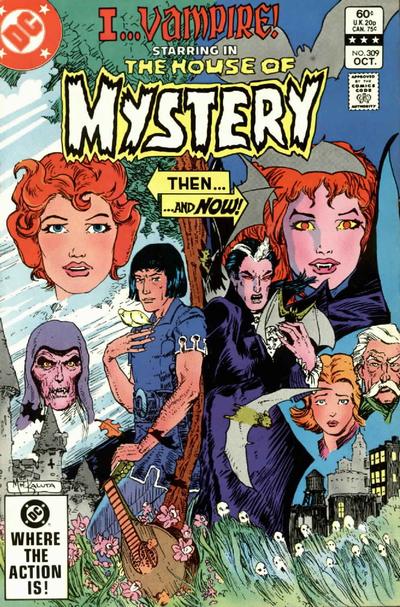
That's what every cover of the famed DC Comics horror anthology begged you to answer. Behind covers by luminaries like Neal Adams, Joe Kubert and Michael Wm. Kaluta, the caretaker of the House, a bespectacled, wild-haired man named Cain, entreated fans to spooky stories. Following in the tradition of previous features like "Dial H for Hero" and "Martian Manhunter," neophyte DC scripter J.M. DeMatteis and veteran artist Tom Sutton brought a new regular series-within-a-series to Cain's House under editor Len Wein, a series that now lives again in DC's "New 52": "I...Vampire!"
Now that Joshua Hale Fialkov, Andrea Sorrentino and Jenny Frison have produced three issues of the new I, Vampire (which I hope all of you are reading!), it's time to take a trip back to 1981 with three of the creative minds behind the series' original incarnation: original series co-creator J.M. DeMatteis (also of Spider-Man, Moonshadow and Brooklyn Dreams fame, among countless others) and series finale co-writers Dan Mishkin & Gary Cohn (also known for the much-beloved Amethyst: Princess of Gemworld and Blue Devil). You'll also see some comments from me on the overall direction of the series, which appeared in The House of Mystery #290-291, 293, 295, 297, 299 and 302-319.
Around the creation of "I...Vampire" superhero books were the most popular genre in American comics (and remain so today). According to DeMatteis, "When I broke into comics in the late 70's, the 'mystery books,' as they called the horror anthologies, were like the vaudeville of comics. A place for new writers to learn their craft, try, fail, grow, without a lot of attention on them. I sold my first script to [DC editor] Paul Levitz, then started working with Jack Harris and Len Wein. Len became more than an editor, he became my mentor, the first person in the business who made me feel as if I had something unique to offer."
DeMatteis set out to prove his craft when Wein assumed control of the horror titles. "Len wanted to inject some ongoing series into Weird War Tales and House of Mystery and asked me for ideas. I'd already had "Creature Commandos" rattling around in my brain and we set that up for Weird War [introduced in issue #93 with artist Pat Broderick], then Len tossed out a title to me—'I...Vampire'—and told me to go home and come up with a concept. That's just what I did, Len loved it, and we were off and running."
When it came to artistic talent, Wein cast his eye toward veteran horror illustrator Tom Sutton, whose previous claims to fame included being Vampirella's first artist in 1969 and drawing various horror series for Warren, Marvel and DC throughout the seventies. DeMatteis remembers: "I'm pretty sure Tom was Len's choice; but I was a huge fan of [his] work. He'd illustrated some stories I'd done for the DC science-fiction anthologies and his style was unique, moody, idiosyncratic, emotional. I loved everything he did with 'I...Vampire.'" Indeed, Sutton would remain on the series long after DeMatteis' departure, either as sole artist or inker over talents Paris Cullins and Adrian Gonzales, even drawing the series' finale.
The first "I...Vampire" story appeared in The House of Mystery #290 (March 1981), a few months after the debut of "Creature Commandos" and a month after DeMatteis' Marvel debut (Defenders #92). All the familiar elements of the series are in place at once: Andrew Bennett was the reluctant vampire who made his lover Mary into a less-reluctant creature of the night. To aid him in his quest to stop her Andrew recruited Dmitri Mishkin and Deborah Dancer, two humans terrorized by vampires.
DeMatteis' inspiration for the series' characters? "It's been a very long time, but my sense is that I started writing and the characters just came together. I know I was drawn to the idea of a vampire who wasn't corrupted by the curse, that it worked as a wonderful metaphor for the struggles we have in our lives, the darkness in our souls that we wrestle with, and the desire to live good and decent lives despite that darkness."
The vampire-as-heroic-protagonist idea was certainly less prevalent in the age of "I...Vampire" than today, where characters like Angel (of Joss Whedon's Buffy and his own eponymous series), Stefan Salvatore (of The Vampire Diaries) and Edward Cullen (of the Twilight novels and films) have caught the public's imagination. Like those latter-day vampire tales, "I...Vampire" also had a provocative, if twisted, love story at its center. "Of course the heart and soul of the story was the Andrew-Mary relationship," says DeMatteis. "Here was this woman Bennett loved, adored, worshipped—and the one time he allowed his vampiric hunger to overtake him, he transformed her into something twisted and evil. And he'd lived with that guilt and shame for hundreds of years. In the end, it wasn't enough for him to redeem himself, he had to redeem Mary, as well. In fact, Bennett was far less concerned with his own salvation than with Mary's. He wanted to oppose her and her forces—but, in the end, he opposed her in order to save her."
Of special note to fans of DeMatteis' work is the character of Dmitri Mishkin, Bennett's male companion throughout the years: "I...recall loving the character...especially once I wrote his back story, explaining how he'd been with Bennett since he was a little boy. It made the character both more heroic and more tragic. (Mishkin was also Russian, so I was able to express my love of Russian literature, specifically my literary hero Dostoyevksy, through the character.)" DeMatteis made his love for the character manifest in issue #295, which explained Mishkin's origins and revealed that his mother had become a vampire when he was a child, a plot point that would be developed much later.
As for the final protagonist, the lovely redheaded Deborah Dancer: "[She], I think, was an attempt to inject someone younger and more contemporary into the mix," says DeMatteis. Bennett and Deborah definitely shared romantic feelings but dared not openly express them—due, no doubt, to his fear of making her another monster like Mary in a moment of passion and weakness—again, a point worth mining at another time.
Bennett had his work cut out for him as a lone vampire allied with two humans against Mary, Queen of Blood and her legion of followers, the Cult of the Blood Red Moon. Whereas Bennett, Deborah and Mishkin were three, the cult consisted of many, often hiding in plain sight among the throngs of humans, ready to pounce, to overwhelm the triad who appeared to be all that stood in the way of their bloody conquest of the Earth. Unlike the latter-day incarnation of the series, the early "I...Vampire" had no elements that directly linked it with the greater DC Universe; in fact, Bennett's only contact with a "superhero," the ever-popular Batman, occurred in another title, the team-up series The Brave and the Bold (#195, February 1983), months before both series' end.
Unfortunately for fans of the series, like Don Corleone, Marvel Comics gave DeMatteis an offer he couldn't refuse in late 1981. "[They] offered me an exclusive contract, so that was the end of my involvement with DC for five or six years." To fill the noticeable void, new editor Karen Berger, who later went on to develop the company's eighties and nineties output into the juggernaut Vertigo line, tapped writer Bruce Jones, who spent much of the seventies on Warren Publishing's Creepy and Eerie magazines.
Jones picked up the series with issue #299 and immediately set Bennett apart from his friends Mishkin and Deborah following an adventure where he nearly killed them both. The series became like a vampire version of The Fugitive, with Bennett wandering from town to town, encountering Mary's minions and dispatching them. The unfortunate centerpiece of Jones' tenure was a multi-part storyline wherein Mary convinced Bennett to use a pair of ancient rings to transport them through time following the development of a vaccine against cancer which made toxic the blood of those who took it. It's difficult to see how Bennett would find Mary's aims anything but transparent (to travel back in time and kill the ancestors of the cancer cure's developer), but he does, and his naïveté nearly proved the series' downfall. What was once a series with incredible pathos instead became a ridiculous exercise in time-travel involving a visit with Deborah Dancer when she was a child and a cat-and-mouse game played between human and vampire pairs of Bennett and Mary during the period before both were transformed.
Leaving before the conclusion of the time-travel storyline, Jones was replaced in issue #310 by another pair of writers new to DC. Dan Mishkin and Gary Cohn came aboard and immediately underplayed the series' more fantastical elements, returning to DeMatteis' tragic take. According to Mishkin: "We’d been doing a bunch of work for Karen Berger in House of Mystery and for some of the other anthology titles...I assume we came to mind because we were right there on hand. I think that our being in the same generation of younger writers probably influenced her decision as well."
The series was less something Mishkin & Cohn sought out, and more a chance to prove they could work on a regular monthly book. "We were novices, and the opportunity to work in a series format, which is the meat of monthly comics, was something we jumped at. And there's a definite appeal to doing genre work, where you have lots of conventions that you're expected to follow, but readers are always hoping you'll defy convention in a way that surprises and delights them while still providing the satisfaction of conforming to them. That balancing act of working within the constraints of a genre while at the same time challenging them was something we ended up doing pretty well in Blue Devil. With 'I...Vampire,' we were learning the ropes."
Mishkin was attracted to the possibilities offered by the horror genre. "I'm generally attracted to stories that delve into the unreal and impossible, like any other genre geek. The idea of the vampire's sensuality and magnetic personality (of which Dracula is the ur-text), and how that works to break down our conventional notions of morality, is one I've always found fascinating." To that end, he and Cohn returned to the core conflict between Bennett and Mary as well as returning Deborah and Mishkin to central roles in the narrative. Once again raising the cancer vaccine plotline (whose resolution had been interrupted in Jones' time-travel arc), they established that the cure was a facade, and that the lab responsible was headed by a vampire who wanted to eliminate his kin from the world by seeding human blood with the poison. Mary's people found a cure for the toxin at the lab, shared it with Bennett, and the plague was ended.
By this time, the series' sales figures had slumped beyond redemption, and DC's other horror and science fiction series had faded away. The House of Mystery wasn't long for the world. "With that book coming to end, we were told to wrap up the Andrew Bennett saga, and to do it with no loose ends and with a finality that would leave no chance of bringing the character back (a dictate that seems awfully naïve in retrospect)."
The series' finale ramped up with the return of Mishkin's mother Dunya, who per the wishes of her mistress, Mary, insinuated herself with Rev. Edgar Warnock of the American Crusade, actually a vampire working to carry the Blood Red Moon's power to the highest position in the land. Warnock was defeated but Dunya kidnapped Mishkin and turned him into a vampire and they fled to Russia. Bennett and Deborah, in pursuit, found out through vampires who'd infiltrated the KGB that Soviet scientists had developed a substance to eliminate vampires' need to avoid sunlight and their lust for blood—a key point toward the series' end.
In the series' 317th issue, Dmitri Mishkin met his end, sacrificing himself so he alone could kill his own mother and thereby save his friends. Dan Mishkin, the series' co-writer (but not, strictly speaking, Dmitri's namesake), found the character's death particularly memorable for the behind-the-scenes events. "It was always a little funny writing a character (not invented by me) who shared my first initial and last name, and when we came to his death, I was amused by the thought of seeing a beautiful Mike Kaluta cover that featured a headstone with the legend "Rest in Peace D. Mishkin." But when I suggested it to Karen Berger, she declined out of a superstitious concern for my well-being. Which was really quite sweet, looking back, though I would have loved to have been able to buy the original art from Mike."
After Mishkin's death, two issues remained, during which Bennett decided to gamble with his un-life and imbibe the substance the Russians developed. While he seemed fine at first, able to tolerate the Sun's rays and survive without the need for blood, he soon discovered its unfortunate side-effects. Having become a vampire several centuries earlier, he found that the return of his humanity also brought rigor mortis, making him a prisoner in his own body. Upon their final confrontation with the Blood Red Moon, Deborah took the formula before encountering Mary, and when the Queen of Blood bit her, she instead became a new breed of vampire with all the immunities the substance provided. So empowered, she brought Mary into the Sun and killed her before saying a final farewell to Bennett, who scattered into ashes as Deborah wept tears of blood for him, the man she loved. It was an unusual finale to the series, empowering Bennett's human love and having her be the one to end the conflict in the fallen protagonist's stead.
The writers called the finale their favorite moment on the series. "Though it’s sad to leave behind characters that you’ve become invested in (also to leave behind a regular paycheck), there's a way in which wrapping up a series was as gratifying as the original opportunity to shepherd one. So much of monthly comics involves keeping the pot boiling that it's easy to get in a rut that's as unpleasant for the creators as it is for the readers. With the chance to do a big finish, we probably turned out our best work on the series—although, given the previous comments about being novices and learning the ropes, and the overall quality that that produced, calling something our best work in this context might not be saying much."
Although "I...Vampire" ended with issue #319 in 1983 and The House of Mystery soon followed with #321, fate, it seemed, was not yet done with Andrew Bennett. When DeMatteis united with artist Shawn McManus on a Doctor Fate series in 1988, the last-page surprise in the first issue was Bennett's shocking return! The six-issue arc dealt with his inexplicable resurrection and his attempts at redeeming himself for his tortured past. "I really liked Bennett, and his inner struggle for redemption fit right into the themes I was exploring in my first arc in the ongoing Doctor Fate series I did with Shawn McManus," offers DeMatteis. "It was a treat to return to the character and his world—I especially enjoyed the Zen monk vampires he was allied with—after something like eight years. I was also a much better writer by then, so I was able to make up for some of the clunkier scripting in my original run."
Bennett's arc ended on a bittersweet note, although certainly DeMatteis left the door open to a more permanent return. "I actually pitched DC on an 'I...Vampire' revival at least once, possibly a couple of times (my memory's fuzzy on the details), but they turned me down," he says. Sadly, DC relegated him to a memory for the next two decades, only allowing him a brief string of appearances in Brian Azzarello and Cliff Chiang's idiosyncratic "Dr. Thirteen" series in the anthology Tales of the Unexpected in 2006-7.
Fans of DeMatteis' original work on the series, which has stood the test of time to inspire the new incarnation, may be surprised to learn the writer did not originally consider himself a major fan of vampire fiction. "I remember reading Bram Stoker's Dracula in college and being surprised by how good it was, but the genre never drew me in any profound way. Once I started writing for the DC horror anthologies, I had to dip into vampire lore because that was a huge part of what those books did. The more I explored, the more I enjoyed the genre. As with Bennett, I saw the vampire as a wonderful symbol of the darkness inside all of us. The vampire's struggle is the universal human struggle. 'To bite...or not to bite.' When I went over to Marvel, I explored the vampire mythos, in a very different way, in my Greenberg, the Vampire graphic novel (and the Bizarre Adventures story that preceded it)—which I remain very fond of, and proud of, to this day." DeMatteis has also worked alongside artist Kent Williams on the Epic Comics miniseries Blood: A Tale, a more unusual take on vampirism.
Asked for his opinion of his original "I...Vampire" tales, the author admits, "To be honest, I haven't gone back and looked at those stories in a long time. I'm sure I will once the collected edition comes out early next year. I'm sure there's a lot I would have done differently, simply because, as noted, I'm a better writer, a better storyteller, now. That said, 'I...Vampire' was my first original creation in comics and I poured my heart and soul into it. It was, at the time, the absolute best I could do. So, in the end, I think I should leave my younger self alone, respect him and let his work stand on its own."
Understandably, with his wishes to bring back Andrew Bennett a few times in the intervening years, DeMatteis is proud to see his creation return in DC's "New 52" this fall. "I loved writing and creating that world and those characters and...based on the first issue of the new series, Josh Fialkov is doing a bang-up job reimagining Andrew Bennett's world. I just hope Mishkin shows up somewhere along the way!"
So do we, Mr. DeMatteis. So do we.
"I...Vampire" will be available in a DC Comics collected edition with a projected on-sale date of February 8, 2012. Consult your local retailer for ordering information, or order it from Amazon.com
, Discount Comic Book Service or any shop you trust.
Please visit writer emeritus J.M. DeMatteis on his blog, Creation Point, at jmdematteis.com! And Dan Mishkin is at danmishkin.com!
That's what every cover of the famed DC Comics horror anthology begged you to answer. Behind covers by luminaries like Neal Adams, Joe Kubert and Michael Wm. Kaluta, the caretaker of the House, a bespectacled, wild-haired man named Cain, entreated fans to spooky stories. Following in the tradition of previous features like "Dial H for Hero" and "Martian Manhunter," neophyte DC scripter J.M. DeMatteis and veteran artist Tom Sutton brought a new regular series-within-a-series to Cain's House under editor Len Wein, a series that now lives again in DC's "New 52": "I...Vampire!"
Now that Joshua Hale Fialkov, Andrea Sorrentino and Jenny Frison have produced three issues of the new I, Vampire (which I hope all of you are reading!), it's time to take a trip back to 1981 with three of the creative minds behind the series' original incarnation: original series co-creator J.M. DeMatteis (also of Spider-Man, Moonshadow and Brooklyn Dreams fame, among countless others) and series finale co-writers Dan Mishkin & Gary Cohn (also known for the much-beloved Amethyst: Princess of Gemworld and Blue Devil). You'll also see some comments from me on the overall direction of the series, which appeared in The House of Mystery #290-291, 293, 295, 297, 299 and 302-319.
![]() |
| Mike Kaluta's stunning covers are still enticing today. |
DeMatteis set out to prove his craft when Wein assumed control of the horror titles. "Len wanted to inject some ongoing series into Weird War Tales and House of Mystery and asked me for ideas. I'd already had "Creature Commandos" rattling around in my brain and we set that up for Weird War [introduced in issue #93 with artist Pat Broderick], then Len tossed out a title to me—'I...Vampire'—and told me to go home and come up with a concept. That's just what I did, Len loved it, and we were off and running."
When it came to artistic talent, Wein cast his eye toward veteran horror illustrator Tom Sutton, whose previous claims to fame included being Vampirella's first artist in 1969 and drawing various horror series for Warren, Marvel and DC throughout the seventies. DeMatteis remembers: "I'm pretty sure Tom was Len's choice; but I was a huge fan of [his] work. He'd illustrated some stories I'd done for the DC science-fiction anthologies and his style was unique, moody, idiosyncratic, emotional. I loved everything he did with 'I...Vampire.'" Indeed, Sutton would remain on the series long after DeMatteis' departure, either as sole artist or inker over talents Paris Cullins and Adrian Gonzales, even drawing the series' finale.
![]() |
| Joe Kubert established the proper horrific mood with the first issue's cover. |
DeMatteis' inspiration for the series' characters? "It's been a very long time, but my sense is that I started writing and the characters just came together. I know I was drawn to the idea of a vampire who wasn't corrupted by the curse, that it worked as a wonderful metaphor for the struggles we have in our lives, the darkness in our souls that we wrestle with, and the desire to live good and decent lives despite that darkness."
The vampire-as-heroic-protagonist idea was certainly less prevalent in the age of "I...Vampire" than today, where characters like Angel (of Joss Whedon's Buffy and his own eponymous series), Stefan Salvatore (of The Vampire Diaries) and Edward Cullen (of the Twilight novels and films) have caught the public's imagination. Like those latter-day vampire tales, "I...Vampire" also had a provocative, if twisted, love story at its center. "Of course the heart and soul of the story was the Andrew-Mary relationship," says DeMatteis. "Here was this woman Bennett loved, adored, worshipped—and the one time he allowed his vampiric hunger to overtake him, he transformed her into something twisted and evil. And he'd lived with that guilt and shame for hundreds of years. In the end, it wasn't enough for him to redeem himself, he had to redeem Mary, as well. In fact, Bennett was far less concerned with his own salvation than with Mary's. He wanted to oppose her and her forces—but, in the end, he opposed her in order to save her."
![]() |
| Andrew Bennett weeps tears of blood for his beloved Mary. Kaluta art. |
As for the final protagonist, the lovely redheaded Deborah Dancer: "[She], I think, was an attempt to inject someone younger and more contemporary into the mix," says DeMatteis. Bennett and Deborah definitely shared romantic feelings but dared not openly express them—due, no doubt, to his fear of making her another monster like Mary in a moment of passion and weakness—again, a point worth mining at another time.
![]() |
| Andrew Bennett only made one appearance outside HoM, and this was it. Jim Aparo art. |
Unfortunately for fans of the series, like Don Corleone, Marvel Comics gave DeMatteis an offer he couldn't refuse in late 1981. "[They] offered me an exclusive contract, so that was the end of my involvement with DC for five or six years." To fill the noticeable void, new editor Karen Berger, who later went on to develop the company's eighties and nineties output into the juggernaut Vertigo line, tapped writer Bruce Jones, who spent much of the seventies on Warren Publishing's Creepy and Eerie magazines.
Jones picked up the series with issue #299 and immediately set Bennett apart from his friends Mishkin and Deborah following an adventure where he nearly killed them both. The series became like a vampire version of The Fugitive, with Bennett wandering from town to town, encountering Mary's minions and dispatching them. The unfortunate centerpiece of Jones' tenure was a multi-part storyline wherein Mary convinced Bennett to use a pair of ancient rings to transport them through time following the development of a vaccine against cancer which made toxic the blood of those who took it. It's difficult to see how Bennett would find Mary's aims anything but transparent (to travel back in time and kill the ancestors of the cancer cure's developer), but he does, and his naïveté nearly proved the series' downfall. What was once a series with incredible pathos instead became a ridiculous exercise in time-travel involving a visit with Deborah Dancer when she was a child and a cat-and-mouse game played between human and vampire pairs of Bennett and Mary during the period before both were transformed.
![]() |
| Bruce Jones' storyline became mired down in too many fantasy elements. Kaluta cover. |
The series was less something Mishkin & Cohn sought out, and more a chance to prove they could work on a regular monthly book. "We were novices, and the opportunity to work in a series format, which is the meat of monthly comics, was something we jumped at. And there's a definite appeal to doing genre work, where you have lots of conventions that you're expected to follow, but readers are always hoping you'll defy convention in a way that surprises and delights them while still providing the satisfaction of conforming to them. That balancing act of working within the constraints of a genre while at the same time challenging them was something we ended up doing pretty well in Blue Devil. With 'I...Vampire,' we were learning the ropes."
Mishkin was attracted to the possibilities offered by the horror genre. "I'm generally attracted to stories that delve into the unreal and impossible, like any other genre geek. The idea of the vampire's sensuality and magnetic personality (of which Dracula is the ur-text), and how that works to break down our conventional notions of morality, is one I've always found fascinating." To that end, he and Cohn returned to the core conflict between Bennett and Mary as well as returning Deborah and Mishkin to central roles in the narrative. Once again raising the cancer vaccine plotline (whose resolution had been interrupted in Jones' time-travel arc), they established that the cure was a facade, and that the lab responsible was headed by a vampire who wanted to eliminate his kin from the world by seeding human blood with the poison. Mary's people found a cure for the toxin at the lab, shared it with Bennett, and the plague was ended.
By this time, the series' sales figures had slumped beyond redemption, and DC's other horror and science fiction series had faded away. The House of Mystery wasn't long for the world. "With that book coming to end, we were told to wrap up the Andrew Bennett saga, and to do it with no loose ends and with a finality that would leave no chance of bringing the character back (a dictate that seems awfully naïve in retrospect)."
The series' finale ramped up with the return of Mishkin's mother Dunya, who per the wishes of her mistress, Mary, insinuated herself with Rev. Edgar Warnock of the American Crusade, actually a vampire working to carry the Blood Red Moon's power to the highest position in the land. Warnock was defeated but Dunya kidnapped Mishkin and turned him into a vampire and they fled to Russia. Bennett and Deborah, in pursuit, found out through vampires who'd infiltrated the KGB that Soviet scientists had developed a substance to eliminate vampires' need to avoid sunlight and their lust for blood—a key point toward the series' end.
![]() |
| Mishkin's death, depicted by Kaluta. |
After Mishkin's death, two issues remained, during which Bennett decided to gamble with his un-life and imbibe the substance the Russians developed. While he seemed fine at first, able to tolerate the Sun's rays and survive without the need for blood, he soon discovered its unfortunate side-effects. Having become a vampire several centuries earlier, he found that the return of his humanity also brought rigor mortis, making him a prisoner in his own body. Upon their final confrontation with the Blood Red Moon, Deborah took the formula before encountering Mary, and when the Queen of Blood bit her, she instead became a new breed of vampire with all the immunities the substance provided. So empowered, she brought Mary into the Sun and killed her before saying a final farewell to Bennett, who scattered into ashes as Deborah wept tears of blood for him, the man she loved. It was an unusual finale to the series, empowering Bennett's human love and having her be the one to end the conflict in the fallen protagonist's stead.
The writers called the finale their favorite moment on the series. "Though it’s sad to leave behind characters that you’ve become invested in (also to leave behind a regular paycheck), there's a way in which wrapping up a series was as gratifying as the original opportunity to shepherd one. So much of monthly comics involves keeping the pot boiling that it's easy to get in a rut that's as unpleasant for the creators as it is for the readers. With the chance to do a big finish, we probably turned out our best work on the series—although, given the previous comments about being novices and learning the ropes, and the overall quality that that produced, calling something our best work in this context might not be saying much."
![]() |
| Bennett finally met his end with issue #319. Art by Kaluta. |
Bennett's arc ended on a bittersweet note, although certainly DeMatteis left the door open to a more permanent return. "I actually pitched DC on an 'I...Vampire' revival at least once, possibly a couple of times (my memory's fuzzy on the details), but they turned me down," he says. Sadly, DC relegated him to a memory for the next two decades, only allowing him a brief string of appearances in Brian Azzarello and Cliff Chiang's idiosyncratic "Dr. Thirteen" series in the anthology Tales of the Unexpected in 2006-7.
![]() |
| Dr. Fate encountered Andrew Bennett early in his 1988 series. McManus art. |
Asked for his opinion of his original "I...Vampire" tales, the author admits, "To be honest, I haven't gone back and looked at those stories in a long time. I'm sure I will once the collected edition comes out early next year. I'm sure there's a lot I would have done differently, simply because, as noted, I'm a better writer, a better storyteller, now. That said, 'I...Vampire' was my first original creation in comics and I poured my heart and soul into it. It was, at the time, the absolute best I could do. So, in the end, I think I should leave my younger self alone, respect him and let his work stand on its own."
![]() |
| Jenny Frison illustrates the new "I, Vampire" covers. |
So do we, Mr. DeMatteis. So do we.
"I...Vampire" will be available in a DC Comics collected edition with a projected on-sale date of February 8, 2012. Consult your local retailer for ordering information, or order it from Amazon.com
Please visit writer emeritus J.M. DeMatteis on his blog, Creation Point, at jmdematteis.com! And Dan Mishkin is at danmishkin.com!
11.11.11
A Weekend of Reviews: The Past (Angel & Faith #3, Hulk #43-44 & More)
Hi Folks!
This weekend, I'm doing something a little special. Today, I'm posting some short reviews of some books from previous weeks that I've just plain missed reviewing. I wanted to make sure you knew about some of these books--good, bad, and ugly.
This time out, we've got special entries from Boom! and Dark Horse Comics, Betrayal of the Planet of the Apes #1 and Angel & Faith #3, as well as traditional Marvel fare like Hulk #43-44 and Fear Itself #7.1: Captain America. Rounding out this entry are Image's Savage Dragon #175 and DC's I, Vampire #2 and Swamp Thing #3.
As always, these books are rated, from great to awful,using my four-stage rating system: Buy It, Read It, Skip It, Burn It.
ANGEL & FAITH #3 - Dark Horse Comics, $2.99
By Christos Gage, Rebekah Isaacs & Joss Whedon
Did everyone know I'm a Whedon fan? No? I guess I'll have to ramp up the articles like this one, then.
Angel & Faith both have ample things in their lives to make up for, and this series, through its three issues, has ably demonstrated this fact. With Giles dead at Angel's hand (in the climactic finale of Buffy Season 8) and magic a thing of the past (see previous!), magical items are at a premium. They don't come more magical than the precious blood of the Mohra demon, famous in Angel lore for temporarily turning him human in the season one episode "I Will Remember You." Someone's selling the cure-all at premium prices, and it's up to the titular duo to take them down.
I lied: I missed the second issue, but thanks to the largely done-in-one nature of Gage's scripts, I wasn't lost at all. Rebekah Isaacs is a name unfamiliar to me, but I'll be tracking down her work from this point forward. And if it's one thing Gage (also famous for Marvel's sensational Avengers Academy) excels at, it's tight characterization in the Whedon mold. Who knew that, so many years after the characters' introductions in Buffy, they'd still be as engaging as ever? A solid story hook, solid art, and some snappy scripting don't lie--definitely Buy It!
BETRAYAL OF THE PLANET OF THE APES #1 - Boom! Studios, $3.99
By Corinna Sara Bechko, Gabriel Hardman & Jordie Bellaire
On the other hand--I hear the gasps from the crowd already starting--I've never truly been a fan of the Planet of the Apes film cycle. Oh, sure, I've seen the 1968 original with the screenplay by Rod Serling, and I've seen Marky Mark--excuse me, Mark Wahlberg--in the Tim Burton remake. Given that I tremendously enjoyed this summer's Rise of the Planet of the Apes, and also that I've been shouting and crying to give Gabriel Hardman's Hulk art the attention it deserved all of the last year, I had to pick this book up.
Based on the earlier film series, Betrayal picks up 20 years before the first film, telling the tale of General Aleron, a military man turned defense lawyer. His client is Dr. Cato, accused of the heretic crime of teaching a human to talk. He is able to convince Dr. Zaius (from the original films) and the council that Cato is not guilty, but that's only the beginning of the tale that turns more insidious with each turn.
Bechko and Hardman, a husband-and-wife creative team, don't just craft a solid story that wholly embraces the Apes universe I'm just learning about. They create an enticing yarn with suspenseful elements, and some of the best art I've seen from Hardman. It's clear they both dearly love the material. Similarly, colorist Jordie Bellaire matches Hardman every step of the way.
I may not have watched the second through fifth films in the Apes cycle, but you can bet I'll be remedying that oversight this weekend. If you can find it, Buy It.
FEAR ITSELF: CAPTAIN AMERICA #7.1 - Marvel Comics, $3.99
By Ed Brubaker, Butch Guice & Bettie Breitweiser
Did anyone not see this one coming?
Yes, that's a bit of hyperbole, but it's no less than this pointed epilogue to Fear Itself deserves. After Bucky's ignoble death in the middle of the summer event, you had to think to yourself, That's a waste. They brought him back, they had him wear the Captain America outfit, for this? The character's been a runaway success since returning early in Brubaker's Cap run, so why eliminate that potential revenue stream? I mean, erm, why kill a big ol' cash korova? Hell, I can't stop telling the obvious truth. (By the way, 'korova' is the phonetic spelling of the Russian word for "cow." Got it?)
For Captain America fans, this story should be all you've wished for, as it's by the same team as that series. There are two stories going at once here: the story of Bucky's funeral, and the story behind the story that everyone who wasn't deluding themselves knew was coming. It's a serviceable storyline aided by excellent artwork by Guice and lavish colors by Breitweiser. It sets up Winter Soldier #1. It exposes the middle of Fear Itself (and some of the ending) as a sham. It goes to show you that nobody really dies at Marvel anymore so long as the company imagines they can turn a profit.
God, I'm jaded! It's by-the-numbers with awesome art. But beware: You'll be paying four whole dollars for 20 pages of story. If that's your bag, well, I can't stop you. My recommendation: Read It.

HULK #43-44 - Marvel Comics, $2.99
By Jeff Parker, Patrick Zircher & Rachelle Rosenberg
It's been a while since last I reviewed Jeff Parker's perennially excellent Hulk. This time, I'll remedy that with two issues for the price of one! And I'll try to keep it brief so I won't be boring.
I've really been torn lately with Hulk. On the one hand, it's got an excellent, inspiring throughline of stories, with the many persistent threats of issues past, including some really novel villains. The book honestly reads like the best of Marvel's Silver Age Incredible Hulk stories from the seventies. On the other hand, the character is utterly derivative of the original, green-skinned Hulk, who's just had his own series relaunched yet again. I should be crying from the mountaintops for Marvel to cancel this book and restore Bruce Banner as the one and only man-monster. It's downright criminal that this series continues its numbering while Banner and (green) Hulk get a new first issue, right?
Ross goes against the wishes of the U.S. government in this storyline, "Hulk of Arabia," leaping into a politically-charged locale with the intent of avenging one of his old military buddies. Of course, because he crosses Steve Rogers, the Super-Soldier takes a few of his Secret Avengers pals with him to defuse the situation.Along the way, this Hulk picks up some characters who've been seen in Hulk tales past: Machine Man (who teamed with the original Hulk during Roger Stern's tenure) and Arabian Knight (whose first iteration was introduced by Bill Mantlo, also in the prior series).
The story is perfectly illustrated by Patch Zircher, an artist I've wanted to see on a Hulk book for many years. The art's terrific. The colors by Rachelle Rosenberg look great. And good grief, can Jeff Parker write pretty.
Like I said, I really want one and only one Hulk book, about a green and not red goliath. But not just yet. Buy It, won't you?
I, VAMPIRE #2 - DC Comics, $2.99
By Joshua Hale Fialkov, Andrea Sorrentino & Marcelo Maiolo
Shouldn't a series come out swinging or the fences with its best shot? Thanks for holding back, Fialkov!
But seriously, folks: The second issue of I, Vampire is even better than the first. That's not to say it's perfect--there are still some aspects creeping in that I don't like and which could prove to be the book's undoing--but overall, this whole creative team should step up and take a bow. They're batting 1.000.
The name of the series is I, Vampire, and with that title comes an intriguing idea: Each issue will have a different narrator, a different spotlighted vampire, than the previous. This time out, it's Mary Seward's turn. Mary, the self-titled Queen of Blood, whom Andrew turned into a vampire so they could spend eternity together, only to find out she really enjoyed the lifestyle.
Mary's narration is engaging, every bit as much as her former lover Andrew's in the previous story. It serves as a counterpoint to the previous, and a scary reminder of what's to come in future episodes. She has sass, she has swagger, she's utterly, terrifyingly gleeful about the state of the world and the part she feels destined to play. Overall, it's a thrilling character piece that picks up the narrative where issue one left off.
I did say there's a potential weakness to the book, didn't I? Unfortunately, that would be the work of artist Andrea Sorrentino. While I love the composition of each panel, the panels themselves are the source of my disdain. With precious few exceptions, every page is filled with the same "widescreen" series of panels from top to bottom, just like a movie storyboard. Having virtually every page filled with the same pattern of four or five panels per page can be truly monotonous, regardless of the artistic talent involved. Worse, it tells me the artist would almost rather be storyboarding movies. I know, I know, Kirby and the greats used to use the six-panel grid all the time, and they're still energetic as anything, right? Still, it would be nice to see a little more variety in the panel layout.
Ah, I've voiced my displeasure enough. This is one of the New 52's "must-buy" titles. Fialkov just gets it, and Maiolo accentuates Sorrentino's art just right. Buy It!
SAVAGE DRAGON #175 - Image Comics, $3.99
By Erik Larsen, Gary Carlson, Frank Fosco & Bill Sienkiewicz
I cannot believe that next year will mark the twentieth anniversary of Savage Dragon's introduction in Image Comics. Who'd have foreseen Erik Larsen's creation lasting so long? No offense to Erik, certainly, as he's the man of a million ideas, and I'm sure he could keep writing and drawing this book until he's old and gray. To be the sole Image founder to have truly stuck with his creation after all these years, that takes some determination. And having met the man, it's clear he's just as enthusiastic now as he likely was when he started this journey.
This book has seen its share of ups and downs, but it's always been, at the very least, entertaining. I remember the days of the over-the-top sexual innuendoes and the ever-evolving Vicious Circle gang. I remember when "This Savage World" was brand-new, feeling like a way for Erik to free himself from a continuity that seemed to box his hero in. And what a terrific play on a reboot it ended up being. I remember the big anniversary issues, I remember the Dragon/Urass ticket, and I remember Dragon meeting Obama (and being lucky enough to receive that first printing variant in my weekly comics shipment without having to pay over cover price). So, yes, I have every issue of Savage Dragon, from both series; every Freak Force; and just about every other Dragon-related miniseries there was. I'm a Fin-Addict.
During the last few issues following Dragon's "death" in #168, I'd grown comfortable with the book being passed on to Malcolm Dragon, our hero's son. Seeing how Erik mostly paces the series in real time, it felt natural that the torch would go to him sooner or later. Imagine my surprise when I saw the cover to this issue, and read the interiors. He's surprised us once again! Where he originally gave us Dragon's origin as a one-off story, he has wisely used it to fuel the last twenty-odd issues of stories, and has now given us an altogether new status quo. Dragon in a Buck Rogers-esque role? Something that must be seen to be believed.
This series never ceases to entertain, and that's what keeps bringing me back. From a great first story, to back-ups featuring the new Dart and Vanguard, it's got something for everyone. The big two don't make comics like this anymore. Thank God for Erik Larsen. If you love old school comics, Buy It. If you don't--there's no hope for you.
SWAMP THING #3 - DC Comics, $2.99
By Scott Snyder, Victor Ibanez & Yanick Paquette
Oh, Swamp Thing. I had such high hopes for you.
As a rule, I'm really enjoying DC's "Dark" subdivision of titles. Oh, sure, I've dropped a couple, and most of the greater line has gone bye-bye. But I've enjoyed Swamp Thing so far because it's been unconventional. It's been interesting through Brightest Day since DC played with the idea that this isn't Alan Moore's Swampy, that this is, for the first time ever, Alec Holland as Swamp Thing, "the way it was always meant to be."
However, at three issues of nearly constant setup, something's got to give.
Oh, sure, it's a well-told bit of setup, but still, the leisurely pace of this "new" origin of the Swamp Thing is clearly structured to appear in a graphic novel collection, and readers who pick up these single issues, well...does this method of storytelling really speak to you? It doesn't speak to me. I like my twenty pages jam-packed with story. I don't like the false advertising bit of having the hero look as he should on the cover but still be the human Holland throughout the issue.
I do like that we're meeting the old cast of characters from the original Swamp Thing, like Abby Arcane. The new character introduced in this tale, "William," is intriguing, and his story does take a dark turn. I'm curious to see how the tapestry is woven between the "Green" of this title, the "Red" of Animal Man, and the mysterious "Black" that's cropped up here and there. It's just, with all due respect to Mr. Snyder and his talented artist Yanick Paquette, I keep wishing they'd get to the point already. It doesn't feel like we've gotten a single complete story in this series yet.
Between the slow pacing of this story and the absence of favorite artist Paquette from well over half this issue's pages, I can't find it in my heart to recommend this book. Skip It until the action picks up.
Agree? Disagree? Sound off!
Tomorrow: This week's reviews, and next week's! Marvel: Point One! Incredible Hulk! And Comic Book Comics!
Be here! Same Bat-time, same Bat-channel!
~G.
This weekend, I'm doing something a little special. Today, I'm posting some short reviews of some books from previous weeks that I've just plain missed reviewing. I wanted to make sure you knew about some of these books--good, bad, and ugly.
This time out, we've got special entries from Boom! and Dark Horse Comics, Betrayal of the Planet of the Apes #1 and Angel & Faith #3, as well as traditional Marvel fare like Hulk #43-44 and Fear Itself #7.1: Captain America. Rounding out this entry are Image's Savage Dragon #175 and DC's I, Vampire #2 and Swamp Thing #3.
As always, these books are rated, from great to awful,using my four-stage rating system: Buy It, Read It, Skip It, Burn It.
ANGEL & FAITH #3 - Dark Horse Comics, $2.99
By Christos Gage, Rebekah Isaacs & Joss Whedon
Did everyone know I'm a Whedon fan? No? I guess I'll have to ramp up the articles like this one, then.
Angel & Faith both have ample things in their lives to make up for, and this series, through its three issues, has ably demonstrated this fact. With Giles dead at Angel's hand (in the climactic finale of Buffy Season 8) and magic a thing of the past (see previous!), magical items are at a premium. They don't come more magical than the precious blood of the Mohra demon, famous in Angel lore for temporarily turning him human in the season one episode "I Will Remember You." Someone's selling the cure-all at premium prices, and it's up to the titular duo to take them down.
I lied: I missed the second issue, but thanks to the largely done-in-one nature of Gage's scripts, I wasn't lost at all. Rebekah Isaacs is a name unfamiliar to me, but I'll be tracking down her work from this point forward. And if it's one thing Gage (also famous for Marvel's sensational Avengers Academy) excels at, it's tight characterization in the Whedon mold. Who knew that, so many years after the characters' introductions in Buffy, they'd still be as engaging as ever? A solid story hook, solid art, and some snappy scripting don't lie--definitely Buy It!
BETRAYAL OF THE PLANET OF THE APES #1 - Boom! Studios, $3.99
By Corinna Sara Bechko, Gabriel Hardman & Jordie Bellaire
On the other hand--I hear the gasps from the crowd already starting--I've never truly been a fan of the Planet of the Apes film cycle. Oh, sure, I've seen the 1968 original with the screenplay by Rod Serling, and I've seen Marky Mark--excuse me, Mark Wahlberg--in the Tim Burton remake. Given that I tremendously enjoyed this summer's Rise of the Planet of the Apes, and also that I've been shouting and crying to give Gabriel Hardman's Hulk art the attention it deserved all of the last year, I had to pick this book up.
Based on the earlier film series, Betrayal picks up 20 years before the first film, telling the tale of General Aleron, a military man turned defense lawyer. His client is Dr. Cato, accused of the heretic crime of teaching a human to talk. He is able to convince Dr. Zaius (from the original films) and the council that Cato is not guilty, but that's only the beginning of the tale that turns more insidious with each turn.
Bechko and Hardman, a husband-and-wife creative team, don't just craft a solid story that wholly embraces the Apes universe I'm just learning about. They create an enticing yarn with suspenseful elements, and some of the best art I've seen from Hardman. It's clear they both dearly love the material. Similarly, colorist Jordie Bellaire matches Hardman every step of the way.
I may not have watched the second through fifth films in the Apes cycle, but you can bet I'll be remedying that oversight this weekend. If you can find it, Buy It.
FEAR ITSELF: CAPTAIN AMERICA #7.1 - Marvel Comics, $3.99
By Ed Brubaker, Butch Guice & Bettie Breitweiser
Did anyone not see this one coming?
Yes, that's a bit of hyperbole, but it's no less than this pointed epilogue to Fear Itself deserves. After Bucky's ignoble death in the middle of the summer event, you had to think to yourself, That's a waste. They brought him back, they had him wear the Captain America outfit, for this? The character's been a runaway success since returning early in Brubaker's Cap run, so why eliminate that potential revenue stream? I mean, erm, why kill a big ol' cash korova? Hell, I can't stop telling the obvious truth. (By the way, 'korova' is the phonetic spelling of the Russian word for "cow." Got it?)
For Captain America fans, this story should be all you've wished for, as it's by the same team as that series. There are two stories going at once here: the story of Bucky's funeral, and the story behind the story that everyone who wasn't deluding themselves knew was coming. It's a serviceable storyline aided by excellent artwork by Guice and lavish colors by Breitweiser. It sets up Winter Soldier #1. It exposes the middle of Fear Itself (and some of the ending) as a sham. It goes to show you that nobody really dies at Marvel anymore so long as the company imagines they can turn a profit.
God, I'm jaded! It's by-the-numbers with awesome art. But beware: You'll be paying four whole dollars for 20 pages of story. If that's your bag, well, I can't stop you. My recommendation: Read It.

HULK #43-44 - Marvel Comics, $2.99
By Jeff Parker, Patrick Zircher & Rachelle Rosenberg
It's been a while since last I reviewed Jeff Parker's perennially excellent Hulk. This time, I'll remedy that with two issues for the price of one! And I'll try to keep it brief so I won't be boring.
I've really been torn lately with Hulk. On the one hand, it's got an excellent, inspiring throughline of stories, with the many persistent threats of issues past, including some really novel villains. The book honestly reads like the best of Marvel's Silver Age Incredible Hulk stories from the seventies. On the other hand, the character is utterly derivative of the original, green-skinned Hulk, who's just had his own series relaunched yet again. I should be crying from the mountaintops for Marvel to cancel this book and restore Bruce Banner as the one and only man-monster. It's downright criminal that this series continues its numbering while Banner and (green) Hulk get a new first issue, right?
Ross goes against the wishes of the U.S. government in this storyline, "Hulk of Arabia," leaping into a politically-charged locale with the intent of avenging one of his old military buddies. Of course, because he crosses Steve Rogers, the Super-Soldier takes a few of his Secret Avengers pals with him to defuse the situation.Along the way, this Hulk picks up some characters who've been seen in Hulk tales past: Machine Man (who teamed with the original Hulk during Roger Stern's tenure) and Arabian Knight (whose first iteration was introduced by Bill Mantlo, also in the prior series).
The story is perfectly illustrated by Patch Zircher, an artist I've wanted to see on a Hulk book for many years. The art's terrific. The colors by Rachelle Rosenberg look great. And good grief, can Jeff Parker write pretty.
Like I said, I really want one and only one Hulk book, about a green and not red goliath. But not just yet. Buy It, won't you?
I, VAMPIRE #2 - DC Comics, $2.99
By Joshua Hale Fialkov, Andrea Sorrentino & Marcelo Maiolo
Shouldn't a series come out swinging or the fences with its best shot? Thanks for holding back, Fialkov!
But seriously, folks: The second issue of I, Vampire is even better than the first. That's not to say it's perfect--there are still some aspects creeping in that I don't like and which could prove to be the book's undoing--but overall, this whole creative team should step up and take a bow. They're batting 1.000.
The name of the series is I, Vampire, and with that title comes an intriguing idea: Each issue will have a different narrator, a different spotlighted vampire, than the previous. This time out, it's Mary Seward's turn. Mary, the self-titled Queen of Blood, whom Andrew turned into a vampire so they could spend eternity together, only to find out she really enjoyed the lifestyle.
Mary's narration is engaging, every bit as much as her former lover Andrew's in the previous story. It serves as a counterpoint to the previous, and a scary reminder of what's to come in future episodes. She has sass, she has swagger, she's utterly, terrifyingly gleeful about the state of the world and the part she feels destined to play. Overall, it's a thrilling character piece that picks up the narrative where issue one left off.
I did say there's a potential weakness to the book, didn't I? Unfortunately, that would be the work of artist Andrea Sorrentino. While I love the composition of each panel, the panels themselves are the source of my disdain. With precious few exceptions, every page is filled with the same "widescreen" series of panels from top to bottom, just like a movie storyboard. Having virtually every page filled with the same pattern of four or five panels per page can be truly monotonous, regardless of the artistic talent involved. Worse, it tells me the artist would almost rather be storyboarding movies. I know, I know, Kirby and the greats used to use the six-panel grid all the time, and they're still energetic as anything, right? Still, it would be nice to see a little more variety in the panel layout.
Ah, I've voiced my displeasure enough. This is one of the New 52's "must-buy" titles. Fialkov just gets it, and Maiolo accentuates Sorrentino's art just right. Buy It!
SAVAGE DRAGON #175 - Image Comics, $3.99
By Erik Larsen, Gary Carlson, Frank Fosco & Bill Sienkiewicz
I cannot believe that next year will mark the twentieth anniversary of Savage Dragon's introduction in Image Comics. Who'd have foreseen Erik Larsen's creation lasting so long? No offense to Erik, certainly, as he's the man of a million ideas, and I'm sure he could keep writing and drawing this book until he's old and gray. To be the sole Image founder to have truly stuck with his creation after all these years, that takes some determination. And having met the man, it's clear he's just as enthusiastic now as he likely was when he started this journey.
This book has seen its share of ups and downs, but it's always been, at the very least, entertaining. I remember the days of the over-the-top sexual innuendoes and the ever-evolving Vicious Circle gang. I remember when "This Savage World" was brand-new, feeling like a way for Erik to free himself from a continuity that seemed to box his hero in. And what a terrific play on a reboot it ended up being. I remember the big anniversary issues, I remember the Dragon/Urass ticket, and I remember Dragon meeting Obama (and being lucky enough to receive that first printing variant in my weekly comics shipment without having to pay over cover price). So, yes, I have every issue of Savage Dragon, from both series; every Freak Force; and just about every other Dragon-related miniseries there was. I'm a Fin-Addict.
During the last few issues following Dragon's "death" in #168, I'd grown comfortable with the book being passed on to Malcolm Dragon, our hero's son. Seeing how Erik mostly paces the series in real time, it felt natural that the torch would go to him sooner or later. Imagine my surprise when I saw the cover to this issue, and read the interiors. He's surprised us once again! Where he originally gave us Dragon's origin as a one-off story, he has wisely used it to fuel the last twenty-odd issues of stories, and has now given us an altogether new status quo. Dragon in a Buck Rogers-esque role? Something that must be seen to be believed.
This series never ceases to entertain, and that's what keeps bringing me back. From a great first story, to back-ups featuring the new Dart and Vanguard, it's got something for everyone. The big two don't make comics like this anymore. Thank God for Erik Larsen. If you love old school comics, Buy It. If you don't--there's no hope for you.
SWAMP THING #3 - DC Comics, $2.99
By Scott Snyder, Victor Ibanez & Yanick Paquette
Oh, Swamp Thing. I had such high hopes for you.
As a rule, I'm really enjoying DC's "Dark" subdivision of titles. Oh, sure, I've dropped a couple, and most of the greater line has gone bye-bye. But I've enjoyed Swamp Thing so far because it's been unconventional. It's been interesting through Brightest Day since DC played with the idea that this isn't Alan Moore's Swampy, that this is, for the first time ever, Alec Holland as Swamp Thing, "the way it was always meant to be."
However, at three issues of nearly constant setup, something's got to give.
Oh, sure, it's a well-told bit of setup, but still, the leisurely pace of this "new" origin of the Swamp Thing is clearly structured to appear in a graphic novel collection, and readers who pick up these single issues, well...does this method of storytelling really speak to you? It doesn't speak to me. I like my twenty pages jam-packed with story. I don't like the false advertising bit of having the hero look as he should on the cover but still be the human Holland throughout the issue.
I do like that we're meeting the old cast of characters from the original Swamp Thing, like Abby Arcane. The new character introduced in this tale, "William," is intriguing, and his story does take a dark turn. I'm curious to see how the tapestry is woven between the "Green" of this title, the "Red" of Animal Man, and the mysterious "Black" that's cropped up here and there. It's just, with all due respect to Mr. Snyder and his talented artist Yanick Paquette, I keep wishing they'd get to the point already. It doesn't feel like we've gotten a single complete story in this series yet.
Between the slow pacing of this story and the absence of favorite artist Paquette from well over half this issue's pages, I can't find it in my heart to recommend this book. Skip It until the action picks up.
Agree? Disagree? Sound off!
Tomorrow: This week's reviews, and next week's! Marvel: Point One! Incredible Hulk! And Comic Book Comics!
Be here! Same Bat-time, same Bat-channel!
~G.
26.9.11
Advance Review: "I, Vampire" #1
Yes, it's true! I've been remiss in my reviewing activities. If you must know, I'm writing a book here, and preparing for this year's New York Comic Con that hits in a few short weeks. In answer to your unspoken questions, I've been reading quite a few of DC Comics' "New 52" projects this last month. Why, you ask, have I not reviewed any of those books? Simply put, I haven't found any that have compelled me to put pen to paper (or, as the case may be, fingers to keyboard). But that's changed. Oh, ye gods, how that has changed...
Early on, it was the most derided of all the series DC announced. If it wasn't "DC, how could you try and cash in on the Twilight craze?" it was "DC, why in God's name did you bring that book back, out of all the old books that could've been relaunched?" People didn't "get" why they would bring back Andrew Bennett, who'd been on the scene in the horror anthology House of Mystery for all of two years prior to its 1983 cancellation. They thought, well, obviously we're going to get "emo" vampires, because they're so de rigueur today.
For those who've caught my previous references to this series, as far back as 2007, this one's for you. For those altogether unfamiliar with the first incarnation, this one's also for you. You want to be here for this. You really do...

I, Vampire #1
"Tainted Love"
By Joshua Hale Fialkov, Andrea Sorrentino, Marcelo Maiolo, Pat Brosseau,
Wil Moss, Matt Idelson & Jenny Frison
"Four hundred years ago my vampiric kiss transformed the woman I loved into a soulless thing called Mary, Queen of Blood! Today an unholy order follows her evil designs, and the blood they spill is on my hands! Thus I must stop her...I, Andrew Bennett...I...Vampire!"
Early on, it was the most derided of all the series DC announced. If it wasn't "DC, how could you try and cash in on the Twilight craze?" it was "DC, why in God's name did you bring that book back, out of all the old books that could've been relaunched?" People didn't "get" why they would bring back Andrew Bennett, who'd been on the scene in the horror anthology House of Mystery for all of two years prior to its 1983 cancellation. They thought, well, obviously we're going to get "emo" vampires, because they're so de rigueur today.
For those who've caught my previous references to this series, as far back as 2007, this one's for you. For those altogether unfamiliar with the first incarnation, this one's also for you. You want to be here for this. You really do...

I, Vampire #1
"Tainted Love"
By Joshua Hale Fialkov, Andrea Sorrentino, Marcelo Maiolo, Pat Brosseau,
Wil Moss, Matt Idelson & Jenny Frison
"Four hundred years ago my vampiric kiss transformed the woman I loved into a soulless thing called Mary, Queen of Blood! Today an unholy order follows her evil designs, and the blood they spill is on my hands! Thus I must stop her...I, Andrew Bennett...I...Vampire!"
7.6.11
Heard About It, Didn't Believe It. "I...Vampire!" is BACK!
Okay, DC. You have me on board for yet another series. I heard rumors about this one months ago (won't say where, or from whom, but they were right on the f***ing money). I dismissed those rumors. Shame on me!
"Vampires threaten to bring ruin to the DC Universe in I, VAMPIRE #1 by rising star Josh Fialkov and artist Andrea Sorrentino. Tortured by his centuries-old love for the Queen of the Damnned, Andrew Bennett must save humanity from the violent uprising of his fellow vampires, even if it means exterminating his own kind."
You can bet I'll be following this story further and trying to get an interview ASAP. I'm a fan of Andrew Bennett from way, way back. (Okay, maybe just a few years, since I bought the full run of House of Mystery in which he starred!) The original series, by J.M. DeMatteis and a host of others, is on the list of my most wanted trades and I've always wanted a revival. Now, if they'll only use the original logo! (And credit DeMatteis & Sutton with the original incarnation!)
~G.
"Vampires threaten to bring ruin to the DC Universe in I, VAMPIRE #1 by rising star Josh Fialkov and artist Andrea Sorrentino. Tortured by his centuries-old love for the Queen of the Damnned, Andrew Bennett must save humanity from the violent uprising of his fellow vampires, even if it means exterminating his own kind."
You can bet I'll be following this story further and trying to get an interview ASAP. I'm a fan of Andrew Bennett from way, way back. (Okay, maybe just a few years, since I bought the full run of House of Mystery in which he starred!) The original series, by J.M. DeMatteis and a host of others, is on the list of my most wanted trades and I've always wanted a revival. Now, if they'll only use the original logo! (And credit DeMatteis & Sutton with the original incarnation!)
~G.
28.4.11
That's What I Want: My Top Requested Graphic Novels of '11 (1)
Bonjour, mes amis!
It's been a long, long time since I've posted one of these things (try 2007!) so I thought it was about time. In the modern age of comics, there isn't a whole lot that isn't in some form of collected edition from the Big Two. That said, there's always room for improvement! Herewith, I present my wish list for collected editions! These are books that have either never been collected in a graphic novel format, or have for whatever reason gone out-of-print and are in dire need of a re-release. (Hey, four out of the ten entries on my previous list have made the jump to collected editions, so I must be onto something. Either that, or the law of averages applies. And that's not counting all my other favorite series that have had collected editions pop up, particularly in the Marvel Masterworks series!) What do you want to see?
In alphabetical order:
(Collecting Age of Innocence: The Rebirth of Iron Man #1; Avengers #390-395; Avengers: The Crossing #1; Avengers: Timeslide #1; Force Works #16-22; Iron Man #319-325; and War Machine #19-23.) Betrayed by Iron Man, the Avengers are faced with the ultimate scheme of the time-traveling villain, Kang, and his band of ne'er-do-wells from the future, including analogues of some Avengers mainstays. Though later retconned in Avengers Forever, this storyline still holds a special place in the hearts of some fans, and a two-volume uber-collection would be a worthwhile effort. Yes, I'm reviewing this catastrophe of epic proportions elsewhere on this blog, so really, everything that I want to say is best explored there. It wasn't all bad, else I wouldn't be blogging about it or begging for its release! The collection seems most likely next year near the release of the Avengers film. (After all, they're releasing The Lost Gods and Blood and Thunder this year as tie-ins with the Thor film, right?)
(Collecting Weird War Tales #93, 97, 100, 102, 105, 108-112, 114-119, 121, 124.) I recently realized this book was one of the first comics I ever bought! Right now I'm trying to amass the whole series, but it's understandably difficult as every store that stocks back issues may have Superman and Batman, but not every one keeps Weird War Tales, which is where this motley crew first assembled. Created by J.M. DeMatteis (whose work I always greatly enjoy) and Pat Broderick (whose run on Firestorm was terrific) in issue #93 in 1980, the team survived nearly twenty adventures, which due to their brevity (the book was an anthology with 2-3 stories per issue) could easily be reprinted in one edition. Who doesn't like a good werewolf or vampire or Frankenstein story? This series had them all! (And hey! Dig that Giant-Size X-Men cover homage!)
(Collecting Deadly Hands of Kung Fu #1-??) Since the most popular series to spin out of the 1970s kung fu craze, Master of Kung Fu, is nearly unreprintable due to licensing issues with the Sax Rohmer estate, and Iron Fist's color adventures from the period are largely reprinted in Essential and soon Masterworks format, that leaves this gem. Although some issues can't be reprinted because of the same licensing matter, there are still many terrific stories, including the "Sons of the Tiger" strip which ran nearly the full length of the series, introducing characters like the first White Tiger and the Jack of Hearts while showcasing the early work of Dick Giordano, Bill Mantlo, and George Perez. Iron Fist also appeared in the series in his own multi-part stories by Chris Claremont, as did the Daughters of the Dragon. Marvel could reprint this series either in the Essential format, or follow the same format as the recent Vampire Tales collections.
(Collecting The Flash (1987) #143-150 & Speed Force #1.) Mark Waid's Flash tenure has been all but forgotten amid Geoff Johns' greatly successful runs (ha) on the Scarlet Speedster. With the upcoming event FlashPoint centered around the character, I'd have thought now the perfect time to catch up via some classic collections such as this one. Waid returned to Wally West after about a year (during which Grant Morrison & Mark Millar had their way with him), wasting no time in aborting his impending nuptials with Linda Park and throwing him into a multipart epic that struck at the core of the character's long history. A villain named Cobalt Blue showed up, and he promised to kill Barry Allen, the Flash he had known. To that end, Wally had to send a "chain lightning letter" to all Flashes in the future where Barry had lived his final days before perishing in the Crisis on Infinite Earths. (Yes, he got better.) But was he really playing into the enemy's hands all along? The story features a wide range of Flashes, past and present, and features terrific artwork by Paul Pelletier, late of Incredible Hulks. Yes, Cobalt Blue's identity may be silly, but this is a great Silver Age-styled tale. If successful, DC could even release the next volume, "Dark Flash," including the remainder of the latter Waid run.
(Collecting Fantastic Four #12, 25-26, 112, 166-167, 320, 368, 533-535; Fantastic Four Unlimited #4; Fantastic Four: The World's Greatest Comic Magazine #5; Giant-Size Super-Stars #1; Hulk (2000) #9; Incredible Hulk #122, 350; Marvel Fanfare #20-21; Marvel Feature #11; Marvel Graphic Novel #29; Marvel Two-In-One #46; Marvel Two-In-One Annual #5 and more.) Arguably one of the greatest conflicts in all of comics, the Hulk and Thing deserve their own omnibus edition to duke it out! Collecting 50 years (!) of stories, it's far too large for one measly Premiere hardcover, so why not? At the very least, let Marvel make the graphic novel and the Marvel Fanfare issues (by Starlin!) available again for the first time since they were published!
(Collecting The House of Mystery #290-291, 293, 295, 297, 299, 302-319, 321 & The Brave and the Bold #195.) There's precious little I can say about this series more than I've already said in that last entry four years ago, but now would be the perfect time with a rumored I...Vampire! revival in the works at Vertigo. These tales of Andrew Bennett, British nobleman cum vampire, would be a great fit in a new collection, either in softcover or hardcover. The talent list is terrific, with stories by J.M. DeMatteis, Bruce Jones, Dan Mishkin and Gary Cohn, and art by Tom Sutton, Joe Kubert, and Mike Kaluta. Throw in a guest appearance by Batman, and you're set! Extra bonus: DC could also release the first six issues of DeMatteis' Dr. Fate co-starring Bennett in a softcover edition.
(Collecting The Incredible Hulk #245-313 & The Incredible Hulk Annual #10-13.) Bill Mantlo is one of Marvel's most underrated talents, and next to Deadly Hands of Kung Fu, this series is really the only one that the publisher can reprint! Unfortunately, they'd probably run into rights issues with issue #296 (due to an appearance by Rom, a licensed character), but still, there's a treasure trove of tales that are well worth reprinting, including epic battles with heroes like Captain Marvel, the Silver Surfer, Thor and Dr. Strange, and villains like the U-Foes, the Leader, the Wendigo, Zzzax, Kang, the Abomination, MODOK and Nightmare! Mantlo also pioneered the Hulk with Banner's brain during the middle of his tenure, and delved deeper into the Hulk's psychological origins than anyone before him. He buried Jarella, killed Glenn Talbot, made General Ross commit treason, and made the Hulk lose his mind! What's not to love?
Concluded tomorrow with the final seven entries!
~G.
It's been a long, long time since I've posted one of these things (try 2007!) so I thought it was about time. In the modern age of comics, there isn't a whole lot that isn't in some form of collected edition from the Big Two. That said, there's always room for improvement! Herewith, I present my wish list for collected editions! These are books that have either never been collected in a graphic novel format, or have for whatever reason gone out-of-print and are in dire need of a re-release. (Hey, four out of the ten entries on my previous list have made the jump to collected editions, so I must be onto something. Either that, or the law of averages applies. And that's not counting all my other favorite series that have had collected editions pop up, particularly in the Marvel Masterworks series!) What do you want to see?
In alphabetical order:
![]() |
| Avengers: The Complete Crossing Epic (Marvel) |
![]() |
| The Creature Commandos (DC) |
![]() |
| Essential Deadly Hands of Kung Fu (Marvel) |
![]() |
| The Flash: Chain Lightning (DC) |
![]() |
| The Hulk Vs. The Thing Omnibus (Marvel) |
![]() |
| I...Vampire! (DC) |
![]() |
| The Incredible Hulk: Bill Mantlo Visionaries (Marvel) |
Concluded tomorrow with the final seven entries!
~G.
Subscribe to:
Posts (Atom)