Showing posts with label vampires. Show all posts

4.12.11

Tears of Blood: DeMatteis, Mishkin & Cohn Remember "I...Vampire!"

Do you dare enter...The House of Mystery?

That's what every cover of the famed DC Comics horror anthology begged you to answer. Behind covers by luminaries like Neal Adams, Joe Kubert and Michael Wm. Kaluta, the caretaker of the House, a bespectacled, wild-haired man named Cain, entreated fans to spooky stories. Following in the tradition of previous features like "Dial H for Hero" and "Martian Manhunter," neophyte DC scripter J.M. DeMatteis and veteran artist Tom Sutton brought a new regular series-within-a-series to Cain's House under editor Len Wein, a series that now lives again in DC's "New 52": "I...Vampire!"

Now that Joshua Hale Fialkov, Andrea Sorrentino and Jenny Frison have produced three issues of the new I, Vampire (which I hope all of you are reading!), it's time to take a trip back to 1981 with three of the creative minds behind the series' original incarnation: original series co-creator J.M. DeMatteis (also of Spider-Man, Moonshadow and Brooklyn Dreams fame, among countless others) and series finale co-writers Dan Mishkin & Gary Cohn (also known for the much-beloved Amethyst: Princess of Gemworld and Blue Devil). You'll also see some comments from me on the overall direction of the series, which appeared in The House of Mystery #290-291, 293, 295, 297, 299 and 302-319.

Mike Kaluta's stunning covers are still enticing today.
Around the creation of "I...Vampire" superhero books were the most popular genre in American comics (and remain so today). According to DeMatteis, "When I broke into comics in the late 70's, the 'mystery books,' as they called the horror anthologies, were like the vaudeville of comics. A place for new writers to learn their craft, try, fail, grow, without a lot of attention on them. I sold my first script to [DC editor] Paul Levitz, then started working with Jack Harris and Len Wein. Len became more than an editor, he became my mentor, the first person in the business who made me feel as if I had something unique to offer."

DeMatteis set out to prove his craft when Wein assumed control of the horror titles. "Len wanted to inject some ongoing series into Weird War Tales and House of Mystery and asked me for ideas. I'd already had "Creature Commandos" rattling around in my brain and we set that up for Weird War [introduced in issue #93 with artist Pat Broderick], then Len tossed out a title to me—'I...Vampire'—and told me to go home and come up with a concept. That's just what I did, Len loved it, and we were off and running."

When it came to artistic talent, Wein cast his eye toward veteran horror illustrator Tom Sutton, whose previous claims to fame included being Vampirella's first artist in 1969 and drawing various horror series for Warren, Marvel and DC throughout the seventies. DeMatteis remembers: "I'm pretty sure Tom was Len's choice; but I was a huge fan of [his] work.  He'd illustrated some stories I'd done for the DC science-fiction anthologies and his style was unique, moody, idiosyncratic, emotional.  I loved everything he did with 'I...Vampire.'" Indeed, Sutton would remain on the series long after DeMatteis' departure, either as sole artist or inker over talents Paris Cullins and Adrian Gonzales, even drawing the series' finale.

Joe Kubert established the proper horrific mood with the first issue's cover.
The first "I...Vampire" story appeared in The House of Mystery #290 (March 1981), a few months after the debut of "Creature Commandos" and a month after DeMatteis' Marvel debut (Defenders #92). All the familiar elements of the series are in place at once: Andrew Bennett was the reluctant vampire who made his lover Mary into a less-reluctant creature of the night. To aid him in his quest to stop her Andrew recruited Dmitri Mishkin and Deborah Dancer, two humans terrorized by vampires.

DeMatteis' inspiration for the series' characters? "It's been a very long time, but my sense is that I started writing and the characters just came together. I know I was drawn to the idea of a vampire who wasn't corrupted by the curse, that it worked as a wonderful metaphor for the struggles we have in our lives, the darkness in our souls that we wrestle with, and the desire to live good and decent lives despite that darkness."

The vampire-as-heroic-protagonist idea was certainly less prevalent in the age of "I...Vampire" than today, where characters like Angel (of Joss Whedon's Buffy and his own eponymous series), Stefan Salvatore (of The Vampire Diaries) and Edward Cullen (of the Twilight novels and films) have caught the public's imagination. Like those latter-day vampire tales, "I...Vampire" also had a provocative, if twisted, love story at its center. "Of course the heart and soul of the story was the Andrew-Mary relationship," says DeMatteis. "Here was this woman Bennett loved, adored, worshipped—and the one time he allowed his vampiric hunger to overtake him, he transformed her into something twisted and evil. And he'd lived with that guilt and shame for hundreds of years. In the end, it wasn't enough for him to redeem himself, he had to redeem Mary, as well. In fact, Bennett was far less concerned with his own salvation than with Mary's. He wanted to oppose her and her forces—but, in the end, he opposed her in order to save her."

Andrew Bennett weeps tears of blood for his beloved Mary. Kaluta art.
Of special note to fans of DeMatteis' work is the character of Dmitri Mishkin, Bennett's male companion throughout the years: "I...recall loving the character...especially once I wrote his back story, explaining how he'd been with Bennett since he was a little boy.  It made the character both more heroic and more tragic.  (Mishkin was also Russian, so I was able to express my love of Russian literature, specifically my literary hero Dostoyevksy, through the character.)" DeMatteis made his love for the character manifest in issue #295, which explained Mishkin's origins and revealed that his mother had become a vampire when he was a child, a plot point that would be developed much later.

As for the final protagonist, the lovely redheaded Deborah Dancer: "[She], I think, was an attempt to inject someone younger and more contemporary into the mix," says DeMatteis. Bennett and Deborah definitely shared romantic feelings but dared not openly express them—due, no doubt, to his fear of making her another monster like Mary in a moment of passion and weakness—again, a point worth mining at another time.

Andrew Bennett only made one appearance outside HoM, and this was it. Jim Aparo art.
Bennett had his work cut out for him as a lone vampire allied with two humans against Mary, Queen of Blood and her legion of followers, the Cult of the Blood Red Moon. Whereas Bennett, Deborah and Mishkin were three, the cult consisted of many, often hiding in plain sight among the throngs of humans, ready to pounce, to overwhelm the triad who appeared to be all that stood in the way of their bloody conquest of the Earth. Unlike the latter-day incarnation of the series, the early "I...Vampire" had no elements that directly linked it with the greater DC Universe; in fact, Bennett's only contact with a "superhero," the ever-popular Batman, occurred in another title, the team-up series The Brave and the Bold (#195, February 1983), months before both series' end.

Unfortunately for fans of the series, like Don Corleone, Marvel Comics gave DeMatteis an offer he couldn't refuse in late 1981. "[They] offered me an exclusive contract, so that was the end of my involvement with DC for five or six years." To fill the noticeable void, new editor Karen Berger, who later went on to develop the company's eighties and nineties output into the juggernaut Vertigo line, tapped writer Bruce Jones, who spent much of the seventies on Warren Publishing's Creepy and Eerie magazines.

Jones picked up the series with issue #299 and immediately set Bennett apart from his friends Mishkin and Deborah following an adventure where he nearly killed them both. The series became like a vampire version of The Fugitive, with Bennett wandering from town to town, encountering Mary's minions and dispatching them. The unfortunate centerpiece of Jones' tenure was a multi-part storyline wherein Mary convinced Bennett to use a pair of ancient rings to transport them through time following the development of a vaccine against cancer which made toxic the blood of those who took it. It's difficult to see how Bennett would find Mary's aims anything but transparent (to travel back in time and kill the ancestors of the cancer cure's developer), but he does, and his naïveté nearly proved the series' downfall. What was once a series with incredible pathos instead became a ridiculous exercise in time-travel involving a visit with Deborah Dancer when she was a child and a cat-and-mouse game played between human and vampire pairs of Bennett and Mary during the period before both were transformed.
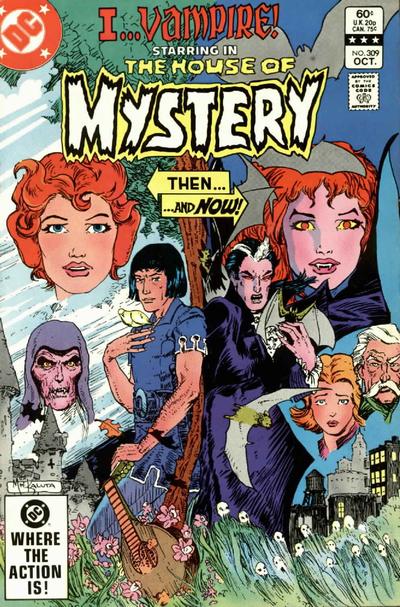
Bruce Jones' storyline became mired down in too many fantasy elements. Kaluta cover.
Leaving before the conclusion of the time-travel storyline, Jones was replaced in issue #310 by another pair of writers new to DC. Dan Mishkin and Gary Cohn came aboard and immediately underplayed the series' more fantastical elements, returning to DeMatteis' tragic take. According to Mishkin: "We’d been doing a bunch of work for Karen Berger in House of Mystery and for some of the other anthology titles...I assume we came to mind because we were right there on hand. I think that our being in the same generation of younger writers probably influenced her decision as well."

The series was less something Mishkin & Cohn sought out, and more a chance to prove they could work on a regular monthly book. "We were novices, and the opportunity to work in a series format, which is the meat of monthly comics, was something we jumped at. And there's a definite appeal to doing genre work, where you have lots of conventions that you're expected to follow, but readers are always hoping you'll defy convention in a way that surprises and delights them while still providing the satisfaction of conforming to them. That balancing act of working within the constraints of a genre while at the same time challenging them was something we ended up doing pretty well in Blue Devil. With 'I...Vampire,' we were learning the ropes."

Mishkin was attracted to the possibilities offered by the horror genre. "I'm generally attracted to stories that delve into the unreal and impossible, like any other genre geek. The idea of the vampire's sensuality and magnetic personality (of which Dracula is the ur-text), and how that works to break down our conventional notions of morality, is one I've always found fascinating." To that end, he and Cohn returned to the core conflict between Bennett and Mary as well as returning Deborah and Mishkin to central roles in the narrative. Once again raising the cancer vaccine plotline (whose resolution had been interrupted in Jones' time-travel arc), they established that the cure was a facade, and that the lab responsible was headed by a vampire who wanted to eliminate his kin from the world by seeding human blood with the poison. Mary's people found a cure for the toxin at the lab, shared it with Bennett, and the plague was ended.

By this time, the series' sales figures had slumped beyond redemption, and DC's other horror and science fiction series had faded away. The House of Mystery wasn't long for the world. "With that book coming to end, we were told to wrap up the Andrew Bennett saga, and to do it with no loose ends and with a finality that would leave no chance of bringing the character back (a dictate that seems awfully naïve in retrospect)."

The series' finale ramped up with the return of Mishkin's mother Dunya, who per the wishes of her mistress, Mary, insinuated herself with Rev. Edgar Warnock of the American Crusade, actually a vampire working to carry the Blood Red Moon's power to the highest position in the land. Warnock was defeated but Dunya kidnapped Mishkin and turned him into a vampire and they fled to Russia. Bennett and Deborah, in pursuit, found out through vampires who'd infiltrated the KGB that Soviet scientists had developed a substance to eliminate vampires' need to avoid sunlight and their lust for blood—a key point toward the series' end.

Mishkin's death, depicted by Kaluta.
In the series' 317th issue, Dmitri Mishkin met his end, sacrificing himself so he alone could kill his own mother and thereby save his friends. Dan Mishkin, the series' co-writer (but not, strictly speaking, Dmitri's namesake), found the character's death particularly memorable for the behind-the-scenes events. "It was always a little funny writing a character (not invented by me) who shared my first initial and last name, and when we came to his death, I was amused by the thought of seeing a beautiful Mike Kaluta cover that featured a headstone with the legend "Rest in Peace D. Mishkin." But when I suggested it to Karen Berger, she declined out of a superstitious concern for my well-being. Which was really quite sweet, looking back, though I would have loved to have been able to buy the original art from Mike."

After Mishkin's death, two issues remained, during which Bennett decided to gamble with his un-life and imbibe the substance the Russians developed. While he seemed fine at first, able to tolerate the Sun's rays and survive without the need for blood, he soon discovered its unfortunate side-effects. Having become a vampire several centuries earlier, he found that the return of his humanity also brought rigor mortis, making him a prisoner in his own body. Upon their final confrontation with the Blood Red Moon, Deborah took the formula before encountering Mary, and when the Queen of Blood bit her, she instead became a new breed of vampire with all the immunities the substance provided. So empowered, she brought Mary into the Sun and killed her before saying a final farewell to Bennett, who scattered into ashes as Deborah wept tears of blood for him, the man she loved. It was an unusual finale to the series, empowering Bennett's human love and having her be the one to end the conflict in the fallen protagonist's stead.

The writers called the finale their favorite moment on the series. "Though it’s sad to leave behind characters that you’ve become invested in (also to leave behind a regular paycheck), there's a way in which wrapping up a series was as gratifying as the original opportunity to shepherd one. So much of monthly comics involves keeping the pot boiling that it's easy to get in a rut that's as unpleasant for the creators as it is for the readers. With the chance to do a big finish, we probably turned out our best work on the series—although, given the previous comments about being novices and learning the ropes, and the overall quality that that produced, calling something our best work in this context might not be saying much."

Bennett finally met his end with issue #319. Art by Kaluta.
Although "I...Vampire" ended with issue #319 in 1983 and The House of Mystery soon followed with #321, fate, it seemed, was not yet done with Andrew Bennett. When DeMatteis united with artist Shawn McManus on a Doctor Fate series in 1988, the last-page surprise in the first issue was Bennett's shocking return! The six-issue arc dealt with his inexplicable resurrection and his attempts at redeeming himself for his tortured past. "I really liked Bennett, and his inner struggle for redemption fit right into the themes I was exploring in my first arc in the ongoing Doctor Fate series I did with Shawn McManus," offers DeMatteis. "It was a treat to return to the character and his world—I especially enjoyed the Zen monk vampires he was allied with—after something like eight years.  I was also a much better writer by then, so I was able to make up for some of the clunkier scripting in my original run."

Bennett's arc ended on a bittersweet note, although certainly DeMatteis left the door open to a more permanent return. "I actually pitched DC on an 'I...Vampire' revival at least once, possibly a couple of times (my memory's fuzzy on the details), but they turned me down," he says. Sadly, DC relegated him to a memory for the next two decades, only allowing him a brief string of appearances in Brian Azzarello and Cliff Chiang's idiosyncratic "Dr. Thirteen" series in the anthology Tales of the Unexpected in 2006-7.

Dr. Fate encountered Andrew Bennett early in his 1988 series. McManus art.
Fans of DeMatteis' original work on the series, which has stood the test of time to inspire the new incarnation, may be surprised to learn the writer did not originally consider himself a major fan of vampire fiction. "I remember reading Bram Stoker's Dracula in college and being surprised by how good it was, but the genre never drew me in any profound way.  Once I started writing for the DC horror anthologies, I had to dip into vampire lore because that was a huge part of what those books did.  The more I explored, the more I enjoyed the genre.  As with Bennett, I saw the vampire as a wonderful symbol of the darkness inside all of us.  The vampire's struggle is the universal human struggle.  'To bite...or not to bite.'  When I went over to Marvel, I explored the vampire mythos, in a very different way, in my Greenberg, the Vampire graphic novel (and the Bizarre Adventures story that preceded it)—which I remain very fond of, and proud of, to this day." DeMatteis has also worked alongside artist Kent Williams on the Epic Comics miniseries Blood: A Tale, a more unusual take on vampirism.

Asked for his opinion of his original "I...Vampire" tales, the author admits, "To be honest, I haven't gone back and looked at those stories in a long time.  I'm sure I will once the collected edition comes out early next year.  I'm sure there's a lot I would have done differently, simply because, as noted, I'm a better writer, a better storyteller, now.  That said, 'I...Vampire' was my first original creation in comics and I poured my heart and soul into it.  It was, at the time, the absolute best I could do.  So, in the end, I think I should leave my younger self alone, respect him and let his work stand on its own."

Jenny Frison illustrates the new "I, Vampire" covers.
Understandably, with his wishes to bring back Andrew Bennett a few times in the intervening years, DeMatteis is proud to see his creation return in DC's "New 52" this fall. "I loved writing and creating that world and those characters and...based on the first issue of the new series, Josh Fialkov is doing a bang-up job reimagining Andrew Bennett's world.  I just hope Mishkin shows up somewhere along the way!"

So do we, Mr. DeMatteis. So do we.

"I...Vampire" will be available in a DC Comics collected edition with a projected on-sale date of February 8, 2012. Consult your local retailer for ordering information, or order it from Amazon.com, Discount Comic Book Service or any shop you trust.

Please visit writer emeritus J.M. DeMatteis on his blog, Creation Point, at jmdematteis.com! And Dan Mishkin is at danmishkin.com!

11.8.11

Hammer Thursday: Captain Kronos, Vampire Hunter!

Two young girls go frolicking in the forest, but when one goes to get some flowers to braid in the other's hair, a stranger approaches. Hypnotized, the blond girl drops her mirror and takes to the hooded figure like a long-lost friend. When the other girl returns, she stands transfixed in terror. The town doctor rides along on his horse and spots the two of them. Coming closer, he realizes the blond girl is now old--prematurely old! Who could have done this? Moreover, how and why?

If that dramatic introduction doesn't entice you to read on, then I'm plumb out of reasons for you to continue. This entry is the first in what I hope to make a regular series. Since today is named after the Norse God of Thunder, and the God of Thunder has a hammer, I thought, what better day to throw emphasis on films from my favorite horror studio? I have to dedicate this opening salvo to British artist and fellow Hammer aficionado Simon Williams, who told me he'd never seen the film in question. Well, get ready, Simon: here's Captain Kronos, Vampire Hunter!

The titles. Director Brian Clemens still has the ring fashioned after the logo!
Written and directed by Avengers alum Brian Clemens in the waning days of Hammer Films' original era, Captain Kronos tells the story of a pot-smoking, sword-slinging former army man (Horst Janson, dubbed by Julian Holloway) turned hunter of the undead. He travels the countryside with his trusty sidekick, the hunchbacked Professor Hieronymus Grost (John Cater), a man knowledgeable of all things supernatural. As the picture opens, they pick up the beautiful gypsy Carla (Caroline Munro, among the best of Hammer's late-era leading lasses) en route to the village where Kronos' friend Dr. Marcus (John Carson) has summoned them.

Kronos: Man of action!
Marcus and Kronos renew acquaintances, and the doctor informs his friend and Grost about the village's problems, which Grost wastes no time in proclaiming the work of vampires. Therein is the first hint that something's different about this film from the rest of Hammer's oeuvre. "You see, Doctor," explains Grost, "there are as many species of vampire as there are beasts of prey. Their methods and their motive for attack can vary in a hundred different ways." Methods of their demise differ, too: "Some can only be destroyed by hanging or decapitation, or fire or water, or by other means." Hence, the vampire film is recast as mystery--not only of the vampire's true identity, but also of their weaknesses. It's a novel idea that, even today, remains not wholly explored.

Professor Hieronymus Grost philosophizes about the vampire.
The film vividly entreats us to visit this village not through the eyes of the vampire, as do the studio's series of Dracula films starring Christopher Lee and the Karnstein Trilogy of more recent vintage, but instead through the eyes of the vampire hunters. In particular, the entry point into Kronos' universe is clearly the raven-tressed Carla, who over the course of the narrative becomes the hero's lover. Munro, just 24 at the time of filming, oozed sex appeal in every scene she was in, to the point one wonders who could resist her charms! Carson's Dr. Marcus also provided the questions that Kronos and Grost could answer about vampirism, with he in turn providing them information about the village and its denizens. He pays the price for his own investigations, but he doesn't look quite so delicious as Munro when doing so.

Oh, Kronos will have her, all right. Caroline Munro in all her glory.
Once explanations are granted, the story really gets moving, with more grisly deaths due to old age, with bosomy young victims reduced to made-up old hags. This is a Hammer Film, after all! In the middle of the action Clemens introduces Shane Briant (then groomed to be "the next Peter Cushing") and Lois Daine as Paul and Sara Durward, son and daughter of a family whose deceased patriarch, Hagen, was "The Greatest Swordsman of His Time" according to his gravestone. (Pretty nifty to throw that into a film about a swashbuckling vampire hunter, no?) Their mother, Lady Durward (Wanda Ventham), is apparently in ill health and seldom interacts with any outside her kin. Could those kin be keeping a secret...?

The Durwards, with dear old dad in the painting behind them.
Clemens admirably texturizes the film, with Grost's unusual tests that prove a vampire is in their midst as well as Kronos' bedroom confessions of why he began hunting. The film's inarguable centerpiece is a remarkable, deliciously campy sequence in which Marcus discovers that he has become one of the life-sucking vampires Kronos seeks. Kronos subdues his friend and then he and Grost elaborately try to kill him. They impale him with a wooden stake. They tie a noose around his neck and hang him. They threaten to set him on fire. Isn't this fun?

John Carson's Dr. Marcus, shortly after he finds out the ugly truth.
Eventually, of course, they find out how to kill him (and it suddenly all makes sense why the hero is good with swords). With one mystery solved at last, Kronos sets off to find the master vampire, whom he suspects has a connection with the Durwards. Simply put, the connection isn't quite what any of the characters believed, and the revelation of the vampires behind it all leads to an epic (by Hammer standards) swordfight between Kronos and the main antagonist. At the end, the good Captain triumphs, kisses his girl Friday farewell, and rides off with Grost in tow toward another thrilling adventure.

Who's this? You'll have to watch the movie to find out...
Captain Kronos, Vampire Hunter is one of my very favorite films from Hammer, owing to its unique treatment of the vampire legend. I first saw the feature many years ago, on the USA Network, and loved it immediately. It's truly unique among the vampire subgenre. I mean, swashbuckling vampires? I could just see the further adventures of Kronos and Grost, traveling to new villages where altogether different breeds of vampires existed. It's too bad the planned trilogy of features never happened! I hear, too, that Kronos briefly headlined a British comic strip, but that rights issues prevented its publication beyond the first few stories. Perhaps the new Hammer might venture once more into the macabre realm of Kronos, doing battle with all manner of creatures of the night?


Ah, perchance to dream...

I'd love your thoughts on this new feature! Your suggestions for future Hammer Films to be spotlighted would also be horrendously (ahem) appreciated. delusionalhonesty [at] gmail[dot] com.

Captain Kronos, Vampire Hunter is available on Region 1 DVD from Paramount/CBS, and will soon be available again on Region 2 DVD from Icon Home Entertainment (September 12).

~G.

2.3.11

First Hammer Films, Now Some "Vampire Tales"!

After that last thrilling entry (to which absolutely nobody replied...seriously, what is wrong with you people?), who wants some more horrific fun? Okay, since you asked so nicely, here we are! I wanted to get away from the Hulk and Firestorm for a while, but don't worry, for they'll be back before you know it. Now, it's time to entertain the seedier side of Marvel Comics, a bygone era where they published black-and-white magazines by the score!

As some of you who know me might be aware, my fascination with Marvel Magazines started some years back when I bought the first few issues of the Doug Moench/Walt Simonson Rampaging Hulk series. Around the same time, I also purchased the first and only issue of The Legion of Monsters, with its cover by Neal Adams. Unfortunately, that one-shot wasn't the best book to start with, as it featured the middle of a few storylines, namely Moench's "Monster of Frankenstein" opus and the Roy Thomas/Dick Giordano adaptation of Bram Stoker's Dracula. True, it also contained the first (and until relatively recently, only) appearance of the Manphibian, a Creature From the Black Lagoon riff--but that wasn't enough to save it. During my college years, I finally completed that 27-issue run of the Hulk's magazine, and thanks again to Eide's Entertainment in downtown Pittsburgh I began to track down the much larger contingent of Marvel Magazines devoted to the horror genre. Unencumbered by the Comics Code Authority, these magazines allowed Marvel to tell some truly horrific tales. In addition, the artwork was by some of the true luminaries in the field, like the Peruvian artist Pablo Marcos, Colombian artist Carlos Garzon, Filipino talent Ernie Chan, and the Spanish draftsmen Esteban Maroto and Vicente Alcazar. They filled books like Dracula Lives!, Tales of the Zombie, Haunt of Horror, and Monsters Unleashed!, but I want to talk about another title, one very near and dear to my heart. And it's the first, but I hope not the last, to be published in Marvel's digest format.

Yes, friends, I'm talking about Vampire Tales.


Morbius & Lilith haunt the covers to the Vampire Tales collections.

I've long held a fascination with vampires, going back to the movie Fright Night, as mentioned in my previous entry, and soon afterward, I enjoyed seeing vampires in fiction (with Stoker's novel an early favorite, a gorgeous hardcover copy with painted art by Greg Hildebrandt in my possession). Could vampires in comics be far behind? Although later favorites would include the Lord of Vampires himself as rendered by Marv Wolfman, Gene Colan & Tom Palmer in Tomb of Dracula, as well as Andrew Bennett of DC's House of Mystery feature "I...Vampire!", my original vampire of interest was Dr. Michael Morbius, the Living Vampire!

A victim of a bizarre blood disorder, fated to die unless a cure could be found, Morbius conducted experiments using electro-shocks combined with enzymes extracted from vampire bats to alleviate his affliction. His friend Nikos and lover Martine watched as he tried cure after cure. One such purported cure instead changed him into a scientific vampire--a living human being that exhibited many of the traits associated with traditional vampirism, including chalk-white skin; the ability to fly or rather glide through the air; superhuman strength and senses; and an inhuman lust for blood. Originally introduced in The Amazing Spider-Man #101, shortly after the Comics Code relaxed its restrictions regarding the depiction of the undead, Morbius was the forbearer of Marvel's charge toward horror-related comics in the 1970s. He appeared in two series concurrently throughout the mid-seventies: the color Adventure Into Fear and the black-and-white magazine which is the topic of this article, Vampire Tales.

Rich Buckler & Pablo Marcos use dramatic page layouts on Morbius. From Vampire Tales #2.
Becoming aware of Morbius from, I believe, one of the one-page pin-up featurettes in the back of Peter Parker, the Spectacular Spider-Man Annual #3 (itself featuring another semi-supernatural Spidey villain, the Man-Wolf)--or maybe it was one of the early issues of the main series--I resolved to pick up each of his appearances, although it wouldn't be until many years later that I'd finish. As a youth in the late eighties and early nineties, I was able to find all of his Spidey appearances--and this was long before he became one of Marvel's "Midnight Sons" and had a series of his own. What books were the hardest to locate? Those would be these babies right here, now available in two digest-sized graphic novel collections, with a third hopefully on the way.

The stories in Vampire Tales featuring Morbius are generally regarded as being among the best depicting the character. The first feature in issue #1, titled simply "Morbius," is by Adventure Into Fear writer Steve Gerber with artist Pablo Marcos. It's a self-contained venture, but the next issue's story would begin a multi-part adventure by new writer Don McGregor, introducing the character of Amanda Saint, whose lover Justin was trying to sacrifice her to a satanic cult. The series continued with a variety of artistic talent, from Rich Buckler, Ernie Chan and Tom Sutton. As the tentpole feature of Vampire Tales, it was often the best thing about the magazine, but after eleven issues and one annual, the series concluded in 1975, and once more Morbius was relegated to guest villain status in Spider-Man's titles until he was "cured," however temporarily, in 1980.
Satana, with awe-inspiring art by Spanish artist Esteban Maroto. From Vampire Tales #3.
Morbius' features in Vampire Tales are far from the only highlights of this series. Through the two collections already in print is a wide variety of features, from a five-part text piece on Montague Summers' historical overview of vampires in culture, The Vampire: His Kith and Kin; to the first solo story of Lilith, Daughter of Dracula; to the introduction of another of my favorite Marvel characters, Satana--the succubus sister to Daimon Hellstrom (the then-newly-introduced Son of Satan); along with various adaptations of short stories and reprints of Atlas Era monster tales. Satana's stories are particularly noteworthy, with her first appearance in Vampire Tales #2 by Roy Thomas and John Romita Sr. that's an amazing course in graphic storytelling in just four pages, rivaling nearly everything else out there. The next Satana story by Gerry Conway and Spanish artist Esteban Maroto takes her series in a different direction, with wonderfully ornate costumes and a compelling narrative. Sadly, she's never to appear again in Vampire Tales, instead dismissed to co-star with Gabriel the Devil-Hunter in the five-issue Haunt of Horror revival beginning with its second issue. (And if you think I'm ever so slightly in lust with Satana and think she'll be featured in an upcoming entry to this blog, you win the Kewpie doll--the red one, with the horns and tail!)

Overall, there's a lot to like in this series, and I'm thrilled to see it in graphic novel collections. (The second volume just went on sale last week.) If there's one shortcoming aside from the size of the collections, it's not the print quality--which is pretty stellar, certainly better than I could have hoped--it's the fact that Marvel chose to spotlight the black-and-white interior artwork from the series on the covers instead of the gorgeous, full-color images that adorned the magazine on a regular basis. True, the black-and-white-and-red covers do set the tone for what's inside, but wouldn't splashes of color better entice readers to look inside? All I can do is sigh heavily at the choice, because with the first two volumes already designed this way, there's no hope they'll change course for the final one. Let's face it, wouldn't you rather see this striking Bob Larkin image?

Morbius looks for his next meal. Cover to the all-reprint Vampire Tales Annual by Bob Larkin.
That I recommend this series of reprints goes without saying. If you like these volumes, I strongly recommend you make your voices heard, in hopes of seeing not only the third and final Vampire Tales collection, but also perhaps magazine series like Tales of the Zombie. Or Monsters Unleashed! or Dracula Lives! Or maybe Marvel could escape the horror genre and reprint the long-running Deadly Hands of Kung Fu. There are certainly some exciting stories and articles throughout all of the above magazines, and it's about time someone threw open the doors to the archives!

~G.