Showing posts with label J.M. DeMatteis. Show all posts

20.6.16

Of Spider-Clones and Supermen: Why "Superman: Rebirth" Is the New "Clone Saga"

Ever since hearing that DC Comics was going to kill off the "New 52" Superman and replace him with the recently-returned "Pre-Crisis" version who disappeared nearly 5 years ago, something's been scratching at the back of my head. And now that we're three full issues into the Pre-Crisis Superman taking over for NuSupes, I can finally put my finger on the feeling. It's one I last had about two decades ago.


For anyone having read Spider-Man comics between 1994 and 1996, you're of course familiar with the much-maligned "Clone Saga." For those not in the know, there was a time shortly after DC's "Death of Superman" storyline where editors pushed their talent to manufacture similar, event-based storylines to drive then-record sales figures ever higher. No idea was too silly when Marvel went looking for their own Spidey-centric tale. (Such events have only gotten more grandiose, but I digress.)

So writer Terry Kavanagh dusted off The Amazing Spider-Man #150, coda to a storyline wherein the villainous Jackal cloned both Spidey himself and his alter ego's late girlfriend, Gwen Stacy. Spidey threw away a report on whether he was really the clone because of, essentially, a gut instinct. The question became, "What if the Spider-Man fans had been reading since 1975 was really the Spider-Clone?" Writers like John Marc DeMatteis (one of my idols) became inspired, and suddenly the dead clone nobody thought twice about returned to life--and a co-starring role in all of Marvel's Spider-Man series for the better part of two years. He became Ben Reilly (so named after Peter Parker's uncle Ben, with his last name the same as Aunt May's maiden name Reilly) and Spider-Man's life would never be the same again!

I read the Clone Saga when it originally came out. One of my friends in the fledgling days of Internet fandom--the inimitable DRILLN0T--helped me write "The Spider-Man/Jackal Dossier," an ungodly tome that consolidated and promulgated fan theories and unresolved facets of the storyline. So yes, I'm kind of well-versed in the storyline and count it as one of the high points of my collecting.

What's that all have to do with Superman: Rebirth? It's funny you should ask...

10.7.12

Against Incredible Odds: Who Will Write The Next 'Hulk' Series?

According to Marvel's October 2012 solicitations, made available today, The Incredible Hulk is being "canceled" with issue #15 of its current run by writer Jason Aaron. Putting aside the irony of the series being "doomed" with less-than-stellar reviews being wrapped up by a battle with Doctor Doom, we know in our bones that the company is just readying yet another relaunch of the series as part of their Marvel NOW! campaign that begins the same month.

Coincidentally--or maybe not so much--Hulk, the book that's been starring Thad Ross, the Red Hulk, concludes in August. The book has been sliding down the sales charts lately despite solid stories and artwork. Rumors have it that the series is being relaunched to coincide with Marvel TV's new animated series, Hulk and the Agents of S.M.A.S.H. I have my doubts, not the least of which is the fact that in spite of some critical acclaim, Greg Pak's Incredible Hulks series that did pretty much the same thing tumbled down those same sales charts month after month.

Below, I've assembled my own serious picks for the new Hulk series that's sure to debut sometime between November and February. I'm likely to be wrong, but I'm playing the odds here. Somebody could come out of left field (even moreso than some of my suggestions!) and steal the book away.

In order from best chance to worst:


1. Fred Van Lente (2-1) - The odds-on favorite. Mr. Van Lente has closely flirted with Hulk super-stardom, having been buddy-buddy with Greg Pak since the days of Incredible Hercules. He created AIM's Scientist Supreme Monica Rappaccini and her daughter Thasanee, better known as the not-so-new-anymore Scorpion. Peter David one-upped him and established Bruce Banner and "Nicky" had a college fling which just might explain where her dear daughter got her green hair. Since then, those characters have only grown closer to the Hulk. Add in that we're a month away from Fred and Tom Fowler's revision of the Hulk's origin in Hulk: Season One and I think you can see where I'm going with this. The book is poised to introduce a new villain into the Hulk's corner of the Marvel Universe, and it will also plant the Scientist Supreme smack dab into his origin. Why not capitalize on these aspects in the best way possible and bring Fred Van Lente into the fold as the regular series' new writer?


2. Matt Fraction (5-1) - The more radical, yet still safe bet. Matt Fraction has been on the periphery of the Hulk universe for some time, writing the 2011 Fear Itself event which turned the mighty monster into Nul, the Breaker of Worlds. Since then, he's been writing Defenders, showcasing the team of heroes the Hulk is most often associated with--that is, up to this summer's blockbuster film, what was it called...? Anyway, he has enough off-the-wall ideas in books like The Mighty Thor and The Invincible Iron Man that he could very well be right at home scripting the adventures of Earth's Mightiest Mortal. Certainly it would make crossovers between his book and Defenders far easier, which would be a major plus if for no other reason than Betty's over there as Red She-Hulk. I admit, I'd be very curious to see Fraction take over.


3. Jeff Parker (20-1) - The guaranteed hit among Hulk fans. Jeff Parker has been writing the Red Hulk's adventures for about two years now. During that time, he's made the book--in this fan's opinion--a whole lot better than it has any right being, and ludicrously better than Jason Aaron's series about the "real," green-skinned Hulk. Hulk fans have longed to see him cut loose on Bruce Banner the way he has with Thad Ross. The only problem is whether Marvel will see the ever-declining sales figures of Hulk as a reason why he shouldn't be made the main series' writer. While his stories win critical acclaim and old-time fans' hearts, they don't seem to be catching on with the larger contingent of fandom essential to long-term success. Giving Incredible Hulk to Parker would be a gamble, but one I'm certain could pay off, especially if he's teamed with an artist capable of putting asses in seats.


4. Kieron Gillen (40-1) - The longshot with the inside track. Kieron Gillen has been making a name for himself in the Fear Itself spinoff series Journey Into Mystery which many have described as Marvel's very own Sandman (DC's dark fantasy series of the 80s by Neil Gaiman). He's also begun plugging away at the X-Men and, as seen in the above cover, he's written the Red Hulk in battle with Colossus-as-Juggernaut. He's not a big name, but this Brit's star is rising, and as a friend said on Twitter, he "can mix bombastic superhero battles with intricate, character-driven stories, a MUST for Hulk writers." That certainly sounds like a ringing endorsement. Again, pick a stellar artist, and this might be the team to beat.


5. J.M. DeMatteis (100-1) - The diamond in the rough. J.M. DeMatteis hasn't been doing much at Marvel these days, but what he has written has been as awe-inspiring as any of his older work. Like Gillen and Fraction, he really hasn't done anything substantial with the Hulk, his work relegated to a couple of stories in the black-and-white Hulk! magazine and some Defenders work here and there. However, when I recently interviewed him for my Hulk retrospective book, he told me that ol' Greenskin was right in his wheelhouse, as the character dealt with the themes of duality so prevalent in his best work. Anyone who enjoyed his stories in Spectacular Spider-Man, Silver Surfer, and Man-Thing would certainly see where he's coming from. Although he's known for deeper, psychological tales, he's also capable of light humor like in Justice League International and Defenders alongside longtime friend Keith Giffen. He's the best pick on my whole list, and I wish he'd get this gig. Never say never, but if the miracle came that we ever got him on Hulk, we'd never regret it.

Your thoughts?

~G.

4.12.11

Tears of Blood: DeMatteis, Mishkin & Cohn Remember "I...Vampire!"

Do you dare enter...The House of Mystery?

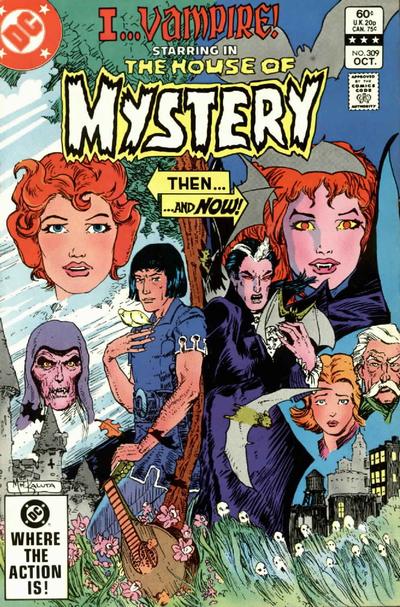
That's what every cover of the famed DC Comics horror anthology begged you to answer. Behind covers by luminaries like Neal Adams, Joe Kubert and Michael Wm. Kaluta, the caretaker of the House, a bespectacled, wild-haired man named Cain, entreated fans to spooky stories. Following in the tradition of previous features like "Dial H for Hero" and "Martian Manhunter," neophyte DC scripter J.M. DeMatteis and veteran artist Tom Sutton brought a new regular series-within-a-series to Cain's House under editor Len Wein, a series that now lives again in DC's "New 52": "I...Vampire!"

Now that Joshua Hale Fialkov, Andrea Sorrentino and Jenny Frison have produced three issues of the new I, Vampire (which I hope all of you are reading!), it's time to take a trip back to 1981 with three of the creative minds behind the series' original incarnation: original series co-creator J.M. DeMatteis (also of Spider-Man, Moonshadow and Brooklyn Dreams fame, among countless others) and series finale co-writers Dan Mishkin & Gary Cohn (also known for the much-beloved Amethyst: Princess of Gemworld and Blue Devil). You'll also see some comments from me on the overall direction of the series, which appeared in The House of Mystery #290-291, 293, 295, 297, 299 and 302-319.

Mike Kaluta's stunning covers are still enticing today.
Around the creation of "I...Vampire" superhero books were the most popular genre in American comics (and remain so today). According to DeMatteis, "When I broke into comics in the late 70's, the 'mystery books,' as they called the horror anthologies, were like the vaudeville of comics. A place for new writers to learn their craft, try, fail, grow, without a lot of attention on them. I sold my first script to [DC editor] Paul Levitz, then started working with Jack Harris and Len Wein. Len became more than an editor, he became my mentor, the first person in the business who made me feel as if I had something unique to offer."

DeMatteis set out to prove his craft when Wein assumed control of the horror titles. "Len wanted to inject some ongoing series into Weird War Tales and House of Mystery and asked me for ideas. I'd already had "Creature Commandos" rattling around in my brain and we set that up for Weird War [introduced in issue #93 with artist Pat Broderick], then Len tossed out a title to me—'I...Vampire'—and told me to go home and come up with a concept. That's just what I did, Len loved it, and we were off and running."

When it came to artistic talent, Wein cast his eye toward veteran horror illustrator Tom Sutton, whose previous claims to fame included being Vampirella's first artist in 1969 and drawing various horror series for Warren, Marvel and DC throughout the seventies. DeMatteis remembers: "I'm pretty sure Tom was Len's choice; but I was a huge fan of [his] work.  He'd illustrated some stories I'd done for the DC science-fiction anthologies and his style was unique, moody, idiosyncratic, emotional.  I loved everything he did with 'I...Vampire.'" Indeed, Sutton would remain on the series long after DeMatteis' departure, either as sole artist or inker over talents Paris Cullins and Adrian Gonzales, even drawing the series' finale.

Joe Kubert established the proper horrific mood with the first issue's cover.
The first "I...Vampire" story appeared in The House of Mystery #290 (March 1981), a few months after the debut of "Creature Commandos" and a month after DeMatteis' Marvel debut (Defenders #92). All the familiar elements of the series are in place at once: Andrew Bennett was the reluctant vampire who made his lover Mary into a less-reluctant creature of the night. To aid him in his quest to stop her Andrew recruited Dmitri Mishkin and Deborah Dancer, two humans terrorized by vampires.

DeMatteis' inspiration for the series' characters? "It's been a very long time, but my sense is that I started writing and the characters just came together. I know I was drawn to the idea of a vampire who wasn't corrupted by the curse, that it worked as a wonderful metaphor for the struggles we have in our lives, the darkness in our souls that we wrestle with, and the desire to live good and decent lives despite that darkness."

The vampire-as-heroic-protagonist idea was certainly less prevalent in the age of "I...Vampire" than today, where characters like Angel (of Joss Whedon's Buffy and his own eponymous series), Stefan Salvatore (of The Vampire Diaries) and Edward Cullen (of the Twilight novels and films) have caught the public's imagination. Like those latter-day vampire tales, "I...Vampire" also had a provocative, if twisted, love story at its center. "Of course the heart and soul of the story was the Andrew-Mary relationship," says DeMatteis. "Here was this woman Bennett loved, adored, worshipped—and the one time he allowed his vampiric hunger to overtake him, he transformed her into something twisted and evil. And he'd lived with that guilt and shame for hundreds of years. In the end, it wasn't enough for him to redeem himself, he had to redeem Mary, as well. In fact, Bennett was far less concerned with his own salvation than with Mary's. He wanted to oppose her and her forces—but, in the end, he opposed her in order to save her."

Andrew Bennett weeps tears of blood for his beloved Mary. Kaluta art.
Of special note to fans of DeMatteis' work is the character of Dmitri Mishkin, Bennett's male companion throughout the years: "I...recall loving the character...especially once I wrote his back story, explaining how he'd been with Bennett since he was a little boy.  It made the character both more heroic and more tragic.  (Mishkin was also Russian, so I was able to express my love of Russian literature, specifically my literary hero Dostoyevksy, through the character.)" DeMatteis made his love for the character manifest in issue #295, which explained Mishkin's origins and revealed that his mother had become a vampire when he was a child, a plot point that would be developed much later.

As for the final protagonist, the lovely redheaded Deborah Dancer: "[She], I think, was an attempt to inject someone younger and more contemporary into the mix," says DeMatteis. Bennett and Deborah definitely shared romantic feelings but dared not openly express them—due, no doubt, to his fear of making her another monster like Mary in a moment of passion and weakness—again, a point worth mining at another time.

Andrew Bennett only made one appearance outside HoM, and this was it. Jim Aparo art.
Bennett had his work cut out for him as a lone vampire allied with two humans against Mary, Queen of Blood and her legion of followers, the Cult of the Blood Red Moon. Whereas Bennett, Deborah and Mishkin were three, the cult consisted of many, often hiding in plain sight among the throngs of humans, ready to pounce, to overwhelm the triad who appeared to be all that stood in the way of their bloody conquest of the Earth. Unlike the latter-day incarnation of the series, the early "I...Vampire" had no elements that directly linked it with the greater DC Universe; in fact, Bennett's only contact with a "superhero," the ever-popular Batman, occurred in another title, the team-up series The Brave and the Bold (#195, February 1983), months before both series' end.

Unfortunately for fans of the series, like Don Corleone, Marvel Comics gave DeMatteis an offer he couldn't refuse in late 1981. "[They] offered me an exclusive contract, so that was the end of my involvement with DC for five or six years." To fill the noticeable void, new editor Karen Berger, who later went on to develop the company's eighties and nineties output into the juggernaut Vertigo line, tapped writer Bruce Jones, who spent much of the seventies on Warren Publishing's Creepy and Eerie magazines.

Jones picked up the series with issue #299 and immediately set Bennett apart from his friends Mishkin and Deborah following an adventure where he nearly killed them both. The series became like a vampire version of The Fugitive, with Bennett wandering from town to town, encountering Mary's minions and dispatching them. The unfortunate centerpiece of Jones' tenure was a multi-part storyline wherein Mary convinced Bennett to use a pair of ancient rings to transport them through time following the development of a vaccine against cancer which made toxic the blood of those who took it. It's difficult to see how Bennett would find Mary's aims anything but transparent (to travel back in time and kill the ancestors of the cancer cure's developer), but he does, and his naïveté nearly proved the series' downfall. What was once a series with incredible pathos instead became a ridiculous exercise in time-travel involving a visit with Deborah Dancer when she was a child and a cat-and-mouse game played between human and vampire pairs of Bennett and Mary during the period before both were transformed.

Bruce Jones' storyline became mired down in too many fantasy elements. Kaluta cover.
Leaving before the conclusion of the time-travel storyline, Jones was replaced in issue #310 by another pair of writers new to DC. Dan Mishkin and Gary Cohn came aboard and immediately underplayed the series' more fantastical elements, returning to DeMatteis' tragic take. According to Mishkin: "We’d been doing a bunch of work for Karen Berger in House of Mystery and for some of the other anthology titles...I assume we came to mind because we were right there on hand. I think that our being in the same generation of younger writers probably influenced her decision as well."

The series was less something Mishkin & Cohn sought out, and more a chance to prove they could work on a regular monthly book. "We were novices, and the opportunity to work in a series format, which is the meat of monthly comics, was something we jumped at. And there's a definite appeal to doing genre work, where you have lots of conventions that you're expected to follow, but readers are always hoping you'll defy convention in a way that surprises and delights them while still providing the satisfaction of conforming to them. That balancing act of working within the constraints of a genre while at the same time challenging them was something we ended up doing pretty well in Blue Devil. With 'I...Vampire,' we were learning the ropes."

Mishkin was attracted to the possibilities offered by the horror genre. "I'm generally attracted to stories that delve into the unreal and impossible, like any other genre geek. The idea of the vampire's sensuality and magnetic personality (of which Dracula is the ur-text), and how that works to break down our conventional notions of morality, is one I've always found fascinating." To that end, he and Cohn returned to the core conflict between Bennett and Mary as well as returning Deborah and Mishkin to central roles in the narrative. Once again raising the cancer vaccine plotline (whose resolution had been interrupted in Jones' time-travel arc), they established that the cure was a facade, and that the lab responsible was headed by a vampire who wanted to eliminate his kin from the world by seeding human blood with the poison. Mary's people found a cure for the toxin at the lab, shared it with Bennett, and the plague was ended.

By this time, the series' sales figures had slumped beyond redemption, and DC's other horror and science fiction series had faded away. The House of Mystery wasn't long for the world. "With that book coming to end, we were told to wrap up the Andrew Bennett saga, and to do it with no loose ends and with a finality that would leave no chance of bringing the character back (a dictate that seems awfully naïve in retrospect)."

The series' finale ramped up with the return of Mishkin's mother Dunya, who per the wishes of her mistress, Mary, insinuated herself with Rev. Edgar Warnock of the American Crusade, actually a vampire working to carry the Blood Red Moon's power to the highest position in the land. Warnock was defeated but Dunya kidnapped Mishkin and turned him into a vampire and they fled to Russia. Bennett and Deborah, in pursuit, found out through vampires who'd infiltrated the KGB that Soviet scientists had developed a substance to eliminate vampires' need to avoid sunlight and their lust for blood—a key point toward the series' end.

Mishkin's death, depicted by Kaluta.
In the series' 317th issue, Dmitri Mishkin met his end, sacrificing himself so he alone could kill his own mother and thereby save his friends. Dan Mishkin, the series' co-writer (but not, strictly speaking, Dmitri's namesake), found the character's death particularly memorable for the behind-the-scenes events. "It was always a little funny writing a character (not invented by me) who shared my first initial and last name, and when we came to his death, I was amused by the thought of seeing a beautiful Mike Kaluta cover that featured a headstone with the legend "Rest in Peace D. Mishkin." But when I suggested it to Karen Berger, she declined out of a superstitious concern for my well-being. Which was really quite sweet, looking back, though I would have loved to have been able to buy the original art from Mike."

After Mishkin's death, two issues remained, during which Bennett decided to gamble with his un-life and imbibe the substance the Russians developed. While he seemed fine at first, able to tolerate the Sun's rays and survive without the need for blood, he soon discovered its unfortunate side-effects. Having become a vampire several centuries earlier, he found that the return of his humanity also brought rigor mortis, making him a prisoner in his own body. Upon their final confrontation with the Blood Red Moon, Deborah took the formula before encountering Mary, and when the Queen of Blood bit her, she instead became a new breed of vampire with all the immunities the substance provided. So empowered, she brought Mary into the Sun and killed her before saying a final farewell to Bennett, who scattered into ashes as Deborah wept tears of blood for him, the man she loved. It was an unusual finale to the series, empowering Bennett's human love and having her be the one to end the conflict in the fallen protagonist's stead.

The writers called the finale their favorite moment on the series. "Though it’s sad to leave behind characters that you’ve become invested in (also to leave behind a regular paycheck), there's a way in which wrapping up a series was as gratifying as the original opportunity to shepherd one. So much of monthly comics involves keeping the pot boiling that it's easy to get in a rut that's as unpleasant for the creators as it is for the readers. With the chance to do a big finish, we probably turned out our best work on the series—although, given the previous comments about being novices and learning the ropes, and the overall quality that that produced, calling something our best work in this context might not be saying much."

Bennett finally met his end with issue #319. Art by Kaluta.
Although "I...Vampire" ended with issue #319 in 1983 and The House of Mystery soon followed with #321, fate, it seemed, was not yet done with Andrew Bennett. When DeMatteis united with artist Shawn McManus on a Doctor Fate series in 1988, the last-page surprise in the first issue was Bennett's shocking return! The six-issue arc dealt with his inexplicable resurrection and his attempts at redeeming himself for his tortured past. "I really liked Bennett, and his inner struggle for redemption fit right into the themes I was exploring in my first arc in the ongoing Doctor Fate series I did with Shawn McManus," offers DeMatteis. "It was a treat to return to the character and his world—I especially enjoyed the Zen monk vampires he was allied with—after something like eight years.  I was also a much better writer by then, so I was able to make up for some of the clunkier scripting in my original run."

Bennett's arc ended on a bittersweet note, although certainly DeMatteis left the door open to a more permanent return. "I actually pitched DC on an 'I...Vampire' revival at least once, possibly a couple of times (my memory's fuzzy on the details), but they turned me down," he says. Sadly, DC relegated him to a memory for the next two decades, only allowing him a brief string of appearances in Brian Azzarello and Cliff Chiang's idiosyncratic "Dr. Thirteen" series in the anthology Tales of the Unexpected in 2006-7.

Dr. Fate encountered Andrew Bennett early in his 1988 series. McManus art.
Fans of DeMatteis' original work on the series, which has stood the test of time to inspire the new incarnation, may be surprised to learn the writer did not originally consider himself a major fan of vampire fiction. "I remember reading Bram Stoker's Dracula in college and being surprised by how good it was, but the genre never drew me in any profound way.  Once I started writing for the DC horror anthologies, I had to dip into vampire lore because that was a huge part of what those books did.  The more I explored, the more I enjoyed the genre.  As with Bennett, I saw the vampire as a wonderful symbol of the darkness inside all of us.  The vampire's struggle is the universal human struggle.  'To bite...or not to bite.'  When I went over to Marvel, I explored the vampire mythos, in a very different way, in my Greenberg, the Vampire graphic novel (and the Bizarre Adventures story that preceded it)—which I remain very fond of, and proud of, to this day." DeMatteis has also worked alongside artist Kent Williams on the Epic Comics miniseries Blood: A Tale, a more unusual take on vampirism.

Asked for his opinion of his original "I...Vampire" tales, the author admits, "To be honest, I haven't gone back and looked at those stories in a long time.  I'm sure I will once the collected edition comes out early next year.  I'm sure there's a lot I would have done differently, simply because, as noted, I'm a better writer, a better storyteller, now.  That said, 'I...Vampire' was my first original creation in comics and I poured my heart and soul into it.  It was, at the time, the absolute best I could do.  So, in the end, I think I should leave my younger self alone, respect him and let his work stand on its own."

Jenny Frison illustrates the new "I, Vampire" covers.
Understandably, with his wishes to bring back Andrew Bennett a few times in the intervening years, DeMatteis is proud to see his creation return in DC's "New 52" this fall. "I loved writing and creating that world and those characters and...based on the first issue of the new series, Josh Fialkov is doing a bang-up job reimagining Andrew Bennett's world.  I just hope Mishkin shows up somewhere along the way!"

So do we, Mr. DeMatteis. So do we.

"I...Vampire" will be available in a DC Comics collected edition with a projected on-sale date of February 8, 2012. Consult your local retailer for ordering information, or order it from Amazon.com, Discount Comic Book Service or any shop you trust.

Please visit writer emeritus J.M. DeMatteis on his blog, Creation Point, at jmdematteis.com! And Dan Mishkin is at danmishkin.com!

31.10.11

Hallowe'en: Ten (Doctor) Strange Tales

Happy Hallowe'en, all!

Welcome to one of my Hallowe'en installments of Delusional Honesty. Originally, I was going to get to some comments on "I...Vampire!" the original series by J.M. DeMatteis, Tom Sutton and a host of other talent. It's still going to be a few more days until I can make that article just the way I want it, so I wanted to give everyone something else that's closely involved with the macabre.

Saturday night on Google+, Marvel and Aspen writer Greg Pak (whose Dead Man's Hand #0 is now available!) posed a question after having read a particular story: Which Doctor Strange stories are fans' favorites? Well, let me tell you, that suggestion made the wheels begin to turn!

Although most of you know me as a die-hard Hulk fan, and those of you who listen to me at Comic Book Noise know I'm well-versed in the ways of Spider-Man, you might not know I'm also of the opinion that Stephen Strange is one of Marvel's best, most underrated heroes. Indeed, between five volumes of Marvel Masterworks and hundreds of back issues, I've read every issue of Doc's adventures in his solo mags. (And from a certain Green Goliath's association with an unusual Non-Team, I've got each of his appearances in Defenders, too!)

Forthwith is my assemblage of Doc's ten greatest adventures, in chronological order. (Greg, don't let anybody tell you I never gave you anything.)

Shall we begin? Tamam Shud!

1. Strange Tales (1951) #126-146
By Stan Lee & Steve Ditko

Lee and Ditko, also famous for creating the amazing Spider-Man, created Doctor Strange in Strange Tales #110, cover-dated July 1963. Although it took them a few issues to get their feet under them, the first time everything really "clicked" for the duo was issue #126, "The Domain of the Dread Dormammu!" The storyline introduced Dormammu, an other-dimensional sorcerer, as well as the then-nameless girl who'd soon become Strange's student and paramour, Clea. A number of other noteworthy events occurred within these pages, too, like the Ancient One's gifting of the Cloak of Levitation that has become a trademark of Strange's look. Having then-established villain Baron Mordo as Dormammu's earthly servant sealed the deal. And even if it didn't, well, there's always Eternity...!

Currently available in graphic novel format in Marvel Masterworks: Doctor Strange, Vols. 1-2 or Essential Doctor Strange, Vol. 1.


2. Doctor Strange (1968) #175-178
By Roy Thomas & Gene Colan

After spending years as a co-feature in Strange Tales, Doc finally graduated to his own series in 1968, with the numbering scheme picking up from there. Roy Thomas first teamed with Wally Wood protege Dan Adkins, and then Tom Palmer, but then hit the big time with the arrival of Gene "The Dean" Colan. The stories, running from #172 until the series' premature conclusion in 183, were the most mature Doc tales we'd seen to that point, in large part due to Colan's influence as a visual storyteller, and Palmer's incredible inking style. Those talents were on prime display in "Unto Us...The Sons of Satannish!" where Doc takes on a demonic cult and emerges nearly a different character. (This is the birth of the "costumed" Strange you may have heard about, but believe me, nothing about it belies Doc's history.) The storyline comes to a head in Avengers #61 and Dr. Strange #178, wherein Doc teams with the Black Knight to face both Ymir and Surtur. What more needs be said?

Currently available in graphic novel format in Marvel Masterworks: Doctor Strange, Vol. 3 or Essential Doctor Strange, Vol. 2.


3. Doctor Strange (1974) #1-2, 4-5
By Steve Englehart & Frank Brunner

Doc may have been left his career as a sorcerer behind shortly after the conclusion of his first series, but once he came back as a founder of the Defenders, could a new solo series be far behind? After spending the first few issues in a quasi-adaptation of H.P. Lovecraft's Cthulhu mythos, Marvel handed the reins to Defenders scripter Steve Englehart and artist Frank Brunner, then known for his work on Warren's horror magazines. The two deftly concluded the Lovecraft storyline before launching into a pair of epics: "The Sise-Neg Genesis" and this four-part storyline that introduced a dark analogue to Strange--disgraced man-of-the-cloth Isaiah Curwen, the Silver Dagger. This epic struggle starts with Strange's death, and stretches across other dimensions with their own challenges. (Ever wonder why an ankh sometimes appeared on Strange's brow during a battle? You'll discover that secret here.)

The Silver Dagger is handily defeated in this storyline, but he would return later to menace Dr. Strange plus Spider-Man and Ms. Marvel in Marvel Team-Up #76-77 and 80-81, which get an honorable mention here. In a story by Chris Claremont, Doc is driven to the edge of sanity and beyond, eventually becoming a werewolf. Unusual? Yes. One of my guilty-pleasure favorites? Absolutely.

Currently available in graphic novel format in Marvel Masterworks: Doctor Strange, Vol. 5 or Essential Doctor Strange, Vol. 3. The Marvel Team-Up tales are currently unavailable.


4. Doctor Strange (1974) #10-13
By Steve Englehart & Gene Colan

Englehart continued on the series after Brunner left, and the series only increased in intensity. Gene Colan and Tom Palmer returned, illustrating this book on even months and Tomb of Dracula on the odd. As books like Warlock and Captain Marvel flirted with cosmic concepts, so too did Strange's, with this gem among the most powerful. Eternity comes to the Doctor, telling him the world will end! Meanwhile, Baron Mordo, reduced to a babbling idiot after having glimpsed the birth of the universe, may not be so powerless as he appears. Doc faces iterations of his past selves as he fights to save the Earth, and it all climaxes explosively! (And hey, what is the secret of Adam Qadmon?) Certainly not to be missed by any "cosmic Marvel" or Doc aficionado.

If you're a fan of cosmic Marvel stories, you may also want to check out Jim Starlin's too-short tenure, as Doc fights the Creators with their "Cosmic Wheel of Change" and tries to disrupt their deadly scheme of transforming themselves into stars (which had the effect of changing stars into humanoid entities). Starlin only worked on #24-26, but the entire "Creators" epic took place over #19-20, 22-28 with work from writers Marv Wolfman and Roger Stern.

Currently available in graphic novel format in Essential Doctor Strange, Vol. 3.

Speaking of Roger Stern...


5. Doctor Strange (1974) #48-53, 56
By Roger Stern & Marshall Rogers

World's worst-kept secret: Once upon a time, comics superstar Frank Miller (no relation!) was to have been artist on Doctor Strange alongside writer Roger Stern. You can even see house ads in 1981 announcing this combo, accentuated by a thrilling piece by Miller. Unfortunately, that supreme duo wasn't to be, but we may have seen something better in its place. Enter: Marshall Rogers.

This storyline, in six parts with an unofficial epilogue in #56, began with the introduction of a new companion of sorts for Doc in Morgana Blessing. She, like Strange's friend Victoria Bentley before her, possesses a degree of untapped supernatural potential. Intrigued by Strange, she attempts to get closer, only to find herself in the middle of an epic involving the return of Baron Mordo, his transformation into a cat (!), and their travels through time to stop Dormammu from escaping the Dark Dimension (alongside Sgt. Fury and his Howling Commandos) as well as into Ancient Egypt where we see the Fantastic Four's first battle with Rama-Tut from a different perspective! The story also brings to a head developments with Clea, caught in the quandary of being both Strange's disciple and lover. Much of the storyline falls into "seen to be believed" territory, and the epilogue, an interview between Blessing and Doc with art by Paul Smith, is sublime.

Currently available in graphic novel format in Essential Doctor Strange, Vol. 4. 


6. Doctor Strange (1974) #58-62
By Roger Stern,  Dan Green & Steve Leialoha

Just as I've got two stories by Steve Englehart on this list, now we've got a second story by Doctor Strange scribe supreme Roger Stern! This one serves as an epilogue to the late, lamented Tomb of Dracula series, with Doc teaming with the Avengers, Blade, Frank Drake and Hannibal King to take down the Lord of Vampires, who'd seen something of an uptick in appearances with the absence of his own book. He appeared in Uncanny X-Men; he appeared in Thor. Doc and Dracula both race to find the demon bible called the Darkhold, but for different reasons. A passage inside, called the Montesi Formula, contains the secret to ending the vampire threat once and for all. But, what will that solution mean for heroic vampire Hannibal King...?

The "Destroy All Vampires" storyline took these things that go bump in the night out of the Marvel mythos for the better part of the eighties, and set up some interesting stories. Its direct sequel, "The Vampiric Verses" (its title a riff on the controversial Salman Rushdie thriller, The Satanic Verses) returned vampires to the Marvel Universe, and is also generally well-done. Roy Thomas and Jackson Guice's story is in Dr. Strange, Sorcerer Supreme #14-18, but its threads begin with #9. It also features the intriguing (at first, anyway) tale of Strange's heretofore-unknown brother, Victor.

Currently available in graphic novel format in Dr. Strange Vs. Dracula: The Montesi Formula. "The Vampiric Verses" currently unavailable.


7. Doctor Strange: Into Shamballa
By J.M. DeMatteis & Dan Green

J.M. DeMatteis has handled Dr. Strange for a number of years, going back to his tenure on Defenders in the early eighties. Is it any wonder he remains one of his favorite characters? I don't want to spoil much of the story here, as it's really brilliant and plays to the character's strengths--why, exactly, wasn't DeMatteis a Doc writer beyond this book and seven issues of his regular series in the nineties?--suffice to say, it's lyrical, it's brilliant, and it's very nearly everything a Dr. Strange story should be. When Strange returns to the Ancient One's former abode, he comes upon a puzzle box. Contacted by the Lords of Shamballa, he embarks on an odyssey whose ultimate goal is the enlightenment of humanity. But then, he discovers the Lords' terrifying secret, and finds himself faced with an awesome dilemma.

Just breathtaking. Go. Now.

Currently unavailable in graphic novel format.


8. Doctor Strange, Sorcerer Supreme #5-8
By Roy & Dann Thomas & Jackson Guice

Roy Thomas returns for his second go-round as Doctor Strange scripter, this time alongside his wife, Dann, as well as artist Jackson "Butch" Guice. Once Roger Stern departed the title, writer Peter B. Gillis trod Strange into dark waters, removing many of his mystic talismans, poking out his eye, having him rely on black magic and bringing him into mortal combat with Shuma-Gorath and other entities that roamed the Earth at the dawn of humanity. The duty fell to the Thomases to bring Doc back from the abyss, and they did it in style here.

In "The Faust Gambit," Baron Mordo returns to menace our resident Sorcerer Supreme, imbued with power far beyond anything he has demonstrated before. Doc is still able to defeat him, however, and traps his soul inside a small sphere before he learns the horrifying truth. Mordo's newfound power comes from promising his soul to not one, but two of Marvel's demonic heavies: Satannish and the mighty Mephisto! With the soul of one of Doc's friends also in the sphere, how can our favorite magician save the world from Mordo's mad scheme? It's an intriguing tale that brings together disparate corners of the Marvel Universe as only Thomas can, echoing various pieces of previous continuity. We even meet Mephista, the daughter of you-know-who, who's got a crush on Strange, much to her daddy's consternation! What more do you need?

Currently unavailable in graphic novel format. Go find the back issues!


9. Doctor Strange & Doctor Doom: Triumph & Torment
By Roger Stern, Mike Mignola & Mark Badger

Third time's the charm for writer emeritus Roger Stern, who outdid himself in this graphic novel which absolutely deserved the hardcover treatment it got upon its 1989 release. Picking up on plot points from several previous Doctor Doom stories (particularly from Astonishing Tales) and presaged by Stern's own meeting between the Doctors in Doctor Strange (1974) #57, Triumph & Torment tells the tale of Doom's annual attempt to free his mother's soul from the clutches of Mephisto. This time, through special circumstance, Strange assists Doom, and the results are unusual and mind-blowing. Add to this rich story some breathtaking artwork by a pre-Hellboy Mike Mignola as well as Mark Badger, and this graphic novel becomes a can't-miss fable in desperate need of being reprinted in the same oversize format as it was introduced.

Currently unavailable in graphic novel format.


10. Doctor Strange, Sorcerer Supreme #60-75 & Annual #4
By David Quinn, Melvin Rubi, Kyle Hotz, Peter Gross & others

Don't let the "Siege of Darkness" crossover stamp on the above issue's cover fool you: This Doctor Strange very much did his own thing during his time among the "Midnight Sons" horror line. The old gave way to the new when Roy Thomas and Geof Isherwood left the book, replaced by Faust writer David Quinn and a herd of artists including then-neophyte Mel Rubi (now known for his work on Dynamite's Red Sonja) and a pre-Lucifer Peter Gross.

His powers severely limited after he declined to participate in a cosmic war at the behest of the Vishanti he served, Strange coordinates many a dark scheme as result. Salome, previous holder of the title of Sorcerer Supreme, returns from the dimension to which she'd been banished, and begins an onslaught on the current title holder. Too weak to resist, Strange cedes his title to the madwoman and begins a series of schemes to regain his former power. Cue the disappearance of Stephen Strange as we knew him, and the arrival of two mysterious entities, each of whom seems to reflect a facet of the man we knew: Victor Stevens, a ruthless businessman, and Strange, a similarly ruthless being of pure elemental magick force. Add Clea into the mix, in the middle of a challenge to her own rule in the Dark Dimension, and what do you have? An intensely fascinating, and daringly different, Dr. Strange epic.

Currently unavailable in graphic novel format. Go find the back issues!


What are some of your favorite Dr. Strange stories?

~G.

26.9.11

Advance Review: "I, Vampire" #1

Yes, it's true! I've been remiss in my reviewing activities. If you must know, I'm writing a book here, and preparing for this year's New York Comic Con that hits in a few short weeks. In answer to your unspoken questions, I've been reading quite a few of DC Comics' "New 52" projects this last month. Why, you ask, have I not reviewed any of those books? Simply put, I haven't found any that have compelled me to put pen to paper (or, as the case may be, fingers to keyboard). But that's changed. Oh, ye gods, how that has changed...

Early on, it was the most derided of all the series DC announced. If it wasn't "DC, how could you try and cash in on the Twilight craze?" it was "DC, why in God's name did you bring that book back, out of all the old books that could've been relaunched?" People didn't "get" why they would bring back Andrew Bennett, who'd been on the scene in the horror anthology House of Mystery for all of two years prior to its 1983 cancellation. They thought, well, obviously we're going to get "emo" vampires, because they're so de rigueur today.

For those who've caught my previous references to this series, as far back as 2007, this one's for you. For those altogether unfamiliar with the first incarnation, this one's also for you. You want to be here for this. You really do...


I, Vampire #1
"Tainted Love"
By Joshua Hale Fialkov, Andrea Sorrentino, Marcelo Maiolo, Pat Brosseau,
Wil Moss, Matt Idelson & Jenny Frison

"Four hundred years ago my vampiric kiss transformed the woman I loved into a soulless thing called Mary, Queen of Blood! Today an unholy order follows her evil designs, and the blood they spill is on my hands! Thus I must stop her...I, Andrew Bennett...I...Vampire!"