Showing posts with label Iron Man. Show all posts

11.5.12

Puny God ("Marvel's The Avengers," Reviewed)


Yes, I've been away writing that book you've heard so much about. Let's remedy that, shall we?

Like many of you, last weekend I went to my local movie theatre to see what's being considered one of this summer's premier events: Marvel's The Avengers, a two-and-a-half hour roller coaster ride of a film starring the headliners from the comic company's five recent in-house productions. In addition to the invincible Iron Man (Robert Downey Jr.), the incredible Hulk (Mark Ruffalo, taking over for Ed Norton), the mighty Thor (Chris Hemsworth) and Captain America (Chris Evans), several other characters seized the spotlight, including SHIELD director Nick Fury (Samuel L. Jackson), agent Maria Hill (Cobie Smulders), Hawkeye (Jeremy Renner) and the Black Widow (Scarlett Johansson).

There was an indefinable energy filling the theatre when my friend Harold and I entered. Of course, I didn't go for just any screening of the film: We bought tickets to the all-day "Ultimate Marvel Marathon" put on by AMC Theatres, wherein all of the previous films were screened back-to-back from 11:30 in the morning all the way through the grand midnight Avengers premiere. The theatre was jam-packed with comics fans in their various T-shirts and other regalia recalling the heroes who were to appear on the screen all day long. (My choice of attire: You need to ask?) Each fan who attended received a special lanyard granting them access in and out of the building, a special release Avengers comic book, and one of four styles of Real D 3D glasses (available in Captain America, Hulk, Iron Man and Thor designs...again, guess which?).

The excitement level started out high, and only elevated throughout the day. Unfortunately, this theatre didn't receive the special introductions by Clark Gregg in his role of Agent Coulson that other AMC Theatres screened. I understand they were quite fun, and I'd like nothing more than to actually see them. Alas, the movies were draw enough. Up front were 2008's Iron Man and  The Incredible Hulk, followed by 2010's Iron Man 2 and 2011's tag-team of Thor and Captain America. In between some of the screenings, theatre employees gave away goodie bags and other special odds and ends to fans who answered depressingly easy trivia questions.

And then, the curtain rose on the final film at midnight. The moment of truth had arrived: Would writer/director Joss Whedon rise to the challenge of directing an action-packed feature filled with the heart and soul we knew was at the core of the mighty Marvel Universe?

You're damned right he would!


From the very first frames--a markedly slow beginning which served to introduce the Cosmic Cube Tesseract, the "MacGuffin" of the piece, locked away in the SHIELD and NASA-sponsored Project: PEGASUS (which any reader of seventies series Marvel Two-in-One will recognize)--I knew something special was happening. And when Loki (Tom Hiddleston) arrived, absconding with the Tesseract and narrowly escaping the Project's destruction, the stage was set. Fury began to assemble his team, and it was a sight to behold, having the stars assembled from the previous films begin to interact and their personalities begin to grate on each other.

Joss Whedon admitted he modeled much of the movie after The Dirty Dozen and Black Hawk Down, war movies which centered not on an overly labyrinthine plotline but on the characters that made up their respective groups. In many ways, Avengers is as much an origin story as Iron Man or Captain America, but instead of showing how the characters got their powers, it's a tale of how they learned to all tolerate each other's annoyances and shortcomings in order to beat the big bad. Yes, Loki is a scenery-chewing antagonist, and yes, he has a rather generic plan to enslave Earth's populace. He has an army which is generally ill-defined but who attack in such terrific numbers that any single super-hero would feel overwhelmed. The characterization of the villains really isn't as important as the scope of their operation. Whedon knows the best way to attack the narrative is in bringing out all the heroes' unique and sometimes grating personalities, and watching the fireworks.

Robert Downey Jr. has the majority of the film's best lines as "genius, billionaire, playboy, philanthropist" Tony Stark, once eliminated from consideration in Fury's Avenger Initiative but now recruited just the same. He's got a bone to pick with just about every member of the team, but learns to work with them just the same. (Especially brilliant is his line to Ruffalo's Banner about just how he's able to control his inner monster. I cackled for a good few minutes afterward.) As any fan of Whedon's television programs (Buffy the Vampire Slayer, Angel, Firefly, et al.) will tell you, the writer/director is an expert at intelligent, snappy dialogue, and here it's no different. The movie is intensely quotable, from Stark's commentary on Thor's cape, to Thor's admission that Loki is his adopted brother, to Loki's quite misogynistic insult toward the Widow. (Yes, let's do look up "mewling quim" and gasp at what we find.) The bottom line is that the snappy dialogue works not just because it's smartly written by Whedon, but because in virtually every case, it all rings true with the characters involved, which is no mean feat in a super-hero film.


Such character moments don't often occur in an action extravaganza like Avengers, and let's make no mistake: This is an action-packed film. And while Downey's Stark may be the master of the witticism, he's physically upstaged in virtually every way by the ever-incredible Hulk. As motion-captured by Ruffalo himself, he steals literally every scene in which he appears, without exception. He may not talk much--and in fact, the theatre was so loud during one of his biggest moments that one could scarcely hear his clearest and perhaps only line of dialogue--but he more than makes up for that economy with the sheer, visceral thrill of seeing him match up against Thor and all manner of alien creatures, cutting loose as only the Hulk from the comics previously could. If you've been upset by the Hulk's seemingly lower strength levels in previous films, you'll find that issue remedied here. This is the Hulk you've been waiting years to see, and I'm hoping against hope that Mark Ruffalo gets to star in his own Incredible Hulk film sooner than later, penned by Whedon or one of his many traditional accomplices. Between actor and writer/director, they have given the character such a synergy that it'd be criminal to not have this character burst free into his own film once more. The formula is just right.

I don't want to go on too long about the movie because I really feel it's important that you see it, and so I'm really holding back on the spoilers. Suffice to say that by the time the ending credits roll, most diehard Marvel Zombies will feel like they've seen the be-all, end-all of super-hero movies. By sharp contrast with Christopher Nolan's Batman cycle, Whedon's Avengers is an unabashed celebration of the super-hero genre rather than a deconstructionist, "real-life" take. Since everyone knows I'm one of the biggest Hulk fans there is, I relish the larger-than-life qualities of that character and the remainder of the characters in Avengers. There are precious few issues with the story--I still don't like Hawkeye's status throughout the first half of the film--but they're outnumbered so greatly by "stand-up-and-cheer" moments that it's hard to remain upset.

And that ending? Stay all the way to the end, folks! You'll see not only the setup for another Marvel film (likely Avengers 2, the threat so great), but also a humorous payoff to what you'd likely believed was a throwaway line in the final battle.

I don't mean to gush, but this is one staggering sci-fi super-hero epic. It really doesn't get any better than this. The Avengers have assembled, and comic book films will never again be the same.

~G.

30.6.11

Avengers - The Crossing: The Terrible, Torturous Tale of TimeSlide & Teen Tony (3)


Finally, the day of judgment has arrived!

Urm, wait. Sorry. Wrong crossover. Wrong company, even.

It was a dark and stormy night deep in the bowels of the Marvel offices...

Alrighty then, no more kidding around: this is the third and final part of my overwrought overanalysis of "The Crossing," covering the four-part "TimeSlide" plus certain epilogues, epitaphs, retcons, and more. It's still not too late to go back and read the previous pieces of the puzzle here and here before proceeding onward.

Before venturing further, it bears stating: I like the storyline, but that doesn't mean I can't laugh at it. (Hard, oftentimes.) I also know that recently, Marvel released a handbook, Blockbusters of the Marvel Universe, that's got a two-page entry all about this storyline. I've read it, and it in no way resembles the narrative you've been digesting here. There are mentions of Immortus, and Space Phantoms, and all kinds of things that were only introduced into the storyline much, much later, when Marvel tried (foolishly, I think) to rework their own history to allow themselves to tell another story. (You know the one, it features the Avengers and goes on Forever.) If my recap gives you indigestion, the one in that book will have you praying to the porcelain god all week long.

If, however, your air sickness bags are full from the last two rounds, go ahead and grab new ones. I promise I'll wait. If you need clean underwear, I'm afraid you're on your own.


Avengers: TimeSlide - Now with 85% uglier art than last month! Art by Roger Cruz & Luke Ross.
With the gastrointestinal distress-inducing pleasantries out of the way, Avengers: TimeSlide opens with a situation we saw way back in Avengers: The Crossing: the attempted infiltration of Avengers Mansion...by the Avengers! Somehow, those ultra-smart Avengers decided "stopping a genius with another genius" meant using the information older Luna put in Hercules' brain to manipulate the time portal in the mansion's basement and venture back in time to snatch a 19-year-old Tony Stark forward to the present. (Was that really right before Kang started pulling strings? Or was that just the best time to align Marvel's armored Avenger with that young and shiny new Green Lantern down the street at the Distinguished Competition? What was his name...Kyle No-Brainer?) The team fights Kang's Anachronauts so they can enter the mansion while Rita DeMara returns to show we're still seeing the same events as in that Crossing special. Captain America returns to the team because sales figures weren't quite the same without him, and besides, Jarvis needs someone to take his side that his younger self would recognize in the past. The Avengers beat back Kang's armies and go through the portal, with Century's staff Parallax guiding the way to the other side sort of like how the advent of DC's Parallax paved the way for ol' Kyle!


In the past, the two Jarvises give each other headaches, and readers' migraines strengthen with ridiculous cameos by Aunt May, Uncle Ben, Peter Parker, Willie Lumpkin, Matt Murdock, Sue Storm and Ben Grimm. Young Tony Stark shows he's still an egghead, no matter his age, by showing off his holographic communicator wristwatch. (Isn't it kewl?) Tobias follows the team and arrives at the Stark Mansion where he kidnaps the Starks. Young Tony returns, the Avengers offer him a (blessedly) abbreviated version of The Story So Far and ask for his help, and he's just crazy enough to agree. He uses his mom's matching holographic cameo to track his parents to Latveria (because we just had to have yet another appearance by another character from today's Marvel U). Although Tony, in a red-and-gold costume obviously meant to remind us of Iron Man, tries his best, his parents die thanks to Tobias, yet he agrees to go with the Avengers and avenge their deaths instead of doing what any sane person would do and tell them to go screw. Malachi retrieves his brother and Dr. Doom lets the Avengers use his time platform to return to the present, taking the opportunity as they depart for an Evil Twisty Mustache Moment. Bwa-ha-ha, he'll get those rascally kids soon.

Haggard and bearded = bad. Smooth as a baby's butt = good!
In Invincible Iron Man #325 with the Avengers again in the present, 19-year-old Tony Stark is in awe of his future self's lab like any nerdy 16-year-old would be, while Masque and Hawkeye debate whether he'll be any match for his older self. Meanwhile, Old Tony mopes in his Antarctic lair, Mantis relates her life's story to her "son" Malachi, and Kang trains his "son" Tobias against a legion of his Anachronauts while regurgitating his maniacal plan to raze the Earth, yadda yadda. Mantis thinks to herself how she used to be the Celestial Madonna, but how that title was stripped from her, and since the Avengers "didn't care" she began an allegiance with Kang. She refers to their enemy as "The One Who Comes" and "The Dark One." How much more obtuse can you get? Finally, she comes to Old Tony and licks his tears away (which, oddly enough, are colored as blood).

We wisely cut away from Tony's overwhelming bow-chicka-wow-wow to Avengers Mansion, where the team determines the time portal vanished after they traveled through it. Quicksilver and Crystal lament their missing daughter (aww...), and Captain America rounds up the team for a charge on Stark's Antarctic lair only to have them all stopped by Henry Peter Gyrich and a host of Mandroids. Hey, where's Century when you need him to teleport everyone away? That's right--for no damn good reason, he still hasn't returned from TimeSlide! D'oh! I smell a deus ex machina!

Ooh! Aah! Old Tony rips Teen Tony's heart out! Art by J. Calafiore. Screams by Sam Kinison.
Believing the other Avengers are on their way, Hawkeye, Masque and Teen Tony arrive at the fortress, and Tony proves one more time that he's, well, Tony, by passing a retinal scan and speaking the magic word to enter the complex. (Was The Once and Future King one of Teen Tony's favorite books, too?) Tony and Hawkeye find a wall of Iron Man armors Old Tony's used over the years (and some he hasn't because they're just too fugly). Speaking of the old fogey, he finds Hawkeye and Masque, and Marianne Rodgers emerges! Faster than you can say brouhaha, they fight, even as Teen Tony jailbreaks one of the fugliest armors. Back at the mansion, Century finally arrives to teleport the rest of the Avengers to where the action is. Teen Tony stops his older self from killing an Avenger that's actually worth a damn (plus Masque and Marianne). They fight, and as the Avengers arrive, Old Tony makes spaghetti out of Teen Tony's heart, because if he's become a heartless S.O.B., then the young'un has to be, too. Old Tony teleports out, Kang and his army teleport in, and the Battle of Who The Hell Cares is ON! Yeah!

"The Crossing" concludes in Avengers #395, whose cover tastelessly advertises "The Death of an Avenger!" The Avengers fight Kang's crew between the bunker and Chronopolis, and that includes Cap fighting Mantis, who is a formidable martial artist (a fact neglected so far!). What is coming is on the Avengers' heads, she says--"[their] past together proved nothing but a prelude to the end of all there is, was, or ever will be" and "[her] new family is the last chance for each and every one of us." Strangling Cap, she continues: "One of yours chose another over this one, drove this one to a loveless union with a man that was not a man...spawning a monster in the form of a messiah. And if he cannot be punished for it, Avenger, you surely will be." And if that commentary didn't reveal the identity of "The One Who Comes," I'll...um, I'll explain it later.

Teen Tony has a near-death experience courtesy of the Vision, who has merged his body with the dying lad's because be obviously must survive to become the new Iron Lad...I mean, Iron Man. And Old Tony, realizing his number is up and his Joe Madureira-designed armor is so 1995, decides to redeem himself, rescuing the Cotati Swordsman, who's growing branches all over the place. Then, Vision is apparently free of Teen Tony, and comes to fight Mantis, because his choice of the Scarlet Witch over her was the event that led to everything she talked about. In pitched battle with the Avengers, Kang admits Henry Pym was his first choice to betray the Avengers, but that his attempts to bring him under control only resulted in his legendary nervous breakdowns.

Kang caused those nervous breakdowns! Art by Mike Deodato.
Old Tony arrives with the Cotati Swordsman, and while the latter wraps up Mantis, Tony sacrifices himself , redirecting Kang's weapon back at itself, saving the world! Kang gives up on the current era, high-tailing it to Chronopolis and returning the Avengers to the Temple of Agaphaur instead of the Antarctic. With his dying breath, Old Tony gives the Avengers the schematics for his chest plate so Teen Tony can survive. And to close off yet another loose end, Tuc returns young Luna to her parents. Yippee!

In the epilogue, Age of Innocence: The Rebirth of Iron Man, Hank Pym heeds Old Tony's last request, performing surgery on Teen Tony to keep him alive. While an unconscious Teen Tony fights for his life, those nearest to Old Tony relive their best memories of their friend and boss. Masque visits the younger Tony, shapeshifting into Meredith McCall and all the girlfriends he wouldn't recognize, including Kathy Dare, Janice Cord, Gretl Anders, Dr. Su Yin, Whitney Frost, and Bethany Cabe. Marianne Rodgers psychically visits Tony's innards (someone tell me how that works?) while outside, a shadowy enemy in a long, McFarlanesque red cape goes booga-booga and threatens that Old Tony's foes are just begging for a shot at the young one. Then it's daylight, and it was all a nightmare! No, wait--Teen Tony's still here. Oops. (Don't worry--he'll be gone faster than you can say "Onslaught.")


"The Crossing," such as it was, appeared during one of the worst periods in the history of publisher Marvel Comics. While in previous years Marvel had expanded dramatically with multiple editor-in-chiefs in charge of its major product lines, in late 1995 the line constricted during the event dubbed "Marvelcution," and was again brought under the control of a single editor-in-chief, Bob Harras. Harras was co-writing Avengers with "Crossing" architect Terry Kavanagh at the time of his promotion, and had to leave the book before the storyline concluded, as he simply didn't have the time to devote to the series.

Oddly, time, or rather the lack thereof, doomed "The Crossing," as surely as the time-traveling adversary Kang stood at the center of the 25-part epic. From the very start, line editor-in-chief Mark Gruenwald was under the gun in all facets of development. How else does one explain 21 pencilers drawing 25 stories, often with two or three pencilers working on any given story?  It's true that many artists, including Jimmy Cheung and J. Calafiore, have gone on to bigger and better things. Even still, aside from Mike Deodato Jr., few of the artists had a professional enough look to be anywhere near this high-profile a project. (Interesting note: Daredevil artist supreme Alex Maleev made his Marvel debut drawing the cover to Iron Man #321!) The wildly inconsistent art was and remains a key barrier to any mass appeal. (That, and the fact that at no time were the chapters of the storyline actually numbered.)

You're darn tootin' Ed Benes' art got better. Dig that sensational title!
While the writing team across all the books stayed relatively stable, with Harras and Kavanagh alongside relative neophytes Dan Abnett, Andy Lanning and Ben Raab, it's painfully clear the storyline had its faults, too. Particularly weak was the unending barrage of mysteries without resolutions, with writers apparently thinking there were never too many plates in the air. What's more, few of the mysteries were really all that mysterious. Tuc and Luna were brother and sister, although the question of Tuc's father remained unknown. Tobias and Malachi, from their powers and Kang's dialogue about not really being their father, were obviously meant to be the children of the Vision and the Scarlet Witch. At the very least, due to the direction of continuity guru Mark Gruenwald in the year before his death, the series of events whereby the Avengers brought a time-displaced Tony Stark to the present violated no rules of Marvel time-travel, as in previous stories (i.e. Marvel Two-In-One #50) he had well established that traveling into one's past only creates a divergent timeline and does not affect the main "616" continuity. (How this affects Kang's jaunts through time, well, *sigh*.)

Many of the key points of the storyline had their genesis in Steve Englehart's aforementioned "Celestial Madonna" storyline, to the point fans might be all but lost without having read it. That storyline was where the bulk of Mantis' development came about, including her relationship with her father, Libra, and her martial arts training with the Priests of Pama at the Temple of Agaphaur. It established the initial conflict between Kang and Mantis, and solidified the idea that Kang, Rama-Tut and Immortus were all the same being in different periods of his life. Finally, it united the Vision and Scarlet Witch, with Immortus marrying both them and the Cotati Swordsman and Mantis. That final event provided the impetus for the "villain" of the greater arc that "The Crossing" was intended to start: the Celestial Messiah, son of the Cotati Swordsman and Mantis, as all-but-stated in Avengers #395. I must say, I'd be very anxious to see what was planned for that character's eventual arrival. (The actual Celestial Messiah, Quoi, finally appeared much later in Englehart's direct "Celestial Madonna" sequel, Avengers: Celestial Quest, in 2001.)

Quoi, Mantis' "real" son and the "real" Celestial Messiah. At least 'til it's retconned.
Unfortunately, sales were flat at the close of "The Crossing," leading to an almost-immediate shift in company policy that heralded the premature end of the saga's status quo. Two series integral to "The Crossing"--Force Works and War Machine--wrapped up their runs only two months after the storyline finished. To help raise flagging sales across the line, Marvel hired Jim Lee and Rob Liefeld, two artists who'd departed to form Image Comics a few years before, and assigned them the "Heroes Reborn" event. Liefeld developed an Avengers reboot that began in the aftermath of the line-wide event, "Onslaught." (Liefeld's series would stink on ice, leading Marvel to bring Thor super-writer Walt Simonson in to "save" it. But that's another article.) To ramp up to "Onslaught," Marvel replaced Kavanagh and co-writer Ben Raab with fan-favorite Mark Waid for all of three issues (#400-402) that concluded the first series. They only maintained "The Crossing's" status quo, kicking the series in neutral until the inevitable reboot. Moonraker even put in one appearance in Avengers Mansion's medlab, recuperating from his injuries, and then he just vanished. The one new character from this brief period, Benedict (from Avengers #398-399), turned out under subsequent writer Kurt Busiek to be an android under the command of Madame Masque, sent to retrieve Masque, her eponymous clone. Her story and that of the gold coin Benedict gave the Avengers concluded in their next appearances, Avengers/Thunderbolts: The Nefaria Protocols, (Avengers #31-34 and Thunderbolts #42-44).

Busiek also took it upon himself to resolve the various plot threads of "The Crossing," to various degrees of success. Rather than deal with the impending threat of a "Celestial Messiah" per Harras, Kavanagh & Gruenwald's original intent, he brushed the entire arc aside as the machinations of Immortus. The first hint at the change was Libra's denial of having ever been Moonraker (Avengers Forever #2). As seen in a tremendous info-dump in Avengers Forever #8, the Time-Keepers charged Immortus, Kang's future self, with protecting timelines, and did not want one to take place in which the Avengers became a galactic conquering force. To that end he briefly manipulated Iron Man (not, as was claimed, for years) and he and a group of Space Phantoms staged an elaborate ploy to keep the Avengers earthbound long enough for Onslaught to require their full attention. Hence, many of the players in "The Crossing," including Moonraker, adult Luna, Tuc, Mantis, Malachi and Tobias weren't who they claimed to be, with their leader Immortus disguising himself as Kang. To date, Neut remains an unknown quantity, having no connection to any contradictory Avengers history. Gilgamesh has recently returned to life without a discussion of his previous whereabouts, so his status during "The Crossing," including his possible death, is unconfirmed. Also in Forever, Immortus admitted his story about causing Pym's breakdowns was a lie.

So glad Libra didn't mention the g'dawful movie of the same name, yeah?
Outside Avengers Forever, other writers continued to refute the events of "The Crossing." Mantis and the Celestial Messiah returned none the wiser (Avengers: Celestial Quest), and the Vision and Scarlet Witch's children eventually stood revealed as Speed and Wiccan of the Young Avengers (with a teammate who was, ironically enough, a teenage Kang clad in armor reminiscent of Iron Man). Busiek planned to address the post-"Heroes Reborn" period in an Iron Man event tentatively titled A Look Back in Armor; however, the project was never scheduled, so instead he settled on a few paragraphs' explanation of the return of Iron Man and Wasp's more traditional appearances in Avengers Annual 2001, relating them to Franklin Richards' reordering of reality that began the "Reborn" event. Stark remembered all of his previous lives, including his "death," Teen Tony's life, and all of "Heroes Reborn." Swiss-cheesed doesn't even begin to cover the state of poor Tony's brain. Maybe that's what drove him nutso and led to the Marvel Civil War?

Writer Howard Mackie also had his shot at dismantling "The Crossing" in the 1997 one-shot Tales of the Marvel Universe, where Rhodey divested himself of the Eidolon Warwear armor (which Skye, obviously a servant of the Messiah, claimed was bonded to him "forever") by sending it into Stark Enterprises' computer system like a virus. He meant it to purge all Stark's sensitive data so that Fujikawa Corp., who just took over the company, couldn't get their mitts on it. Marvel cared so little, they let the story go to press with two pages of duplicate dialogue! (But seriously, why did these stooges of Immortus'--as I presume Skye would have to be--try to get Rhodey to go into space to track the Eidolon when he wanted the rest of the team to remain on Earth so they couldn't start that galactic Avengers army? I guess it takes all kinds to make the universe go 'round.) What I wouldn't give to see that suit return, all pissed off at Rhodey for having tried to get rid of it!

The legacy of "The Crossing" is alive and well in Suzi Endo.
The only remnant of "The Crossing" that has weathered the 15 (!) years since the storyline ended is Suzi Endo, whose origin is an intriguing one. Originally she wasn't the Cybermancer of Force Works #17; rather, Stark brought another universe's Suzi (that term comes up a lot, doesn't it?) to the main Marvel Universe, and put the real Suzi on ice. After "The Crossing" concluded, in the two-part Force Works finale in #21-22, the members of Force Works that didn't run away screaming back to the Avengers thawed "our" Suzi, and she became Cybermancer in order to help stop the evil version of herself. Greg Pak, a name familiar to readers of this blog, took a liking to Endo in recent years, using her in his War Machine series and even more recently in his Silver Surfer miniseries, the latter as a herald to the High Evolutionary and love interest to the Surfer himself. Not bad for a character who started as a bit player in Force Works and whose evolution leapt forward in a storyline most Avengers fans openly revile.

Overall, while Busiek's dissection of "The Crossing" was grist for the mill for his from-the-ground-up revisionist take on the Avengers' relationship with Kang and his many alternate selves, it really did genuine "Crossing" fans a disservice by reducing their favorite situations and characters to bit players in what amounted to an elaborate stage play--the ultimate metafictional creation that's become even more ludicrous to think about in its new context. What could have been a terrific story engine, with Moonraker's struggle against himself and his adjustment to this new parallel reality, to the developing mystery of the Celestial Messiah, to the eventual reunion between the Vision, the Scarlet Witch, and their sons, to the ongoing dramas involving Rhodey's Eidolon Warwear and yes, even the further adventures of Teen Tony, all of it's been wiped away, most by Busiek, some by other writers.

He's a Space Phantom, she's a Space Phantom, wouldn't you like to be a Space Phantom, too?
More than any event in comics over the last several decades, Busiek's Avengers Forever demonstrates a contempt for the source material. Just because he didn't agree with facets of the storyline, debatably didn't have any way to find out how other writers planned to continue it, felt that many Avengers fans shared his opinions, and had his own story to tell that he felt worked best by bulldozing continuity, that didn't give him the excuse to dump on a story that had some potential diamonds in the rough. Avengers Forever could have worked quite well without reducing "The Crossing" to an even more ridiculous shell of its former self. It reminds me of what Marvel also tried to do with Spider-Man during the same timeframe as "The Crossing," inserting the Spider-Clone as the "real" Spidey and hence implying that the last two decades of stories didn't matter because we were now being told the Spider-Man in them wasn't the real Spider-Man. That one smarted, and Marvel even had to concoct a one-shot, The Parker Years, just to deal with fans' fears. Still, Peter Parker eventually returned as the one, true Spider-Man because fans felt slighted.

I'm not saying "The Crossing" was a great story, or even a good story. But I do like it, and I like it because it was ambitious, perhaps overly so. So Tony Stark killed who again? The Avengers' nanny, Force Works' PR lady, and somebody who was only an Avenger in an annual a few years back? His targets were damage control in and of themselves. I liked the idea of exploiting Kang's utmost advantage over the Avengers--that he was such a master of time travel, he could disappear and then reappear fully armed for another round of battle, or specifically, he could monkey with the timestream, manipulating your friends into your enemies, sowing sleeper agents. I liked the idea of a Marvel hero with a suit of alien armor, and Rhodey worked because he wasn't Tony Stark. I liked the suspense of the door in the basement. I liked the idea of having to go back in time to see an uncorrupted version of the hero-cum-sleeper-agent...although it would have been nice to see exactly how Kang gained that foothold in Stark's psyche--and perhaps stopped him instead of launching into the Teen Tony nonsense.(Yes, you'd have to have some method of changing time for good, as apparently Kang had, else how was he able to mold Stark as he did?) I liked the lapsed Avenger gone bad, with Mantis becoming the mirror opposite of what she'd been in the "Celestial Madonna" storyline. I liked the idea of her son becoming what Kang perceived as a great, cosmic-level threat, and wondered about the implications of such a being's relationship with the Avengers. And Moonraker, in spite of the ridiculous name, I enjoyed for his complex relationship with Force Works in general and Spider-Woman in particular. (A fascinating idea, that his history from a parallel world came with him.) The pieces were all there for a grand Avengers epic, but spread out across too many titles, like the Spider-Clone storyline that ran for over two years. The storyline blurred focus, with too many plates in the air, and with the art especially it suffered.

Ssssssssmokin'!
But yes, Teen Tony ranks among my guiltiest of pleasures, mostly because for one brief, shining moment, I saw the utter lunacy of what could have been. Of course he couldn't have stayed a teen and eventually we'd have to get the old Tony back. (Am I wrong in thinking of Teen Tony every time I watch Iron Man: Armored Adventures?)

So let's all have a moment of silence for "The Crossing," not for what it was, but what it could and should have been.

And then, let's get back to laughing at it. But not too hard, for pity's sake.

Let's see this puppy in collected editions in '12, yeah?

~G.

SUGGESTED READING:
  1. Iron Man #319
  2. Avengers #390
  3. Avengers: The Crossing
  4. Force Works #16
  5. Invincible Iron Man #320
  6. Avengers #391
  7. Invincible Iron Man #321
  8. Force Works #17
  9. War Machine #20
  10. Avengers #392
  11. Invincible Iron Man #322
  12. Force Works #18
  13. War Machine #21
  14. Iron Man #323
  15. Avengers #393
  16. Force Works #19
  17. War Machine #22
  18. Force Works #20
  19. Invincible Iron Man #324
  20. War Machine #23
  21. Avengers #394
  22. Avengers: TimeSlide
  23. Invincible Iron Man #325
  24. Avengers #395
  25. Age of Innocence: The Rebirth of Iron Man

4.6.11

Avengers - The Crossing: Worse Than Visiting Betty Ford, As Voted By Iron Man (2)

Welcome back my friends, to the show that never ends...

Continuing my (over-)analysis of "The Crossing," the storyline many Avengers fans decry as a mighty embarrassment, this time we're getting to the middle seven pieces of the puzzle, where the immediate mysteries are (somewhat) resolved and the team undergoes some drastic changes, for better or worse. We'll begin with Force Works #18, which technically belongs in our last installment but whose revelations fit much better in this segment. We'll then ramp up to the four-part finale, "TimeSlide," wherein...well, you know. Everyone got their air sickness bags? It's gonna be a bumpy ride...

Nothing quite like headache-inducing exposition with your cliffhanger, eh?

Force Works' Hex-Ship crash-lands in the lost land of Vietnam. Back at the home base, Cybermancer and Spider-Woman's daughter Rachel wonder what's become of the team and Works PR rep Amanda Chaney realizes she can't remember anything about Moonraker having joined the team. (News flash: ask Abnett & Lanning!) She asks the Works computer Plato instead, and they discover temporal radiation emanating from a previously-unknown sub-basement. The basement contains Virgil, a "global chronography analysis and control suite" created by Timely Industries, a company founded by Tony Stark in 2009--fourteen years in the future. (Readers may remember "Victor Timely" was one of Kang's aliases from the early 20th Century. That sound you just heard was every continuity nerd's head exploding.) In Vietnam, Moonraker comes across the Temple of Agaphaur built by the Priests of Pama. A team of Anachronauts engages the team in battle. In the middle of the fight, a boy exposed to "chronal energies" transforms into an adult, winged creature the Anachronauts call an "alpha-level candidate," hinting at their endgame while the rest of us are swatting at the swarm of buzzwords. His memories resurfacing, Moonraker reveals himself as Gustav Brandt, formerly the rogue called Libra--and father to Mantis. (Dun dun DUNNN.)

"Dance, puppet, dance!" cries the Conqueror!

Next, we rejoin Tony Stark, newly outed as a TRAITOR!, back on Chronopolis among Kang, Mantis, the Professor, Mary Ann and a host of Anachronauts. Kang reveals that their longtime enemy is ready to make his move, years ahead of schedule, and that they must secure this "temporal beachhead" so they can defeat him. (Hey, wait...what are years to time travelers?) Stark returns to Works HQ to find Amanda in the sub-basement. Chased by Stark, she finds freezer units, one of which is occupied by Suzi Endo, which begs the question: who is Cybermancer? That answer must wait until just before cancellation, as Stark coldly kills Amanda then activates Virgil's "Siege Perilous" protocol, synching up with a recently-launched satellite. War Machine flies to The Works while USAgent and Black Widow pursue on land. Meanwhile in Vietnam, Brandt reveals that when he died, the Priests of Pama saved his spirit and grafted it to the body of Moonraker, who in an alternate reality was a trusted member of Force Works. They sent him as a warning against Mantis to be activated when the time was right. When Moonraker crossed from the alternate reality of his creation to this one, his history, including his romantic relationship with Spider-Woman, crossed too. (Say huh?) He says Kang plans to reshape the Earth with his "chronographic powers" which, loosed on Vietnam, caused the young boy's metamorphosis from the last issue. Many will die, but those that mutate like the boy will fill Kang's Anachronaut ranks.

Back at The Works, Century, an alien member of the team, returns from a solo adventure as Rhodey arrives. As before, Stark tries to convince Century how "they've all turned against [him]," but he doesn't take the bait and saves Rachel and Rhodey from being blasted to bits. Century takes Rachel away, and Rhodey transforms into his new alien War Machine suit to take on Stark...and it's on like Donkey Kong. But with uglier art.

Are Stark and Rhodey in those suits, or did the Hulk take over? Art by Fred Haynes.

War Machine and Iron Man square off, and Stark is as fierce as Rhodey's ever seen him. Century discovers Amanda's corpse while fighting Cybermancer. He defeats the villainess handily, while Iron Man and War Machine punish each other. Rhodey can't deliver the killing blow because, well, there are still several parts left in the event. Stark lasers him, refraining from killing him (because there are three issues left in the series!) and flies away, while authorizing Virgil to use deadly force to defend itself from completing its duty to activate the Starcore satellite that will bombard the Earth with the same chronographic energies that affected Vietnam. War Machine heals, and after a meeting of the remaining members of the team, he, Scarlet Witch, Fisher Todd and USAgent remain at The Works to shut down the Siege Perilous protocol while Black Widow, Century, Moonraker, Spider-Woman and daughter teleport to rejoin the Avengers.
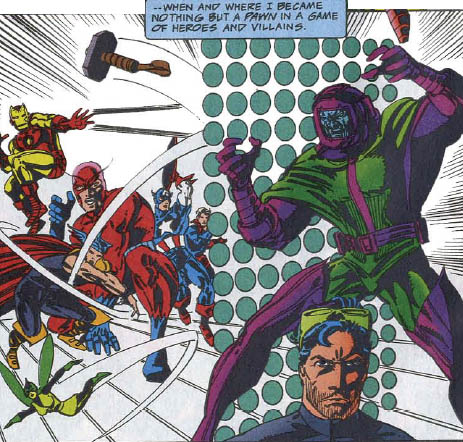
Stark returns to his secret arctic lair and repairs Machinesmith, whom Masque demolished during her escape. Meanwhile, Masque and the assembled members of Force Works and the Avengers compare revelations, and they communicate via telepresence with the remaining Force Works members who are facing Virgil. Masque alerts them to Stark's arctic bunker and a small team consisting of Crystal, Vision, Century and Moonraker teleports there. Marianne Rodgers is seemingly getting past Stark's emotional barriers at last when the team arrives, setting off the facility's alarms. Unable to penetrate the bunker's defenses, the team is contacted by Marianne, who tells them that Stark has been corrupted for years and that (wait for it...) there was a time when a younger Stark was free of that evil. They teleport back to the Avengers' temporary HQ but Moonraker is no longer with them, kidnapped in mid-journey by Kang and Mantis.

Eenie, meenie, meinie, moe, which Avenger will be the next to go?

Back at The Works, Cybermancer and Virgil (revealed as a super-beefy computerized avatar of Stark...egotistical much?) conduct their attack on the remaining Force Works crew. Thanks to using some holographic images to weasel around some traps, and thanks to Plato, another of Stark's computer systems with allegiance to the team, they're able to abort the firing sequence to Kang's chronographic weapon. Everyone commences another round of uninspired bitching about Stark being a traitorous so-and-so. Can we move along now?

Help! It's a guy with even uglier armor than Rhodey's!

You bet we'll move along, but it's into space, where the chronographic weapon in Stark's satellite waits to be triggered on-site! Who can activate the weapon from space, you might ask? It's Dirge, one of Kang's mighty minions, wearing a suit of Warwear just like Rhodey. Also on the satellite is Skye, a woman Rhodey met while on vacation, who reveals that her cosmic-level employer foresaw "The Crossing" and wanted him to combat Stark. To that end, when Rhodey lost his regular War Machine armor, she led him to the Eidolon Warwear as a replacement. She expected him to kill Stark but obviously that didn't happen. Dirge delivers a fatal blow to Skye, who survives long enough to see Rhodey use more of the Warwear's abilities to defeat Dirge. His destiny and that of the Warwear are linked, she says, and that destiny lies....IN SPAAAAAAAACE! Ahem. And oh yeah, Rhodey destroys that pesky satellite. The end.

In the last stop before "TimeSlide," Kang and Mantis relentlessly torture Moonraker/Libra at Chronopolis. Older Luna frees him, but Malachi, Tobias, Neut and other Anachronauts bar her exit. She summons her "time-chair" and succeeds in crossing through time to the Avengers, demanding they help Moonraker. Masque knocks her unconscious even as Hercules remembers she was the one who tried to warn them about Stark at the very beginning. When she awakens in Pym's med-lab, Quicksilver and Crystal find her familiar, as do the others. There's no time to rest, however, as Kang's soldiers have followed Luna and Moonraker. Neut cleaves a path deep into the mansion singlehandedly, disemboweling the new Swordsman and knocking the rest of the team on their keisters. Luna throws herself between Neut's energy beam and her parents, taking the brunt of the blow and dying. Neut is ready to kill the team when the revivified, newly-mutated Wasp emerges from her cocoon and takes him down from behind. She's now more wasp than human, but other than that, Hank Pym declares her to be in "perfect physical health--better than [she's] ever been before!" Uh, yeah, but she still looks like a bug, genius!

The not-so-winsome Wasp, as designed by Joe Madureira.

As the team licks their wounds, Masque and Black Widow discuss their next move. They have a time portal in the basement, but they can't just go back and kill Tony Stark. Masque suggests the best way to stop a genius like Stark is with another genius. And thence begins the madness that leads to...Teen Tony!

Sorry it's taken so long to get to this point, peoples, but entry number three (the finale, honest!) will be en route soon enough. Who is Kang's mortal enemy? What more madness could Marvel wring out of Earth's mightiest heroes? Next time: Let's do the TimeSlide (again?)!

It's just a jump to the left...

~G.

29.4.11

That's What I Want: My Top Requested Graphic Novels of '11 (2)

Here we go with the second of two entries about the graphic novel collections I'd most like to see. They include both existing collections which have sadly fallen out-of-print, as well as original collections that have never seen the light of day. Allow me to start with one out-of-alphabetical-order pick that honestly should have been in yesterday's entry, and then we'll continue with the final seven eight picks!

Batman: Prodigal (DC)
(Collecting Batman #512-514; Batman: Shadow of the Bat #32-34; Detective Comics #679-681; and Robin #0, 11-13.) After all that's happened in the world of Batman over the last year, with Dick Grayson inheriting the cowl in the wake of Bruce Wayne's apparent demise, then continuing as Batman in Gotham while the returned Bruce begins an international Batmen recruiting drive, it's truly a wonder to me that this collection can only be found at hyper-inflated costs on eBay and amazon.com. This storyline, released in the aftermath of everything that began with "Knightfall," showed what happened when Batman left the cowl in the hands of the man best qualified for the role, instead of the noob Azrael. It's an intriguing character study that touches on all the major bases such a storyline should. It's also, in context, an excellent prologue for current events. Because it's relevant to the beginning of "Prodigal," I've also taken the liberty of including one extra story here: "Brothers in Arms" from Robin #0, a Zero Month spotlight on Robin and Nightwing that paved the way for this arc. It's the single improvement in an otherwise terrific volume. (And hey, DC? While we're on the subject, it's well past time for that collection of "Batman: Year 3" by Wolfman & Perez. Okay?)

Iron Man: The Iron Scream (Marvel)
(Collecting Iron Man #163-170.) I'm really shocked that this collection hasn't already been done, considering its conclusion is already available in the Iron Man: Iron Monger Premiere Classic hardcover. Written by comics vet Denny O'Neil and drawn by Luke McDonnell, this is the storyline that introduced Tony Stark's chief competitor, Obadiah Stane (seen in the film!), and set the two on a collision course. Playing a game of chess with real people as the pieces, Stane takes Stark to the edge of sanity in a storyline that ends with our hero back to drowning his sorrows away, leading to Rhodey donning the steel-mesh armor for the first time. That's right, it's the start of the long road that leads to the birth of War Machine, and it all starts here! What better reason to bring this storyline in print?

Morbius the Living Vampire: A Stillborn Genesis (Marvel)
(Collecting Adventure Into Fear #20-31.) Since Marvel has been releasing the rest of what would be in an Essential Morbius volume in their Vampire Tales collections, it'd be great to see them release the other solo Morbius stories in living color, which brings me to this volume, written by Steve Gerber and Doug Moench, with art by Paul Gulacy and Frank Robbins. These are Morbius stories with a more sci-fi bent than in his Vampire Tales series. The series guest-stars Blade and Simon Stroud from the Tomb of Dracula and Creatures on the Loose strips, respectively. An entertaining diversion, this volume could even pave the way for more Morbius the Living Vampire collections from the 1990s series!

The Punisher: Purgatory & Revelation (Marvel)
(Collecting Punisher: Purgatory #1-4 and Punisher/Wolverine: Revelation #1-4.) Franken-Castle? One of my favorite Punisher stories. I'm not a typical Punisher fan, and I don't like typical Punisher stories. The last time I enjoyed the character before then was in these two storylines, which have an impressive pedigree. It's not often you get a Punisher story drawn by Bernie Wrightson, with covers by Joe Jusko. The story is about as ridiculous as Frank Castle's ever gotten, right up there with having his skin turned black. He commits suicide and gets brought back as an angel of vengeance, with an arsenal from God. He finds out his guardian angel screwed the pooch the day Maria and the kids were killed. This collection of eight issues over two miniseries, including a team-up with Wolverine, would easily fit in one volume. We've got Franken-Castle. Why not Angel Punisher?

The Spectre: Crimes and Punishments (DC)
(Collecting The Spectre (1992) #1-4.) John Ostrander and Tom Mandrake are one of the best duos in comics, with work ranging from the creator-owned Grimjack, to the Superman-as-western riff The Kents, to the elemental fury of Firestorm and the alien worlds of the Martian Manhunter. The apotheosis of their collaboration is this 62-issue series that lasted from 1992 to 1998. Noteworthy for its exploration of Christian mythology, its striking covers by fantasy's foremost artists, and its development of the Jim Corrigan character far beyond anything seen over the previous half a decade, Ostrander and Mandrake's Spectre stands with James Robinson's Starman as one of the most consistent creative visions in DC history. Not only does it deserve a re-release of the first volume, it also deserves the royal treatment: either a whole series of graphic novel collections, or a deluxe omnibus release. It's time to show the masses that the Spectre, when written well, was one of the best damn characters and one of the best damn comics, period.

Spider-Man: The Cosmic Adventures (Marvel)
(Collecting The Amazing Spider-Man #326-329; Quasar #7; The Spectacular Spider-Man #158-160; and Web of Spider-Man #59-61, 64-65.) While the majority of these issues are now available in the brand-new Acts of Vengeance Omnibus, let's face it: that collected edition is a $100 hardcover and hardly something the casual Spider-Man fan would feel comfortable purchasing. Instead, I strongly suggest Marvel release an updated version of this collection from 1993, with the original Ron Lim cover, and with the additions of Spidey's guest appearance in Quasar and the two-part event where all the bad guys came back to fight Spidey after his cosmic powers had left him. Certainly a $30 softcover is more economical than that epic tome that's already available.

Spider-Man: The Owl/Octopus War (Marvel)
(Collecting Peter Parker, the Spectacular Spider-Man #72-79.) While it may be readily accessible in two Essential collections, a Premiere Classic hardcover edition of this eight-part storyline in full color would be welcome indeed. In 1983, Bill Mantlo and Al Milgrom crafted what I consider to be among the best clashes between Spider-Man and one of his deadliest foes, Dr. Octopus. Guest-starring the Black Cat, and co-featuring the villainy of the Owl, this saga encapsulates just about everything I enjoyed about early 1980s Spidey books. I've already told listeners of Jon Westhoff's and my Spectacular Spider-Cast all about my love for this arc, but it bears repeating here. If you've never read this storyline, you're really missing out--as is Marvel by withholding this terrific collection. 'Nuff said.

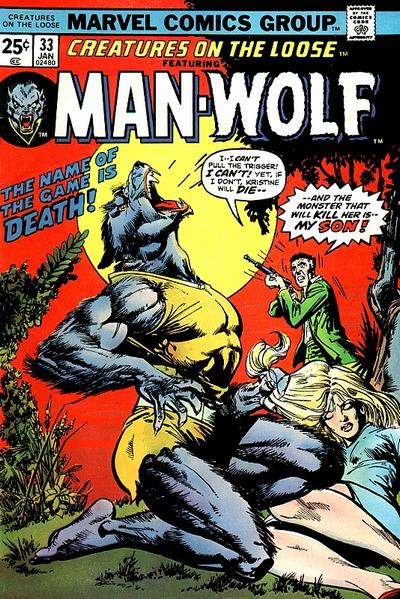
Spider-Man Presents: The Mark of the Man-Wolf (Marvel)
(Collecting The Amazing Spider-Man #124-125, 189-190; Creatures on the Loose #30-37; Giant-Size Super-Heroes #1; Marvel Premiere #45-46; Marvel Team-Up #37; Peter Parker. the Spectacular Spider-Man Annual #3; and Savage She-Hulk #13-14.) Of all the neglected monster characters, John Jameson as the Man-Wolf may rank atop the leader boards. Emblazoning Spider-Man's name on the top of this volume would, I hope, bring ample notice to this collection, filled with both battles with Spider-Man as well as the Man-Wolf's own solo adventures (some of which were drawn by a young George Perez--say, whatever happened to him?). Yes, the collection would also reprint all John Jameson's appearances as Stargod. I can't tell you how much I want to see this volume. Bark at the moon, kids!

Swamp Thing: Bad Gumbo (DC/Vertigo)
(Collecting Swamp Thing #140-143.) Especially topical considering today's return of Swamp Thing in Brightest Day (and possibly strongly a no-no to be reprinted because Swampy's back at mainstream DC), this storyline is by three industry giants and well deserves a collection. Was Swamp Thing only a dream, a hallucination of botanist Alec Holland, stoned out of his mind? This contrarian take on Swamp Thing had more than its share of psychological horror courtesy of co-writers Grant Morrison and Mark Millar and artist Phil Hester. This is an utterly raw story by all talents, but something makes it work. Millar's plotlines may have meandered in later issues, leading down the long road to cancellation in issue #171, but this four-part storyline is solid and representative of some of the best of 1990s Vertigo that isn't Sandman. It actually led me to dive into the back-issue bins for Alan Moore's original run. How's that for inspiration?

Well, that's my list! What say you fellas?

~G.

27.4.11

The Crossing: NOT The Avengers' Abbey Road (1)

(Newly re-edited with pictures!)

Aw, gawd, you have NO idea how badly I wish I had a picture of the various Avengers changed during the brief period in their history known as "The Crossing," all posed like the Beatles on their famous album cover. Maybe not even really succeeding at crossing the street. Maybe Giant Man's looking one direction, the Wasp's looking the other, Moonraker's getting his toes stepped on, and Iron Man's repulsor is at the ready. Maybe Hawkeye's tripping over the corpse of the second Yellowjacket. I don't know. Would any of the artists reading this blog (you know who you are, and I know you're out there) get on that? No? All right, then: I'll have to settle for this picture that doesn't quite conjure a thousand words:

This story changes everything. If that's not enough: really kewl chromium cover!
I was looking through my collection some weeks ago, and that got me thinking how pitifully few articles are out there about "The Crossing," the Avengers storyline meant to Change Everything We Knew About Earth's Mightiest Heroes (TM). It was constructed in 1995 under the auspices of then-Avengers group editor Mark Gruenwald by a group of writers including Dan Abnett, Bob Harras, Terry Kavanagh, Andy Lanning and Ben Raab, and artists including Mike Deodato, a bevy of his studiomates, and miscellaneous other talent. Here, I want to give my readers a look--as honest a one as I can without surrendering to raucous laughter--at the storyline in all its (should I use this word?) glory.

When did Stark become a pawn? Wink wink, nudge nudge. Art by Tom Morgan.
Please remember, "The Crossing" came about in a comics era that was, on the surface, very different from today. It was the era of special effect covers--of hologram covers, of multi-color foil covers, of neon fifth ink covers, of chromium covers, embossed covers, die-cut covers, quadruple gatefold covers, polybags, free trading card inserts, platinum variants, and every permutation of the above. It was also the era of the Special Event Designed To Change Your Favorite Character Forever (a mutually-owned trademark of Marvel and DC Comics), where DC killed Superman and decided it couldn't stop there, and then Marvel decided whatever DC did, they had to do it bigger, better, and often bloodier.

(Wait. Minus a few of the more outré components in the previous paragraph, it seems...I don't believe it! Ah, well--that's a topic for a totally different article! Moving right along...)

Tuc hints to Luna's nanny of her impending demise. Art by Mike Deodato.
"The Crossing" starts with two prequels in Invincible Iron Man #319, wherein Tony Stark reminisces about his life as an Avenger and decides to reunite with his old team (whom he'd left some time earlier to assemble the ruins of their west coast branch into Force Works), and Avengers #390, wherein Janet Van Dyne, aka the Wasp, learns she's broke, and the rest of the Avengers team tell stories around a campfire. There, they're visited by a mysterious guest named Tuc with ties to Quicksilver and Crystal's daughter Luna. Simple enough, right? The hallmarks of major storylines were all there: looking back upon the past, introducing new and mysterious characters, hinting at unusual situations to come. Little did everyone know what was right around the corner.

In the one-shot, chromium-covered Avengers: The Crossing, things go kablooey. Rita DeMara, the second Yellowjacket, returns from adventures in the 30th Century alongside the original Guardians of the Galaxy, flitting through a few moments of the not-too-distant future, seeing glimpses of fugitive Avengers, of the team fighting to enter their own mansion, of Avengers in different costumes, and an enigmatic blonde woman who warns her moments before a mysterious assailant kills her at the gates to Avengers Mansion. Whoever it is does a good job of hiding the body, because next thing you know, it's the following day, and the Avengers are reuniting to celebrate the day of their founding. Hercules finds the blonde woman who tries to warn him of events too, but the moment she disappears, he forgets her as if she were never there. The team finds itself under siege by mysterious attackers who disappear before they can be defeated, and discovers they left behind the Eternal named Gilgamesh, a former Avenger, now elderly and near death. All the while, something happens to the mysterious door in the team's basement--a door that didn't exist before one of the Watchers reconstructed the mansion in the wake of an extradimensional attack. Then, the mysterious attacker bookends the story by claiming another victim, Luna's nanny Marilla, before standing revealed as...Tony Stark! (Gasps, oohs, ahhs. Aren't you excited?)

DC's Green Lantern killed people? Screw that! Tony Stark can do it, too!
Over the next few months of stories, Tony Stark grapples with apparent memory loss and a split personality of sorts before arriving at the truth about his own schemes, denying it but at the same time trying to make Hawkeye into the fall guy for the murders he knows he committed. He helps seal up the mansion and the team relocates, then Janet forces him to leave when she finds out he was behind her current financial status. Hawkeye escapes following a confrontation with Stark and the Force Works team and their newest member, Suzi Endo aka Cybermancer, and goes on the run alongside former Avengers teammates Jim Rhodes, aka War Machine (enhanced with a new, alien suit of armor--the "Eidolon Warwear"...hey, if it worked for Spidey in the '80s...!) and John Walker, aka USAgent. They grow increasingly suspicious of Stark but ultimately refuse to believe he could have any malevolent intent.

Suzi Endo--the modern exception to the 1st rule of The Crossing. (You don't talk about it.)
Marianne Rodgers, a former flame of Tony's with psychic powers, escapes from an institution where Tony'd sent her many years before. She's convinced that having glimpsed the truth in Stark's soul--of which even he wasn't consciously aware--left her mind irreparably damaged, and she teams with a woman wearing the mask of Stark's former lover/foe Madame Masque. This new Masque can disguise herself as any woman, and when Stark captures the duo and ships them to his secret arctic fortress, she demonstrates her ability in a bait-and-switch escape sequence. (But, can she make the carpet match the curtains? Inquiring minds wanna know!)

Neut! Why do we care? He's killing Gilgamesh--because he's NEUT!
Meanwhile, the Avengers get in more trouble as result of that damned door in their basement, with a blue-skinned, big-headed creature called Neut killing Gilgamesh while the team is helpless to stop him. One of the newest Avengers, the other-dimensional analogue of the Swordsman, Philip Jarvert, finds himself visited by the Cotati incarnation of the Swordsman (who married Mantis during the "Celestial Madonna" storyline in the '70s). The alien tries to warn of an imminent threat, but then the blond-haired woman from The Crossing #1 returns with the axe-wielding brothers Malachi and Tobias, whose solar eyebeams possess a creepy similarity to those of the Vision. The brothers defeat Vision and Swordsman, but their blonde compatriot bids them away out of apparent concern for the Avengers. With the Cotati Swordsman captured, they return to their "mother"--Mantis herself!

Something familiar about those boys Bo and Luke...er, Malachi and Tobias.
Still elsewhere, the Force Works team, formed from the remnants of the West Coast Avengers, finds a new member in their midst, the enigmatic (there's that word again!) Moonraker. (The real mystery being, of course, how someone could possibly think naming a character after one of the worst James Bond movies could ever be remotely cool.) Other strange things occur at Works HQ, like Moonraker's girlfriend Spider-Woman (Julia Carpenter) making breakfast only to realize the eggs are still in the container on the counter, or cutting and putting roses in a vase only to find they're still in their wrapping from the florist. On top of that, Julia's daughter seems to be the only one who realizes Moonraker wasn't around in the previous issue. And, oh yeah, Vietnam's gone missing, and nobody realizes it was ever a real country! Somebody cue that "Twilight Zone" music...
Look, kids! Mantis! And she's eee-vil now! MANTIS! EVIL!
As it becomes increasingly apparent that "The Crossing" is a sequel of sorts to the beloved "Celestial Madonna" storyline, we see Black Widow join Rhodey, USAgent and Hawkeye because it was all getting to be too much of a boys' club. They all fight Deathunt 9000, one of Kang's Anachronauts. (Nobody here wins awards for names, but at least these ones were created before this arc.) Hawkeye goes to call out Stark on his own, and together they go to the Van Dyne mansion, where the Avengers have holed up since the abandonment of their own mansion due to the door in the basement. The visiting Hank McCoy, the X-Men's Beast and a former Avenger himself, helps Hank Pym reconfigure an image inducer so it can bring Avengers' memories to holographic life in hopes of discovering the identity of the murderer. When Stark's memories are probed, they find nothing, but Luna's memories clearly show Stark as the culprit. (The jig is up! The news is out! They finally found him...) A battle wages, during which Stark critically injures the Wasp. Pym becomes Giant Man and nearly crushes Stark, who narrowly escapes and falls into a portal. The scientist then takes the Wasp back to his lab and attempts to save her life using a similar procedure to the one that originally empowered her, resulting in her body being surrounded by a strange cocoon. Tuc returns and absconds with Luna, to whom he refers as "sister," and soon afterward, a ship lands and Masque disembarks, telling the Avengers that they must stop Tony Stark--and now! (Or is that yesterday?)

Can we order up some cheese with that whine, Tony? Huh?
Are we confused yet? I gotta warn you, it may well get worse before it gets better! But don't worry, folks--Uncle Gary's gonna show this saga who's boss in the second segment of this review-a-thon, coming soon to this very blog! Aren't you excited?

Yeah. Didn't think so. All the same, it is coming. Along with, you know, the reasons why we'll never see this story referred to in-continuity ever again. (You know: Avengers Forever.)

~G.