Showing posts with label DC Comics. Show all posts

20.6.16

Of Spider-Clones and Supermen: Why "Superman: Rebirth" Is the New "Clone Saga"

Ever since hearing that DC Comics was going to kill off the "New 52" Superman and replace him with the recently-returned "Pre-Crisis" version who disappeared nearly 5 years ago, something's been scratching at the back of my head. And now that we're three full issues into the Pre-Crisis Superman taking over for NuSupes, I can finally put my finger on the feeling. It's one I last had about two decades ago.


For anyone having read Spider-Man comics between 1994 and 1996, you're of course familiar with the much-maligned "Clone Saga." For those not in the know, there was a time shortly after DC's "Death of Superman" storyline where editors pushed their talent to manufacture similar, event-based storylines to drive then-record sales figures ever higher. No idea was too silly when Marvel went looking for their own Spidey-centric tale. (Such events have only gotten more grandiose, but I digress.)

So writer Terry Kavanagh dusted off The Amazing Spider-Man #150, coda to a storyline wherein the villainous Jackal cloned both Spidey himself and his alter ego's late girlfriend, Gwen Stacy. Spidey threw away a report on whether he was really the clone because of, essentially, a gut instinct. The question became, "What if the Spider-Man fans had been reading since 1975 was really the Spider-Clone?" Writers like John Marc DeMatteis (one of my idols) became inspired, and suddenly the dead clone nobody thought twice about returned to life--and a co-starring role in all of Marvel's Spider-Man series for the better part of two years. He became Ben Reilly (so named after Peter Parker's uncle Ben, with his last name the same as Aunt May's maiden name Reilly) and Spider-Man's life would never be the same again!

I read the Clone Saga when it originally came out. One of my friends in the fledgling days of Internet fandom--the inimitable DRILLN0T--helped me write "The Spider-Man/Jackal Dossier," an ungodly tome that consolidated and promulgated fan theories and unresolved facets of the storyline. So yes, I'm kind of well-versed in the storyline and count it as one of the high points of my collecting.

What's that all have to do with Superman: Rebirth? It's funny you should ask...

31.5.16

Just When I Thought I Was Out... (DCU Rebirth SPOILERS!)

Hey, y'all.

Remember when I said that both DC and Marvel Comics had catastrophically screwed the pooch when it came to handling their greatest super-heroes and super-villains?  (The most recent spate of comments started here with a discussion of Secret Wars and Convergence and continued over here with some talk about Superman: Lois & Clark.)

Yeah, Marvel's still doing it. I think right now I'm about the most opposite-of-excited as I've been for Marvel in a long, long while. Maybe ever! And it's something that's well reflected in my current buying habits. In my Discount Comic Book Service order for the month of May, I've only ordered nine ongoing Marvel titles--and five of those are in the Spider-Man family of books! I'm only reading what I enjoy, but even the current crop is subject to elimination. (And no, Steve Rogers: Captain America isn't doing the company any favors in my eyes, although certainly I'd be more apt to judge after we see more than just the first chapter.)

But DC? This last week returned a skosh of the goodwill they squandered over the last year. And the next several weeks will either validate that early feeling or maybe just sour me the rest of the way.


Of course, I'm talking about DC Universe Rebirth #1, the book that officially pulls back the curtain on the DCU of old and turns the trickle of old DCU carryovers into a veritable flood. Sure, a few characters like Batman and Green Lantern kept the majority of their continuity thanks to writers with long-term projects (Grant Morrison on the former, Rebirth scribe Geoff Johns on the latter). But it wasn't until Convergence with its undoing of Crisis On Infinite Earths that the ripple effect began in earnest.


12.3.16

Post-Crisis (Superman)

[I've been a bad, bad blogger over the last few months. Here's hoping I can start making my lack of regular posts up to everybody and bring back some regular readers in 2016. Sound good to you? Good! --GMM]
Maybe the single book I was happiest about in 2015. Happy irony!
When last I wrote, I was having a little crisis regarding my comic book buying habits. I developed a severe lack of faith in the output of the Big Two in 2015, exacerbated by line-wide events like Convergence at DC Comics and Secret Wars (what, again?) at Marvel.

Looking at some articles out there from not only fans but also some retailers, it appears I'm not alone in my trepidation. One thing the market hates is uncertainty, and in 2015 the Big Two gave it to retailers and readers alike in spades. With a spate of regular series, retailers can base their orders on their regular customers and their buying habits, forecasting here and there for "new" series based on the performance of other, similar books. With a two-month-long event like Convergence, there's a degree more of uncertainty because the entire regular lineup is replaced by forty two-issue miniseries anchored by a 9-issue event series. And because Marvel must take every idea DC has and shoot it full of Gamma Rays to do it "better," they anchored a staggering 42 miniseries of indeterminate length (upon early solicitations), as well as several issues of 10 ongoing series, to their own 9, then 10-issue event series.

So, to recap: we've got big event miniseries, which usually sell gangbusters. But what happens when you tie them to countless miniseries instead of the traditional issues of ongoing series? Remember the theory to using events and crossovers in the first place: namely, to prop up flagging sales of series by tying them--unnecessarily, even--to said event. But how do retailers even begin to determine orders when juggling an event with a whole bunch of new #1 issues for series of unknown length, with no real corollaries to existing series? Danger, Will Robinson! Danger! Danger!

4.7.15

Convergence (Or, an Essay on My Changing Comic Buying Habits)

...and no, this time I don't mean DC's Convergence event that ran through their June and July-dated books this year. But, then again, that's not a bad place to begin...

Convergence #0 variant cover by Adam Hughes...just because I like it!
Historically speaking, my comic book buying habits have been rather crazy. And when I began ordering from Discount Comic Book Service in 2006 was when that habit kicked up another few notches. With astonishing 40% discounts across the Big Two and sizable discounts for the other companies, I could afford more than under my local comics retailer's discount.

4.12.11

Tears of Blood: DeMatteis, Mishkin & Cohn Remember "I...Vampire!"

Do you dare enter...The House of Mystery?

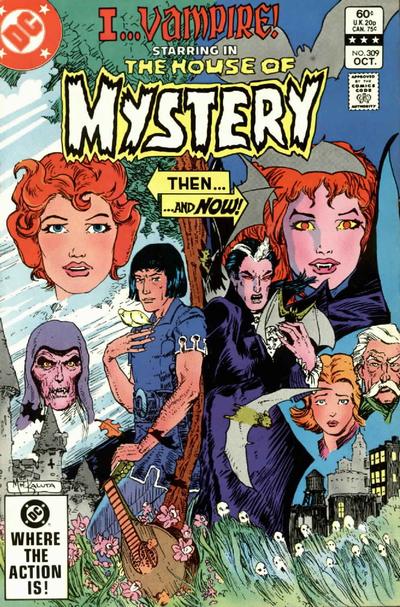
That's what every cover of the famed DC Comics horror anthology begged you to answer. Behind covers by luminaries like Neal Adams, Joe Kubert and Michael Wm. Kaluta, the caretaker of the House, a bespectacled, wild-haired man named Cain, entreated fans to spooky stories. Following in the tradition of previous features like "Dial H for Hero" and "Martian Manhunter," neophyte DC scripter J.M. DeMatteis and veteran artist Tom Sutton brought a new regular series-within-a-series to Cain's House under editor Len Wein, a series that now lives again in DC's "New 52": "I...Vampire!"

Now that Joshua Hale Fialkov, Andrea Sorrentino and Jenny Frison have produced three issues of the new I, Vampire (which I hope all of you are reading!), it's time to take a trip back to 1981 with three of the creative minds behind the series' original incarnation: original series co-creator J.M. DeMatteis (also of Spider-Man, Moonshadow and Brooklyn Dreams fame, among countless others) and series finale co-writers Dan Mishkin & Gary Cohn (also known for the much-beloved Amethyst: Princess of Gemworld and Blue Devil). You'll also see some comments from me on the overall direction of the series, which appeared in The House of Mystery #290-291, 293, 295, 297, 299 and 302-319.

Mike Kaluta's stunning covers are still enticing today.
Around the creation of "I...Vampire" superhero books were the most popular genre in American comics (and remain so today). According to DeMatteis, "When I broke into comics in the late 70's, the 'mystery books,' as they called the horror anthologies, were like the vaudeville of comics. A place for new writers to learn their craft, try, fail, grow, without a lot of attention on them. I sold my first script to [DC editor] Paul Levitz, then started working with Jack Harris and Len Wein. Len became more than an editor, he became my mentor, the first person in the business who made me feel as if I had something unique to offer."

DeMatteis set out to prove his craft when Wein assumed control of the horror titles. "Len wanted to inject some ongoing series into Weird War Tales and House of Mystery and asked me for ideas. I'd already had "Creature Commandos" rattling around in my brain and we set that up for Weird War [introduced in issue #93 with artist Pat Broderick], then Len tossed out a title to me—'I...Vampire'—and told me to go home and come up with a concept. That's just what I did, Len loved it, and we were off and running."

When it came to artistic talent, Wein cast his eye toward veteran horror illustrator Tom Sutton, whose previous claims to fame included being Vampirella's first artist in 1969 and drawing various horror series for Warren, Marvel and DC throughout the seventies. DeMatteis remembers: "I'm pretty sure Tom was Len's choice; but I was a huge fan of [his] work.  He'd illustrated some stories I'd done for the DC science-fiction anthologies and his style was unique, moody, idiosyncratic, emotional.  I loved everything he did with 'I...Vampire.'" Indeed, Sutton would remain on the series long after DeMatteis' departure, either as sole artist or inker over talents Paris Cullins and Adrian Gonzales, even drawing the series' finale.

Joe Kubert established the proper horrific mood with the first issue's cover.
The first "I...Vampire" story appeared in The House of Mystery #290 (March 1981), a few months after the debut of "Creature Commandos" and a month after DeMatteis' Marvel debut (Defenders #92). All the familiar elements of the series are in place at once: Andrew Bennett was the reluctant vampire who made his lover Mary into a less-reluctant creature of the night. To aid him in his quest to stop her Andrew recruited Dmitri Mishkin and Deborah Dancer, two humans terrorized by vampires.

DeMatteis' inspiration for the series' characters? "It's been a very long time, but my sense is that I started writing and the characters just came together. I know I was drawn to the idea of a vampire who wasn't corrupted by the curse, that it worked as a wonderful metaphor for the struggles we have in our lives, the darkness in our souls that we wrestle with, and the desire to live good and decent lives despite that darkness."

The vampire-as-heroic-protagonist idea was certainly less prevalent in the age of "I...Vampire" than today, where characters like Angel (of Joss Whedon's Buffy and his own eponymous series), Stefan Salvatore (of The Vampire Diaries) and Edward Cullen (of the Twilight novels and films) have caught the public's imagination. Like those latter-day vampire tales, "I...Vampire" also had a provocative, if twisted, love story at its center. "Of course the heart and soul of the story was the Andrew-Mary relationship," says DeMatteis. "Here was this woman Bennett loved, adored, worshipped—and the one time he allowed his vampiric hunger to overtake him, he transformed her into something twisted and evil. And he'd lived with that guilt and shame for hundreds of years. In the end, it wasn't enough for him to redeem himself, he had to redeem Mary, as well. In fact, Bennett was far less concerned with his own salvation than with Mary's. He wanted to oppose her and her forces—but, in the end, he opposed her in order to save her."

Andrew Bennett weeps tears of blood for his beloved Mary. Kaluta art.
Of special note to fans of DeMatteis' work is the character of Dmitri Mishkin, Bennett's male companion throughout the years: "I...recall loving the character...especially once I wrote his back story, explaining how he'd been with Bennett since he was a little boy.  It made the character both more heroic and more tragic.  (Mishkin was also Russian, so I was able to express my love of Russian literature, specifically my literary hero Dostoyevksy, through the character.)" DeMatteis made his love for the character manifest in issue #295, which explained Mishkin's origins and revealed that his mother had become a vampire when he was a child, a plot point that would be developed much later.

As for the final protagonist, the lovely redheaded Deborah Dancer: "[She], I think, was an attempt to inject someone younger and more contemporary into the mix," says DeMatteis. Bennett and Deborah definitely shared romantic feelings but dared not openly express them—due, no doubt, to his fear of making her another monster like Mary in a moment of passion and weakness—again, a point worth mining at another time.

Andrew Bennett only made one appearance outside HoM, and this was it. Jim Aparo art.
Bennett had his work cut out for him as a lone vampire allied with two humans against Mary, Queen of Blood and her legion of followers, the Cult of the Blood Red Moon. Whereas Bennett, Deborah and Mishkin were three, the cult consisted of many, often hiding in plain sight among the throngs of humans, ready to pounce, to overwhelm the triad who appeared to be all that stood in the way of their bloody conquest of the Earth. Unlike the latter-day incarnation of the series, the early "I...Vampire" had no elements that directly linked it with the greater DC Universe; in fact, Bennett's only contact with a "superhero," the ever-popular Batman, occurred in another title, the team-up series The Brave and the Bold (#195, February 1983), months before both series' end.

Unfortunately for fans of the series, like Don Corleone, Marvel Comics gave DeMatteis an offer he couldn't refuse in late 1981. "[They] offered me an exclusive contract, so that was the end of my involvement with DC for five or six years." To fill the noticeable void, new editor Karen Berger, who later went on to develop the company's eighties and nineties output into the juggernaut Vertigo line, tapped writer Bruce Jones, who spent much of the seventies on Warren Publishing's Creepy and Eerie magazines.

Jones picked up the series with issue #299 and immediately set Bennett apart from his friends Mishkin and Deborah following an adventure where he nearly killed them both. The series became like a vampire version of The Fugitive, with Bennett wandering from town to town, encountering Mary's minions and dispatching them. The unfortunate centerpiece of Jones' tenure was a multi-part storyline wherein Mary convinced Bennett to use a pair of ancient rings to transport them through time following the development of a vaccine against cancer which made toxic the blood of those who took it. It's difficult to see how Bennett would find Mary's aims anything but transparent (to travel back in time and kill the ancestors of the cancer cure's developer), but he does, and his naïveté nearly proved the series' downfall. What was once a series with incredible pathos instead became a ridiculous exercise in time-travel involving a visit with Deborah Dancer when she was a child and a cat-and-mouse game played between human and vampire pairs of Bennett and Mary during the period before both were transformed.

Bruce Jones' storyline became mired down in too many fantasy elements. Kaluta cover.
Leaving before the conclusion of the time-travel storyline, Jones was replaced in issue #310 by another pair of writers new to DC. Dan Mishkin and Gary Cohn came aboard and immediately underplayed the series' more fantastical elements, returning to DeMatteis' tragic take. According to Mishkin: "We’d been doing a bunch of work for Karen Berger in House of Mystery and for some of the other anthology titles...I assume we came to mind because we were right there on hand. I think that our being in the same generation of younger writers probably influenced her decision as well."

The series was less something Mishkin & Cohn sought out, and more a chance to prove they could work on a regular monthly book. "We were novices, and the opportunity to work in a series format, which is the meat of monthly comics, was something we jumped at. And there's a definite appeal to doing genre work, where you have lots of conventions that you're expected to follow, but readers are always hoping you'll defy convention in a way that surprises and delights them while still providing the satisfaction of conforming to them. That balancing act of working within the constraints of a genre while at the same time challenging them was something we ended up doing pretty well in Blue Devil. With 'I...Vampire,' we were learning the ropes."

Mishkin was attracted to the possibilities offered by the horror genre. "I'm generally attracted to stories that delve into the unreal and impossible, like any other genre geek. The idea of the vampire's sensuality and magnetic personality (of which Dracula is the ur-text), and how that works to break down our conventional notions of morality, is one I've always found fascinating." To that end, he and Cohn returned to the core conflict between Bennett and Mary as well as returning Deborah and Mishkin to central roles in the narrative. Once again raising the cancer vaccine plotline (whose resolution had been interrupted in Jones' time-travel arc), they established that the cure was a facade, and that the lab responsible was headed by a vampire who wanted to eliminate his kin from the world by seeding human blood with the poison. Mary's people found a cure for the toxin at the lab, shared it with Bennett, and the plague was ended.

By this time, the series' sales figures had slumped beyond redemption, and DC's other horror and science fiction series had faded away. The House of Mystery wasn't long for the world. "With that book coming to end, we were told to wrap up the Andrew Bennett saga, and to do it with no loose ends and with a finality that would leave no chance of bringing the character back (a dictate that seems awfully naïve in retrospect)."

The series' finale ramped up with the return of Mishkin's mother Dunya, who per the wishes of her mistress, Mary, insinuated herself with Rev. Edgar Warnock of the American Crusade, actually a vampire working to carry the Blood Red Moon's power to the highest position in the land. Warnock was defeated but Dunya kidnapped Mishkin and turned him into a vampire and they fled to Russia. Bennett and Deborah, in pursuit, found out through vampires who'd infiltrated the KGB that Soviet scientists had developed a substance to eliminate vampires' need to avoid sunlight and their lust for blood—a key point toward the series' end.

Mishkin's death, depicted by Kaluta.
In the series' 317th issue, Dmitri Mishkin met his end, sacrificing himself so he alone could kill his own mother and thereby save his friends. Dan Mishkin, the series' co-writer (but not, strictly speaking, Dmitri's namesake), found the character's death particularly memorable for the behind-the-scenes events. "It was always a little funny writing a character (not invented by me) who shared my first initial and last name, and when we came to his death, I was amused by the thought of seeing a beautiful Mike Kaluta cover that featured a headstone with the legend "Rest in Peace D. Mishkin." But when I suggested it to Karen Berger, she declined out of a superstitious concern for my well-being. Which was really quite sweet, looking back, though I would have loved to have been able to buy the original art from Mike."

After Mishkin's death, two issues remained, during which Bennett decided to gamble with his un-life and imbibe the substance the Russians developed. While he seemed fine at first, able to tolerate the Sun's rays and survive without the need for blood, he soon discovered its unfortunate side-effects. Having become a vampire several centuries earlier, he found that the return of his humanity also brought rigor mortis, making him a prisoner in his own body. Upon their final confrontation with the Blood Red Moon, Deborah took the formula before encountering Mary, and when the Queen of Blood bit her, she instead became a new breed of vampire with all the immunities the substance provided. So empowered, she brought Mary into the Sun and killed her before saying a final farewell to Bennett, who scattered into ashes as Deborah wept tears of blood for him, the man she loved. It was an unusual finale to the series, empowering Bennett's human love and having her be the one to end the conflict in the fallen protagonist's stead.

The writers called the finale their favorite moment on the series. "Though it’s sad to leave behind characters that you’ve become invested in (also to leave behind a regular paycheck), there's a way in which wrapping up a series was as gratifying as the original opportunity to shepherd one. So much of monthly comics involves keeping the pot boiling that it's easy to get in a rut that's as unpleasant for the creators as it is for the readers. With the chance to do a big finish, we probably turned out our best work on the series—although, given the previous comments about being novices and learning the ropes, and the overall quality that that produced, calling something our best work in this context might not be saying much."

Bennett finally met his end with issue #319. Art by Kaluta.
Although "I...Vampire" ended with issue #319 in 1983 and The House of Mystery soon followed with #321, fate, it seemed, was not yet done with Andrew Bennett. When DeMatteis united with artist Shawn McManus on a Doctor Fate series in 1988, the last-page surprise in the first issue was Bennett's shocking return! The six-issue arc dealt with his inexplicable resurrection and his attempts at redeeming himself for his tortured past. "I really liked Bennett, and his inner struggle for redemption fit right into the themes I was exploring in my first arc in the ongoing Doctor Fate series I did with Shawn McManus," offers DeMatteis. "It was a treat to return to the character and his world—I especially enjoyed the Zen monk vampires he was allied with—after something like eight years.  I was also a much better writer by then, so I was able to make up for some of the clunkier scripting in my original run."

Bennett's arc ended on a bittersweet note, although certainly DeMatteis left the door open to a more permanent return. "I actually pitched DC on an 'I...Vampire' revival at least once, possibly a couple of times (my memory's fuzzy on the details), but they turned me down," he says. Sadly, DC relegated him to a memory for the next two decades, only allowing him a brief string of appearances in Brian Azzarello and Cliff Chiang's idiosyncratic "Dr. Thirteen" series in the anthology Tales of the Unexpected in 2006-7.

Dr. Fate encountered Andrew Bennett early in his 1988 series. McManus art.
Fans of DeMatteis' original work on the series, which has stood the test of time to inspire the new incarnation, may be surprised to learn the writer did not originally consider himself a major fan of vampire fiction. "I remember reading Bram Stoker's Dracula in college and being surprised by how good it was, but the genre never drew me in any profound way.  Once I started writing for the DC horror anthologies, I had to dip into vampire lore because that was a huge part of what those books did.  The more I explored, the more I enjoyed the genre.  As with Bennett, I saw the vampire as a wonderful symbol of the darkness inside all of us.  The vampire's struggle is the universal human struggle.  'To bite...or not to bite.'  When I went over to Marvel, I explored the vampire mythos, in a very different way, in my Greenberg, the Vampire graphic novel (and the Bizarre Adventures story that preceded it)—which I remain very fond of, and proud of, to this day." DeMatteis has also worked alongside artist Kent Williams on the Epic Comics miniseries Blood: A Tale, a more unusual take on vampirism.

Asked for his opinion of his original "I...Vampire" tales, the author admits, "To be honest, I haven't gone back and looked at those stories in a long time.  I'm sure I will once the collected edition comes out early next year.  I'm sure there's a lot I would have done differently, simply because, as noted, I'm a better writer, a better storyteller, now.  That said, 'I...Vampire' was my first original creation in comics and I poured my heart and soul into it.  It was, at the time, the absolute best I could do.  So, in the end, I think I should leave my younger self alone, respect him and let his work stand on its own."

Jenny Frison illustrates the new "I, Vampire" covers.
Understandably, with his wishes to bring back Andrew Bennett a few times in the intervening years, DeMatteis is proud to see his creation return in DC's "New 52" this fall. "I loved writing and creating that world and those characters and...based on the first issue of the new series, Josh Fialkov is doing a bang-up job reimagining Andrew Bennett's world.  I just hope Mishkin shows up somewhere along the way!"

So do we, Mr. DeMatteis. So do we.

"I...Vampire" will be available in a DC Comics collected edition with a projected on-sale date of February 8, 2012. Consult your local retailer for ordering information, or order it from Amazon.com, Discount Comic Book Service or any shop you trust.

Please visit writer emeritus J.M. DeMatteis on his blog, Creation Point, at jmdematteis.com! And Dan Mishkin is at danmishkin.com!

6.11.11

Ultimate Failstorm! (Or: The Failure of Firestorm)

Since September's relaunch of every mainstream DC comic in the line, I've been reading, and reading, and reading still more. I started off reading nearly half the "New 52" and have pared my way downward from there. How's that coming? I'm still working on it, but I can tell you I've already dropped a few titles.

At the beginning, I had a master list of sorts. Books that I wanted to be really good. Books that I thought would surprise everyone. Books that I felt certain wouldn't last a year.

Some books met my expectations. Some exceed them by a mile.

One was an utter letdown in almost every respect.

Wouldn't you know, it's one I wanted to be good, and it really is surprising everyone. And based on the first two issues alone, I don't want the thing to last a year.

Enter: The Fury of Firestorm, the Nuclear Men.


7.10.11

DCnU: Beating a Red Hood...er, a Dead Horse

Welcome back, kids.

Tonight's impassioned entry was inspired by a conversation I had just an hour or so ago with Tim aka @Ikariniku, one of my followers over on Twitter. Anyone who enjoys my entries over here, please, get yourself over there and follow me there at @Gary_M_Miller, and follow Tim while you're at it! We have some fun debates, 140 characters at a time.

What makes a "great" first issue?

It's a deceptively simple question, isn't it?

As someone who, once upon a time, wrote a story during Marvel's Epic 2.0 initiative, let me tell you: a first issue isn't easy to write. Especially when you're "pitching," a first issue has to hit all the right notes. Depending on what a company needs, that story might become a one-shot, or the first issue in a miniseries, or if you're very, very lucky, it might become the first issue in an "unlimited" series. If the latter occurs, congratulations, because it means you can do a bit of world-building and seriously expound on the concepts in that first story.

DC Comics creators got very lucky this year, because up popped fifty-two magical lottery tickets. Last month, fifty-two series premiered. They were written by forty-two writers, including fourteen writers who took on more than one project (and two who braved three!) and seven writing duos.

With the sheer amount of new first issues coming out last month, and the onslaught of publicity that surrounded the DC relaunch, it was important--nay, essential--that the writers know how to write great first issues. To coin a cliche, the stakes were never higher.

In simplest terms, a first issue must introduce the key roster of characters, tell us why we should love or hate each character, provide at least one thrilling set piece, and tell an engaging enough story so that we, the readers, just can't live without picking up the second issue in a month's time.

And yeah, there's that whole "first issue of how many?" question.

With these tenets in mind, I started thinking about the DC "New 52." And just as there are some stunningly good examples of what a first issue should be, there are also some depressingly horrible ones. Because it's so much fun to beat a dead horse until it wakes up and barfs blood all over you and fifteen of your closest friends, I've chosen to level my criticisms at what I declared to be far and away the worst of the new lot.


That's right: Red Hood and the Outlaws #1 is again squarely in my sights.

2.10.11

DCnU: Crisis? What Crisis? (The New 52 & Rampant DiDioism)

Spoilers for the last four weeks of DC's books. Haven't read 'em? Look away, look away, look away, Dixieland.

Breaking news: Dan DiDio has just punched Superboy-Prime right out of the DC Universe. Film at 11.


Just over a month following my last mighty missive about DC Comics' relaunch of 52 of their titles, I'm back with some thoughts, after having read all but four of the titles I've signed on for. (To be read: Aquaman, Justice League Dark, Superman and Voodoo. Am I a masochist? Consider the books I've already read, noted below, and then attempt an answer.) What did I think of the books? Which books will I continue reading? And hey, just what did I think of DC co-publisher Dan DiDio's recent announcement that all company events bearing the umbrella word "Crisis" have been retconned out with the relaunch?

Those are all questions I'm just itchin' to answer. Shall we?

To date, I've read twenty-three "New 52" titles. The old cliche goes, some are good and some suck. Some of them--albeit very few--are fitting for the new audience that DC states they want to lure in. A few will appeal to those fans who are lapsed readers. For the vast majority, however, it's business as usual, with almost nothing really changed from August's books. And then, there are a couple--just one or two, mind you, and I think you know which ones--that are patently offensive and should be canceled as soon as possible.


Of course, they won't actually be canceled because DC has made it obvious that they thrive on controversy, and apparently every bad word about these books only serves to drive sales figures up, up, up. Joker's face ripped off and hung on the wall in Detective Comics? Controversy! Babs Gordon, out of her wheelchair and back to fighting crime as Batgirl, but with acknowledgment of her previous handicap? Controversy! Mister Terrific and an apparently unpowered Karen Starr (formerly Power Girl) possibly being "friends with benefits"? Horrors! Superman ran around in a li'l cape and jeans in his early days, and has never dated or married Lois Lane? Holy Toledo! Amanda Waller, formerly Suicide Squad's rotund leader, now a svelte, sexy lady who might weigh 100 lbs. after eating dinner? Great googly moogly!

And I haven't even gotten to Catwoman's sexcapades with Batman where they keep most of their costumes on in a fetishized scene. Nor have I told about former Teen Titan Starfire, who once had a long-term relationship with Dick Grayson, aka Nightwing, being reduced to a caricature who doesn't even remember who she fought or slept with--little more than, to be blunt, a pretty, curvy set of warm, wet holes that occasionally speaks.

It's been all over the internet now, of course. And hey, did anyone mention that Red Hood and the Outlaws #1 came out on the exact same day as Marv Wolfman and George Perez's New Teen Titans magnum opus, the hardcover graphic novel Games? You know, a book where Starfire is actually treated with some degree of humanity? For maybe the last time ever? And of course DC closes the book on their end with the proclamation that everyone should look at the rating on the book and take a big dose of STFU. Yes, hooray for tact, DC. You care about the bucks, not the content. We get it.


(Yes, I actually went out and bought Red Hood and the Outlaws #1. I didn't want to give DC a dime for the book. Alas, my decision was made a little better when I considered that my retailer had already paid for the drek that lined his shelves, and I'd be doing him a disservice by not relieving him of the book. I did, however, tell him that I most definitely would not return for any subsequent issues, so he need only take my copy in consideration when adjusting his future orders downward.)

There are, of course, equal-opportunity digs at male characters. Ray Palmer, the original Atom, is a mere scientist in Frankenstein, Agent of S.H.A.D.E. And...wait. Did any male character who was obscenely obese get trim? Did any paraplegic male character get up and walk? Is any male character reduced to humping the leg of any female in sight?

Don't misunderstand: there are parts of the new DC Universe I enjoy. As in my earlier review, I love I, Vampire. It's a brilliant reinvention of the original concepts by J.M. DeMatteis and Tom Sutton. I also really enjoy the stylishness of Batwoman by J.H. Williams III. Couldn't honestly imagine anyone else making the book quite so good. Frankenstein, Agent of S.H.A.D.E. is just goofy enough to work. I'm giving Resurrection Man another month or two, but boy, would it thrive under a more stylish artist. Speaking of stylish artists, Yanick Paquette is the next Kevin Nowlan in Swamp Thing, and the story by Scott Snyder fires on all cylinders even as it undoes everything Alan Moore did in "The Anatomy Lesson." Animal Man is the creepy polar opposite of Swamp Thing and I loved that cliffhanger. I even liked Snyder with Greg Capullo on Batman but at the same time I don't feel any compulsion to buy the next one. Aside from the astonishingly sexy art by Guillem March on Catwoman, there's little to recommend--for titillationists only. All-Star Western is okay enough and I could get it in collected editions, but I've the feeling I should reach for Jonah Hex Vol. 1 first. Nightwing? I'm really, really close to picking up number two. And Batgirl? Gail Simone takes into account the ongoing evolution of the character, doesn't throw out the baby with the bathwater, and gives me adventures of Babs monthly without my having to dig in the back issue bins. What's not to love? (Okay, besides the overcomplicated costume!) Yes, Batgirl is sublime. As for Grant Morrison's Action Comics...it's Grant Morrison, and I'm giving him the benefit of the doubt. It doesn't match the complexity of Batman Incorporated, alas, nor is it meant to.


Still, there are a lot of misses. I couldn't stomach Justice League no matter how much I used to enjoy Geoff Johns' scripts. It just felt like a team-up between the two heroes everybody should recognize from the movies, with another movie hero at the end in case anyone started to fall asleep. Hawk & Dove is typical Rob Liefeld, and although I like the relationship between Dove and Deadman....it's Rob Liefeld. Green Lantern tries too hard to turn Hal Jordan into a jerkier Peter Parker. I'd almost be interested in picking up issue two if not for the fact that Johns has burned me out on Sinestro. O.M.A.C. is DC's very own version of the Hulk, right down to the sci-fi milieu, but the "lead" plays just a bit part in the book so far, hardly a character at all. In DC Universe Presents Deadman, Paul Jenkins and Bernard Chang don't give me anything better than Neal Adams & co. already offered in the seventies. Wonder Woman, I found guilty of trying way too hard.

In the "didn't make enough of an impression to care" department, I humbly submit Justice League International, Demon Knights and Stormwatch.

Aside from Red Hood, the biggest travesty I've discovered so far has been the book for which I held out the most hope. When DC promised a "reimagining" and a land of new and exciting concepts--when they said the character never existed before now in this post-"Flashpoint" universe--I should have known something would go horribly wrong. And, well, remembering the old jokes about a previous series being named after the fury instead of the character himself...just shoot me now.


The Fury of Firestorm: The Nuclear Men is the biggest dud of them all, if you don't consider the horrendous treatment of the women of the DC Universe to be worse offenses. (I kinda do.)

I've still got the next two issues of the series on order from the good folks at Discount Comic Book Service, but from reading the first issue, it was just too kooky, cliche, and derivative to stand a decent chance of working. Where would you like me to start? Cliff Carmichael is recast as a super-badass black ops guy who likes to kill people. Instead of being a potential mentor, Professor Stein is still dead. And Ronnie Raymond and Jason Rusch are about the most generic study in contrasts I've ever seen, all their attributes recited by rote. The Large Hadron Supercollider in Europe replaces the Hudson Nuclear Power Plant for a topical touchstone of superscience. And I haven't even gotten to Firestorm him/themselves!

Long ago, when the series was first announced, I looked at Jason and Ronnie's costumes and thought they were ridiculous. I get the idea: one character is mainly in red, and one is in yellow, and when they merge, hooray! Something vaguely resembling the original Firestorm!

Bzzt. Wrong answer. The bad news is that the costumes don't look any less ridiculous in the issue itself, which actually has capable artwork by Yildiray Cinar. The worse news is that when our heroes merge, they turn into Fury, a Hulky, Anti-Monitor-esque character that oozes nuclear fire and speaks in sixties slang. You can even tell right now that Jason and Ronnie won't be the only two characters to "plug into" this new entity. There are six circles on Fury's chest, y'see, and only two of them are now occupied by emblems that match the ones on their costumes. So I'm guessing we'll get to see four more nuclear characters. Firehawk, Pozhar...Atomic Skull, Tokamak anybody? (And if there are six total slots, why do we have seven nuclear men/women? Check the middle of the book...)

And, pardon me for drawing attention to cliche, but...Jason turns into Firestorm by saying the magic word? What are we, twelve?

Incredibly, "God Particle," the first story in this new era of Firestorm, is co-written by Gail Simone, who wrote Batgirl, which is one of my very favorite books in the "New 52." It seems she does her best, but I've really got my doubts about this new direction. I've got the uncanny feeling I'm about to drop Firestorm for only the second time ever. It's really that different and that unrecognizable to me. We'll see if Simone, Van Sciver and Cinar are able to make me reverse course, but it's not looking good.


All of the above brings me to this week's news from Dan DiDio that none of the events labeled "Crisis" happened the way we remember. Is it really that much of a shock? It appears that, with rare exception centered around most but not all facets of Green Lantern and Batman, everything about DC continuity prior to last month is up for grabs. That means you're best off not even acknowledging any events that occurred before four weeks ago as part of DC continuity. Unless they happened to Batman or Green Lantern. And in those cases, only about seven out of ten of those things happened. Get out your graphing calculators, kids, it's gonna be a bumpy ride.

Look at what hints at the past we've got in the books, and we're only a month along. Already we know the original Dove (from Hawk & Dove) died during "the worst crisis the world's ever seen." In Red Hood and the Outlaws, Arsenal clearly quizzes Starfire about her previous team, the New Teen Titans, bringing up names including "Vic," which is likely a reference to Cyborg, a.k.a. Victor Stone. The only problem is Cyborg has been set up to be a founding member of the "New 52" version of the Justice League...so why would he have been batted down to the Titans? Similarly, if Final Crisis never happened, under what circumstances did Bruce Wayne "die" so that Dick Grayson became Batman for the better part of a year (referenced in Nightwing #1)?

DC is on a slippery slope with this new approach to continuity. If they really are serious about September being a new beginning, then they should keep the references to pre-"Flashpoint" events to a bare minimum. If they're trying to put the continuity genie back in the bottle--as I postulated in my previous post where I labeled the recently-finished event the "Anti-Crisis"--they should work hard to adhere to their own new set of rules. Without that commitment, the company fails in the same way as they did during the fallout to 1985's Crisis on Infinite Earths.


Already we're seeing all manner of new stories that dredge up new versions of the past. Superman showed up in Metropolis wearing a little red cape and blue jeans some five years ago. At the same time we've got him showing up in Justice League, also five years ago, wearing his armor.

I've heard that Batman has been around for ten years, but I don't know how much stock I put in that idea. He must have been around for some time, as he's on his fourth Robin right now...who just so happens to be his illegitimate son. I have to suppress a chuckle every time I see a reference to DC publicity painting Robins as Batman's revolving door internship program. Please.

My point is that if we're really not supposed to think about older continuity, then the whole line should have been rebooted like Man of Steel and Wonder Woman did in 1987, and like only a few books--Mister Terrific, The Fury of Firestorm, Supergirl and a few others--did last month. If we're not supposed to try and fill in the blanks what happened and what didn't, then there shouldn't be four Robins, multiple Batgirls, Batmen across the world, etc., etc.

And if they care about historical interpretations of classic characters, then they shouldn't take characters that are familiar to kids from animated series like Teen Titans and make them into thoughtless sex drones.

Lastly, let's please, please, please not clear the decks of "Crisis"-type events just for the sake of 2012's line-wide event, First Crisis, No, Really, We Swear, Why Are You Looking at Us Like That, Just Shut Up and Buy It Already, These Aren't the Droids You're After. You've already given us hints that everyone's going to start to crossover in the third and fourth issues of various series, but please, if I wanted to read interconnected chaos, I'd be a Marvel Zombie forever and ever, amen.


DC, really, with the relaunch, I'm pulling for you guys. If you're successful, then maybe Marvel will lay off the aforementioned chaos. Then maybe we'll start to heal the industry.

I'm getting the idea you're gonna blow it. Don't do that. Don't.

Or Hulk will smash.

~G.

26.9.11

Advance Review: "I, Vampire" #1

Yes, it's true! I've been remiss in my reviewing activities. If you must know, I'm writing a book here, and preparing for this year's New York Comic Con that hits in a few short weeks. In answer to your unspoken questions, I've been reading quite a few of DC Comics' "New 52" projects this last month. Why, you ask, have I not reviewed any of those books? Simply put, I haven't found any that have compelled me to put pen to paper (or, as the case may be, fingers to keyboard). But that's changed. Oh, ye gods, how that has changed...

Early on, it was the most derided of all the series DC announced. If it wasn't "DC, how could you try and cash in on the Twilight craze?" it was "DC, why in God's name did you bring that book back, out of all the old books that could've been relaunched?" People didn't "get" why they would bring back Andrew Bennett, who'd been on the scene in the horror anthology House of Mystery for all of two years prior to its 1983 cancellation. They thought, well, obviously we're going to get "emo" vampires, because they're so de rigueur today.

For those who've caught my previous references to this series, as far back as 2007, this one's for you. For those altogether unfamiliar with the first incarnation, this one's also for you. You want to be here for this. You really do...


I, Vampire #1
"Tainted Love"
By Joshua Hale Fialkov, Andrea Sorrentino, Marcelo Maiolo, Pat Brosseau,
Wil Moss, Matt Idelson & Jenny Frison

"Four hundred years ago my vampiric kiss transformed the woman I loved into a soulless thing called Mary, Queen of Blood! Today an unholy order follows her evil designs, and the blood they spill is on my hands! Thus I must stop her...I, Andrew Bennett...I...Vampire!"

30.8.11

DCnU: The Coming of The Anti-Crisis! Continuity's Last Stand (5)

(DCnU Continuity Series:  Part 1 | Part 2 | Part 3 | Part 4 | Part 5)

The end is nigh! The skies have turned red! Worlds will live! Worlds will die! Nothing will ever be the same again!


No, it's not another post about Crisis on Infinite Earths, which I covered two entries ago. It's true, it keeps popping up, and with very good reason. No, this is the fifth and, swear-to-God, final part of my discussion of continuity in comic books prior to the midnight launch of DC Comics' "New 52" initiative with the one-two punch of Flashpoint #5 and Justice League #1. Herein, I'm going to try my best to tie together all the disparate ideas I've brought up in previous sections. If you need a refresher course before we begin, well, that's what the links at the top of the page are for!

25.8.11

DCnU: The New Continuity - Crisis Of Infinite Events (4)

(DCnU Continuity Series:  Part 1 | Part 2 | Part 3 | Part 4 | Part 5)


This article is the fourth in a series analyzing a concept that has been one of the major underpinnings of comic books since Stan and Jack decided to have each series in their new line of Marvel Comics build on the others before. Here, I'm going to transition from the continuity craziness of the nineties...to the continuity craziness of the 2000s. And you'll see special attention paid to crossover events, a throughline from the last few entries. We're running a bit long, so within the next few days I promise to bring it all home with how DC Comics' "New 52" figures into the mix.

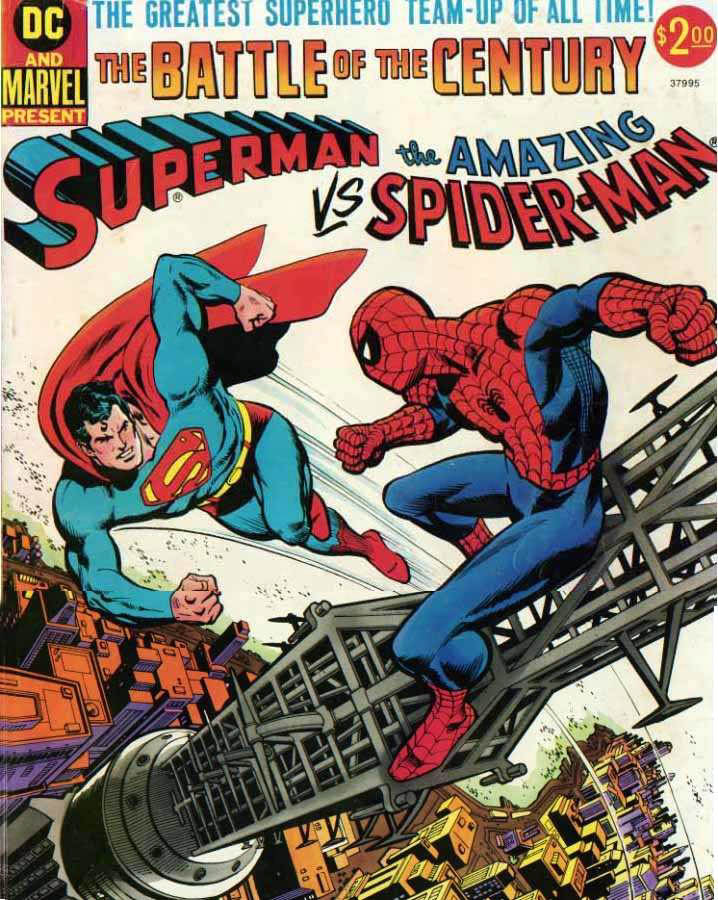
Before the sixties, comics stories only rarely referenced each other, but with a new breed of comic came a new breed of comics fan interested in seeing how disparate elements in the universe connected. While Marvel developed their own, at first tightly-knit continuity, DC experimented with alternate realities across which their adventures took place. In the seventies, when comics' direct market took shape, the shared universe concepts especially took root as did a more fan-centric atmosphere. This was the age of the Omniverse fanzine and the Superman Vs. The Amazing Spider-Man tabloid-size crossover. The crossovers between companies stopped in the eighties, with companies finding value in having their own characters all team-up in line-wide events that haven't stopped to this day. In Crisis on Infinite Earths DC sought to do away with their Multiverse concept in favor of a streamlined, more "realistic" lineup, but only created more problems that would plague them for decades.

17.8.11

DCnU: Comic Books Are Really, Really Great (For Continuity P0rn!) (3)

(DCnU Continuity Series:  Part 1 | Part 2 | Part 3 | Part 4 | Part 5)

Welcome back, comics compatriots!

Springing forth from the September relaunch of DC Comics like Athena busting out fully-formed from Zeus' noggin, here's yet another in a series of discussions of various facets of the comics medium. This is the third part of my very complex discussion of comics continuity. In the first part, I discussed the development of Marvel Comics' shared universe and DC's development of their Multiverse. In the second, I addressed how DC's attention to combining all their universes into one "New Earth" during Crisis on Infinite Earths actually created logistical problems that grew to rival any inconsistencies with the previous "Multiverse" system. I don't think it's overstating the case to suggest Crisis gave birth to the continuity-obsessed comics culture of the present day. And that brings us to this section, where I'll explore continuity gone wild.

Silly season begins at DC: Tim Truman's Hawkworld.
Out of the Crisis, several characters' histories were "rebooted"--which is to say their prior histories were to be ignored as if they had never occurred. While writer Marv Wolfman intended for the conclusion of Crisis to result in a "new," composite DC Universe whose history we would see unfurl from that point forward, the editorial regime headed by Jenette Kahn, Dick Giordano and Paul Levitz nixed the idea. (More on this point as we race to the conclusion of this series!) Only Superman, Wonder Woman and the Justice League really enjoyed true "reboots," while the vast majority of the DC line pushed forward as before. Never mind that Superman had just appeared in an issue of Hawkman only a few months before, for Superman was just being introduced to the city of Metropolis over in Man of Steel. Nevermind that Wonder Woman had been fighting crime since the forties, for that was really Hippolyta, Diana of Themyscira's mother. And please, oh please oh please oh please, don't get me started about the hideous mess DC made when they relaunched Hawkman's continuity with Hawkworld in 1990!

On top of that, by very virtue of there being only one Earth when previously there were many, all kinds of bits of history were reshuffled. Earth-2's heroes, the Justice Society of America, were now part of the history of this new Earth, but neither Superman nor Batman were their contemporaries. (Wonder Woman? See above.) And most certainly, Batman and Catwoman never married and never had a daughter, Helena Wayne, that became the Huntress. Although there would be a Huntress, her origin was dramatically rewritten. Power Girl? Now, there was a question that wouldn't definitively be resolved until Infinite Crisis in 2005.

Retconning 101: The revised origin of the Swamp Thing by Alan Moore.
Hand in hand with the concept of a "reboot" or "relaunch" is the "retcon," short for "retroactive continuity," wherein previously established facts are changed. In-story facts can be changed to facilitate new stories being told (as you'll see in my explanations of certain Spider-Man storylines below) or to resolve apparent discrepancies in continuity that have arisen for any number of reasons (as you'll see in the below story about Superboy and the Legion of Super-Heroes). Some retcons only added "previously-unknown" details that cast a character's present in new light, such as when Alan Moore posited that the Swamp Thing was only a plant creature that thought it was Alec Holland (in "The Anatomy Lesson," from Saga of the Swamp Thing #21), or when Barry Allen, the second Flash, was revealed to have a twin brother (Cobalt Blue, as revealed in The Life Story of the Flash and Flash [vol. 2] #144). Other stories used retcons to substantially alter characters' histories, or eliminate them altogether, such as the aforementioned Crisis on Infinite Earths. As you can imagine, retconning, no matter how well done, has come to have a negative connotation and it's easy to understand why. Retcons, retcons, everywhere!

With all that DC had done in the previous fifty years, the current generation of DC's writers took it upon themselves to stitch together a continuity that was utterly fractured by the company's own hand. And the more they drew attention to the problems they created, the worse in turn those problems became. I mentioned the relationship between Superboy and the Legion of Super-Heroes in my last post. This relationship became an easy target because, well, in post-Crisis continuity, Clark Kent never became Superboy!
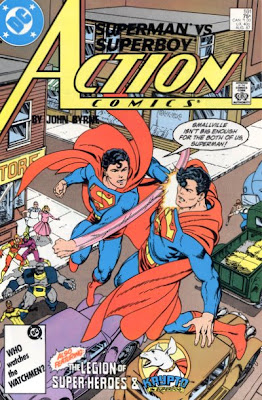
"If there was never a Superboy, who the hell is fighting Superman?"
To address the issue--perhaps the earliest incidence of continuity porn to spin out of Crisis--John Byrne and Paul Levitz concocted a byzantine plot whereby the Legion's arch-enemy, the Time Trapper, created a "pocket universe" and populated it with Earth and Krypton. (Told in Action Comics #591, Superman #8 and  Legion of Super-Heroes #37-38, 1987.) He then manipulated events that resulted in Superboy's creation, and whenever the Legion traveled to the past, it was really the Trapper's pocket universe they visited. The explanation gets loopier from there, with every plot contrivance underscoring the fact the story wasn't being told because somebody thought it would make a good story, but rather, because they needed some explanation in place! (A few months later, the same pocket universe would give birth to the first post-Crisis iteration of General Zod and his fellow criminals, as well as a "good" Lex Luthor who sent his creation Matrix, imprinted with the mental engrams of that universe's Lana Lang, to Earth. There, Matrix became the first post-Crisis Supergirl, who fell in love with Lex Luthor's clone, merged with the post-Crisis Linda Danvers, and eventually became an angel. But, I'm digressing!)

Eventually, DC's continuity problems continued to grow, which led to ever more drastic measures to "fix" them. The first major, whole-house attempt was Dan Jurgens' Zero Hour: A Crisis in Time, which endeavored to fix not only Crisis but also an earlier summer crossover, Armageddon 2001, whose ending had been mishandled after fans figured out the ending months ahead of release. A time-traveling villain named Extant acted as servant for hero-gone-bad Hal Jordan, Earth's second Green Lantern, who took ever more drastic measures to bring back his hometown Coast City, which had been decimated in the "Reign of the Supermen" storyline the previous year. The series, which started at issue #4 and "counted down" toward the finale in the aptly-numbered #0, ended in a drastic re-ordering of time that was supposed to magically fix everything that came before. They even included a fold-out timeline that included events from the distant past to the far future to prove their point that everything was nearly addressed!

Everything ends, and begins again. Zero Hour: A Crisis in Time #1.
It wasn't, of course, but in the meantime, we got a quasi-reboot with a month full of special issues of every DC title, all numbered #0 and their covers printed with metallic ink highlights. Some new series arrived, the most noteworthy of which was Starman under the aegis of James Robinson and Tony Harris. Meanwhile the Legion of Super-Heroes was relaunched with all evidence of Superboy's involvement in their origins erased, while the biggest change to Batman was re-establishing that his parents' killer was a nameless crook (and not Joe Chill, a fact true in both pre-Crisis continuity and in the post-Crisis "Batman: Year Two").

At the same time as DC dealt with their second big event centered around a "Crisis," Marvel initiated perhaps the most notorious example of using continuity as a weapon. To attempt to follow DC's lead with such events as "The Death of Superman" and "Knightfall," they concocted (there's that word again!) a storyline in which a clone of Spider-Man, who'd appeared in a series of stories in the seventies, had never died. The character, who renamed himself Ben Reilly (itself a continuity nugget, combining Spidey's uncle's first name with his aunt's maiden name), went on the road for many years but came back when he heard of Aunt May's sudden illness. His return between 1994-1996 also prompted the return of the villain that created him, the nefarious Jackal, who brought with him a host of half-baked clones including one of Gwen Stacy, Spidey's lost love. All along the way, the writers constantly refuted previous stories about the clones, bridging the gaps outside the Spider-Man group of titles.

Silly season begins at Marvel: The Spider-Clone returns.
In theory, the clone's return was meant to be a return to form for Spider-Man, who was seen as increasingly alienated from his fanbase by virtue of his marriage to Mary Jane Watson, then a successful supermodel. Marvel re-characterized Peter Parker as a "dark" character, and even a villain, in the hopes that Ben Reilly would be accepted as the one, true Spider-Man. They even exploited a decades-old plot point whereby Peter could be the clone, and Ben the real one. Peter left New York with a pregnant Mary Jane, and Ben Reilly became a Spider-Man who lost track of which heroes and villains he knew from the point his memories diverged from Peter's. Eventually Marvel opened up an even bigger can of worms by resurrecting Mendel Stromm and Norman Osborn to solve the narrative, kill off Ben, and restore Peter as the one, true Spider-Man. (Don't worry--Marvel would again try, more successfully, to divest themselves of the Spider-marriage. Keep reading.)

Worse, once the "Clone Saga" was complete, writer Roger Stern returned to Spider-Man to rewrite years of continuity since he left the book, with the express aim of providing the "real" identity of the Hobgoblin. He'd already been unmasked years before as Daily Bugle reporter Ned Leeds, but that didn't stop Stern from reopening a dead case and providing his own answer to the puzzle as he originally intended. The three-issue series, Spider-Man: Hobgoblin Lives, contained references to back issues on the back covers, a sure-fire sign that continuity had been taken too far. And, of course, Stern revealed the Hobgoblin to be one of his own creations who hadn't been seen for over a decade. And an evil twin! Le sigh.

The book that led to the revival of the Multive--um, Hypertime: Kingdom Come.
Back at DC, writer Mark Waid and artist Alex Ross' Kingdom Come told a dystopic version of events from DC's future. The four-issue series, published in 1996, continued a special-event line of comics called "Elseworlds," which weren't tales from alternate realities because, well, alternate realities didn't exist anymore at DC, right? Still, on the strength of the storyline, Waid helmed another event series in 1999, The Kingdom, as a sequel of sorts, during which he revealed that the Multiverse was alive and well and part of a concept now called "Hypertime." Hypertime supposed that reality was like a river whose paths could randomly converge and diverge, allowing for different versions of Superman or any other character to coexist or team up as circumstances dictated. It also encompassed the original Multiverse plus all the Elseworlds realities. Most notably, Waid used the Hypertime concept himself at great length during the end of his tenure on The Flash when Walter West, the Flash of an alternate reality, briefly took the place of the mainstream DC Flash, Wallace West. For a while, there was talk of Grant Morrison using the concepts introduced in The Kingdom in a new crossover event to be called Hypercrisis, but the project was shelved.

Writer Kurt Busiek, who rose to prominence through his work on the revolutionary Marvels project with Alex Ross, was that unique breed of writer who endeavored in ways similar to Roy Thomas to link Marvel's past with its present. He never met a continuity reference he didn't like, and if there's one man who embodies the essence of "continuity gone wild" for better or worse, 'tis he. Marvels was filled with references both in the story itself, or in poses of characters, or really, any old thing. They may not have been intrusive to the degree they were in others' work, but there they were all the same. Busiek's intense detail toward continuity minutiae became a driving force behind two of his most well-known projects: Avengers Forever, itself a scrutinous examination of Avengers continuity through the eyes of villain Kang the Conqueror; and the DC/Marvel co-publication JLA/Avengers, itself rummaging through years of unusual continuity to tell a story that spanned the full length of both teams' histories. While demonstrating Busiek's obsessive attention to detail, both series were impenetrable to all but the most fervent fans.

Continuity pr0n for Earth's Mightiest Heroes.
DC's own answer to Kurt Busiek hit the ground running as writer of niche book Stars and S.T.R.I.P.E. and co-writer of James Robinson's JSA revival. In some ways, Geoff Johns could make Busiek look positively amateur by comparison. He sifted through years of complex continuity to return Hawkman from permanent "damaged goods" status in JSA and his own book. He's worked on various "event series" including Day of Judgment, Identity Crisis, Green Lantern: Rebirth, Infinite Crisis, Final Crisis, Flash: Rebirth, Blackest Night, Brightest Day and the currently-running Flashpoint. Each of the company's recent event series has been predicated on older continuity for maximum effect, from Brad Meltzer's Identity Crisis' reworking of the JLA's "Satellite Era" to Infinite Crisis as direct sequel to Crisis on Infinite Earths, to Grant Morrison's Final Crisis as a love letter to Jack Kirby's "Fourth World" tales, to Blackest Night as an ultimate extension of decades of "Green Lantern" mythos.

Infinite Crisis in particular poked fun of the conventions of intense scrutiny of continuity when in its Secret Files & Origins special, writer Marv Wolfman revealed that since Crisis on Infinite Earths, Superboy-Prime punched at the walls of reality from the "paradise" he shared with Earth-2's Superman and Lois, with each punch causing disruptions to continuity. Those disruptions included the resurrection of Jason Todd (Robin II), the changing origins of Superman, and the various incarnations of Hawkman and the Legion of Super-Heroes. If there was an apparent continuity mistake, DC could say that Superboy-Prime made it that way. (And when he was released during Infinite Crisis, he continued the trend of messing everything up. Rimshot!)

Infinite Crisis also brought back the Multiverse in a big way, and for enthusiasts of that brand of storytelling, writer Johns "revealed" (using quotes because it was his own made-up history, not from prior precedent) that legacy characters like the Kyle Rayner Green Lantern and the Jason Rusch Firestorm were really the heroes from another, heretofore unknown Earth ("Earth-8") that was merged into the "new Earth" during the original Crisis on Infinite Earths. Yes, the writers just had to cater to the original spirit of the Crisis-that-was. But Johns kept pushing the envelope further...

Did someone mention "continuity pr0n"? Geoff Johns goes overboard with the Legion.
His work on Final Crisis: Legion of 3 Worlds in particular was hugely evocative of the continuity-heavy stories that Crisis on Infinite Earths spawned, relying on the reader's knowledge of three distinct alternate versions of the Legion of Super-Heroes to assist in comprehension of the narrative (not to mention the returns of several non-Legion characters). Johns catered to his artist, George Perez of 1985's Crisis fame, allowing him to draw dozens or even hundreds of characters in incredible detail such as Perez has become well-known for doing. Lovers of DC's often labyrinthine continuity gobbled the series up, but it often left more casual fans cold--as did, for that matter, Final Crisis itself.

Not to be outdone, Marvel has done some selective continuity editing of their own, almost establishing a sort of "anti-continuity" with Spider-Man's infamous "One More Day" storyline. In it, Spider-Man made a deal with Mephisto, Marvel's representation of the devil, to save his aunt from certain death and to ensure his identity (revealed to the world in a then-recent storyline) became a secret again. Suddenly and without explanation, Spidey's marriage to Mary Jane was edited out of continuity. So ingrained into fans' minds was the idea that some additional explanation was required, that the fans were owed the details as to exactly what changes were made in history to arrive at this point. They couldn't simply accept that "they never got married" because, well, what about Mary Jane's pregnancy during the "Clone Saga"? Didn't that mean their beloved hero was having sex out of wedlock and thus was immoral and unclean? (They seemed to gloss over that part where Spidey made a deal with a bad guy, satanic or otherwise.) The "mystery" went on for nearly a hundred issues until only the points directly raised by "One More Day" were addressed, and no more, in "One Moment in Time." Of course, since then, they've moved on, content to never, ever address the finer points of Spidey's relationship with MJ again.

1st rule of Spidey continuity: You don't talk about Spidey continuity.
Continuity continues to prove a slippery slope, a double-edged sword, a (insert cliche of your choice here). I get the desire to make order out of the chaos, and to show that more or less, fictional realities have similar physical rules to our own. However, the more changes that are done, the less "real" the reality of the comics becomes. Also, continuity creates an insular subdivision of fandom, so engrossed in the "reality" of the characters that they will cry foul on any deviations from previously established events. (Really, the mentality that gave birth to the concept of the "No-Prize," writ large.) Ultimately, one may even see an expansive continuity as one more reason that comic circulation has slowly dwindled, as fewer and fewer people can make sense of these universes the bigger companies have created.

Was DC in danger of collapsing under its own weight when they announced the grand reboot that spins out of the Flashpoint miniseries this month? That's a good and fair question, but it'll have to wait until my fourth and final part of this little (heh) essay.

Next: Grand Guignol

(DCnU Continuity Series:  Part 1 | Part 2 | Part 3 | Part 4 | Part 5)

~G.