(Updated thanks to an eagle-eyed Facebook friend. Thanks, GG!)
When last we left our intrepid blogger, I was constructing a narrative by which I proved that there's a great, big target on the Hulk's green butt, put there by Marvel's powers-that-be and set to have the bull's-eye hit on Wednesday, July 13th, only 3 short days from now, in the pages of Marvel's Civil War II #3. Now, get ready to go beyond the actual event, into what the Hulk's death means for the world of Marvel Comics and its creators, for you the fans, and for the entire doomed comics industry.
(Whoops. Did I just say "doomed"? Heh-heh.)
While I've been taking the time to write these new chapters, I hope you've familiarized yourself with Totally Awesome Hulk #7-8, both now on sale, the latter of them since I published part one. As writer Greg Pak stated himself, the books mark his return to writing Bruce Banner. What he didn't say--but which is patently obvious from reading the eighth issue in particular--is that these stories are intended as a final look back at our favorite physicist, since his next appearance in Civil War II will end with an arrow through his [insert whatever part of Banner's anatomy you want].
Showing posts with label Essays. Show all posts
4.7.16
O Death, Where Is Thy...Smash??!? (1 of 2)
(EDITED 7/8 thanks to Cth at The Incredible Hulk Message Board!)
It's been about a year since my last post on Marvel's Green Goliath. Those of you who have followed me for any considerable time know the Hulk is my favorite comics character. Hence, I'm a bit territorial when it comes to big events surrounding Big Green. And when I'm displeased, I'm known to write pieces like those dissecting the runs of Jason Aaron and Mark Waid.
Up to now, I've been staying eerily quiet about Totally Awesome Hulk. That ends today.
I've got much more to get into than Totally Awesome Hulk by itself, so I'll try to be brief. For Greg Pak--one of my very favorite Hulk writers, his name spoken in the same breath as Len Wein, Bill Mantlo & Peter David--to have a comeback would ordinarily be a cause for celebration. At the same time, there was apprehension, for what writer successfully returns to the book on which he made his mark? Even Peter David couldn't make lightning strike twice, leaving not even a year into his second tenure. It was true that this time, Pak was making his own creation, Amadeus Cho, into a brand new Hulk, in a move that I previously stated echoed Bill Mantlo's original plans before he handed the book to John Byrne. Some at the time called it a Gary Stu situation (look it up) beyond all others. Me, I went along for the ride, as Pak had earned much goodwill in his prior five-year run.
4.7.15
Convergence (Or, an Essay on My Changing Comic Buying Habits)
...and no, this time I don't mean DC's Convergence event that ran through their June and July-dated books this year. But, then again, that's not a bad place to begin...
Historically speaking, my comic book buying habits have been rather crazy. And when I began ordering from Discount Comic Book Service in 2006 was when that habit kicked up another few notches. With astonishing 40% discounts across the Big Two and sizable discounts for the other companies, I could afford more than under my local comics retailer's discount.
![]() |
| Convergence #0 variant cover by Adam Hughes...just because I like it! |
3.8.11
The New Spider-Man & The License of Power (Blame Film Class!)
(Updated to include Bill Foster & Jaime Reyes in my roundup.)
It's been a crazy week, kids, and it's only gotten crazier with yesterday's announcement that half-black, half-Hispanic teen Miles Morales will become Marvel's new Ultimate Spider-Man in this week's Ultimate Fallout #4 by Brian Michael Bendis & Sara Pichelli. I figured I'd touch on the hubbub and make a point that dovetails, ever so lightly, with my articles on continuity (the second of which, no kidding, is coming really soon).
So, there's a new Spider-Man, and in a move apparently inspired by African-American comedian Donald Glover's desire to land the role of Peter Parker in next summer's Amazing Spider-Man film, he belongs to a racial minority. With this move, Marvel makes Spidey the next in a long line of superheroes who've been "replaced" by a minority character. This practice has been more common in DC Comics of late, with co-publisher Dan DiDio having launched an aggressive campaign to add diversity to their line-up of super-heroes.
Looking at the trend of "replacing"--always temporarily--major super-heroes with minority characters, I thought it interesting to be able to tie the concept back to something I worked on, years ago, back in film class! Y'see, once upon a time I took a class in colonialism in cinema, and the paper I worked on for my final was a dissection of the Blaxploitation genre. I introduced this concept of the "License of Power," in which I put forth the idea that the blacks in these films weren't really as in control of their destinies as the filmmakers would have one believe. Rather, the colonial relationship--which is essentially between master and subject/slave--was left intact, consciously or subconsciously, with power firmly resting in the hands of whites.
To drive a narrative forward, to be the "hero," blacks were licensed a measure of power that made them capable of accomplishing their tasks within the narrative. The implicit license transferred the whites' power onto the black protagonists (and sometimes antagonists), with the implication that without white interference, the blacks would be unable to succeed. The other side of the coin was that the "license of power" was not indefinite and did have particular conditions. If the licensee didn't follow through on the assigned task(s), or if he exceeds his authority, then the white men who have granted him such power were obligated to strip the character of it.
I went through a number of examples in the Blaxploitation genre to prove my argument, using films like Mandingo, Blacula, Shaft and Black Caesar. (In the end, I did get an "A" on the paper, so I suppose my claims have a degree of merit.) Which, of course, brings me to the License of Power as it applies to superheroics.
There is a dearth of truly original minority super-heroes in comics. Obviously Luke Cage, Storm and Black Panther come to mind at Marvel, while Black Lightning, Bronze Tiger and Vixen are solid if not particularly well-known examples at DC. While it's grown difficult for new characters to gain a foothold in the comics market, it's even more daunting for an original minority hero to find that niche. Since the sixties, it's become a common trope for the Big Two to develop a new minority hero by introducing them in the mold of an established white one. In all the below cases, the "license" idea refers chiefly to the passing of the tights.
Miles Morales is a member of one of the fastest-growing minority classes (which will, we're told, become a sizable majority in the U.S. sometime later this century if trends continue). Besides that, we really don't know anything about the new Spider-Man; he's a blank slate and will continue to have only the barest hint of characterization until the new volume of Ultimate Comics Spider-Man arrives in comic shops in September. Although it will be interesting to see someone other than Peter Parker behind the mask for a change (Ben Reilly doesn't count, and Hobie Brown did it for all of five seconds), I can't help but feel Marvel's energies would have been better spent introducing the "next great character in the Ultimate Marvel firmament" who happens to belong to a minority, instead of just promulgating the next in a line of seemingly endless iterations of their number one hero. It's a publicity stunt either way, right? What would have been better than having several new heroes--white, black, Hispanic, Indian, Asian, whatever--trying to live up to the legend begun by Spider-Man, a young kid who could have been any one of them behind that mask that didn't give a hint to the identity or race of the person behind it? Imagine the development of several original characters inspired by Spidey, all under the event umbrella, "The Hero Who Could Be You!"
Ah, but there we go, again. The last Marvel "hero" of any sort to really resonate with so-called fans is Deadpool, created in 1991. And the last minority character to really strike a chord was Luke Cage, created in 1972. (Does Bishop count? Where is he now, anyway?) And neither is really in the public eye--that honor belongs to Samuel L. Jackson as Nick Fury, and don't get me started on him. Perhaps it's better to endlessly regurgitate the old stuff in new ways--and in this case, the same tired colonialist tropes--simply because it's better to take small chances like changing a beloved character's ethnicity than take a bigger chance like trying to do something truly new, interesting, and perhaps, just perhaps, original.
Give us some heroes, Marvel. Don't give us a bunch of musical masks.
~G.
It's been a crazy week, kids, and it's only gotten crazier with yesterday's announcement that half-black, half-Hispanic teen Miles Morales will become Marvel's new Ultimate Spider-Man in this week's Ultimate Fallout #4 by Brian Michael Bendis & Sara Pichelli. I figured I'd touch on the hubbub and make a point that dovetails, ever so lightly, with my articles on continuity (the second of which, no kidding, is coming really soon).
![]() |
| New costume. New Spider-Man. Art by Kaare Andrews. |
Looking at the trend of "replacing"--always temporarily--major super-heroes with minority characters, I thought it interesting to be able to tie the concept back to something I worked on, years ago, back in film class! Y'see, once upon a time I took a class in colonialism in cinema, and the paper I worked on for my final was a dissection of the Blaxploitation genre. I introduced this concept of the "License of Power," in which I put forth the idea that the blacks in these films weren't really as in control of their destinies as the filmmakers would have one believe. Rather, the colonial relationship--which is essentially between master and subject/slave--was left intact, consciously or subconsciously, with power firmly resting in the hands of whites.
![]() |
| Fresh from the 70s Blaxploitation craze, and still Marvel's most popular black hero. |
I went through a number of examples in the Blaxploitation genre to prove my argument, using films like Mandingo, Blacula, Shaft and Black Caesar. (In the end, I did get an "A" on the paper, so I suppose my claims have a degree of merit.) Which, of course, brings me to the License of Power as it applies to superheroics.
There is a dearth of truly original minority super-heroes in comics. Obviously Luke Cage, Storm and Black Panther come to mind at Marvel, while Black Lightning, Bronze Tiger and Vixen are solid if not particularly well-known examples at DC. While it's grown difficult for new characters to gain a foothold in the comics market, it's even more daunting for an original minority hero to find that niche. Since the sixties, it's become a common trope for the Big Two to develop a new minority hero by introducing them in the mold of an established white one. In all the below cases, the "license" idea refers chiefly to the passing of the tights.
![]() |
| John Stewart, forerunner of the minority replacement heroes. Art by Neal Adams. |
- John Stewart: Introduced in 1972's Green Lantern #87, Stewart wasn't even the first alternate selected to be the Green Lantern of Sector 2814. He was only selected when Guy Gardner was comatose with brain damage. He was often a "substitute" Green Lantern during the late seventies, and stepped up to be the sector's only Green Lantern when Hal Jordan briefly quit in the early eighties. Hal Jordan has struck him down as Green Lantern, most notably when Hal as Parallax put an end to his life as the first human Guardian when he destroyed Oa's Central Power Battery. Interestingly, he's the Green Lantern the public finds most familiar, due to his appearance in Cartoon Network's Justice League Unlimited animated series.
- Bill Foster: Originally a lab assistant to Dr. Henry Pym, Dr. Bill Foster assumed the identity of Black Goliath in the seventies, using Pym's growth formula while Pym himself enjoyed a career as Yellowjacket in the Avengers. Later, he took yet another of Pym's noms du guerre, Giant Man. Much later, he surrendered the Giant Man name and powers to Pym, but eventually returned only to be killed during Marvel's Civil War.
- Jim Rhodes: Introduced in 1979 as billionaire industrialist Tony Stark's pilot, Rhodey didn't take the spotlight until 1983. Denny O'Neil and Luke McDonnell took Stark out of the Iron Man armor, having relapsed into alcoholism, and gave the armor to him. Rhodey wore the armor for over two years, until Tony actually fought his friend and diagnosed him with a physiological condition over wearing armor not meant for him. Afterward he rarely wore the suit, but upon Stark's "death" a few years later he donned the "War Machine" armor, which he's done off and on for years, mostly at Stark's discretion, often clashing with his boss and friend and even losing the armor. (Stark never had an alien armor bail him out of a jam!) He currently moonlights as "Iron Man 2.0."
![]() |
| Rhodey takes center stage as the new Iron Man. Art by Luke McDonnell. |
- Isaiah Bradley: In the revisionist era of the early 2000s, African-American creator Kyle Baker posited that after Steve Rogers was given the Super-Soldier Serum that made him into Captain America, the U.S. government tried to duplicate the lost serum by experimenting on black men. The storyline evoked similarities to the Tuskegee Syphilis Study, and Isaiah Bradley was its biggest success, first becoming superhumanly powered (the "Black Captain America") but eventually falling victim to ill effects that left him incapacitated in his later years. Eventually Rogers learned of his existence and sought reconciliation, feeling guilt for what had happened to Isaiah.
- Jason Rusch: Ron Raymond, a.k.a. Firestorm, floundered from series to series after DC canceled his own long-running title in 1990. What else could DC do but relaunch the character with a new secret identity? While they wisely reinstated the dual personality that marked the Firestorm entity since his creation in 1978, it nonetheless remains expressly clear that Jason originally received his power as direct result of Raymond's death during Identity Crisis. And when Ron returned in Blackest Night, DC quickly relegated Jason to the voice in his head, going the way of his predecessor, Martin Stein.
- Crispus Allen: Originally introduced as a Gotham City detective in Detective Comics, he graduated to a role in Gotham Central before being murdered by a crooked cop named Jim Corrigan, not-so-coincidentally also the name of DC's original Spectre, an entity of immense power committed to vengeance against the guilty. Allen became the new Spectre, wearing the raiment longtime DC fans associated with the (for now) deceased, original Corrigan. Often, especially in big events, this Spectre is largely interchangeable with his earlier counterpart. (Death is a great way to inherit the "license," innit?)
![]() |
| Ryan Choi, Asian replacement for Ray Palmer, the Atom. Art by Ariel Olivetti. |
- Ryan Choi: DC introduced the Chinese scientist specifically to add even more color to its diversifying line in the wake of Infinite Crisis. Created by Grant Morrison and Gail Simone, Dr. Choi was a previously unknown protege of the previous Atom, Ray Palmer, and took over the role when Palmer went conveniently went missing during the earlier Identity Crisis. He not only became the Atom, but he also took Palmer's place on the staff of Ivy University.
- Jaime Reyes: Also spinning out of the end of Infinite Crisis was this Hispanic variant on the Blue Beetle character, picking up where previous versions Dan Garrett and then-recently-deceased Ted Kord left off. The source of his powers was the same magical scarab used by Garrett, the first Beetle. He has had a three-year run in his own title, followed by a regular second feature in Booster Gold, becoming his partner in the same way as Ted Kord was before him in the Justice League International.
- Tyrone Cash: The Ultimate Marvel universe had one previous flirtation with changing races in Dr. Leonard Williams, the retconned-in "First Hulk." Introduced in Ultimate Comics Avengers by Mark Millar and Leinil Yu, Williams worked with Banner on the Hulk experiment, and became a Hulk that kept his intelligence and used his smarts to fake his death and set himself up as a gang lord in South America, surrounded by gangstas and hoes, embodying the very worst of the "Black Buck" stereotype. He also took the place of the "real" Hulk for a time.
![]() |
| They say this cat Hulk is a baaaad motha'--shut yo'mouth! Art by Leinil Yu. |
- "Thunderbolt" Ross: Only a minority in the sense of his age group (originally to have been nearly 70 if older stories were judge, but edited to be in his 50s), Ross became a Hulk oddly similar to his predecessor, a sharp counterpoint to all previous gamma-enhanced individuals. Since being defeated by the Hulk, he keeps his power under writer Jeff Parker so long as Banner and Captain America deem it appropriate (i.e. as long as sales don't falter).
Miles Morales is a member of one of the fastest-growing minority classes (which will, we're told, become a sizable majority in the U.S. sometime later this century if trends continue). Besides that, we really don't know anything about the new Spider-Man; he's a blank slate and will continue to have only the barest hint of characterization until the new volume of Ultimate Comics Spider-Man arrives in comic shops in September. Although it will be interesting to see someone other than Peter Parker behind the mask for a change (Ben Reilly doesn't count, and Hobie Brown did it for all of five seconds), I can't help but feel Marvel's energies would have been better spent introducing the "next great character in the Ultimate Marvel firmament" who happens to belong to a minority, instead of just promulgating the next in a line of seemingly endless iterations of their number one hero. It's a publicity stunt either way, right? What would have been better than having several new heroes--white, black, Hispanic, Indian, Asian, whatever--trying to live up to the legend begun by Spider-Man, a young kid who could have been any one of them behind that mask that didn't give a hint to the identity or race of the person behind it? Imagine the development of several original characters inspired by Spidey, all under the event umbrella, "The Hero Who Could Be You!"
![]() |
| Maybe young Miles Morales is right. Art by Sara Pichelli. |
Give us some heroes, Marvel. Don't give us a bunch of musical masks.
~G.
19.7.11
DCnU-Inspired: Continuity - Please Use in Moderation (1)
(DCnU Continuity Series: Part 1 | Part 2 | Part 3 | Part 4 | Part 5)
Wow! The DC Relaunch is the gift that just keeps on giving. This article is the fifth in a series centered on issues surrounding DC Comics' September relaunch of all their series. In previous articles, I've addressed a lot of retailer concerns, and even provided a historical perspective on distribution. Now I'm emphasizing fans instead of retailers, content instead of trappings. This article's been in mind for some time, but recent developments concerning DC's flagship character, Superman, have made it unavoidable. Don't know what's happened to Supes lately? Don't know that he's getting super-armor and will no longer be married to Lois Lane? It's just the next in a long line of changes, friends, and it all concerns the big "C"-word: continuity.
Strictly defined, "continuity" is "the state or quality of being continuous"--straightforward enough. As applied to serial fiction (according to the always-right-yeah-right Wikipedia), it's defined as "consistency of the characteristics of persons, plot, objects, places and events seen by the reader or viewer over some period of time." It's a term used in movies and television, where they often have a script supervisor in charge of getting the details right because scenes are often shot out-of-order. A continuity expert makes sure a glass of water is at the same level throughout a scene. makes sure an actor wears the same clothes or is groomed a certain way in every take for a scene.
In comics, continuity takes on an arguably more twisted meaning. When telling stories about the same characters in one fictional universe, the details shouldn't change. Superman shouldn't have the hots for Lois one month and then do the same for Lori Lemaris the next month. He shouldn't have super-strength and speed one month and the next have electrical powers without explanation. It's all a matter of consistency, of keeping characters and their ongoing situations recognizable to the core model from month to month. Even if one waits a year or more between picking up an issue of any given series, the storylines shouldn't be all that different as to render the reader totally lost.
In the early days of comics, the thirties and the forties, creators didn't have to worry about continuity except in a very basic sense. In his secret identity, Superman was really Clark Kent, reporter for a great metropolitan newspaper, and he often competed with himself for the affections of fellow reporter Lois Lane in between saving the world and reporting about it. Simple, right? Even still, some of the details got mixed up. Clark worked for the Daily Star in one issue, the Cleveland Evening News in the next, and far later the Star became The Daily Planet. A new villain, named only Luthor, was a redheaded mad scientist when he first appeared in Action Comics #23 (1940), and yet he appeared soon after in a daily newspaper strip (and then Superman #10) as a bald man. The goof was attributed to Leo Novak, who either mistook Luthor for a bald henchman or the Ultra-Humanite, another early villain.
No one thought twice about these discrepancies at the time, which brings up another important point about early comics as they were never intended as serious literature. They were designed to be read by children and discarded after a few short years so those children would then form attachments to novels, magazines and the like. Certainly no one expected comic books to gain any manner of cultural relevance! Comic creators were also often those who couldn't get jobs creating newspaper cartoons or who were otherwise unable to write or draw what they wanted elsewhere. Nobody wanted to work in comics! (Stan Lee, hired at Marvel/Timely in 1941, actually changed his name because he wanted to write the Great American Novel, and thought he couldn't do it if everyone knew Stanley Martin Lieber wrote comics.)
Eventually, writers would begin to tell stories that delved into the backgrounds of their characters, like Jerry Siegel, who in 1960 told Luthor's origin in Adventure Comics #271, incorporating his original red hair but stating the reason he lost it--and hence, hated Superman--was due to the Man of Steel's actions when they were both boys. Silly? Maybe. Still, it didn't solve anything since Superman and Lex were both adults in that first appearance when he had red hair. However, in reinventing the past, this story marks an important use of the retcon, or retroactive continuity--a fundamental conceit of comic books that writers have embraced with increasing frequency.
In the later era of the fifties and sixties, Superman editor Mort Weisinger engaged in spotting mistakes in his letter columns, a practice that gave rise to what some might deem the worst kind of fan behavior (actively looking for said errors). I'm told rewards were offered by many publishers--free comics, money, something else. Directly or indirectly, the practice led in 1964 to Stan Lee, Marvel's key writer/editor, instituting the No-Prize, an award given for not only spotting a continuity gaffe, but also explaining why it wasn't really an error at all, because, after all, Marvel didn't make mistakes. Lee forced fans to be creative to win the prize, which originally was mere recognition in a letter column, but soon became an empty Marvel stationery envelope.*
(* My favorite No-Prize idea concerned the Hulk. In the seventies, Banner wore another color of pants, but when he changed they turned purple, which prompted one astute reader to surmise that gamma rays sometimes cause fabric to turn purple! The explanation has remained in place ever since.)
Another leap forward came in 1961, just before the dawn of the Marvel Age of Comics. As detailed previously, comics circulation plummeted in the years following World War II, leading to cancellation of many books. Only Superman, Batman and a handful of other characters were consistently published from the late thirties through the present. Hence, DC introduced a new Flash, Barry Allen, instead of returning their original "Golden Age" Flash character, Jay Garrick, and no one was really the wiser. They opened up a can of worms with September 1961's Flash #123, featuring the landmark "Flash of Two Worlds" story by Gardner F. Fox, inspired by DC's then-editor, Julius Schwartz. The tale firmly established the earlier Flash had existed as part of a separate reality that could "cross over" with the then-current DC. But again, the revelation that the other Flash existed in another universe led to questions about the characters who'd been continually published in the same era!
Over the next several years, DC would showcase meetings between its older and newer generations of characters, often framing them as "crises" when the Justice League of America (JLA) teamed up with its predecessor, the Justice Society of America (JSA). The first such meeting between the groups, in Justice League of America #21, established the names "Earth-1" for the modern DC heroes and "Earth-2" for their Golden Age counterparts. Dennis O'Neil and Dick Dillin addressed the "problem" of Superman having existed in both the JLA and JSA eras in Justice League of America #73 (August 1969) with the (re-)introduction of the Superman of Earth-2. That Superman was named Kal-L (not Kal-El), had parents named John and Mary Kent, worked at the Daily Star, and was middle-aged. Soon after the development of the Superman of Earth-2 came the Batman of Earth-2, following a similar premise, and years later DC introduced Power Girl, the Earth-2 counterpart to Supergirl. These characters could do things DC wouldn't allow their Earth-1 counterparts to even consider, like aging, marrying, having children (like Batman's daughter, the Huntress) and dying.
Meanwhile, another trend swept comics, spurred on by Marvel Comics throughout the sixties and seventies, but which was also employed by DC: the proliferation of editor's notes. Such notes were used to interconnect various series by indicating in which series and issues certain other events occurred.The last time the Fantastic Four fought Doctor Doom, that time Bucky was killed, a subtle reminder that the fella snapping photos while Daredevil fights the Eel is really Spider-Man--all were in these notes. While many notes were relatively unobtrusive, some writers would get carried away and reference multiple stories or otherwise write a caption that stopped the narrative dead in its tracks. Only infrequently could fans just coming to the hobby readily pick up the books referred to in these notes. (Some notes even cited recent reprints of the stories back when there were such vehicles, in the age before graphic novel collections.) The notes reinforced the shared universe feel of the comics in their best moments, but at their worst could be totally off-putting.
While the Crisis sagas of the sixties and seventies relied on two generations of characters, it was at first a manageable system. The real trouble hastened with the acquisition of other companies' characters and making those characters part of separate universes instead of merely blending them into DC's own "Earth-1" tapestry. Fawcett Comics' Captain Marvel (himself the target of a copyright infringement lawsuit by DC) and his ilk became denizens of Earth-S, and Blue Beetle and the other Charlton Comics heroes lived on Earth-4. DC added Earth-3, home to the Crime Syndicate, an evil variant of the Justice League. Every time you turned around, another DC character was doing something crazy in an "imaginary story" that couldn't happen in the mainstream DC universe, and another alternate Earth was created. For a while it appeared that every off-base continuity element from DC's middle decades was explained away by just being another alternate Earth, in a broader continuity of universes, or multiverse.
By comparison, Marvel took pains to acknowledge all its characters as part of the same cohesive universe. In the sixties Stan Lee established Captain America had been frozen in ice since the end of World War II, and was thawed by the Avengers. Similarly, the Sub-Mariner had been reduced to an amnesiac vagrant until the new Human Torch, the Fantastic Four's Johnny Storm, awakened his dormant memories. Later, writers Roy Thomas and Steve Englehart established the original Human Torch's body was rebuilt and became the Avengers' resident android, the Vision. During the "Kree-Skrull War," Thomas had Rick Jones harness some power that brought to life versions of earlier generations of Marvel heroes without bringing them in from alternate realities. And in the early seventies, Englehart established the Captain America of the fifties was not really Steve Rogers, and used that idea to springboard a new story of his return. In addition, most of the dimensions the heroes visited weren't shadows of the main Marvel universe, but far different dimensions with their own physical laws, like the Dark Dimension and the Negative Zone. Only a handful of alternate realities or alternate futures were ever glimpsed, and were different enough from the main reality to avoid confusion.
Only later would Marvel begin to play in the "alternate universe" sandbox with the advent of What If?, a series starring the Watcher, a tertiary character introduced in Fantastic Four. Fascinated by the heroes of Earth, the alien peered into alternate realities to see other versions of key Marvel events, such as what might have happened if Spider-Man had joined the Fantastic Four back in Amazing Spider-Man #1, or if Conan the Barbarian (then licensed by Marvel from the Robert E. Howard estate) had time-traveled to present-day New York City. The series afforded Marvel the opportunity to tell stories outside canon, while its episodic nature meant that a different hero or team could be spotlighted every issue (occasionally with more than one story per book). Although the book only ran 47 issues, it would return in 1989 for many years. Even today, the series returns annually with a number of one-shots. More than any series before or since, What If? serves as a foremost example of fanservice in comics due to its very nature, where anything can and often does happen to beloved characters--albeit often with a "monkey's paw"-style twist. (DC would exploit their own version of What If? much later in their "Elseworlds" imprint from 1989-2008. The stories were often anchored less to any individual divergence in the comics themselves and more the result of changing world history or the character's milieu, like involving a late 19th Century Batman against Jack the Ripper.)
While Marvel developed their own multiverse in 1977, a group of fans took it upon themselves to analyze the different continua of both DC and Marvel. Mark Gruenwald and Dean Mullaney developed the two-issue fanzine Omniverse and in so doing coined the very term, defined as a system of multiverses: Marvel's, DC's, all the independent publishers', every novel, every piece of literature, every story ever told, even our reality, all strung together in a string theory of deliciousness. The fanzine led to Marvel hiring Gruenwald as a writer and editor, where he put his ideas to further use in some early Marvel Two-In-One stories about time-travel and Serpent Crowns from across the multiverse. He also codified much of Marvel's universe in the first-ever official handbook, called (what else?) The Official Handbook of the Marvel Universe.
Adding to Gruenwald's vision, whether he knew it or not, was British creator Alan Moore, who teamed with artist Alan Davis on a revival of the Captain Britain character for Marvel U.K. beginning in 1982. In that series he established the Captain as but one in a group of British warriors across a myriad of realities. Henceforth the mainstream Marvel universe was dubbed "Earth-616," after the alleged newsstand release date of Fantastic Four #1. (Although the book was cover-dated November, it may have hit newsstands as early as June. The British invert the month and year, hence 61-6.)
And somewhere in there, DC decided that enough was enough. With the newfound attention to multiverses and continuity came the idea to tear it all down and simplify...
Next: "O Crisis! Where Aren't Thou?" (Or, Continuity Gets Kinky)
(DCnU Continuity Series: Part 1 | Part 2 | Part 3 | Part 4 | Part 5)
~G.
Wow! The DC Relaunch is the gift that just keeps on giving. This article is the fifth in a series centered on issues surrounding DC Comics' September relaunch of all their series. In previous articles, I've addressed a lot of retailer concerns, and even provided a historical perspective on distribution. Now I'm emphasizing fans instead of retailers, content instead of trappings. This article's been in mind for some time, but recent developments concerning DC's flagship character, Superman, have made it unavoidable. Don't know what's happened to Supes lately? Don't know that he's getting super-armor and will no longer be married to Lois Lane? It's just the next in a long line of changes, friends, and it all concerns the big "C"-word: continuity.
![]() |
| The New-New-New-New Superman. (We'll get to him later.) Art by George Perez. |
Strictly defined, "continuity" is "the state or quality of being continuous"--straightforward enough. As applied to serial fiction (according to the always-right-yeah-right Wikipedia), it's defined as "consistency of the characteristics of persons, plot, objects, places and events seen by the reader or viewer over some period of time." It's a term used in movies and television, where they often have a script supervisor in charge of getting the details right because scenes are often shot out-of-order. A continuity expert makes sure a glass of water is at the same level throughout a scene. makes sure an actor wears the same clothes or is groomed a certain way in every take for a scene.
In comics, continuity takes on an arguably more twisted meaning. When telling stories about the same characters in one fictional universe, the details shouldn't change. Superman shouldn't have the hots for Lois one month and then do the same for Lori Lemaris the next month. He shouldn't have super-strength and speed one month and the next have electrical powers without explanation. It's all a matter of consistency, of keeping characters and their ongoing situations recognizable to the core model from month to month. Even if one waits a year or more between picking up an issue of any given series, the storylines shouldn't be all that different as to render the reader totally lost.
![]() |
| In the early days, consistency didn't even really matter. |
In the early days of comics, the thirties and the forties, creators didn't have to worry about continuity except in a very basic sense. In his secret identity, Superman was really Clark Kent, reporter for a great metropolitan newspaper, and he often competed with himself for the affections of fellow reporter Lois Lane in between saving the world and reporting about it. Simple, right? Even still, some of the details got mixed up. Clark worked for the Daily Star in one issue, the Cleveland Evening News in the next, and far later the Star became The Daily Planet. A new villain, named only Luthor, was a redheaded mad scientist when he first appeared in Action Comics #23 (1940), and yet he appeared soon after in a daily newspaper strip (and then Superman #10) as a bald man. The goof was attributed to Leo Novak, who either mistook Luthor for a bald henchman or the Ultra-Humanite, another early villain.
No one thought twice about these discrepancies at the time, which brings up another important point about early comics as they were never intended as serious literature. They were designed to be read by children and discarded after a few short years so those children would then form attachments to novels, magazines and the like. Certainly no one expected comic books to gain any manner of cultural relevance! Comic creators were also often those who couldn't get jobs creating newspaper cartoons or who were otherwise unable to write or draw what they wanted elsewhere. Nobody wanted to work in comics! (Stan Lee, hired at Marvel/Timely in 1941, actually changed his name because he wanted to write the Great American Novel, and thought he couldn't do it if everyone knew Stanley Martin Lieber wrote comics.)
![]() |
| The origin of Luthor in Adventure Comics #271 was one of comics' biggest retcons. |
Eventually, writers would begin to tell stories that delved into the backgrounds of their characters, like Jerry Siegel, who in 1960 told Luthor's origin in Adventure Comics #271, incorporating his original red hair but stating the reason he lost it--and hence, hated Superman--was due to the Man of Steel's actions when they were both boys. Silly? Maybe. Still, it didn't solve anything since Superman and Lex were both adults in that first appearance when he had red hair. However, in reinventing the past, this story marks an important use of the retcon, or retroactive continuity--a fundamental conceit of comic books that writers have embraced with increasing frequency.
In the later era of the fifties and sixties, Superman editor Mort Weisinger engaged in spotting mistakes in his letter columns, a practice that gave rise to what some might deem the worst kind of fan behavior (actively looking for said errors). I'm told rewards were offered by many publishers--free comics, money, something else. Directly or indirectly, the practice led in 1964 to Stan Lee, Marvel's key writer/editor, instituting the No-Prize, an award given for not only spotting a continuity gaffe, but also explaining why it wasn't really an error at all, because, after all, Marvel didn't make mistakes. Lee forced fans to be creative to win the prize, which originally was mere recognition in a letter column, but soon became an empty Marvel stationery envelope.*
(* My favorite No-Prize idea concerned the Hulk. In the seventies, Banner wore another color of pants, but when he changed they turned purple, which prompted one astute reader to surmise that gamma rays sometimes cause fabric to turn purple! The explanation has remained in place ever since.)
![]() |
| Flash #123: in many ways, a landmark for the comics industry. |
Another leap forward came in 1961, just before the dawn of the Marvel Age of Comics. As detailed previously, comics circulation plummeted in the years following World War II, leading to cancellation of many books. Only Superman, Batman and a handful of other characters were consistently published from the late thirties through the present. Hence, DC introduced a new Flash, Barry Allen, instead of returning their original "Golden Age" Flash character, Jay Garrick, and no one was really the wiser. They opened up a can of worms with September 1961's Flash #123, featuring the landmark "Flash of Two Worlds" story by Gardner F. Fox, inspired by DC's then-editor, Julius Schwartz. The tale firmly established the earlier Flash had existed as part of a separate reality that could "cross over" with the then-current DC. But again, the revelation that the other Flash existed in another universe led to questions about the characters who'd been continually published in the same era!
Over the next several years, DC would showcase meetings between its older and newer generations of characters, often framing them as "crises" when the Justice League of America (JLA) teamed up with its predecessor, the Justice Society of America (JSA). The first such meeting between the groups, in Justice League of America #21, established the names "Earth-1" for the modern DC heroes and "Earth-2" for their Golden Age counterparts. Dennis O'Neil and Dick Dillin addressed the "problem" of Superman having existed in both the JLA and JSA eras in Justice League of America #73 (August 1969) with the (re-)introduction of the Superman of Earth-2. That Superman was named Kal-L (not Kal-El), had parents named John and Mary Kent, worked at the Daily Star, and was middle-aged. Soon after the development of the Superman of Earth-2 came the Batman of Earth-2, following a similar premise, and years later DC introduced Power Girl, the Earth-2 counterpart to Supergirl. These characters could do things DC wouldn't allow their Earth-1 counterparts to even consider, like aging, marrying, having children (like Batman's daughter, the Huntress) and dying.
![]() |
| The first of many, many crises for DC's heroes. |
Meanwhile, another trend swept comics, spurred on by Marvel Comics throughout the sixties and seventies, but which was also employed by DC: the proliferation of editor's notes. Such notes were used to interconnect various series by indicating in which series and issues certain other events occurred.The last time the Fantastic Four fought Doctor Doom, that time Bucky was killed, a subtle reminder that the fella snapping photos while Daredevil fights the Eel is really Spider-Man--all were in these notes. While many notes were relatively unobtrusive, some writers would get carried away and reference multiple stories or otherwise write a caption that stopped the narrative dead in its tracks. Only infrequently could fans just coming to the hobby readily pick up the books referred to in these notes. (Some notes even cited recent reprints of the stories back when there were such vehicles, in the age before graphic novel collections.) The notes reinforced the shared universe feel of the comics in their best moments, but at their worst could be totally off-putting.
While the Crisis sagas of the sixties and seventies relied on two generations of characters, it was at first a manageable system. The real trouble hastened with the acquisition of other companies' characters and making those characters part of separate universes instead of merely blending them into DC's own "Earth-1" tapestry. Fawcett Comics' Captain Marvel (himself the target of a copyright infringement lawsuit by DC) and his ilk became denizens of Earth-S, and Blue Beetle and the other Charlton Comics heroes lived on Earth-4. DC added Earth-3, home to the Crime Syndicate, an evil variant of the Justice League. Every time you turned around, another DC character was doing something crazy in an "imaginary story" that couldn't happen in the mainstream DC universe, and another alternate Earth was created. For a while it appeared that every off-base continuity element from DC's middle decades was explained away by just being another alternate Earth, in a broader continuity of universes, or multiverse.
![]() |
| Steve Englehart retcons the Captain America of the 50s. |
By comparison, Marvel took pains to acknowledge all its characters as part of the same cohesive universe. In the sixties Stan Lee established Captain America had been frozen in ice since the end of World War II, and was thawed by the Avengers. Similarly, the Sub-Mariner had been reduced to an amnesiac vagrant until the new Human Torch, the Fantastic Four's Johnny Storm, awakened his dormant memories. Later, writers Roy Thomas and Steve Englehart established the original Human Torch's body was rebuilt and became the Avengers' resident android, the Vision. During the "Kree-Skrull War," Thomas had Rick Jones harness some power that brought to life versions of earlier generations of Marvel heroes without bringing them in from alternate realities. And in the early seventies, Englehart established the Captain America of the fifties was not really Steve Rogers, and used that idea to springboard a new story of his return. In addition, most of the dimensions the heroes visited weren't shadows of the main Marvel universe, but far different dimensions with their own physical laws, like the Dark Dimension and the Negative Zone. Only a handful of alternate realities or alternate futures were ever glimpsed, and were different enough from the main reality to avoid confusion.
Only later would Marvel begin to play in the "alternate universe" sandbox with the advent of What If?, a series starring the Watcher, a tertiary character introduced in Fantastic Four. Fascinated by the heroes of Earth, the alien peered into alternate realities to see other versions of key Marvel events, such as what might have happened if Spider-Man had joined the Fantastic Four back in Amazing Spider-Man #1, or if Conan the Barbarian (then licensed by Marvel from the Robert E. Howard estate) had time-traveled to present-day New York City. The series afforded Marvel the opportunity to tell stories outside canon, while its episodic nature meant that a different hero or team could be spotlighted every issue (occasionally with more than one story per book). Although the book only ran 47 issues, it would return in 1989 for many years. Even today, the series returns annually with a number of one-shots. More than any series before or since, What If? serves as a foremost example of fanservice in comics due to its very nature, where anything can and often does happen to beloved characters--albeit often with a "monkey's paw"-style twist. (DC would exploit their own version of What If? much later in their "Elseworlds" imprint from 1989-2008. The stories were often anchored less to any individual divergence in the comics themselves and more the result of changing world history or the character's milieu, like involving a late 19th Century Batman against Jack the Ripper.)
![]() |
| Marvel's experimentation with the multiverse kicks in high gear. |
While Marvel developed their own multiverse in 1977, a group of fans took it upon themselves to analyze the different continua of both DC and Marvel. Mark Gruenwald and Dean Mullaney developed the two-issue fanzine Omniverse and in so doing coined the very term, defined as a system of multiverses: Marvel's, DC's, all the independent publishers', every novel, every piece of literature, every story ever told, even our reality, all strung together in a string theory of deliciousness. The fanzine led to Marvel hiring Gruenwald as a writer and editor, where he put his ideas to further use in some early Marvel Two-In-One stories about time-travel and Serpent Crowns from across the multiverse. He also codified much of Marvel's universe in the first-ever official handbook, called (what else?) The Official Handbook of the Marvel Universe.
Adding to Gruenwald's vision, whether he knew it or not, was British creator Alan Moore, who teamed with artist Alan Davis on a revival of the Captain Britain character for Marvel U.K. beginning in 1982. In that series he established the Captain as but one in a group of British warriors across a myriad of realities. Henceforth the mainstream Marvel universe was dubbed "Earth-616," after the alleged newsstand release date of Fantastic Four #1. (Although the book was cover-dated November, it may have hit newsstands as early as June. The British invert the month and year, hence 61-6.)
And somewhere in there, DC decided that enough was enough. With the newfound attention to multiverses and continuity came the idea to tear it all down and simplify...
Next: "O Crisis! Where Aren't Thou?" (Or, Continuity Gets Kinky)
(DCnU Continuity Series: Part 1 | Part 2 | Part 3 | Part 4 | Part 5)
~G.
1.10.10
San Diego Comic-Con: Too Big To Move?
As I sit in my apartment in the desert southwest, every once in a while loading something-or-other into my luggage for my forthcoming trip to the New York Comic-Con, recent headlines have grabbed my attention and made it necessary I address them. The San Diego Comic-Con International is staying in the town that birthed it through at least 2015. It's a frustrating decision, but at the same time, it unfortunately makes total sense given the relationship between Comic-Con International and the city of San Diego.

A bit of background: I have attended the San Diego Comic-Con International five times, with the first time in 1993 and most recently in 2007. I have seen the show grow from "just" the first major convention I had the pleasure of attending, to an event utterly unlike anything else I've found on this planet to date. The San Diego Convention Center has doubled in size over that time. I still have some sentimentality for the show, but it's been tempered over the last handful of years due to the explosion of popular non-comics media into the convention. And by explosion, do I ever mean the word!
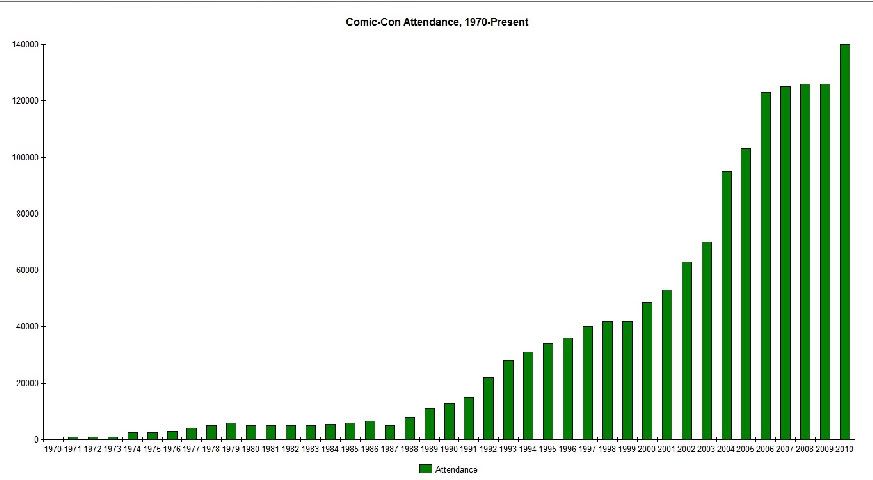
See? Here's what I mean by "explosion"!

The growth that the San Diego Comic-Con International has undergone since the Convention Center completed its first expansion in 2001 has been nothing short of mind-boggling. While you can correlate the growth to the expansion itself, keep in mind what else has exploded in popular culture: super-heroes and comic books have become Hollywood's darlings. True, Blade (1998) and the first X-Men film (2000) predated the explosion, but you can argue that 2002's Spider-Man truly broke the barrier and sent comics into that stratospheric next realm. Since then, Hollywood's optioned virtually every worthwhile comic book for a movie or TV show, and even some that are pretty worthless. And Hollywood took another look at this comic book convention that never attracted much of their attention before, and found they could gain a foothold and promote their comic-related projects. And their sci-fi projects. And their horror projects. And some other movies and shows that don't have a damn thing to do with comics? We'll throw them in there, too, and hope nobody notices.
Somewhere along the line, comics fell out of favor with Comic-Con, and the management of Comic-Con International decided they didn't really care so much. Sure, you'll find Marvel, DC, Image, and the other comic companies have a presence there, but they've been eclipsed by Warner Bros., New Line, Miramax, 20th Century Fox, Walt Disney, and various other movie studios. And yes, they draw the crowds and put the asses in the seats in the now-legendary Hall H. But is that really what Comic-Con is or should be about?
Now, the door was ajar for years. I've heard many stories about how some film craftspeople would use Comic-Con for their own personal soapbox, but never in the scope as in recent years. The last decade's worth of comic book movies has proven the catalyst for the Hollywood takeover of San Diego Comic-Con. And Comic-Con International (the company who runs the convention) seems all too happy to let Hollywood take over. Revenues have never been so good! Demand increases, prices for booth space go up, and CCI makes money hand over fist to spend on non-profit type stuff. It all comes out great for everyone, doesn't it?
I don't think it does. You see, there's also the flipside of the coin in so many ways. At first, the comics fans enjoy Hollywood as a presence because they're bringing to life their favorite heroes and related projects. Then you have the trickle of fans who come to Comic-Con because of the movies or TV they're seeing, and CCI maybe hoped that those fans would find something they enjoyed of what birthed those movies or TV shows. Only, that doesn't happen, or happens only rarely, and people continue to come for the popular media, the chance to touch Hollywood.
The convention floor now reflects this loss of ground from a primarily comics-centered event to one mainly devoted to Hollywood in its totality, nearly to the exclusion of the elements that founded the event. The comics pavilions have become smaller and smaller as New Hollywoodland is now the fulcrum about which Comic-Con revolves. Booth prices continue to rise meteorically, making it increasingly difficult, especially in the current economic climate, for the very same kinds of comics retailers who began the show to have any kind of presence there. I've had discussions on Twitter about this phenomenon, and the pro-San Diego faction stated something along the lines of, "Smart comics retailers find ways to cut their budgets to attend the convention, even splitting and/or sharing their spaces." (And this is if the space isn't already taken up by the studios.) I found those comments to be truly abhorrent. It's like living in the same place year after year, but when they put in those nice new spacious condos for the top one-half of one percent and property values up, you have to either move out, or start taking on boarders and give up what was previously your own space to "enjoy" your "home"--if you can either call it enjoyable or home anymore.
The dramatic increase in exposure for Comic-Con has translated to greater revenues for virtually all businesses in the area surrounding the Convention Center, including the various hotels at which the tens of thousands of visitors stay, plus the restaurants and other shops making up the Gaslamp Quarter and surrounding Downtown areas. The convention was estimated to bring in over $163 million in revenue to the city of San Diego in 2010. San Diego Mayor Jerry Sanders freely admitted in a cbs8.com article that "The convention center is a huge economic generator, but it could literally double that economic generation once we expand it," referring to the current plans to increase floor space by another 200,000 square feet in the next few years.
Can you see where I'm going with this? If not, here's a bit more. Per the San Diego Convention Center's website, no other event held at the locale even comes close to the annual attendance of Comic-Con. The event that comes closest according to their 18-month schedule is the "Rock 'n' Roll Marathon Health & Fitness Expo," at about 40,000 people--still not even a third of the crowd Comic-Con attracts annually. And I think to myself, this is the same Convention Center that has committed to the aforementioned expansion? Why else do they need the expansion if not to keep Comic-Con?
I might go so far as to suggest the city needs Comic-Con. With Hollywood largely driving it, and the huge revenues it currently provides only hinting at the even larger revenues that could be drawn from the upcoming Convention Center expansion, and the absolutely insane room rates that are part of that revenue stream, letting CCI take Comic-Con out of the city would be tantamount to dropping an economic bomb in Downtown San Diego. In different economic times, I'd really waffle on whether San Diego would let the convention go, but Comic-Con is that proven sure thing that the city can't do without. Simply put, San Diego Comic-Con has become akin to the big Wall Street banks you heard about the last two years. It's "Too big to move." And as in the banking world, I find this idea truly saddening, considering what the convention has become over the last decade.
So, how do we undo the damage Hollywood has done to Comic-Con? Assuming, of course, that it can be undone--and I'm not convinced at all this is a genie you can put back in the bottle. I think two things can level the playing field a fair bit, if CCI were to seriously consider them. Sadly, I don't think they would, because the demographic for Comic-Con is shifting into that which really wouldn't like the same kind of show that it was before the floodgates opened. Anything that could potentially upset the goldmine the city of San Diego has going is too radical an idea to be considered.
First, I think that the huge displays at Comic-Con, as extravagant as they are, must go. To maximize space and find room for as many retailers and craftspeople as can attend, there should be a limit as to the size of displays. Hollywood's booths are too huge, and they force out those who are just trying to get a corner booth, or some small space. Ten or more smaller booths can fit into just one of the larger studio booths! Bigger is not necessarily better (in fact, hardly ever!), and studios and other companies can most assuredly find better, more inventive ways to use the space they are given.
Second, I don't think it's enough to limit booth size. I think it's also worth apportioning space, which is done a bit with Artist's Alley (which is still too small!). It can be done gradually at first so it's barely noticed, but I think a nice balance can be struck between the different kinds of companies and individuals who attend Comic-Con. Imagine only so much space allocated to Hollywood's setups, so much given to comic companies, so much to small press, so much to Artist's Alley, so much to some specific kinds of vendors. I haven't heard of any such plan, and it would surprise me tremendously if it did exist. It would go a long way toward reversing the unfortunate trend of forcing those who don't have deep pockets (i.e. those who aren't major comic companies or movie studios) to the background or offsite entirely.
There are other options I've heard, each with their ups and downs. I know the idea of making the convention a week-long affair has been floated as a cost-managing or cost-recouping measure, and would allow more people to visit the show on a daily basis, but it would involve radically altering how special guests and talent attend the convention. There is also talk about extricating the "comics" part of Comic-Con from the popular media part and setting them months apart, which is a slippery slope, a prospect that suggests that the two can't rightly coexist.
Is Comic-Con as we knew it dead? It certainly is no longer the show Shel Dorf intended it to be when he organized the very first show in 1970, with Forrest J. Ackerman as its special guest, and a small handful of talent and attendees. It seems the show is stuck in San Diego, a town that will do just about whatever it has to do to keep it there and to keep or increase the extraordinary revenue stream it brings. It's gone mainstream, commercialist, "Hollywood," and the management seems locked into keeping it that way so long as they can shout CCI is a non-profit organization that proliferates the arts above everything else. To make changes--anything other than making the show bigger, making it "more"--would be admitting that somewhere in the intervening years, the show's purpose erred.
I'll be anxious to see what the new round of renovations to the San Diego Convention Center brings. Will the smaller retailers be given a new entry into Comic-Con, or will Hollywood gobble up the space as soon as it's made available? Will a bit of the old Comic-Con find its way back, or will it be pushed aside, buried forever, presuming it hasn't already been? At any rate, it's going to be interesting to see what CCI does over the next few years.
~G.
A bit of background: I have attended the San Diego Comic-Con International five times, with the first time in 1993 and most recently in 2007. I have seen the show grow from "just" the first major convention I had the pleasure of attending, to an event utterly unlike anything else I've found on this planet to date. The San Diego Convention Center has doubled in size over that time. I still have some sentimentality for the show, but it's been tempered over the last handful of years due to the explosion of popular non-comics media into the convention. And by explosion, do I ever mean the word!
See? Here's what I mean by "explosion"!
(CCI attendance 1970-present, Click to enlarge.)
The growth that the San Diego Comic-Con International has undergone since the Convention Center completed its first expansion in 2001 has been nothing short of mind-boggling. While you can correlate the growth to the expansion itself, keep in mind what else has exploded in popular culture: super-heroes and comic books have become Hollywood's darlings. True, Blade (1998) and the first X-Men film (2000) predated the explosion, but you can argue that 2002's Spider-Man truly broke the barrier and sent comics into that stratospheric next realm. Since then, Hollywood's optioned virtually every worthwhile comic book for a movie or TV show, and even some that are pretty worthless. And Hollywood took another look at this comic book convention that never attracted much of their attention before, and found they could gain a foothold and promote their comic-related projects. And their sci-fi projects. And their horror projects. And some other movies and shows that don't have a damn thing to do with comics? We'll throw them in there, too, and hope nobody notices.
Somewhere along the line, comics fell out of favor with Comic-Con, and the management of Comic-Con International decided they didn't really care so much. Sure, you'll find Marvel, DC, Image, and the other comic companies have a presence there, but they've been eclipsed by Warner Bros., New Line, Miramax, 20th Century Fox, Walt Disney, and various other movie studios. And yes, they draw the crowds and put the asses in the seats in the now-legendary Hall H. But is that really what Comic-Con is or should be about?
Now, the door was ajar for years. I've heard many stories about how some film craftspeople would use Comic-Con for their own personal soapbox, but never in the scope as in recent years. The last decade's worth of comic book movies has proven the catalyst for the Hollywood takeover of San Diego Comic-Con. And Comic-Con International (the company who runs the convention) seems all too happy to let Hollywood take over. Revenues have never been so good! Demand increases, prices for booth space go up, and CCI makes money hand over fist to spend on non-profit type stuff. It all comes out great for everyone, doesn't it?
I don't think it does. You see, there's also the flipside of the coin in so many ways. At first, the comics fans enjoy Hollywood as a presence because they're bringing to life their favorite heroes and related projects. Then you have the trickle of fans who come to Comic-Con because of the movies or TV they're seeing, and CCI maybe hoped that those fans would find something they enjoyed of what birthed those movies or TV shows. Only, that doesn't happen, or happens only rarely, and people continue to come for the popular media, the chance to touch Hollywood.
The convention floor now reflects this loss of ground from a primarily comics-centered event to one mainly devoted to Hollywood in its totality, nearly to the exclusion of the elements that founded the event. The comics pavilions have become smaller and smaller as New Hollywoodland is now the fulcrum about which Comic-Con revolves. Booth prices continue to rise meteorically, making it increasingly difficult, especially in the current economic climate, for the very same kinds of comics retailers who began the show to have any kind of presence there. I've had discussions on Twitter about this phenomenon, and the pro-San Diego faction stated something along the lines of, "Smart comics retailers find ways to cut their budgets to attend the convention, even splitting and/or sharing their spaces." (And this is if the space isn't already taken up by the studios.) I found those comments to be truly abhorrent. It's like living in the same place year after year, but when they put in those nice new spacious condos for the top one-half of one percent and property values up, you have to either move out, or start taking on boarders and give up what was previously your own space to "enjoy" your "home"--if you can either call it enjoyable or home anymore.
The dramatic increase in exposure for Comic-Con has translated to greater revenues for virtually all businesses in the area surrounding the Convention Center, including the various hotels at which the tens of thousands of visitors stay, plus the restaurants and other shops making up the Gaslamp Quarter and surrounding Downtown areas. The convention was estimated to bring in over $163 million in revenue to the city of San Diego in 2010. San Diego Mayor Jerry Sanders freely admitted in a cbs8.com article that "The convention center is a huge economic generator, but it could literally double that economic generation once we expand it," referring to the current plans to increase floor space by another 200,000 square feet in the next few years.
Can you see where I'm going with this? If not, here's a bit more. Per the San Diego Convention Center's website, no other event held at the locale even comes close to the annual attendance of Comic-Con. The event that comes closest according to their 18-month schedule is the "Rock 'n' Roll Marathon Health & Fitness Expo," at about 40,000 people--still not even a third of the crowd Comic-Con attracts annually. And I think to myself, this is the same Convention Center that has committed to the aforementioned expansion? Why else do they need the expansion if not to keep Comic-Con?
I might go so far as to suggest the city needs Comic-Con. With Hollywood largely driving it, and the huge revenues it currently provides only hinting at the even larger revenues that could be drawn from the upcoming Convention Center expansion, and the absolutely insane room rates that are part of that revenue stream, letting CCI take Comic-Con out of the city would be tantamount to dropping an economic bomb in Downtown San Diego. In different economic times, I'd really waffle on whether San Diego would let the convention go, but Comic-Con is that proven sure thing that the city can't do without. Simply put, San Diego Comic-Con has become akin to the big Wall Street banks you heard about the last two years. It's "Too big to move." And as in the banking world, I find this idea truly saddening, considering what the convention has become over the last decade.
So, how do we undo the damage Hollywood has done to Comic-Con? Assuming, of course, that it can be undone--and I'm not convinced at all this is a genie you can put back in the bottle. I think two things can level the playing field a fair bit, if CCI were to seriously consider them. Sadly, I don't think they would, because the demographic for Comic-Con is shifting into that which really wouldn't like the same kind of show that it was before the floodgates opened. Anything that could potentially upset the goldmine the city of San Diego has going is too radical an idea to be considered.
First, I think that the huge displays at Comic-Con, as extravagant as they are, must go. To maximize space and find room for as many retailers and craftspeople as can attend, there should be a limit as to the size of displays. Hollywood's booths are too huge, and they force out those who are just trying to get a corner booth, or some small space. Ten or more smaller booths can fit into just one of the larger studio booths! Bigger is not necessarily better (in fact, hardly ever!), and studios and other companies can most assuredly find better, more inventive ways to use the space they are given.
Second, I don't think it's enough to limit booth size. I think it's also worth apportioning space, which is done a bit with Artist's Alley (which is still too small!). It can be done gradually at first so it's barely noticed, but I think a nice balance can be struck between the different kinds of companies and individuals who attend Comic-Con. Imagine only so much space allocated to Hollywood's setups, so much given to comic companies, so much to small press, so much to Artist's Alley, so much to some specific kinds of vendors. I haven't heard of any such plan, and it would surprise me tremendously if it did exist. It would go a long way toward reversing the unfortunate trend of forcing those who don't have deep pockets (i.e. those who aren't major comic companies or movie studios) to the background or offsite entirely.
There are other options I've heard, each with their ups and downs. I know the idea of making the convention a week-long affair has been floated as a cost-managing or cost-recouping measure, and would allow more people to visit the show on a daily basis, but it would involve radically altering how special guests and talent attend the convention. There is also talk about extricating the "comics" part of Comic-Con from the popular media part and setting them months apart, which is a slippery slope, a prospect that suggests that the two can't rightly coexist.
Is Comic-Con as we knew it dead? It certainly is no longer the show Shel Dorf intended it to be when he organized the very first show in 1970, with Forrest J. Ackerman as its special guest, and a small handful of talent and attendees. It seems the show is stuck in San Diego, a town that will do just about whatever it has to do to keep it there and to keep or increase the extraordinary revenue stream it brings. It's gone mainstream, commercialist, "Hollywood," and the management seems locked into keeping it that way so long as they can shout CCI is a non-profit organization that proliferates the arts above everything else. To make changes--anything other than making the show bigger, making it "more"--would be admitting that somewhere in the intervening years, the show's purpose erred.
I'll be anxious to see what the new round of renovations to the San Diego Convention Center brings. Will the smaller retailers be given a new entry into Comic-Con, or will Hollywood gobble up the space as soon as it's made available? Will a bit of the old Comic-Con find its way back, or will it be pushed aside, buried forever, presuming it hasn't already been? At any rate, it's going to be interesting to see what CCI does over the next few years.
~G.
Subscribe to:
Posts (Atom)