Showing posts with label Spectre. Show all posts

3.8.11

The New Spider-Man & The License of Power (Blame Film Class!)

(Updated to include Bill Foster & Jaime Reyes in my roundup.)

It's been a crazy week, kids, and it's only gotten crazier with yesterday's announcement that half-black, half-Hispanic teen Miles Morales will become Marvel's new Ultimate Spider-Man in this week's Ultimate Fallout #4 by Brian Michael Bendis & Sara Pichelli. I figured I'd touch on the hubbub and make a point that dovetails, ever so lightly, with my articles on continuity (the second of which, no kidding, is coming really soon).

New costume. New Spider-Man. Art by Kaare Andrews.
So, there's a new Spider-Man, and in a move apparently inspired by African-American comedian Donald Glover's desire to land the role of Peter Parker in next summer's Amazing Spider-Man film, he belongs to a racial minority. With this move, Marvel makes Spidey the next in a long line of superheroes who've been "replaced" by a minority character. This practice has been more common in DC Comics of late, with co-publisher Dan DiDio having launched an aggressive campaign to add diversity to their line-up of super-heroes.

Looking at the trend of "replacing"--always temporarily--major super-heroes with minority characters, I thought it interesting to be able to tie the concept back to something I worked on, years ago, back in film class! Y'see, once upon a time I took a class in colonialism in cinema, and the paper I worked on for my final was a dissection of the Blaxploitation genre. I introduced this concept of the "License of Power," in which I put forth the idea that the blacks in these films weren't really as in control of their destinies as the filmmakers would have one believe. Rather, the colonial relationship--which is essentially between master and subject/slave--was left intact, consciously or subconsciously, with power firmly resting in the hands of whites.

Fresh from the 70s Blaxploitation craze, and still Marvel's most popular black hero.
To drive a narrative forward, to be the "hero," blacks were licensed a measure of power that made them capable of accomplishing their tasks within the narrative. The implicit license transferred the whites' power onto the black protagonists (and sometimes antagonists), with the implication that without white interference, the blacks would be unable to succeed. The other side of the coin was that the "license of power" was not indefinite and did have particular conditions. If the licensee didn't follow through on the assigned task(s), or if he exceeds his authority, then the white men who have granted him such power were obligated to strip the character of it.

I went through a number of examples in the Blaxploitation genre to prove my argument, using films like Mandingo, Blacula, Shaft and Black Caesar. (In the end, I did get an "A" on the paper, so I suppose my claims have a degree of merit.) Which, of course, brings me to the License of Power as it applies to superheroics.

There is a dearth of truly original minority super-heroes in comics. Obviously Luke Cage, Storm and Black Panther come to mind at Marvel, while Black Lightning, Bronze Tiger and Vixen are solid if not particularly well-known examples at DC. While it's grown difficult for new characters to gain a foothold in the comics market, it's even more daunting for an original minority hero to find that niche. Since the sixties, it's become a common trope for the Big Two to develop a new minority hero by introducing them in the mold of an established white one. In all the below cases, the "license" idea refers chiefly to the passing of the tights.

John Stewart, forerunner of the minority replacement heroes. Art by Neal Adams.
  • John Stewart: Introduced in 1972's Green Lantern #87, Stewart wasn't even the first alternate selected to be the Green Lantern of Sector 2814. He was only selected when Guy Gardner was comatose with brain damage. He was often a "substitute" Green Lantern during the late seventies, and stepped up to be the sector's only Green Lantern when Hal Jordan briefly quit in the early eighties. Hal Jordan has struck him down as Green Lantern, most notably when Hal as Parallax put an end to his life as the first human Guardian when he destroyed Oa's Central Power Battery. Interestingly, he's the Green Lantern the public finds most familiar, due to his appearance in Cartoon Network's Justice League Unlimited animated series.
  • Bill Foster: Originally a lab assistant to Dr. Henry Pym, Dr. Bill Foster assumed the identity of Black Goliath in the seventies, using Pym's growth formula while Pym himself enjoyed a career as Yellowjacket in the Avengers. Later, he took yet another of Pym's noms du guerre, Giant Man. Much later, he surrendered the Giant Man name and powers to Pym, but eventually returned only to be killed during Marvel's Civil War.
  • Jim Rhodes: Introduced in 1979 as billionaire industrialist Tony Stark's pilot, Rhodey didn't take the spotlight until 1983. Denny O'Neil and Luke McDonnell took Stark out of the Iron Man armor, having relapsed into alcoholism, and gave the armor to him. Rhodey wore the armor for over two years, until Tony actually fought his friend and diagnosed him with a physiological condition over wearing armor not meant for him. Afterward he rarely wore the suit, but upon Stark's "death" a few years later he donned the "War Machine" armor, which he's done off and on for years, mostly at Stark's discretion, often clashing with his boss and friend and even losing the armor. (Stark never had an alien armor bail him out of a jam!) He currently moonlights as "Iron Man 2.0."
Rhodey takes center stage as the new Iron Man. Art by Luke McDonnell.
  • Isaiah Bradley: In the revisionist era of the early 2000s, African-American creator Kyle Baker posited that after Steve Rogers was given the Super-Soldier Serum that made him into Captain America, the U.S. government tried to duplicate the lost serum by experimenting on black men. The storyline evoked similarities to the Tuskegee Syphilis Study, and Isaiah Bradley was its biggest success, first becoming superhumanly powered (the "Black Captain America") but eventually falling victim to ill effects that left him incapacitated in his later years. Eventually Rogers learned of his existence and sought reconciliation, feeling guilt for what had happened to Isaiah.
  • Jason Rusch: Ron Raymond, a.k.a. Firestorm, floundered from series to series after DC canceled his own long-running title in 1990. What else could DC do but relaunch the character with a new secret identity? While they wisely reinstated the dual personality that marked the Firestorm entity since his creation in 1978, it nonetheless remains expressly clear that Jason originally received his power as direct result of Raymond's death during Identity Crisis. And when Ron returned in Blackest Night, DC quickly relegated Jason to the voice in his head, going the way of his predecessor, Martin Stein.
  • Crispus Allen: Originally introduced as a Gotham City detective in Detective Comics, he graduated to a role in Gotham Central before being murdered by a crooked cop named Jim Corrigan, not-so-coincidentally also the name of DC's original Spectre, an entity of immense power committed to vengeance against the guilty. Allen became the new Spectre, wearing the raiment longtime DC fans associated with the (for now) deceased, original Corrigan. Often, especially in big events, this Spectre is largely interchangeable with his earlier counterpart. (Death is a great way to inherit the "license," innit?)
Ryan Choi, Asian replacement for Ray Palmer, the Atom. Art by Ariel Olivetti.
  • Ryan Choi: DC introduced the Chinese scientist specifically to add even more color to its diversifying line in the wake of Infinite Crisis. Created by Grant Morrison and Gail Simone, Dr. Choi was a previously unknown protege of the previous Atom, Ray Palmer, and took over the role when Palmer went conveniently went missing during the earlier Identity Crisis. He not only became the Atom, but he also took Palmer's place on the staff of Ivy University.
  • Jaime Reyes: Also spinning out of the end of Infinite Crisis was this Hispanic variant on the Blue Beetle character, picking up where previous versions Dan Garrett and then-recently-deceased Ted Kord left off. The source of his powers was the same magical scarab used by Garrett, the first Beetle. He has had a three-year run in his own title, followed by a regular second feature in Booster Gold, becoming his partner in the same way as Ted Kord was before him in the Justice League International.
  • Tyrone Cash: The Ultimate Marvel universe had one previous flirtation with changing races in Dr. Leonard Williams, the retconned-in "First Hulk." Introduced in Ultimate Comics Avengers by Mark Millar and Leinil Yu, Williams worked with Banner on the Hulk experiment, and became a Hulk that kept his intelligence and used his smarts to fake his death and set himself up as a gang lord in South America, surrounded by gangstas and hoes, embodying the very worst of the "Black Buck" stereotype. He also took the place of the "real" Hulk for a time.
They say this cat Hulk is a baaaad motha'--shut yo'mouth! Art by Leinil Yu.
  • "Thunderbolt" Ross: Only a minority in the sense of his age group (originally to have been nearly 70 if older stories were judge, but edited to be in his 50s), Ross became a Hulk oddly similar to his predecessor, a sharp counterpoint to all previous gamma-enhanced individuals. Since being defeated by the Hulk, he keeps his power under writer Jeff Parker so long as Banner and Captain America deem it appropriate (i.e. as long as sales don't falter).
Finally, we come to Miles Morales, the alliteratively-named (just like Peter!) new Spider-Man. Unlike the majority of the previously-named characters, because it's the Ultimate Marvel universe and not the regular one, this change has a chance of sticking a bit longer than the rest. Indeed, he stands the chance of disproving the tried-and-true colonialist view of replacement heroes, in an in-story if not a meta context. Will the grand experiment succeed? You decide!

Miles Morales is a member of one of the fastest-growing minority classes (which will, we're told, become a sizable majority in the U.S. sometime later this century if trends continue). Besides that, we really don't know anything about the new Spider-Man; he's a blank slate and will continue to have only the barest hint of characterization until the new volume of Ultimate Comics Spider-Man arrives in comic shops in September. Although it will be interesting to see someone other than Peter Parker behind the mask for a change (Ben Reilly doesn't count, and Hobie Brown did it for all of five seconds), I can't help but feel Marvel's energies would have been better spent introducing the "next great character in the Ultimate Marvel firmament" who happens to belong to a minority, instead of just promulgating the next in a line of seemingly endless iterations of their number one hero. It's a publicity stunt either way, right? What would have been better than having several new heroes--white, black, Hispanic, Indian, Asian, whatever--trying to live up to the legend begun by Spider-Man, a young kid who could have been any one of them behind that mask that didn't give a hint to the identity or race of the person behind it? Imagine the development of several original characters inspired by Spidey, all under the event umbrella, "The Hero Who Could Be You!"
Maybe young Miles Morales is right. Art by Sara Pichelli.
Ah, but there we go, again. The last Marvel "hero" of any sort to really resonate with so-called fans is Deadpool, created in 1991. And the last minority character to really strike a chord was Luke Cage, created in 1972. (Does Bishop count? Where is he now, anyway?) And neither is really in the public eye--that honor belongs to Samuel L. Jackson as Nick Fury, and don't get me started on him. Perhaps it's better to endlessly regurgitate the old stuff in new ways--and in this case, the same tired colonialist tropes--simply because it's better to take small chances like changing a beloved character's ethnicity than take a bigger chance like trying to do something truly new, interesting, and perhaps, just perhaps, original.

Give us some heroes, Marvel. Don't give us a bunch of musical masks.

~G.

29.4.11

That's What I Want: My Top Requested Graphic Novels of '11 (2)

Here we go with the second of two entries about the graphic novel collections I'd most like to see. They include both existing collections which have sadly fallen out-of-print, as well as original collections that have never seen the light of day. Allow me to start with one out-of-alphabetical-order pick that honestly should have been in yesterday's entry, and then we'll continue with the final seven eight picks!

Batman: Prodigal (DC)
(Collecting Batman #512-514; Batman: Shadow of the Bat #32-34; Detective Comics #679-681; and Robin #0, 11-13.) After all that's happened in the world of Batman over the last year, with Dick Grayson inheriting the cowl in the wake of Bruce Wayne's apparent demise, then continuing as Batman in Gotham while the returned Bruce begins an international Batmen recruiting drive, it's truly a wonder to me that this collection can only be found at hyper-inflated costs on eBay and amazon.com. This storyline, released in the aftermath of everything that began with "Knightfall," showed what happened when Batman left the cowl in the hands of the man best qualified for the role, instead of the noob Azrael. It's an intriguing character study that touches on all the major bases such a storyline should. It's also, in context, an excellent prologue for current events. Because it's relevant to the beginning of "Prodigal," I've also taken the liberty of including one extra story here: "Brothers in Arms" from Robin #0, a Zero Month spotlight on Robin and Nightwing that paved the way for this arc. It's the single improvement in an otherwise terrific volume. (And hey, DC? While we're on the subject, it's well past time for that collection of "Batman: Year 3" by Wolfman & Perez. Okay?)

Iron Man: The Iron Scream (Marvel)
(Collecting Iron Man #163-170.) I'm really shocked that this collection hasn't already been done, considering its conclusion is already available in the Iron Man: Iron Monger Premiere Classic hardcover. Written by comics vet Denny O'Neil and drawn by Luke McDonnell, this is the storyline that introduced Tony Stark's chief competitor, Obadiah Stane (seen in the film!), and set the two on a collision course. Playing a game of chess with real people as the pieces, Stane takes Stark to the edge of sanity in a storyline that ends with our hero back to drowning his sorrows away, leading to Rhodey donning the steel-mesh armor for the first time. That's right, it's the start of the long road that leads to the birth of War Machine, and it all starts here! What better reason to bring this storyline in print?

Morbius the Living Vampire: A Stillborn Genesis (Marvel)
(Collecting Adventure Into Fear #20-31.) Since Marvel has been releasing the rest of what would be in an Essential Morbius volume in their Vampire Tales collections, it'd be great to see them release the other solo Morbius stories in living color, which brings me to this volume, written by Steve Gerber and Doug Moench, with art by Paul Gulacy and Frank Robbins. These are Morbius stories with a more sci-fi bent than in his Vampire Tales series. The series guest-stars Blade and Simon Stroud from the Tomb of Dracula and Creatures on the Loose strips, respectively. An entertaining diversion, this volume could even pave the way for more Morbius the Living Vampire collections from the 1990s series!

The Punisher: Purgatory & Revelation (Marvel)
(Collecting Punisher: Purgatory #1-4 and Punisher/Wolverine: Revelation #1-4.) Franken-Castle? One of my favorite Punisher stories. I'm not a typical Punisher fan, and I don't like typical Punisher stories. The last time I enjoyed the character before then was in these two storylines, which have an impressive pedigree. It's not often you get a Punisher story drawn by Bernie Wrightson, with covers by Joe Jusko. The story is about as ridiculous as Frank Castle's ever gotten, right up there with having his skin turned black. He commits suicide and gets brought back as an angel of vengeance, with an arsenal from God. He finds out his guardian angel screwed the pooch the day Maria and the kids were killed. This collection of eight issues over two miniseries, including a team-up with Wolverine, would easily fit in one volume. We've got Franken-Castle. Why not Angel Punisher?

The Spectre: Crimes and Punishments (DC)
(Collecting The Spectre (1992) #1-4.) John Ostrander and Tom Mandrake are one of the best duos in comics, with work ranging from the creator-owned Grimjack, to the Superman-as-western riff The Kents, to the elemental fury of Firestorm and the alien worlds of the Martian Manhunter. The apotheosis of their collaboration is this 62-issue series that lasted from 1992 to 1998. Noteworthy for its exploration of Christian mythology, its striking covers by fantasy's foremost artists, and its development of the Jim Corrigan character far beyond anything seen over the previous half a decade, Ostrander and Mandrake's Spectre stands with James Robinson's Starman as one of the most consistent creative visions in DC history. Not only does it deserve a re-release of the first volume, it also deserves the royal treatment: either a whole series of graphic novel collections, or a deluxe omnibus release. It's time to show the masses that the Spectre, when written well, was one of the best damn characters and one of the best damn comics, period.

Spider-Man: The Cosmic Adventures (Marvel)
(Collecting The Amazing Spider-Man #326-329; Quasar #7; The Spectacular Spider-Man #158-160; and Web of Spider-Man #59-61, 64-65.) While the majority of these issues are now available in the brand-new Acts of Vengeance Omnibus, let's face it: that collected edition is a $100 hardcover and hardly something the casual Spider-Man fan would feel comfortable purchasing. Instead, I strongly suggest Marvel release an updated version of this collection from 1993, with the original Ron Lim cover, and with the additions of Spidey's guest appearance in Quasar and the two-part event where all the bad guys came back to fight Spidey after his cosmic powers had left him. Certainly a $30 softcover is more economical than that epic tome that's already available.

Spider-Man: The Owl/Octopus War (Marvel)
(Collecting Peter Parker, the Spectacular Spider-Man #72-79.) While it may be readily accessible in two Essential collections, a Premiere Classic hardcover edition of this eight-part storyline in full color would be welcome indeed. In 1983, Bill Mantlo and Al Milgrom crafted what I consider to be among the best clashes between Spider-Man and one of his deadliest foes, Dr. Octopus. Guest-starring the Black Cat, and co-featuring the villainy of the Owl, this saga encapsulates just about everything I enjoyed about early 1980s Spidey books. I've already told listeners of Jon Westhoff's and my Spectacular Spider-Cast all about my love for this arc, but it bears repeating here. If you've never read this storyline, you're really missing out--as is Marvel by withholding this terrific collection. 'Nuff said.

Spider-Man Presents: The Mark of the Man-Wolf (Marvel)
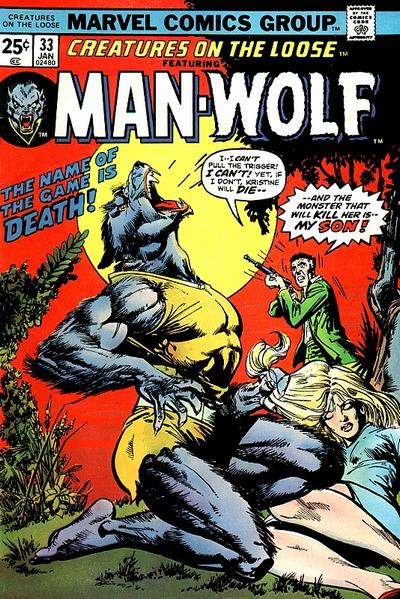
(Collecting The Amazing Spider-Man #124-125, 189-190; Creatures on the Loose #30-37; Giant-Size Super-Heroes #1; Marvel Premiere #45-46; Marvel Team-Up #37; Peter Parker. the Spectacular Spider-Man Annual #3; and Savage She-Hulk #13-14.) Of all the neglected monster characters, John Jameson as the Man-Wolf may rank atop the leader boards. Emblazoning Spider-Man's name on the top of this volume would, I hope, bring ample notice to this collection, filled with both battles with Spider-Man as well as the Man-Wolf's own solo adventures (some of which were drawn by a young George Perez--say, whatever happened to him?). Yes, the collection would also reprint all John Jameson's appearances as Stargod. I can't tell you how much I want to see this volume. Bark at the moon, kids!

Swamp Thing: Bad Gumbo (DC/Vertigo)
(Collecting Swamp Thing #140-143.) Especially topical considering today's return of Swamp Thing in Brightest Day (and possibly strongly a no-no to be reprinted because Swampy's back at mainstream DC), this storyline is by three industry giants and well deserves a collection. Was Swamp Thing only a dream, a hallucination of botanist Alec Holland, stoned out of his mind? This contrarian take on Swamp Thing had more than its share of psychological horror courtesy of co-writers Grant Morrison and Mark Millar and artist Phil Hester. This is an utterly raw story by all talents, but something makes it work. Millar's plotlines may have meandered in later issues, leading down the long road to cancellation in issue #171, but this four-part storyline is solid and representative of some of the best of 1990s Vertigo that isn't Sandman. It actually led me to dive into the back-issue bins for Alan Moore's original run. How's that for inspiration?

Well, that's my list! What say you fellas?

~G.