Showing posts with label Storm Warning. Show all posts

2.6.11

Storm Warning Epitaph: Firestorm & The DC Reboot

This news was announced this morning in the wake of the upcoming DC whole-line reboot:

THE FURY OF FIRESTORM
By Gail Simone & Ethan Van Sciver (w) / Yildiray Cinar (a)

"Jason Rusch and Ronnie Raymond are two high school students, worlds apart – and now they’re drawn into a conspiracy of super science that bonds them forever in a way they can’t explain or control."

I was looking forward to a Firestorm relaunch in the wake of Brightest Day, but based on the above image, I might be having second thoughts.

First, the pedigree: Gail Simone? Win. I loved her work on Wonder Woman and have heard good things about Secret Six, although I must confess I haven't really read more than one or two issues.

Ethan Van Sciver? It looks like he's doing covers, but I've heard elsewhere he's also contributing to the stories. I love his artwork but I've never seen him write a series that I know of. Still, so far so good.

Yildiray Cinar? Definitely a win. I saw his artwork at his New York Comic Con booth last year and to say it was stunning was an understatement. The guy's definitely got talent. His work is very dynamic and I've been waiting to see him on a project I'm interested in.

Now, for the doubts...and you should see three big ones on the top of the page. Three ugly, ugly costumes for Firestorm--two of which share a Flash/Reverse Flash motif. Apparently either Jason and Ronnie are both able to form a kind of Firestorm variant on their own, or else similar to Brightest Day their appearance changes depending on who's in control. And what's that Firestorm character above them both? A kind of uber-Firestorm? Is it some kind of living version of the matrix that was hinted back in Brightest Day? Or something else?

I'm ambivalent about regressing Ronnie Raymond and Jason Rusch to both being teenagers. Are there good stories that could be told with this paradigm? Probably. Are they going to tell a new origin in the first issue? Is the "countdown" referred to in Brightest Day #24 going to occur? At this point, who can say?

Ah, plenty of questions....and, a few fugly costumes.

~G.

26.5.11

Storm Warning 7: Shadowstorm Was a Wuss, Dude (Blackest Night/Brightest Day)

Are we all here? I'm sure you were all beginning to worry...

Welcome back, my friends, to the show that never ends. I know it's been a long time since the previous installment of this series, but sometimes, that's the way things go. I always intended to come back at the conclusion of Brightest Day and summarize my thoughts on the most recent iteration of everyone's favorite nuclear hero. In the previous segment, I took you through the death of Ronald Raymond, the introduction of Jason Rusch, and the return of Professor Martin Stein to a prominent role in the Firestorm matrix. This time out, we're picking up Firestorm's activities in two fixed-length series, Blackest Night (2009's runaway hit "event" series by DC) and its direct continuation, Brightest Day (which just finished a few weeks ago).

Black Lantern Firestorm. Original design by Ethan Van Sciver.

It's worth noting early on that Geoff Johns is a master of DC Comics' long and varied history. He began his career as production assistant to Richard Donner (yes, that Superman director-guy) and soon started writing for DC on books like Stars and S.T.R.I.P.E. and JSA. After briefly sojourning down the street at Marvel, he returned to DC where he's been ever since, having written Flash (both Wally West, in the wake of longtime scribe Mark Waid), Green Lantern, Teen Titans, and several "event" series like Infinite Crisis, 52, and the two series I'm about to discuss here. And, back in 2003, he pitched a Firestorm revival that interestingly fused Ron Raymond with his "brainy ex-girlfriend," a take that was tabled in favor of Mike Carey and Lewis LaRosa's version (which I touched upon a few episodes ago). Perhaps that version was a conscious or unconscious inspiration for the latter-day merging of Jason Rusch and Gehenna that opened Blackest Night.

The crossover that set in motion everything about Firestorm that continues to date is to a vast degree a Green Lantern story that spilled over to the rest of the DC Universe. Everyone who's familiar with DC lore knows the Lanterns' oath: "In brightest day, in blackest night..." and Johns parlayed the oath into a prophecy of sorts. Not only that, he took the previously-established Star Sapphires and Yellow Lanterns and wrapped them with the Green Lanterns into a color spectrum of powered beings. In the lead-up to Blackest Night Johns introduced the other corps to both explode the Green Lantern brand and set the stage for the massive storyline to come. You don't need to know the gory details for the purposes of this article. Just know that an old Green Lantern enemy, Nekron, captured the Anti-Monitor (the big bad from 1985's Crisis on Infinite Earths) and used him to establish a beachhead of power in this reality in the form of a Black Lantern whose rings infected dead bodies and reanimated them, using their memories to draw in the living and generate more power. When the rings and lantern were sufficiently powered, Nekron would again rise. Easy peasy?

Firestorm, surrounded by his oldest foes all as Black Lanterns.

For the components of Firestorm--Jason Rusch, Gehenna Hewitt and Martin Stein--the return of the dead obviously spelled the return of Ron Raymond. Meeting at Ron's grave in Pittsburgh, they discussed Ron while the rain fell and plants mysteriously died. The rings came later in the first issue, and with them, Ron came back as a Black Lantern Firestorm. In the next issue, he appeared in a Black Lantern version of the Justice League who battled Green Lantern Hal Jordan and the Flash (Barry Allen). The third issue (which features a stunning Firestorm-centric variant cover by Ethan Van Sciver) would easily be the most essential to Firestorm fans for its momentous events. Jason and Gehenna quarreled over her thoughts on starting a family, which Jason "overheard" while they were merged as Firestorm. Jason thought they were too young to be having such ideas, and Gehenna countered by suggesting they no longer be Firestorm anymore. (Be careful what you wish for, Gen.)

Summoned by an emergency signal at the Justice League's Washington, DC headquarters, Jason and Gehenna arrived as Firestorm and talked with Mera, Aquaman's wife, about the emerging chaos. Green Lantern, Flash, Atom and a group of Indigo Lanterns arrived and compared notes about the Black Lanterns before the BL League arrived. Then, BL Firestorm fissioned his counterpart, removing Jason and Gehenna. He merged with Jason, who watched in horror as "Ron" turned his girlfriend to salt, killing her. The strength of his emotions for Gehenna powered the lantern considerably.

In the fourth issue, Jason gained control over BL Firestorm to warn Flash to evacuate the Earth, but soon "Ron" reasserted himself. Jason remained trapped within BL Firestorm for virtually the rest of the story, through the return of Nekron, the introduction of a "rainbow corps" of Lanterns and the White Lantern Entity, and the revelation that life in the DC Universe originated on Earth. Finally, the heroes formed a "White Lantern Corps" and defeated Nekron by using the rings to resurrect a number of characters, from Nekron's herald Black Hand, to the Anti-Monitor, to several heroes and villains including Firestorm, now comprised of Ron Raymond and Jason Rusch.

Firestorm and the Atom, together! Art by Ivan Reis, from Brightest Day #2.

The new status quo of all the resurrected characters became the thrust of the next series, the 24-issue Brightest Day. Was there a method to the White Lantern's madness? Who, if any of those resurrected, would become the Guardian of Life? Would the heroes and villains permanently be returned to life, or was it a temporary situation? As in Blackest Night, there's much more to this story than just Firestorm's involvement, but I'll only discuss the portions germane to our guy(s).

Brightest Day began for Firestorm with the wake of Gehenna Hewitt, attended by Professor Stein, Ray Palmer (the Atom), Jason Rusch, and members of Jason's family. Ron didn't attend the funeral, missing appointments to file paperwork with the Justice League to renew his legal status in favor of partying with friends at Pittsburgh University. He also no longer remembered anything that happened after his death at the hands of the Shadow Thief (which meant he didn't remember meeting Jason). Arriving at the wake, Ron talked with Jason but a shouting match erupted, resulting in merging into Firestorm--a Firestorm who could not fission!

At Pittsburgh University, Professors Stein and Palmer met to diagnose the problem, and Palmer reduced in size to infiltrate the matrix and discover the source of Firestorm's new instability. He caused an explosion that successfully fissioned them, and Ron and Jason awoke in the hospital, where Stein made it imperative that they remain separate. Ron, who actually did remember some of what had happened when the Black Lantern possessed him, found himself haunted by a salt effigy of Gehenna. Similarly, a disembodied voice nagged at Jason before a crane nearby turned into bubble gum, prompting a disaster that caused him to again become Firestorm. With a hungover Ron in control, the hero vomited a black ichor on someone he saved from the disaster. Ron apologized to Jason and admits he remembered when BL Firestorm killed Gehenna, even as they reached the conclusion something else was in the matrix with them.

Firestorm learns his final (?) fate. Cover to Brightest Day #10.

Ron and Jason went to the Professor, then, who ominously hinted at a "third and final stage of Firestorm." Before he could elaborate, the White Lantern entity showed them its wisdom: "You need to study," it told Ronald, while it told Jason "You need to get your head out of the books." It told them they needed to learn from each other so they could stop "him"--the mysterious third being in the matrix. During a series of tests back at Pittsburgh University, Professor Stein put forth his theory that the Jason/Ron merger made Firestorm more powerful, but also more unstable. In a bit of retroactive continuity, Stein told Firestorm that his original experiments aimed at finding the spark that led to the Big Bang, and that's what Firestorm is: the universe's cosmic reset button. And the more agitated Ron and Jason become, the more likely the Big Bang would again occur, This is all the third entity needs to know to break free, fissioning Firestorm and rendering the Professor unconscious before standing revealed as the Black Lantern Firestorm, henceforth called Deathstorm.

Deathstorm wasted no time in drawing Professor Stein into itself along with Jason's father Alvin before finding its way, Firestorm in tow, to Star City and the White Lantern. It infected the lantern to be able to lift it so that it might bring it to its new master, who also said that Deathstorm must bring him/it an army and stop the Entity's replacement from being chosen. To that end, the creature recreated Black Lantern duplicates of all those the Entity resurrected, and left. Firestorm traveled to the JLA Watchtower in hopes that scientists Dr. Mid-Nite and Atom might help stabilize the matrix, while Deathstorm toys with Stein and Alvin Rusch, tempting them to kill themselves in hopes his threat would perish. Anger got the better of Jason and Ron, however, causing an explosion that left them as Firestorm in an apparent black void. Did they end the universe?

Ah! That classic logo! A terrific cover for Brightest Day #16.

Not so fast! Shedding some proverbial light on the subject, Ron found they were amid a swarm of Shadow Demons, which meant they did not end the universe, but instead had been transported to another one: the Anti-Matter Universe, home of the Anti-Monitor and the Weaponers of Qward. After briefly intervening in a battle between some Green Lanterns, Sinestro and the Weaponers, Firestorm finally found Deathstorm, the Black Lantern Corps, and their master...the Anti-Monitor.

Now, everything to this point in Brightest Day was a prologue. We had solid character development and an interesting throughline that proved Firestorm was among the most important characters in the series, but in issue #22, he finally took the spotlight in an epic battle with the Anti-Monitor. It's a true masterpiece in virtually every sense of the word and one that all Firestorm fans should read. Ron and Jason finally work together to save all life--as well as their "fathers"--from the clutches of ultimate evil and death. Unfortunately, while Firestorm was able to save the White Lantern and destroy the Black Lanterns, he was not able to save Martin Stein, who sacrificed himself to save Ron and Jason from Deathstorm's transmuting power. Turned into salt the same as Gehenna, he bequeathed his final wishes to the two men, "knowing" that Jason would be a better partner to Ron than he was. His life now returned, Firestorm found himself transported to the Star City forest, where Deadman demanded the Lantern, and the Lantern wished to be given to him.

Gary Frank illustrates the final battle between Firestorm & Anti-Monitor.

The final two issues really have very little to do with Firestorm, his story all but fulfilled in the previous story. All of the resurrected united at the Star City forest, where Deadman told them they were there to combat the "dark avatar," in actuality the Swamp Thing, the former Earth elemental whose body was possessed by the power of the Black Lantern. The five key heroes--Firestorm, Aquaman, Hawkman, Hawkgirl, and the Martian Manhunter--all transformed into elementals to form a last line of defense until the Entity's replacement could assume his role. Under a tree in that forest was--miraculously--the body of Alec Holland, the man whose consciousness had been imprinted upon the Green to become the original Swamp Thing. Now, Holland literally became the Swamp Thing and combined with the elementals to banish the dark avatar. At the end of the battle, most of the elementals returned to their normal forms and went their separate ways.

Ominously, as the main Brightest Day saga ended, a new era dawned for Ron and Jason. Upon examining some tests designed by the Professor, Jason found that the Anti-Monitor's blasts had caused a change in the Firestorm matrix, beginning a countdown to the detonation they all feared. That's where we leave our heroes until their next appearance.

The new merger, as previously glimpsed in Firestorm #9-13, was similar to the Jason/Professor merger of Stuart Moore's run in that it combined elements of both the "new era" (Jason) with the "classic era" (Ron) in hopes of pulling both new and old fans along--a smart move. This time, however, Firestorm returned to being about the "dumb jock" fused with the "intellectual" that fell in line with the original Conway/Milgrom iteration, getting away from the "dual intellectual" bit of Moore/Igle vintage. Only this time, due to popular demand, DC forsook one type of comic book minority (the fifty or sixty-something Stein) for another (the black Jason). They even went so far as to kill Martin Stein--my favorite character in the mythos--and with his parting words Geoff Johns and Brightest Day co-writer Peter J. Tomasi hit fans over the head with how much better a partner Jason would be than he was. It was one powerful line of dialogue for its sheer wrongheadedness, a moment where it felt less like the character saying the words and more like the writers forcing them in.

Deathstorm! Cover by David Finch.

Instead of getting a "voice of experience" in the dynamic, we now have two guys who are similar enough in age whose key differences are in intelligence and skin color. (Is anyone other than Kurt Busiek really going to call Ron Raymond "experienced"?) In selecting a Jason/Ron merger, Johns and Tomasi established a racial dynamic--or, at the very least, a stereotypical one where Jason functioned as the "angry black man" and Ron as a similarly intolerant white man who found themselves at odds, sharing the body and power of Firestorm. (It's not the first time such a dynamic has been used--anyone remember that Blaxploitation film, "The Thing With Two Heads"?) The point was even made explicit by Deathstorm in one of his early non-appearances.

I do enjoy the dramatic tension of having Ron and Jason at odds, and I do want it sticking around, but it goes without saying I want the racial undercurrent to be curtailed. The light antagonism is a plot point that didn't gain much traction in previous Firestorm series, with perhaps its strongest showings in John Ostrander's first issues (wherein Ron and the Professor were at odds over the ban on superheroes during the Legends crossover) and early in Dan Jolley's tenure, where Jason got to pick his partners in the matrix.

In some ways, the infighting between Ron and Jason highlights a key distinction and an evolution in Firestorm that I'd love to explore in deeper detail. Subtextually, the original relationship between Martin Stein and Ron Raymond was always depicted as one between a father and son, with Martin as the father that Ed Raymond couldn't be. Johns and Tomasi made that relationship explicit with Stein's death, while the entire Brightest Day arc functioned to establish a different dynamic between Ron and Jason Rusch. Since the Professor mentored them both, one can easily read the characters' antagonism and their very relationship as being between brothers--moreover, brothers who have experienced the loss of their "father." An intriguing shift, to be sure, and one that I hope DC will investigate in issues to come.

Deathstorm, Deathstorm, Deathstorm. More by Ivan Reis.

As far as villains go, Deathstorm seems like another "dark mirror" character in a long line, which is interesting since Firestorm already had one in Shadowstorm. It's true, he's all but forgotten--didn't he die in Captain Atom?--but since when did that ever stop a character from returning? While Shadowstorm was often too straight-faced, too stoic, too eeeeeeevil, Deathstorm was too often off in the other direction, with his deliberately horrible "surfer dude" dialect. I hear he'll be back, but I'm not so sure I like that prospect.

So, where are we heading from here? I keep hearing September will be rife with new first issues and it's obviously when the new Aquaman (by Geoff Johns & Ivan Reis) and Hawkman (by James Robinson & Rags Morales) series will debut. However, DC's made definite plans for Firestorm as well, and I wonder if we won't see a brand-new Firestorm #1 in September as well. At the very least, we should soon see him in a book like Justice League of America or somewhere his new, post-Brightest Day status quo can be explored. Who could be writing the book, if Firestorm returns to a solo series? I don't know, but you can bet that you'll see an interview with the new guy (or girl) either here, courtesy me, or at FirestormFan.com, courtesy Shag, that site's owner. I'm feeling good about this.

~G.

24.3.11

Storm Warning 6: From the Ashes...The Firestorm of Earth-8!

Hi, heroes!

When last we left our intrepid hero Ronald Raymond, he'd been through the proverbial blender. Split off from his partner, Professor Martin Stein, who'd become a Fire Elemental and gone off to explore the deepest reaches of space, he learned to once again harness his own atomic powers and become Firestorm anew, without having to merge with another being. He became an alcoholic and recovered. He became the "dumb jock" hero writ large, requiring other heroes like Oracle and the Atom to help him with his restructuring abilities. He rejoined the JLA and was even about to be featured in a new series that would've included several other beings in a re-exploration of the Firestorm Matrix. Then, plans changed, and DC instead decided to kill him in 2004.

If you can't make 'em marketable, kill 'em. Cover to Firestorm #6 by ChrisCross.
Well, actually the death would occur in Identity Crisis #5 (December 2004), when a group of super-heroes including Firestorm, Shazam, Vixen, and Shining Knight were on the trail of the sinister Shadow Thief. The villain used the Shining Knight's mystical sword to pierce Firestorm's body, triggering the equivalent of a nuclear core breach that led to a tremendous explosion. Of course, several months before creators Brad Meltzer and Rags Morales revealed this event, another pair of creators, writer Dan Jolley and artist ChrisCross, combined their talents for the newest Firestorm #1 (July 2004), telling the tale of Jason Rusch, a African-American teen in Detroit who mysteriously obtained the power of Firestorm during an errand for a local thug. It was only in the series' sixth issue that the connection was explained, that the explosion released the "Firestorm Matrix" which then found a new host in Jason.

While I liked the idea of a new Firestorm series, I wasn't totally sold on the concept as told by Jolley. While it'd been previously established that the Firestorm Matrix could absorb others into it, it had never before wholly transferred to another being who was not Ron or Martin. I did, however, enjoy the novelty of Jason needing to merge with other unrelated individuals to form Firestorm. The situation was vaguely similar to the early days of Ron and Martin's fusion, wherein Ron was fully aware of what happened when he was Firestorm, but Martin suffered amnesia. Each person involved in the merger would suffer from memory loss upon being separated from Firestorm, which was convenient--almost too convenient--to many stories' central plot. Also, each new individual in the Matrix now functioned like a battery for Jason, who had to be careful with his power output or else he could "burn out" the other person, killing them. (Disgustingly, this event occurred once, and blessedly only once, in the series, in issue #3.) The most interesting merger of the period involved a crossover with Jolley and artist Leonard Kirk's short-lived creation Bloodhound, where Jason combined with a criminal, resulting in a demonic-looking Firestorm creature controlled by that criminal while Jason became the one apparently at risk of dying.

Jason Rusch is the new Firestorm. Nice face tats. Cover to Firestorm #1 by ChrisCross.
After the first seven issues, I'm not sure whether there was an outcry by fandom to return to aspects of the original Firestorm, or if Jolley already planned to address specific plot elements.  The eighth issue by Jolley and new artist Jamal Igle was a quantum leap forward from the previous issue, with the reintroduction of original now-and-then cast member Lorraine Reilly, the original Firestorm's ex-paramour Firehawk. The narrative would expand to include Louise Lincoln, the second Killer Frost, whom Jason would modify with his restructuring power in an attempt to cure what he only saw as a sick human woman. Her powers returned and enhanced, she nearly defeated Jason, who had to let his partner of the moment go or else face killing him. When Lorraine caught up with him again, he decided to merge with her, to her shock and dismay. When the Matrix absorbed her, it triggered a tremendous explosion. Her own superpowers, having been triggered by a similar situation as had birthed Firestorm, supercharged the Matrix and returned Ron Raymond as Firestorm, with both Lorraine and Jason "on the inside."

From here on in, I was on board 100%--in spite of a distressing answer to a question I asked Jolley some months earlier at San Diego Comic Con 2004. Some Firestorm fans may remember seeing coverage of the DC Universe panel that Friday, July 23, when I asked one of the last questions of the panel. Would Martin Stein return in Firestorm? The writer had a one-word answer for me: "No." But of course, Ron Raymond would be a pretty good substitute, right?

A tale of two Firestorms. Cover to Firestorm #10 by Matt Haley.
The six-part storyline I can call "The Return of Ronnie Raymond" in issues #8-13 captured the essence of what made the original series so much fun, heaping on original supporting cast members and original villains. By re-introducing the original Firestorm, Jolley and Igle showcased what was so special about him, contrasting both his abilities and his very character with the "new guy" Jason. Yes, it felt like the last lap before truly saying farewell, but if this were the way Ron Raymond were going to go out, well, there were much worse ways to go! Jason defeated Killer Frost by restructuring her body back to what it was before, upsetting Ron but insisting he didn't have much of a choice. They discovered Firehawk destabilized the Matrix and had to fission, after which Jason still found Ron in his head.

Ron and Jason found they were both able to form their own version of Firestorm, and issue #11 developed a "teacher-student" relationship between the two men while Ron hoped to meet up with his father in Pittsburgh. They arrived at Ed and Felicity Raymond's home, but Dad and Stepmom weren't there, and before a reunion could occur, Firestorm again had to rush into battle in Detroit against Typhoon and Multiplex. Those villains were in turn following orders from a surprising face: Cliff Carmichael, Ron Raymond's high school nemesis, who'd years ago enhanced his own brain, become the Thinker, and briefly joined the Suicide Squad. Firestorm defeated him by dissolving the cybernetic enhancements in his brain, but shortly afterward Ron again dissipated from the Matrix. Jason's future was wide open, and he'd learned and grown tremendously from his experiences with Ron. Unlike when the character had been shoved down DC fans' throats, after issue #13 it felt like the torch had finally been passed.

Not a new #1, but DC wanted you to think it was. Cover to Firestorm #14 by Matt Haley.
More than we knew!

Citing having to devote increasing attention to new projects, writer Dan Jolley announced his leave from Firestorm in January 2005. He stated he was excited with what he would have been writing in the series' second year, but had to leave the book in editor Steve Wacker's capable hands. Soon after that announcement came another series of articles heralding the arrival of former DC/Vertigo and Marvel Knights editor Stuart Moore as the new writer, effective with June's issue #14. In interviews, he emphasized that Jason Rusch would remain the book's protagonist, and that he would delve into the character's more scientific aspects, making him a student at Lowrance University and giving him a job at STAR Labs, as well as introducing a new villain called the Pionic Man in his second issue. Here, although Jason doesn't have to merge with another person to become Firestorm, he can when he needs, fusing with a scientist to help him defeat the aforementioned villain. Then, there's this matter of some type of spirit at the fringes of the galaxy speaking of "Firestorm" and "Ronald." Hmm...

Over the next few months Moore continued the mystery of who sent the Pionic Man against Firestorm and he introduced Gehenna, an girl artificially aged to adulthood who'd become a major factor in Jason Rusch's life to date. The series was hit by crossovers with DC miniseries Villains United and The OMAC Project before the big crossover event of 2006, Infinite Crisis, hit. During this arc, the mysterious space entity stood revealed as Martin Stein, the Fire Elemental version of Firestorm, which made me stand up and cheer. (Take that, Dan Jolley!)

The league of extraordinary Firestorms? Jamal Igle conjures Uncanny X-Men #136.
It was wonderful to see Stuart Moore appreciated the rich history of the character, and events spinning out of Infinite Crisis #4 enabled the Professor to be re-integrated into the Firestorm Matrix, partnering with Jason as he'd done with Ron years earlier. In the two-part milestone "Building a Better Firestorm," spanning Firestorm #21-22, Firestorm had been effectively destroyed, and it was only due to the intervention of Stein that Jason did not perish with his partner and friend Mick. The storyline directly addressed Stein's whereabouts in recent years and presented an even greater possible teacher-student relationship between Stein and Jason than the one between Ron and Jason several issues previous. Jason implored Stein to join him, and together they rebuilt Firestorm from the ground up. Moore may have gone a little exposition-heavy, but he hit all the right notes, appealing to old and new Firestorm fans (including an homage that directly conjures the Ron Raymond-Martin Stein days of yesteryear) all the while paving the way for something new.

"Building a Better Firestorm" easily ranks among my top five stories featuring the character; unfortunately, Firestorm himself escaped back to Infinite Crisis for its remaining three issues without anyone ever really exploring the new dynamic. The most worthwhile thing we learned about Firestorm in that event miniseries was an interesting echo of pre-Crisis on Infinite Earths continuity, where there were often different versions of mainstay DC characters across multiple alternate realities (Earth-2, Earth-S, Earth-Prime). Fittingly, writer Geoff Johns revealed that in the pre-Crisis multiverse, Jason Rusch would have been the Firestorm of Earth-8, alongside that Earth's Green Lantern, Kyle Rayner. (Of course, the Earths were all combined into one in the aforementioned Crisis series.) Then, all series in the DC line jumped forward with the "One Year Later" event, and the status quo shifted yet again.

Brian Stelfreeze brings Firestorm's covers to life.
One year after the end of Infinite Crisis, Jason Rusch was bonded with Lorraine Reilly again, but this time, thanks to the "ideal merge" with Stein having effectively rewritten the rules, the duo couldn't physically separate by more than a mile without causing an immense explosion. Reilly was now a U.S. Senator, taking over the same district as her father. Jason had transferred from Lowrance to Columbus University in New York, where Stein was now a professor of physics. Prior to Firestorm #23, the first issue of the new era, Prof. Stein was kidnapped by persons unknown, so the first arc through #27 became a search for Stein. Jason and Lorraine found that he had been kidnapped by the Pupil, who was intent on discovering as much as he could about Firestorm. They freed Stein and defeated the Pupil, after which the imperfect merger was negated. Finally--finally--the path was clear, and the next issue, #28, would feature the new Jason Rusch-Martin Stein merger. And another new Firestorm.

"In My Father's House," this Firestorm incarnation's final major arc, took all of what Moore had been planning from his first issue and drove the overall storyline to a grand climax. Looking back, it's likely that the writer had an inkling that this arc would be his last, as it ties up the main arc so neatly while allowing just a few nuggets out there to transition to whatever subsequent writer that might pick them up. Yes, the story featured the merger I wanted, and it was used superbly in a way that screams "more!" but there was so much else to recommend "In My Father's House" to longtime Firestorm fans, like the return of Mikhail Denisovitch Arkadin as Pozhar, transformed this time as result of a nuclear accident in Russia. Thankfully, Mikhail seemed to have spent quite a bit of time studying English since his last appearance! But the nods to older Firestorm stories didn't stop there, because this five-part arc functioned as a direct sequel to the first mega-arc in The Fury of Firestorm #14-18 & Annual #1, featuring the return of Hewitt Industries.

If you'll remember from my fourth "Storm Warning" entry, Henry Hewitt developed a plan to turn himself into a nuclear engine of power similar to Firestorm, first experimenting on Lorraine Reilly and turning her into Firehawk before he himself became Tokamak. Hewitt apparently died in that earlier story, but in fact he was able to survive, and began a series of cloning experiments. He "merged" Firestorm-style with one of those clones, becoming his own son, "Victor Hewitt." He raised another of his clones, Gehenna, as his own daughter, while employing other clones as "Dollies," his footsoldiers. His aim this time was simple: to use his strategically-placed Dollies to create an unparalleled, worldwide nuclear disaster to teach humanity the error of their ways, while at the same time giving himself incredible power. The final battle included all of the major players in Moore's stories to date--Jason, Martin, Lorraine, Pozhar, Gehenna, the Pionic Man, Tokamak and the Pupil--and concluded when Jason used his abilities to fission Hewitt from his cloned "son's" body. Before his weak body passed, Hewitt confided a secret to Firestorm: that he knew why Firestorm existed, and after he died Jason never would.

Firestorm faces Tokamak, in Moore & Igle's finale. Cover by Brian Stelfreeze.
Moore and Igle's final issue, #32, served as an epilogue with Jason and Martin dealing with dire weather-related phenomena caused by their having transmuted organic matter in the previous issue. It's a nice coda to the series, with resolutions among the major cast members. It still isn't clear whether the secret of Firestorm's creation was a plot point for a future arc if Moore had continued to write the book, or if it was mere setup for the then-upcoming Countdown to Final Crisis series, in which Firestorm would play a role. The late Dwayne McDuffie took over for Moore on the final three issues, taking Firestorm wholly out of his element and setting him against Darkseid's legions because the Firestorm entity contained one-fourth of "The Life Equation," which Darkseid saw as a threat to his own Anti-Life Equation. In the final issue, #35, Darkseid separated the Professor from Jason, and took him back to Apokolips. Then, Jason fused with Gehenna and the two of them left in pursuit. It was a hasty, contrived exit that led to Firestorm's involvement in Countdown, in which his involvement was nigh-incomprehensible, with Desaad stealing his power.

The downward spiral continued in McDuffie's Justice League of America, where the bad sadly outnumbered the good. While it was a good idea for Batman to draft the new Firestorm into the League, and a pleasant enough idea to have the new Firestorm face the Shadow Thief, the villain who "killed" Ron Raymond, the series underscores the problem of featuring the character in a team lineup. Firestorm is already a "team" unto himself, and other heroes can't really "see" the other person he's bonded to, so it makes his own internal dynamic difficult to present when there are seventeen other characters to deal with. From what I've seen in Justice League of America: The Injustice League (the only collection I own featuring Firestorm in the League), we don't even know who is merged with Firestorm! (However, if I had to guess, I'd say it's Gehenna...anyone wanna confirm?)

Similar to the era that preceded it, DC's recasting of Jason Rusch as Firestorm had its share of problems. The best stories came up when embracing the character's rich history, like the brief return of Ron Raymond during Jolley's run, and especially the return of Martin Stein during Moore's. Unfortunately, DC showed tremendous aversion to actually using Stein once he returned, giving him next to no part in Firestorm's involvement with 52 (the less said, the better) and only really giving us one good storyline with him as part of Firestorm before taking him away again for Countdown. The Professor is truly my favorite character in the Firestorm mythos, so the book was at its best when he was involved and the quality fell precipitously when he wasn't. On the plus side, Jason Rusch, whom I never really liked under Jolley, matured and developed tremendously under Moore, who fleshed out his family life and gave the character a relatable quality he previously lacked. And the interplay with both Stein and Lorraine was always solid. Stuart Moore and Jamal Igle should particularly be praised for their nineteen issues (excepting the fill-in here and there). I've met Jamal at Pittsburgh Comicon and told him so--but sadly, I didn't get to say hello to Stuart Moore last year at New York Comic Con. (Maybe next year?) When Firestorm was good, it was really good, and became a must-read, top-of-the-weekly-pile event.

To date, the only Firestorm graphic novel collection. Ever.
Unfortunately, DC never saw fit to release much of the series in graphic novel collections--only issues #23-27 are in a collection, Firestorm the Nuclear Man: Reborn. A few issues more have popped up during Brightest Day, albeit in 100-page collections alongside other heroes, but it's highly unlikely we'll ever see the collections this series truly deserves--especially in light of where DC now seems intent on taking the character.

And that's a terrific cue for an exit.

Next: In Brightest Day, In Blackest Night. (No, Green Lantern's not taking over!) The finale!

~G.

11.3.11

Storm Warning 5: All the Firestorm That Will Stick!

Yes, I've been away...again! But now I'm back to tackle the fifth in a series of posts chronicling my enjoyment of the adventures of everyone's favorite Nuclear Man (because, you know, that guy Luthor cloned from Kal-El's hair for Superman IV: The Quest For Peace didn't really cut it). This outing, we'll take a look at everything that's happened to Ron Raymond and Martin Stein in the years since their 100-issue series The Fury of Firestorm ceased publication up through that point where they decided they'd done just about everything with him they could possibly think to do. Y'know--all the poop that'll stick. Onward? Onward!

At long last--Firestorm returns. Cover art to Extreme Justice #5 by Marc Campos.
After DC canceled Firestorm in mid-1990, the character floundered, more than likely because after the radical changes John Ostrander had effected, no one quite knew what to make of him. Was he a nuclear-powered hero, or an elemental force? Was he comprised of two men, just one, or many? Love it or hate it, what we now refer to as the "Firestorm Matrix" is at the center of the debate over the character to this day, and in some ways, opening up Firestorm to being people other than Ron Raymond and Martin Stein was the worst thing that could happen, a dark stain on the character that divided the fanbase. And yet, just as it adds divisiveness, the Matrix also provides a broadening of the character's scope to allow for various types of stories, the like of which Ostrander only hinted at during his tenure. Hence, it's somewhat embarrassing to see that not only did it take some time in returning Firestorm to print (a few token appearances in the summer crossover War of the Gods and the conclusion of Shadowstorm's story in Captain Atom #54-57 notwithstanding), when he finally returned DC took pains to eliminate the dual personality aspect that had driven the character through his most successful incarnation of the Gerry Conway period.

In the series Extreme Justice, a Justice League of America spin-off, writer Dan Vado and artists Marc Campos and Mozart Couto chose to again bestow Nuclear Man status upon Ron Raymond. They revealed in the #0 issue that Ron had developed some form of leukemia and it had the strange side-effect of making him burst into nuclear fire above the city of Pittsburgh. The Extreme Justice team arrived to try to help, followed by Martin Stein as the elemental version of Firestorm. Having lost touch with his emotions, Martin intended to re-merge with Ron, absorbing his memories and consciousness into his own so that he could again look at the universe with a sense of wonder. Of course, Ron declined, but Martin chose to cure him of his leukemia, allowing him to remain Firestorm and serve alongside Captain Atom, Blue Beetle and the other team members.

I remember picking up issues four and five of the series, wherein most of the Firestorm-related action occurred, but I hastily dropped the book soon afterward because it truly wasn't the version of the character I wanted to read. Oh, sure, I bought one more issue of the series--number eight--that reinforced my opinion that whoever DC thought Firestorm was, he wasn't my hero anymore. They made him an underwear model--nicknamed "Ron Ray"--and they made him an active, then recovering, alcoholic. That chain of events--that led him to getting kicked off the Extreme Justice team right around the time the book itself got canned--culminated in a nauseating, totally uncharacteristic two-part "solo adventure" by Robert L. Washington III and Randy DuBurke in Showcase '96 #6-7 that had Ron entering rehab and featured precious little to remind me of who Ron and Firestorm ever used to be. Then and now, I honestly don't know what DC was thinking in changing the character so drastically, probably in a knee-jerk reaction to what was happening to the rest of their heroes during the decade. Superman died, someone broke the Batman, Green Lantern destroyed the Corps, and oh yeah, Firestorm turned into a raging alcoholic! So after a fashion, they turned the Nuclear Man into a cheap knockoff of Michael J. Fox in "Bright Lights, Big City." They darkened him up. Was that the best they could do?

Firestorm teams with yet another character to help him use his powers.
Thankfully, Firestorm's "dark" period passed, and DC started using him in their crossover events such as DC One Million and The Final Night. In James Robinson's Starman #38, he bore witness to the deaths of virtually all of the Justice League's European branch. Despite his having been around the DC Universe for many years by this point, he was continually played as the "noob," the guy who is standing around in the shadow of the big boys but who doesn't really know what the hell he's doing. Really, when you think about it, it was half an insult due to his tenure (and the fact he'd quickly been snatched up by the Justice League so soon after his introduction), but also half-truthful, for Ron Raymond was no longer operating in conjunction with Martin Stein, whose smarts allowed Firestorm access to the full complement of his powers, chiefly his atomic restructuring abilities which relied on advanced knowledge of chemistry. Hence, in the absence of a "Firestorm Matrix," DC's solution was simple: partner the hero with another one who can fill the Martin Stein role, but not be an actual part of Firestorm. Essentially, they wanted to dilute the concept and turn Firestorm into the guy who needs a sidekick because he can't use his powers well enough by himself. Does that sound stupid? I thought so.

Why was DC so evasive about using the "Firestorm Matrix"? Did they truly associate everything John Ostrander did in exploring the Matrix with why the book had been canceled years before? Or did they believe the existence of the Matrix made the book too cerebral? More likely, they believed--perhaps rightly--that the Firestorm character could never be popular enough to again be a solo feature, so instead they attempted to couple one not-quite-popular-enough-to-carry-his-own-book hero with another not-quite-popular-enough-to-carry-his-own-book hero, in hopes their combined popularity could lead to a limited or even a full-time team-up series. I think it was Geoff Johns who first explored the idea of teaming him with Ray Palmer, the Atom, and it's really an inspired choice beyond the fact that he's named after something that Firestorm is able to manipulate. Throughout the Day of Judgment crossover, Professor Palmer advises Ron in an effort to teach him chemistry concepts he's apparently forgotten after prolonged separation from Martin Stein. However, the role of sidekick becomes something of an insult to the Atom, whom DC introduced 17 years before Firestorm. Still, I guess they thought ol' Ray had nothing better to do than sit on a younger character's shoulder and recite chemical formulae.

One of the Firestorms-that-almost-was, in a never-resolved cliffhanger. Art by Doug Mahnke.
I'm told (although I haven't picked up the books in question) that Firestorm appeared during some issues of Grant Morrison's JLA as well as Geoff Johns' JSA, and that his appearances there built upon his relationship with Palmer, with writers even going so far as to have Ron enroll at the university where Palmer taught. Palmer accompanied him during the Green Lantern: Circle of Fire event, where they again ran into the Martin Stein elemental incarnation (who was, again, out in the furthest reaches of space, again losing touch with his humanity...anyone else sleepy?). Firestorm also started appearing in JLA during the "Obsidian Age" crossover, which I started but never finished picking up. Interestingly, this multipart storyline nearly paved the way for a new Firestorm regular series by the creative team of Mike Carey (of Lucifer fame) and Lewis LaRosa. That series would not only have reintroduced the "Firestorm Matrix," but given Ron not one but five "partners" with whom to merge, including a dead woman and a robot! The series was planned so completely that JLA #84 featured a cliffhanger designed to lead into the new Firestorm #1, which was aborted by editorial (see above). I don't think I'd be the first to say, based on the initial concept I think Carey and LaRosa had a nugget of something interesting, but it seemed to really exploit the original Firestorm concept in ridiculous ways, more like a parody of the core concept instead of something genuinely growing out of the character's roots. True, it again used the idea of the Matrix, the first such mention since Martin left, but..."Team Firestorm"? Really? Urgh.

Firestorm joins another failed team. At least the art (by Tom Grummett) is pretty.
So where did the abandoning of another Firestorm series leave the character? Ironically, he fell into Kurt Busiek and Tom Grummett's newly-developed team book, The Power Company. Brought on board to replace the then-ailing Josiah Power, Firestorm quickly found that he was not comfortable with the way the group operated, disagreeing with their de facto field leader, Manhunter (Kirk DePaul). Thankfully, Kurt Busiek gave the character back some of his respect, allowing him the ability to transmute inorganic matter and making him something of a voice of reason within the group as well as making him feel like the veteran he should be treated as in comparison with the other team members. His entrance, development, and exit from the group was exceptionally well-handled, and artist Tom Grummett drew an excellent version of the Nuclear Man (except he did seem to make Ron's face look far too old).

After this entire period of experimentation during which his development often felt rudderless, what remained for the Ron Raymond iteration of Firestorm to do? One thing that DC proved beyond a reasonable doubt in the years since his title's cancellation was that they honestly didn't know what the hell to do with him. Nobody wanted to really touch the "elemental" version of Firestorm because of his insane power level and his having been developed from a character who was a senior citizen. Nobody wanted to really touch the "Firestorm Matrix" that John Ostrander had developed, probably because the concept seemed too complex to DC's writers--and when someone did have the sense to tackle it, they made the idea even more deliriously complex. And everyone who touched Ron Raymond as Firestorm seemed to want to make him something he wasn't--a model, a drunk, a newbie, a loser.

So of course, somebody at DC editorial decided Firestorm had to die.

~G.

Next: The Blistering Tale of the Firestorm of Earth-Eight!

18.2.11

Storm Warning 4: Back at the Beginning (At Last!)

Here we are again! After a nearly two-week hiatus from posting about DC's resident Nuclear Man (that nasty fourth Superman movie notwithstanding), I'm journeying back to the mid-1990s. That may not be when the books in question came out, but it's when I finally rummaged through the back-issue bins at a few different stores--mostly the late, largely unlamented Mr. Jake's Funny Books in Rochester, PA, and another store whose name I don't recall, right on McKnight Road in front of Ross Park Mall. Strangely there's also a connection to where I currently live, since my father went on a trip to Arizona and bought me the majority of Firestorm's first series as well as the backup stories in The Flash at a shop I still frequent today, All About Books & Comics. Ah, but that's pretense, and the time for such is passed. Now, it's time to talk about the work of Firestorm's co-creator, Marvel and DC vet turned Hollywood guy, Gerry Conway!

Firestorm the Nuclear Man vol. 1 #1, March 1978. Cover by Allen Milgrom.

In some ways it feels bizarre to talk about Gerry Conway as the second Firestorm writer I read, but it's true. I may have a tremendous affection for John Ostrander's tenure, and I enjoyed the constant forward momentum in learning about the true nature of Firestorm. However, there's something to be said for a status quo, and Conway created the foundations without which Ostrander wouldn't have been able to do such richly textured work. And with that in mind, may I say hot damn, these early Firestorm stories are fun!

Firestorm's early stories are so self-contained that outside of a handful of issues of The Flash featuring Professor Zoom (a tale for another blog entirely) they're the earliest DC Comics I care to own. Conway and his artist, longtime Marvel madman Allen Milgrom, do a terrific job with ol' Flamehead's origin in the first issue, setting up the origins of the first few villains he'd fight in Multiplex (#2) and Killer Frost (#3). The dynamic of the first five stories is interesting because while Ronnie Raymond remembers Firestorm, Professor Stein only knows of his involvement as one half of Firestorm while merged. When they fission, Stein suffers from amnesia. Ronnie is so self-absorbed about all the good they're doing as Firestorm that he neglects telling him, and so the Professor's life gets flushed ever deeper down the toilet.

The introduction of the longest-tenured Firestorm villain, Killer Frost. Cover by Allen Milgrom.

The series starts off on decent enough footing, being pretty much a "Spider-Man" riff for DC. (In fact, more than once Firestorm has been called a Marvel character who makes his home at DC. Being a Marvel geek first and foremost, that could well explain my attraction to him.) Conway gave the characters quite the inversion, with Ronnie Raymond being a high school jock where Peter Parker was a bookworm. The Flash Thompson to his Peter was Cliff Carmichael, an intellectual who learned to fight from being beaten down--again, an inversion of the Spider-Man paradigm. Rounding out the supporting cast were Ronnie's girlfriend, Doreen Day; his father, Ed; and his principal, Wallace Hapgood. It's interesting that, with the exception of the Hyena, Firestorm's friends all come from Ronnie's life while his enemies come from Professor Stein's.

It's a shame after such interesting beginnings, then, that the "DC Explosion" (referring to an influx of talent and new titles in the mid-1970s) so quickly became the "DC Implosion" during which many, many titles were canceled in a short period due to economic downturn and rising paper costs. Firestorm the Nuclear Man was canceled abruptly at issue #5, after the introduction of the Hyena (#4) and the return of Multiplex (#5). A sixth issue was already nearly complete by the time the cancellation news came down, featuring the introduction of another new villain, Typhoon, and can be read right here online. The sixth issue's cover just turned up recently, and according to an interview with Gerry Conway, the never-written seventh issue's villain, "The Reptile Man," actually got recycled and became the Batman villain, Killer Croc. (There's a DC trivia bit for you!)
Firestorm lends the Flash a hand. From The Flash #293, cover by George Perez.

The series wasn't quickly forgotten, and soon Firestorm appeared alongside Superman in DC Comics Presents #17 (the company's answer to Marvel Team-Up). A few months later, Superman sponsored the Nuclear Man for membership in the Justice League of America with #179 of that series. Both these appearances, of course, were written by Firestorm co-creator Gerry Conway. Firestorm continued as a member of the Justice League (but I confess I only own #179). A few months later still, he made his grand reappearance in a regular feature all his own--that is, as the second feature in The Flash between issues 289 and 304. The series began by solving the worst crisis in the series' early run, having Ronnie reveal the secret of Firestorm to Professor Stein, which smartly also brought any readers who hadn't read the first series up to date. The stories continued in eight-page increments, illustrated by the likes of George Perez, Jim Starlin, Denys Cowan, and Pat Broderick. Aside from Stein learning his secret identity, the books are worthwhile only for the reworked first appearance of Typhoon (in #294-296) and the second Hyena story (#301-304), which established her identity as Ronnie's girlfriend's sister, Summer Day.

Firestorm graduates to his second series. Cover by Pat Broderick & Dick Giordano.

More noteworthy than these plot points was Firestorm's increased popularity, which enabled Conway and artist Broderick to re-launch a regular series, this time titled The Fury of Firestorm, the Nuclear Man, with its first issue cover-dated June of 1982. This is the series that really made me enjoy Pat Broderick's art. His style was very dynamic and provided just the right amount of detail. Gerry Conway was really having fun with the stories, too, introducing one player in the first issue who'd come to mean a lot to Firestorm to this day: Lorraine Reilly, daughter of Senator Walter Reilly. Upon meeting Firestorm, she develops quite the crush on him, which is made more interesting by the fact that she's in college while Ronnie is in high school--not to mention Ronnie already has a girlfriend in Doreen.

I'd really love to go in-depth on Conway's tenure on the book, but with several entries left to go, I'm afraid I'll have to give everyone the highlight reel. Here are a few storylines and ideas that are high points of The Fury of Firestorm up through the time John Ostrander took over:

  • Fury of Firestorm #7: The first appearance of the super-villainess Plastique, who for a brief time was Mrs. Captain Atom, is chiefly noteworthy for the way Firestorm gets out of the predicament on the cover. I'll say this: never have Firestorm's atomic restructuring powers been put to better use! File this one under "seen to be believed."
  • Fury of Firestorm #10-13: After the first few issues of the series, Conway and Broderick really kicked in high gear with this four-part storyline. The Hyena never enjoyed such exposure before or since. The idea of were-hyenas is pretty out there, even for Firestorm, but this storyline made it work so well, it's not surprising nobody stepped up and put the Hyena in the spotlight since. Summer Day's back in town, along with the doctor who "cured" her of the curse of the Hyena, Dr. Jivan Shi...but then, why is the Hyena prowling around? The arc hits all the major bases and even has Firestorm suffering from the curse at one point, which must be seen to be believed. The cliffhanger from #12 into #13 is ridiculous fun. This multi-part storyline is a true underappreciated gem.
  • Fury of Firestorm #14-18 & Annual #1: Did someone say "underappreciated"? Whereas the last arc was just a good Firestorm story, this storyline is, simply put, the most important Firestorm story since the origin, with ripples that echo down to Stuart Moore's Firestorm tales from the 2004 series. There's so much payoff from longstanding plot nuggets, like the full story of the Shine family and how it relates to the Raymond family; the introduction of Henry Hewitt and his recruitment of Multiplex in a scheme to take down Firestorm; and most importantly, the development of Lorraine Reilly through her metamorphosis into Firehawk. Sadly, artist Pat Broderick took his leave of the series midway through this arc, but classic artist George Tuska would fill in ably before the debut of new series artist Rafael Kayanan. With inker Rodin Rodriguez staying on board for the duration, the transition went smoothly.
  • Fury of Firestorm #20-21, 33-36: I group these two storylines together because they have similaries, in their co-star status for Firehawk, and the villain shared in both is Killer Frost. It's true, the first Killer Frost perishes in the first storyline and a new one replaces her in the second, but these are overall two very powerful arcs. Add in the superhero soap caused by the Firestorm/Firehawk relationship, and it's all terrific. The only weak link in the run here is in the latter issues, with Rafael Kayanan's pencils totally lost behind Alan Kupperberg's strong inking style. (Thankfully Ian Akin & Brian Garvey came aboard shortly thereafter, making Kayanan's art look strong as ever.)
  • Fury of Firestorm #40: Graduation day arrives for Ronnie Raymond, and with it a longstanding subplot comes to a head. Does the merger really stop when Ronnie and the Professor fission? If so, then how did a C+ student like Ronnie ace all his final exams? A fun little story with an ingenious solution that gets the nuclear hero closer to that move to Pittsburgh.
  • Fury of Firestorm #45-47 & Blue Devil #23: Multiplex returns with a team of Firestorm's greatest nemeses. It's a good thing Blue Devil's on the case too! A good little story with artwork by George Tuska and new regular artist Joe Brozowski.
  • Fury of Firestorm #50: In the last tale illustrated by the amazing Rafael Kayanan, a number of long-running sub-plots come to a head, including the reasons behind the resolution of a lawsuit against ol' Flamehead by Felicity Smoak, the woman who becomes Mrs. Ed Raymond in this issue. (Yes, it's pretty close to being just what you think.) Behind the Denys Cowan cover with the ugly, plain new series logo lurks another solid story that addresses Ronnie's father's past and his intriguing connection with the World War II hero, Captain X. Plus, something happens with Cliff Carmichael that really puts him in his place.
Issue #53 of The Fury of Firestorm was Conway's last, with the development of the key plot point that would inform John Ostrander's tenure: Martin Stein's brain tumor. Nobody really knows where Conway was going with that particular idea, but it's certain that he never intended all of the very radical changes Ostrander introduced. It really felt like he told most if not all the Firestorm stories he intended to tell, and I'm not really sure what other ideas he could have brought to the table if he'd stayed on board. I would've been anxious to see any return by Firehawk in the series, in light of her heavy involvement throughout the #20s-30s. Everything I've written in the first three sections of this feature follow here, with the return of Firehawk, the introduction of the Post-Crisis Parasite, the new incarnation of Firestorm, and the ongoing mystery of Killer Frost. Finally, we're ready to go forward, out of back-issue land.

Next: An in-depth examination of Firestorm's appearances between the end of his second regular series and the beginning of his third. Yes, friends, that means Extreme Justice, The Power Company, and something about a Green Lantern robot. Stay tuned!

~G.

2.2.11

Storm Warning 3: Just When I Thought I Was Out...


So, I was out.

Oh, not out of comics, mind you--my habit has remained firmly in place, more or less, since 1982--but rather, 1989 through 1992 really are my "Marvel Zombie" years. Aside from my first real dipping in the "indie" comic pool with NOW Comics' Fright Night (adapting the film of the same name, following the two leads after), these years were filled with nothing but Marvel books. On the plus side, I learned to really pay attention to the credits in the interim, largely due to the artistry of Todd McFarlane and the hubbub surrounding his leaving Amazing Spider-Man for a Spidey book all his own in 1990. It wouldn't be until late 1992 when I came back to the DC fold. You all know the event, I'm sure: the death of Superman!

However, Firestorm was noticeably absent from the big funeral scenes. Why?

Not important, not important. But instead of following up, I read more Superman. And then some of Batman. And Green Lantern. And The Flash. And The Spectre (which I very much want to address in a future blog). Like it or don't, the big speculator boom of the early 1990s, together with DC's event-oriented storytelling, made me a DC fan for real--moreso than the countless Millennium tie-ins did a few years before. (Curiously, their over-reliance on events I don't really care about is making me drop book after book I used to enjoy nowadays. How's that for irony?)

But yes, this blog is about Firestorm--at least it is today--and that means I eventually found my way back to ol' 'Stormy. I'm not really sure, but I think I came back in the fold in late 1994. At the time, I was buying comics out in Boardman, Ohio, at Rainbow Comics & Cards. (Another place I'm not sure is even there anymore.) I remember buying the Advance Comics catalog--one of Previews' competitors, I'm sure--and one month the DC previews showed Extreme Justice #4, one of the Justice League of America spin-offs from those days. And Firestorm was back.

So the next few months--from the announcement of the book for pre-orders, on through the appearance of the actual book--were a firestorm (pun intended) of activity from me. (To this point, I'd only bought four back issues of Firestorm: the first issue from '78, the first issue from '82, and issues 51 and 52 because Firestorm fought some giant reptilian monster in them. Ironically, the latter informed my knowledge of Eddie Slick, the Sand Demon from my last entry.) I don't quite remember the order in which I assembled the majority of my Firestorm collection, but it occurs to me I started by picking up the remainder of John Ostrander's run; in fact, I remember buying back issues at New Dimension Comics in Cranberry Township. Specifically, I picked up the Svarozhich arc from #82-85 early on, as well as the finale, the triple-sized #100. I'd buy most of the rest at that same shop, with an excursion to Eide's Entertainment in downtown Pittsburgh to fill in the final gaps. As I remember buying those earliest, I'll review the end run before tracing everything back to the original Gerry Conway run in my fourth entry.

During the Invasion! crossover, one of the alien Dominators detonated a Gene Bomb, isolated from the human metagene, whose catastrophic effects were felt by every super-powered human on Earth. In Firestorm's case, his nuclear powers blazed out of control and resulted in many deaths before the Gene Bomb's effects were negated. Traumatized, Firestorm then refused to come out, and any attempt by Ron or Mikhail to initiate the merger would cause both of them intense pain. This unfortunate event was shown in #82, when in trying to save Lorraine "Firehawk" Reilly from the second Killer Frost, Ron ended up having to save her himself.

There would be no time to rest, however, as during the time Firestorm spent in Russia, Red Shadows, a branch of the K.G.B., secured a sample of the hero's DNA and used it to create a clone, codenamed Svarozhich ("destructive fire"). Devoid of humanity, the entity cut a swath of destruction until Serafina was able to talk to Firestorm and stay merged long enough to deal with it. However, Svarozhich turned the tables and made Ron and Mikhail fission, in so doing allowing the duo to meet for the first time, face-to-face on the streets of Russia. He also said he now possessed the "Soul of Fire." Hmm...

Unfortunately for them, Ron and Mikhail couldn't understand each other outside the Matrix (Mikhail only spoke Russian), so they had to rely on Serafina as a psychic interpreter. Upon meeting Gregori Eilovotich Rasputin ("perhaps" the Mad Monk of Russian legend; actually a substitute for John Constantine), the final pieces of who and more importantly what Firestorm was finally came together. In "Soul of Fire," Ostrander framed the improbability of Ron and Martin having survived a nuclear explosion and become Firestorm in the same vein as Alan Moore framed Alec Holland's absurd resurrection as Swamp Thing five years earlier in Saga of Swamp Thing #21's "The Anatomy Lesson." Without directly aping, he established that Firestorm's origin was truly the advent of a new Fire Elemental, as Swamp Thing's was the introduction of an Earth Elemental. The Matrix enveloped Ron Raymond, but it was Martin Stein who was the intended recipient of the elemental force! This was about the time where today I would say, "Mind=blown." How much sense it made to have Stein's mind as the template for the "new" Firestorm of issues #65 onward!

Firestorm #85 marks the maturation of the core concept of the character in a genre that is largely resistant to change, so I'm not altogether surprised when "purists" of the character condemn this period in the character's history. However, for something that according to Ostrander wasn't planned at the time of the "new" Firestorm's introduction twenty issues before, the new status quo of Firestorm as Fire Elemental fit like a glove. Along the way we did lose another key conceit of the original series in that, to create the new Elemental, Ron and Mikhail had to give up their individual identities and be entirely subsumed in Firestorm's new persona. It wouldn't be until the finale in #100 that we saw Ron or Mikhail again.


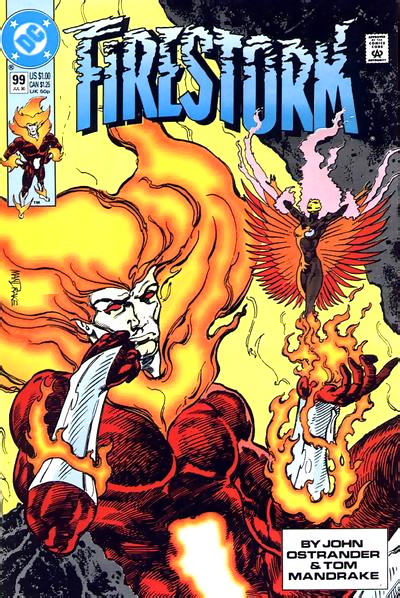
Over the next dozen-plus issues, the new Firestorm, in a totally new and altogether unrecognizable design by artists Tom Grindberg and Tom Mandrake, would find himself wrapped up in environmental issues, vacillating between his care for humanity and his elemental natures that would see the Earth wiped clean from pollutants (and evil corporations like Sunderland, in another echo of Moore's Swamp Thing). This conflict exploded in the "Elemental War" storyline, where just as Firestorm decided he was "humanity's friend," environmental activist Mai Miyazaki became Naiad, a new Water Elemental who teamed with the Air Elemental, Red Tornado, against humanity. To end the conflict, Firestorm allied himself with the Swamp Thing. This arc, in issues #90-93, was a visually arresting tour de force which was done a disservice on newsprint. I'd really like to see this arc--and much of Firestorm, to be honest--in a deluxe format. Someday, someway!

After an story (#94) in which Lorraine Reilly told Martin Stein of his connection with Firestorm (who saved the day, "Lassie"-style, when Martin found himself under fire from the Killer Frost), Firestorm journeyed back to East Africa, where Swamp Thing had previously revealed that his actions in #77-79 had made a hell out of paradise. He encountered Shango and other representatives from the Orishas, the African pantheon of gods, and became embroiled in their conflict against the Orish-Nla, their shadowy opposites. Although the conflict was resolved successfully, out of that war, those shadows gave birth to Shadowstorm, a negative-image opposite to Firestorm who unfortunately wouldn't have anything resembling a "final battle" with his progenitor. (I've heard stories that John Ostrander planned for the two to battle after #100, but after the book's cancellation, a version of the storyline instead saw print as the "Quantum Quest" in Captain Atom #54-57. The story also guest-starred Rasputin educating Atom about his place as another kind of elemental. The story--which I won't review here--could have been so, so much better with Firestorm than it was without. Especially with Mandrake on art duties.)

Did you think that the final metamorphosis of Firestorm was passed? Au contraire, mon frere!

The ramp-up to the final, hundredth issue actually has its roots two years hence in issue #76, the last battle between Firestorm and Brimstone, the gigantic creature who was first seen in the Ostrander-plotted Legends miniseries (that led to his getting the Firestorm gig in the first place, natch). The techno-seed that contained Brimstone's essence found its way into Earth's sun, and the creature was reborn in the most catastrophic place possible. Maser, a superhuman working for the Institute for Metahuman Studies in Pittsburgh, discovered Brimstone alive in the sun, and the duty fell to Martin Stein to find a solution. The problem with just sending Firestorm to the sun was that, issues prior, Firestorm tried to exit Earth's atmosphere and nearly died, finding that as one of the planet's elementals, his life force was tied to it. (Presumably as the "nuclear man" iteration of older times, he wasn't quite so tied to the planet, which explained his off-Earth excursions with the Justice League, especially Crisis on Infinite Earths. Can anyone else come up with a better explanation?)

Martin's plan tied into the fact that, as established in "Soul of Fire," he was to have been the original host to the Fire Elemental. In his words: "I propose we use one of these craft, equip it with oxygen tanks...and a quantity of explosives. Firehawk and Firestorm then supply sufficient thrust to put it--and me--into orbit. We detonate the explosive, ending my and Firestorm's lives...and hopefully, re-creating us both into a new Firestorm...who is then free to journey to the sun. In theory, anyway." Before Firestorm "died," however, he released his component halves, powerless, and they reunited with their families. Svarozhich then helped Martin complete the plan. The theory worked; not only did Svarozhich, possessed of the Fire Elemental, perish as it broke Earth's atmosphere and Martin become the new Firestorm, but Martin-as-Firestorm regained all his lost memories. This new Firestorm then defeated Brimstone, but found himself sucked into a singularity and into a "new universe" where he could not find a way home. He thanked the Earth-mother, Maya, for the experience and went off to parts unknown while Ron Raymond explored a new life with Lorraine, and Mikhail reunited with his wife Nina. One thing was sure: although he was nowhere near, they were sure Firestorm still lived!

I may have made a tiny tactical error in reading Firestorm #100 before issues #86-99, but that doesn't diminish my opinion of the final issue. The issue in many ways brought the saga of Firestorm full circle, summing up everything the character had come to mean since his introduction and tying up the plot thread that had been the through-line of Ostrander's entire tenure, summed up by Lorraine in the final story: "Funny, here they spend all kinds of money trying to determine if powers make one a hero. And the definitive answer [Martin Stein] is walking around on two feet...and most people never noticed him." Although for the longest time, Ron Raymond was the focus of the Firestorm series because his personality was ascendant, Martin was no less a hero, and with this issue he had his chance to prove just that. Interestingly, as the early Conway period would prove to be about the maturation of Ron Raymond, the Ostrander run framed the entire series as the maturation of the Firestorm entity, culminating in the eradication of the original dual-personality Firestorm and the coronation of Martin Stein as the "one, true" Firestorm. Not until the final issue was Ostrander done with his changes, which definitively established the Conway years as the character's larval stage, and the vast majority of his own tenure, kickstarted by the arc in #62-65, as his puberty. In "Soul of Fire," the "new" Firestorm may look different--certainly more like an adult as opposed to the garish costume seen before--but he wasn't fully mature until Martin took control. Even now, I'm awed at how well the whole story fits together, with organic change built upon organic change. Even if you don't like the finished product of Martin-as-Firestorm, you have to admire the method by which Ostrander slowly yet drastically changed the character.

As you can tell, the Ostrander run of Firestorm is one of my favorite comic eras of all time, and the letter columns in those last few dozen issues are filled with the opinions of the foremost letterhacks of the period, such as Jan C. Childress, "Uncle" Elvis Orten, T.M. Maple, and Charles J. Sperling, whose deep opinions speak to the high quality of the creators' efforts. It's entirely fitting that Ostrander's lasting legacy with the Firestorm character, for better or for worse, is the introduction of the Matrix. It has been used in nearly every Firestorm story or pitch that has been put forth since 1990, by subsequent writers like Joe Kelly, Mike Carey, Dan Jolley, Stuart Moore, and current Firestorm co-writer in Brightest Day, Geoff Johns. That alone speaks to the durability of Ostrander's concepts.

Next: Back to the beginning with Gerry Conway and friends.

~G.