4.2.11

Scorched Earth: A Redemptive Moment for Red Hulk (HULK #26-29 4-in-1 Review)

Well, now, another day, and another promise from my list of New Year's Resolutions to fulfill. I must admit, in all the twice-a-month Incredible Hulks hoopla, I've been remiss in reviewing that other Hulk book that's been haunting the newssstands--you know, the one that, up until lately, had been Jeph Loeb and Ed McGuinness' personal toybox for all their Hulkish ideas and which had introduced the Red Hulk to the comic buying public. Well, as I reported before I went to New York Comic-Con, writer Jeff Parker, artist Gabriel Hardman, and colorista Bettie Breitweiser have lent their considerable talents to the Red Hulk's book upon Loeb & McGuinness' departure. A few months later, here I am finally reviewing the first story arc. Hopefully I'll bring to the fore some things you didn't see on the first pass.

(Note: I did review the first issue by the new creative team, Hulk #25, and you can find that review here. This entry, then, will briefly recap that issue but mainly focus on issues #26-29.)

Covers to Hulk #26-29 by Ed McGuinness, easing the transition to interior artist Gabriel Hardman.
Hulk #26-29
"Scorched Earth" Parts 2-5
Writer: Jeff Parker
Artists: Gabriel Hardman, Mark Robinson, Ben Oliver & Terry Pallot
Colorists: Bettie Breitweiser, Jim Charalampidis, Antonio Fabela & Frank Martin
Letterer: Ed Dukeshire
Production: Irene Lee
Associate Editors: Nathan Cosby & Jordan D. White
Editor: Mark Paniccia
Publisher: Marvel Comics

Alas, the first arc of the Parker/Hardman/Breitweiser Hulk era is finished. One arc into the Loeb/McGuinness run, people were upset about Red Hulk beating up all their favorite heroes, and upset because they didn't learn his real identity at the conclusion of that sixth story. So what's the dirt on this arc, "Scorched Earth"? I'm loath to admit at the risk of shooting my wad too early, but Hulk under the new team perfectly captures the old-school feel of the best Hulk epics of yesteryear while giving a modern spin. While showing echoes of Banner and the green Hulk, "Thunderbolt" Ross is his own monster, with his own methods, and in some ways, the book outperforms Greg Pak's companion title.

I know you want me to put my money where my mouth is, because granted, that's a pretty bold statement to make. I'll start with the fact that "Scorched Earth" is the most direct epilogue to the events of the last six months' worth of Hulk stories. The premise here is elegantly simple, in that M.O.D.O.K. and the Leader set in motion a "doomsday scenario," aptly titled "Scorched Earth," in case they were captured or killed during "World War Hulks." While Bruce Banner works from the converted former A.I.M. outpost at Gamma Base to isolate and stop the ongoing attacks, he and Steve Rogers send Ross on related missions alongside some of Earth's most powerful heroes. In the back-up tales throughout #25-27, Banner also sends his best friend Rick Jones, a.k.a. A-Bomb, on a mission which dovetails with the main storyline and leads to its inevitable conclusion.

While the storyline starts off as little more than an apparent means of having all the heroes Red Hulk beat throughout his run take their revenge shots, thankfully it proves to be more than that under writer Jeff Parker's capable hands. To be fair, the hero-versus-hero fights became formulaic by the time Namor cornered the Red Hulk deep under the sea at the end of issue #27. (In spite of the formula, the Red Hulk vs. Thor fight in issue #26 was a definite highlight, made better still by Thor's admission to Banner after its climax.) Parker wisely shifts focus for the last two parts of the storyline, unifying the story with the A-Bomb back-ups. The obligatory fight between Red Hulk and A-Bomb feels less like another revenge beating because, simply, it's not, instead relying on another tried-and-true trope, namely mind control. Again, the fight doesn't last long, but it leaves Red Hulk overheated and changing back to Ross. Hence we transition to the final conflict, wherein a big secret about the Red Hulk's powers is revealed.

I've had a bit of an argument with Ratchet from his Hulk Collection blog about the turn that occurred in the last issue (SPOILER goggles on for this paragraph!) It's first hinted at when, as soon as the Hulk appears on Monster Isle, Ross is able to overcome his weakness and immediately change back to the Red Hulk. The Hulk reveals that Banner lied to Ross, and that he never lost his energy-absorbing abilities. Later in the story, when confronted with his betrayal, Banner admits the lie but states he did it to save Ross. Parker smartly sets up a likely hook for an eventual Red Hulk power-down because if Ross continues to use those energy absorption abilities, he risks losing one of his two forms--and Banner doesn't know which one it will be. Now, whereas my fellow blogger thinks this development is awfully convenient, I'm of the mind that it's very smart, taking the decision that had in #25 been out of Ross' hands and putting it squarely back in them. Each time he uses that power that differentiates him from the original Hulk, he risks either being trapped as man or monster forever. Conceptually it is sound, and certainly makes more sense than saying Banner suddenly learned how to perform brain surgery overnight. Consequently, it does make Betty Banner's situation as Red She-Hulk more interesting if these same elements are indeed in play over in Pak's Incredible Hulks in months to come.

Along the way, "Scorched Earth" has differentiated Ross' Hulk from Banner's in a few key ways, and yet interestingly, as remnant of Loeb's conclusion, moved him toward a "Bizarro" version of the Hulk from the 1970s TV show. This Hulk is a military genius, a tactician, who analyzes his foes' behaviors. He also not only convinces Banner to interrogate Sam Sterns, the former Leader, and George Tarleton, the former M.O.D.O.K., to find out what they may know about how to shut down the initiative, believing that regardless of what they may consciously know (which is essentially nothing), they may--and do--give subconscious clues. Ross' Hulk is an ironic twist on a secret agent, a big crimson goliath who's easily spotted, who is Steve Rogers' trump card because of his military background. The world believes Ross dead, just like David Banner in the aforementioned TV program, whose creator Ken Johnson's ruminations likely led to the development of a red-skinned Hulk in the first place. The only way he can make amends is through being the Red Hulk, and ironically, in #30.1 that will bring him into conflict with another army general who will be after him because he believes he killed Ross. (Holy echoes of Jack McGee!)

I've been going on and on about the story and the subtle nuances amid the bombast that I nearly forgot to mention the tremendous artistic talents of both Gabriel Hardman, whom I had the pleasure of meeting in New York in October, and Bettie Breitweiser. Yes, Gabe's artwork is a 180-degree turn from the sleek, stylish quality of Ed McGuinness' (no doubt why McGuinness has stayed on board to provide covers, as a means of easing the transition). But the man can draw anything, and I do mean anything. And if his art wasn't dynamic all by itself, the added artistry of Bettie Breitweiser just completes the package. That's right, I said artistry, as she brings more to the table than virtually any colorist out there, stunningly finishing pages that looked damned gorgeous and complete in ordinary black-and-white! (I should know, as I've seen many of Gabe's inked pages in New York. You can, too, right here.) At times, it's incredibly hard to believe that these pages are colored on a computer and not by hand. Lofty praise indeed. (There are pages Gabe drew that Bettie didn't ink. They're in #29 and they stick out like a sore thumb.) Simply put, I hope the Hardman/Breitweiser team sticks together a long, long time.

My only complaints, honestly, have more to do with nitpicks than any actual story problems: The Leader's human self is routinely referred to as Sam Stearns, and the final issue's chapter five is mislabeled as four, while chapter two's credits were left out of the issue entirely. However, I'm sure Marvel can get this product under control swiftly.

So, what do we have in the total of "Scorched Earth"? A solid start to the next major era of the Red Hulk, with an impressive, meaty plot; a smart, savvy script; and breathtakingly gorgeous artwork befitting Marvel's foremost crimson rampager. Look closer, and you'll see the development of at least two villains soon to face off against ol' Thunderbolt. (One, the Omegex in #29, is obvious, while the other--Zero/One--is more subtly shown in issues #25-26.) There's enough story fodder here to keep things going for at least a year. Overall, Jeff Parker, Gabriel Hardman and Bettie Breitweiser are poised to steamroll forward past their inaugural collaborations on Atlas, and I for one can't wait to see what they do next.

Red Hulk: Scorched Earth may be coming in trade paperback to a comic shop near you in April 2011, but don't wait--pick these issues up now.

~G.

2.2.11

Storm Warning 3: Just When I Thought I Was Out...


So, I was out.

Oh, not out of comics, mind you--my habit has remained firmly in place, more or less, since 1982--but rather, 1989 through 1992 really are my "Marvel Zombie" years. Aside from my first real dipping in the "indie" comic pool with NOW Comics' Fright Night (adapting the film of the same name, following the two leads after), these years were filled with nothing but Marvel books. On the plus side, I learned to really pay attention to the credits in the interim, largely due to the artistry of Todd McFarlane and the hubbub surrounding his leaving Amazing Spider-Man for a Spidey book all his own in 1990. It wouldn't be until late 1992 when I came back to the DC fold. You all know the event, I'm sure: the death of Superman!

However, Firestorm was noticeably absent from the big funeral scenes. Why?

Not important, not important. But instead of following up, I read more Superman. And then some of Batman. And Green Lantern. And The Flash. And The Spectre (which I very much want to address in a future blog). Like it or don't, the big speculator boom of the early 1990s, together with DC's event-oriented storytelling, made me a DC fan for real--moreso than the countless Millennium tie-ins did a few years before. (Curiously, their over-reliance on events I don't really care about is making me drop book after book I used to enjoy nowadays. How's that for irony?)

But yes, this blog is about Firestorm--at least it is today--and that means I eventually found my way back to ol' 'Stormy. I'm not really sure, but I think I came back in the fold in late 1994. At the time, I was buying comics out in Boardman, Ohio, at Rainbow Comics & Cards. (Another place I'm not sure is even there anymore.) I remember buying the Advance Comics catalog--one of Previews' competitors, I'm sure--and one month the DC previews showed Extreme Justice #4, one of the Justice League of America spin-offs from those days. And Firestorm was back.

So the next few months--from the announcement of the book for pre-orders, on through the appearance of the actual book--were a firestorm (pun intended) of activity from me. (To this point, I'd only bought four back issues of Firestorm: the first issue from '78, the first issue from '82, and issues 51 and 52 because Firestorm fought some giant reptilian monster in them. Ironically, the latter informed my knowledge of Eddie Slick, the Sand Demon from my last entry.) I don't quite remember the order in which I assembled the majority of my Firestorm collection, but it occurs to me I started by picking up the remainder of John Ostrander's run; in fact, I remember buying back issues at New Dimension Comics in Cranberry Township. Specifically, I picked up the Svarozhich arc from #82-85 early on, as well as the finale, the triple-sized #100. I'd buy most of the rest at that same shop, with an excursion to Eide's Entertainment in downtown Pittsburgh to fill in the final gaps. As I remember buying those earliest, I'll review the end run before tracing everything back to the original Gerry Conway run in my fourth entry.

During the Invasion! crossover, one of the alien Dominators detonated a Gene Bomb, isolated from the human metagene, whose catastrophic effects were felt by every super-powered human on Earth. In Firestorm's case, his nuclear powers blazed out of control and resulted in many deaths before the Gene Bomb's effects were negated. Traumatized, Firestorm then refused to come out, and any attempt by Ron or Mikhail to initiate the merger would cause both of them intense pain. This unfortunate event was shown in #82, when in trying to save Lorraine "Firehawk" Reilly from the second Killer Frost, Ron ended up having to save her himself.

There would be no time to rest, however, as during the time Firestorm spent in Russia, Red Shadows, a branch of the K.G.B., secured a sample of the hero's DNA and used it to create a clone, codenamed Svarozhich ("destructive fire"). Devoid of humanity, the entity cut a swath of destruction until Serafina was able to talk to Firestorm and stay merged long enough to deal with it. However, Svarozhich turned the tables and made Ron and Mikhail fission, in so doing allowing the duo to meet for the first time, face-to-face on the streets of Russia. He also said he now possessed the "Soul of Fire." Hmm...

Unfortunately for them, Ron and Mikhail couldn't understand each other outside the Matrix (Mikhail only spoke Russian), so they had to rely on Serafina as a psychic interpreter. Upon meeting Gregori Eilovotich Rasputin ("perhaps" the Mad Monk of Russian legend; actually a substitute for John Constantine), the final pieces of who and more importantly what Firestorm was finally came together. In "Soul of Fire," Ostrander framed the improbability of Ron and Martin having survived a nuclear explosion and become Firestorm in the same vein as Alan Moore framed Alec Holland's absurd resurrection as Swamp Thing five years earlier in Saga of Swamp Thing #21's "The Anatomy Lesson." Without directly aping, he established that Firestorm's origin was truly the advent of a new Fire Elemental, as Swamp Thing's was the introduction of an Earth Elemental. The Matrix enveloped Ron Raymond, but it was Martin Stein who was the intended recipient of the elemental force! This was about the time where today I would say, "Mind=blown." How much sense it made to have Stein's mind as the template for the "new" Firestorm of issues #65 onward!

Firestorm #85 marks the maturation of the core concept of the character in a genre that is largely resistant to change, so I'm not altogether surprised when "purists" of the character condemn this period in the character's history. However, for something that according to Ostrander wasn't planned at the time of the "new" Firestorm's introduction twenty issues before, the new status quo of Firestorm as Fire Elemental fit like a glove. Along the way we did lose another key conceit of the original series in that, to create the new Elemental, Ron and Mikhail had to give up their individual identities and be entirely subsumed in Firestorm's new persona. It wouldn't be until the finale in #100 that we saw Ron or Mikhail again.


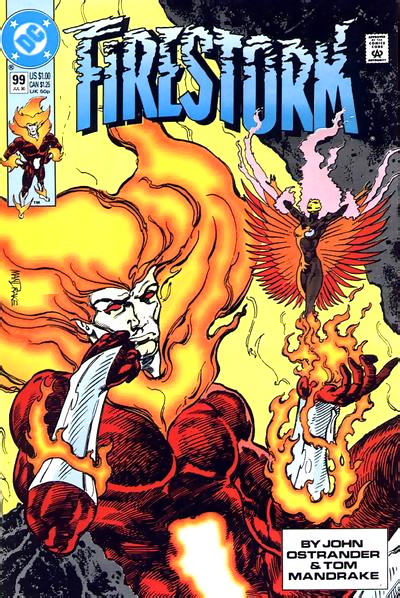
Over the next dozen-plus issues, the new Firestorm, in a totally new and altogether unrecognizable design by artists Tom Grindberg and Tom Mandrake, would find himself wrapped up in environmental issues, vacillating between his care for humanity and his elemental natures that would see the Earth wiped clean from pollutants (and evil corporations like Sunderland, in another echo of Moore's Swamp Thing). This conflict exploded in the "Elemental War" storyline, where just as Firestorm decided he was "humanity's friend," environmental activist Mai Miyazaki became Naiad, a new Water Elemental who teamed with the Air Elemental, Red Tornado, against humanity. To end the conflict, Firestorm allied himself with the Swamp Thing. This arc, in issues #90-93, was a visually arresting tour de force which was done a disservice on newsprint. I'd really like to see this arc--and much of Firestorm, to be honest--in a deluxe format. Someday, someway!

After an story (#94) in which Lorraine Reilly told Martin Stein of his connection with Firestorm (who saved the day, "Lassie"-style, when Martin found himself under fire from the Killer Frost), Firestorm journeyed back to East Africa, where Swamp Thing had previously revealed that his actions in #77-79 had made a hell out of paradise. He encountered Shango and other representatives from the Orishas, the African pantheon of gods, and became embroiled in their conflict against the Orish-Nla, their shadowy opposites. Although the conflict was resolved successfully, out of that war, those shadows gave birth to Shadowstorm, a negative-image opposite to Firestorm who unfortunately wouldn't have anything resembling a "final battle" with his progenitor. (I've heard stories that John Ostrander planned for the two to battle after #100, but after the book's cancellation, a version of the storyline instead saw print as the "Quantum Quest" in Captain Atom #54-57. The story also guest-starred Rasputin educating Atom about his place as another kind of elemental. The story--which I won't review here--could have been so, so much better with Firestorm than it was without. Especially with Mandrake on art duties.)

Did you think that the final metamorphosis of Firestorm was passed? Au contraire, mon frere!

The ramp-up to the final, hundredth issue actually has its roots two years hence in issue #76, the last battle between Firestorm and Brimstone, the gigantic creature who was first seen in the Ostrander-plotted Legends miniseries (that led to his getting the Firestorm gig in the first place, natch). The techno-seed that contained Brimstone's essence found its way into Earth's sun, and the creature was reborn in the most catastrophic place possible. Maser, a superhuman working for the Institute for Metahuman Studies in Pittsburgh, discovered Brimstone alive in the sun, and the duty fell to Martin Stein to find a solution. The problem with just sending Firestorm to the sun was that, issues prior, Firestorm tried to exit Earth's atmosphere and nearly died, finding that as one of the planet's elementals, his life force was tied to it. (Presumably as the "nuclear man" iteration of older times, he wasn't quite so tied to the planet, which explained his off-Earth excursions with the Justice League, especially Crisis on Infinite Earths. Can anyone else come up with a better explanation?)

Martin's plan tied into the fact that, as established in "Soul of Fire," he was to have been the original host to the Fire Elemental. In his words: "I propose we use one of these craft, equip it with oxygen tanks...and a quantity of explosives. Firehawk and Firestorm then supply sufficient thrust to put it--and me--into orbit. We detonate the explosive, ending my and Firestorm's lives...and hopefully, re-creating us both into a new Firestorm...who is then free to journey to the sun. In theory, anyway." Before Firestorm "died," however, he released his component halves, powerless, and they reunited with their families. Svarozhich then helped Martin complete the plan. The theory worked; not only did Svarozhich, possessed of the Fire Elemental, perish as it broke Earth's atmosphere and Martin become the new Firestorm, but Martin-as-Firestorm regained all his lost memories. This new Firestorm then defeated Brimstone, but found himself sucked into a singularity and into a "new universe" where he could not find a way home. He thanked the Earth-mother, Maya, for the experience and went off to parts unknown while Ron Raymond explored a new life with Lorraine, and Mikhail reunited with his wife Nina. One thing was sure: although he was nowhere near, they were sure Firestorm still lived!

I may have made a tiny tactical error in reading Firestorm #100 before issues #86-99, but that doesn't diminish my opinion of the final issue. The issue in many ways brought the saga of Firestorm full circle, summing up everything the character had come to mean since his introduction and tying up the plot thread that had been the through-line of Ostrander's entire tenure, summed up by Lorraine in the final story: "Funny, here they spend all kinds of money trying to determine if powers make one a hero. And the definitive answer [Martin Stein] is walking around on two feet...and most people never noticed him." Although for the longest time, Ron Raymond was the focus of the Firestorm series because his personality was ascendant, Martin was no less a hero, and with this issue he had his chance to prove just that. Interestingly, as the early Conway period would prove to be about the maturation of Ron Raymond, the Ostrander run framed the entire series as the maturation of the Firestorm entity, culminating in the eradication of the original dual-personality Firestorm and the coronation of Martin Stein as the "one, true" Firestorm. Not until the final issue was Ostrander done with his changes, which definitively established the Conway years as the character's larval stage, and the vast majority of his own tenure, kickstarted by the arc in #62-65, as his puberty. In "Soul of Fire," the "new" Firestorm may look different--certainly more like an adult as opposed to the garish costume seen before--but he wasn't fully mature until Martin took control. Even now, I'm awed at how well the whole story fits together, with organic change built upon organic change. Even if you don't like the finished product of Martin-as-Firestorm, you have to admire the method by which Ostrander slowly yet drastically changed the character.

As you can tell, the Ostrander run of Firestorm is one of my favorite comic eras of all time, and the letter columns in those last few dozen issues are filled with the opinions of the foremost letterhacks of the period, such as Jan C. Childress, "Uncle" Elvis Orten, T.M. Maple, and Charles J. Sperling, whose deep opinions speak to the high quality of the creators' efforts. It's entirely fitting that Ostrander's lasting legacy with the Firestorm character, for better or for worse, is the introduction of the Matrix. It has been used in nearly every Firestorm story or pitch that has been put forth since 1990, by subsequent writers like Joe Kelly, Mike Carey, Dan Jolley, Stuart Moore, and current Firestorm co-writer in Brightest Day, Geoff Johns. That alone speaks to the durability of Ostrander's concepts.

Next: Back to the beginning with Gerry Conway and friends.

~G.

28.1.11

God Smash, Puny Mortals! (Incredible Hulks #621 in Review)

Friends, Greeks, Countrymen--

Chaos War #5 arrived this Wednesday, bringing with it the conclusion to the storyline of the same name that prominently featured newly-minted skyfather Hercules and Amadeus Cho in mortal combat with Amatsu-Mikaboshi, the self-proclaimed Chaos King, who threatened to destroy all of reality. With the help of the incredible Hulks, Thor, a couple of (dead) Avengers, Galactus, the Silver Surfer, and the also-dead original members of Alpha Flight, the crisis was averted and reality restored. If you don't want to know specifics beyond the above, I strongly recommend you turn back now, as this review will feature two prominent spoilers about the conclusion of Chaos War.

Now, then, shall we indulge?


The Incredible Hulks #621
"God Smash" Part 1 of 2

Writer: Greg Pak
Artists: Paul Pelletier & Danny Miki
Colorist: Paul Mounts
Letterer: Simon Bowland
Production: Irene Lee
Assistant Editor: Jordan D. White
Editor: Mark Paniccia
Publisher: Marvel Comics

In the aftermath of the Chaos War, the incredible Hulk's family finds themselves in the middle of a city, surrounded by people just awakening from the sleep caused by the Chaos King. Briefly, they bemoan having helped save the world only to have the "puny humans" terrified by their presence. But this scene doesn't last long, and the remainder of this epilogue of sorts to Chaos War moves to the efforts of Bruce Banner to resolve his family's issues...by begging the indulgence of the Olympian gods, including the skyfather himself, who isn't exactly who we thought he'd be.

I'll say this for writer Greg Pak: he dreams big. It's interesting seeing how he positions Bruce Banner as the narrative focal point here, and at once I have to again question just whose decision it was to pluralize the title of this comic magazine. After all, the book has never, in the ten issues since becoming The Incredible Hulks, truly been an ensemble book. Rather, it's been about the Hulk, his son, and arguably the Red She-Hulk as a sort of post-nuclear family. The rest of the cast--Korg, A-Bomb, She-Hulk--has just been bit players in the ongoing drama, never really ascending to the same level as the main trio. Aside from the first three pages, this issue is entirely devoted to Bruce Banner and the Hulk, to the exclusion of the rest of the cast. Oh, sure--Banner makes it clear in talking with Hercules that this fool's errand is about them, but I get the feeling they won't figure much in the remainder of this two-part storyline.

(Interestingly, shortly before this issue became available it was announced in Marvel's April solicitations that the incredible one is going back to being a solo act with that month's issues. Think what you will, but I believe it's the right move, as the balancing act has proven untenable.)

So, after the events of Chaos War, Hercules is no longer empowered to the drastic degree he had to be in order to defeat the Chaos King; in fact, he's no longer super-powered at all, which lays to waste Banner's desperate plan to solve his family's ills. Is this the degree to which Banner feels utter guilt toward what his family's been through since "Fall of the Hulks"? He wants Rick to be healed from the wounds the Abomination inflicted upon him (in #618). He wants Betty to be cured of this "insanity" she suffers from as Red She-Hulk. (Denial, as they say, isn't just a river in Egypt, Dr. Banner.) He wants to ease his family's suffering, and maybe, superhuman as they are, he has to crawl before omnipotent forces, but something about the man of science begging the gods for help rings false. (So does the Hulk's slow healing in these issues, but there's a tale for another blog.)

On the other hand, the premise of this issue--that the Hulk challenges the gods so that his family may be relieved of their burdens, or perhaps that he may be relieved of them--allows for some truly awe-inspiring artwork from Paul Pelletier and Danny Miki. The Hulk smashes the Olympian gods on his way to encounter the newly-resurrected Zeus, and it's great fun seeing this indulgence and knowing through Zeus' narration that it's not going to end well next issue. "I hate spunk," says Zeus, his wife Hera by his side, a smoldering Hulk at their feet. The issue closes on a note that leaves no question as to what we're in for next month.

I'm somewhat unimpressed by the issue, on the whole. While there is something of a bond between the Hulk and Hercules, it's largely seemed artificial, an invention of Peter David (in his "Green Pieces" story teaming the Hulk and the Champions of L.A. in the second Giant-Size Hulk special, 2006) and Pak himself (throughout the "World War Hulk" crossover issues of The Incredible Hulk). The two-parter seems less an organic part of where the Hulk (er, Hulks) book was going, and more a way to bookend the character's involvement with Hercules that began in the aforementioned stories.

The one potential silver lining I see in this saga isn't even something that's directly referred to within this issue, but instead one plot point involved in the ending of Chaos War #5. Of all those resurrected to fight the Chaos King during the storyline, the Canadian super-group Alpha Flight remained alive at the end. This event occurred because, as Hercules himself tells Banner in #621, "When I grasped that power, I was guided by the wisdom beyond all our ken. And if you weren't healed...then perhaps that is as it should be." The way I like to read that comment from Hercules is that some others may have been resurrected when Hercules re-ordered reality and saved it from the Chaos King. If that's true, then potentially, one or more of those we saw in the last two issues of Incredible Hulks could again be alive. It doesn't matter who you choose, for each of the characters from the Hulk's past--Glenn Talbot, Hiroim, Doc Samson, and Jarella--could, as mentioned in my previous entry, have a full storyline devoted to even one of their returns. I hope Greg Pak realizes just what a golden nugget he has laid at the Hulk's feet.

So, what else is there to say about Incredible Hulks #621? After the flurry of activity in the last three issues, this issue certainly takes a break and slows the pace, but it's just a bit lacking, maybe because the story doesn't seem particularly fitting of the character. We'll see how it all bears out in next issue's finale, however.

What say you, sirs?

~G.

27.1.11

A Word About Those Who Keep Their Comics in the Polybag...


The second and third books above were released at the height of the 1990s speculator boom. One's worth $20USD on a good day. The other you can find in dollar bins. The first? Well, that one's now on sale (although I have, ahem, doctored it a little). On eBay a first printing, unsigned and still in the polybag, has reached a price of $20.50. Soon to plummet as, you guessed it, the member of the FF who died in the issue eventually returns.

I'm not getting into how major characters in comics really . That argument's been done to death. If the public at large is gullible enough to believe DC would really kill Superman, or Marvel would really kill Captain America, well...like I said, so not going there. This is about the polybag.

They're comics. Read 'em. If you like 'em, recommend them to friends. Lend your books out. Donate them to your local library, or ask to put some at your local pediatrician's office waiting room for the kids there. Don't try to hoard 'em hoping one day they'll help you put your kids through college. Supply and demand, folks.

There are better ways to popularize the product than emphasizing death. Can we please find them? Soon?

~G.

Incredible Hulks #623 Preview

Folks,

While waiting for my Chaos War #5/Incredible Hulks #621 review (coming before the weekend, I swear!), here's a sumptuous feast of a page by Dale Eaglesham, Drew Hennessy & Dean White from the February 23-shipping Incredible Hulks #623:

Preview page - Click for MORE
If you click here or on the above link, you'll see more preview pages from the same issue. It looks like the Warbound will be having one last adventure with a very humbled Hulk. Elsewhere in the preview pages lurks No-Name of the Brood, but here in this page are the assembled Hulks plus Kate Waynesboro and Elloe Kaifi!

Great, great stuff by Dale, Drew and Dean, and I can't wait to see the finished issue. It looks like #625 is the end of the line for the Hulk family, and it all starts here with part one of the three-part "Planet Savage" storyline. This epic storyline guest-stars Ka-Zar and features the return of renegade Warbound member Miek, fresh from his appearance in the final two issues of Chaos War. Don't miss out!

Visit Dale Eaglesham's website here to see some process artwork from the arc. With five pages looking as good as this, can it be very long before he's asked to come back?

INCREDIBLE HULKS #623 (DEC100578)
Written by GREG PAK
Pencils and Cover by DALE EAGLESHAM
Rated A… $2.99
FOC – 1/31/11, On-Sale 2/23/11


~G.

25.1.11

Storm Warning 2: The Only Constant Is Change!

The Greek philosopher Heraclitus gave this article its title, and it couldn't be more appropriate for this era of Firestorm, the Nuclear Man. I mentioned in the last segment how I came on board this title at a fortuitous time, the last half-dozen issues of the "old" status quo of two men, Ron Raymond and Martin Stein, combining to form the titular hero. From issue #65 until the series finale in #100, through the character's other incarnations in JLA and the third Firestorm series, straight on through to Brightest Day, the focus has been sharply removed from the men and centered on the idea of the "Firestorm Matrix"--but I'm getting very sharply ahead of myself.


Regardless of the corner box, this issue was drawn by underappreciated DC and Marvel '70s artist Ross Andru. This issue was released in that period before I really paid attention to creator credits, but Andru's art stands as unique amid the capable-and-not-much-more efforts of Joe Brozowski. It also jump-started the new era of Firestorm quite ably, and John Ostrander's skilled script put forth a mystery, front-and-center: who is the new Firestorm? As result of last issue's climactic finale,Ron had initiated the fusion into Firestorm with Mikhail Denisovitch Arkadin, a Russian whose active metagene (DC's analogue to Marvel's mutants) made him something like a Human Torch. Martin, suffering from a brain tumor and apparently near death, could be somewhere in the new configuration, or he might be dead. The twists didn't stop there, as upon fusion, both Ron and Mikhail were "stuck" in Firestorm's head--and Firestorm himself didn't seem to have any personality except for his own. He was an amnesiac, operating his powers instinctively. Was Firestorm asserting his own personality somehow? So many questions, so few answers.

Looking back, of course, the answer to the questions above becomes so apparent it's a wonder I didn't put two and two together immediately--then again, I was young so I can be excused. (Can't I?) Without getting completely in-depth in my reviews--I don't want to carry this bit on too long--I want to at least put forth how I felt about reading these books before I quit. (Say whaaaaaa?) I remember being interested in the plights of Ron Raymond and Mikhail Arkadin as they encountered threats from both the U.S. and Russia, as well as dealt with being thrown together as passengers in this new Firestorm entity. The character of Zastrow, the Russian who found Mikhail in the first place in #62, became of increasing importance as he unearthed another Russian superhuman, the mustachioed Stalnoivolk, to face the new Firestorm.

Meanwhile, Firestorm suffered through the Millennium crossover, and in my personal comics collecting career, I crossed over from the newsstand (The Book End at the Northern Lights Shopping Center in Baden, PA--now defunct!) to an actual comic shop (Bill & Walt's Hobby Shop at North Hills Village in Pittsburgh--still around today in some form, but no longer carrying comics!). I daresay it was the dawn of the golden age of comics of my youth.

One of the book's strengths was that Firestorm was getting to know himself just as we, the readers, were. It was also fascinating how the book had so suddenly captured a worldly flavor, with half its action taking place behind the Iron Curtain. (Remember, these books were released in 1988, when Communism hadn't yet fallen in Russia!) A particular source of fun was the Russians' attempt to discover what linked Ron with Firestorm in the U.S. even as the K.G.B. tried to find out what linked Firestorm with Mikhail. Along the way, readers met Mikhail's extended family, from his wife and children, to his brothers, to their children. Serafina Arkadin, Mikhail's niece, was leader of a team of Russian super-teens called Soyuz. They battled the alien Zuggernaut alongside Firestorm, and later, Serafina would help in unveiling perhaps the biggest piece of Ostrander's ongoing Firestorm mystery (later).

Through this range of issues, Joe Brozowski. the series' capable artist, was "replaced" by J.J. Birch, who had a style more reminiscent of mid-80s Keith Giffen. He brought us the story in which, thanks to a time-traveling former university professor calling himself the Flying Dutchman of Time, Firestorm's astral self was able to watch the entire development of all his component selves--a good way of catching the character up on his own history. A few issues later, once Joe Brozowski had "taken back" the artistic reins, editor Denny O'Neil revealed that Birch was really a pseudonym for Brozowski himself, who had wanted to try out a new style. Unsurprisingly, some parts of the new style carried through into Brozowski's post-Birch period, much for the better.

In issues #74-75, the latter of which would probably be a "big anniversary blowout" today, Firestorm came another step closer to fulfilling Ostrander's ultimate promise when he encountered a "sand demon" out in the Nevada desert. The story echoed Annual #5, where Firestorm made his last stand against the world's governments in that same desert. Since nobody had found what had become of Martin Stein to that point, and a great physical similarity existed between the Sand Demon and Stein, upon sight Ron believed the creature to be Stein! The truth was revealed over the second issue--that the Sand Demon was really Eddie Slick, a crooked wrestling promoter that Firestorm had previously encountered in Firestorm #51-52. Still, the mystery of Martin Stein's whereabouts were smartly not far from a resolution.

Since the first time Ed Raymond met the "new" Firestorm, he noticed a striking similarity in manner to Stein. Using his newspaperman instincts, he operated under the supposition that Stein had never died, and his research led him to a facility in Nevada where an older gentleman with amnesia was kept. After defeating the Sand Demon, Ron went with his father and stepmother to the facility where they found Martin, alive and well. The doctor on staff revealed more details--that every once in a while, Martin would lapse into a coma, later to awaken as if nothing happened. These episodes coincided, no doubt, with the Firestorm merger, with Stein's mind as the template for the new iteration. In fact, the next issue showed Martin subconsciously initiating the change when the villain Brimstone appeared at the facility. However, only Martin's mind was involved in the Firestorm Matrix at the time, and not his body, which would lead to further developments.

Also at this time, as consequence of there being a new Firestorm who only existed when Ron and Mikhail initiated the fusion, the new Nuclear Man questioned his existence. It was an intriguing bit of philosophy that Ostrander generated that would be a harbinger of the next major status quo shift (in the next eventual installment). Here was a character who couldn't even have a life outside his existence as Firestorm, who only lived to beat the bad guys! Right after the returns of Martin Stein and Brimstone, this plot point bore fruit in the "Eden" arc of #77-79. Ron accompanied his father to Africa, where he saw firsthand the hunger and desperation endured by the area's inhabitants. Determined to do something good, Ron and Mikhail initiate the merger, and Firestorm uses his abilities to transmute matter to make a paradise in the middle of the desolation. Soon, he finds that "no good deed goes unpunished," as cartels move to seize the paradise. Amid the fiery carnage, somehow Jama, one of the African men who has befriended Ron, finds himself merged into the Firestorm Matrix and a new, bestial Firestorm emerges with pieces of four men in the mix!

The status quo only lasted through #79, where Jama died, but the question arose how another could be brought into the Firestorm Matrix. Further, the question couldn't be avoided any longer: What exactly is Firestorm? How powerful can he truly be? What could happen of his newfound desire for independence, for a life? Unfortunately, I couldn't be bothered to stick around for the answers at this time. The Invasion! crossover hit the DC line the next month, and my supreme disinterest led to my promptly removing virtually every DC title from my pull list, a trend that wasn't reversed until the death of some guy named Superman in 1992. Interestingly, longtime Firestorm artist Joe Brozowski also took his leave with #79. It wouldn't be until quite a few years later that 'Stormy and I would again cross paths...

And that, my friends, is a tale for another entry of "Storm Warning," coming your way soon.

~G.

19.1.11

Storm Warning 1: Musings on My Favorite DC Hero

I really was going to start blogging today about my aborted attempt at joining the hallowed ranks of Marveldom from 2003; however, I've decided to forgo that particular discussion in favor of switching party lines from Marvel to DC. It strikes me that I haven't given enough love to other comic companies, so now begins the turnaround. (Just one of my many mini-resolutions I had for you, dear readers!)

Many of you may know my first exposure to comics came with the 1977-1982 CBS live-action TV show, "The Incredible Hulk," as well as the 1981-1986 cartoon, "Spider-Man and His Amazing Friends" and the accompanying "The Incredible Hulk" toon. However, I also remember watching "Super Powers" on ABC in the mid-eighties. I may have read one or two issues of DC Comics Presents or Green Lantern, and I had a few trial subscriptions to Batman and GL through 1985, but it wasn't until after my exposure to "Super Powers" that I really "got" DC. And the lion's share of the blame for my getting into DC was this guy right here:


That's right: "Super Powers" brought me in contact with Firestorm, the Nuclear Man! I remember enjoying the dynamic involved with the character, and upon later reflection, I don't think it's a coincidence I enjoy the character nearly as much as my favorite Marvel character, the Hulk. Both characters have a strong duality about them, with Dr. Robert Bruce Banner transforming in times of stress into the Hulk, while Ron (I refuse to call him "Ronnie") Raymond and Professor Martin Stein combine to form the heroic nuclear hero, Firestorm. I think it was that two-in-one dynamic that engaged my interest, and it was different than Banner and Hulk in that both Stein and Raymond were conscious, with the former as a "talking head" in the latter's mind. The character had other dualities as well, with Ron as a "jock" while Martin was clearly an intellectual; Ron younger and a student while Martin was older, a teacher. (And, as would be shown later, Ron's strained relationship with his own father eventually transformed their relationship into something more along the lines of father-son. But leave us not digress.)

I remember getting the Firestorm action figure from the Kenner "Super Powers Collection," with its mini-comic, which must have been in 1985, but then I didn't rush out right away and buy a Firestorm comic book. That didn't happen until I happened upon Ryan's News in downtown Columbiana, OH in early 1987, where I found two issues at once: The Fury of Firestorm #60 and 61, by John Ostrander (then making miracles happen as writer of DC's hit, Suicide Squad) and Joe Brozowski. Although I didn't know it then, the copy of #61 I bought that day would become a minor collector's item because it was the "Superman Comics" variant of that issue. (A few weeks later, I would find the other cover to #61 at another shop. It was my first--though far from my last--dealing with a "variant cover," something common today but certainly far more of an oddity then.)

In retrospect, I was very lucky to have come on board the book just then, as Ostrander was about to give the book the mother of all overhauls! Since the character's creation in 1978 by Gerry Conway and Al Milgrom, the series had always been about the trials and tribulations of Ron and Martin, but that was all about to change. (I've previously written about the status quo change in my first-ever Internet column, "Crusty Comic Cavalcade," several years back, but that article is lost to antiquity.) Conway had been replaced only a half-dozen issues before by Ostrander, who wasted no time attacking some of the core conceits of the series, like why must Ron and Martin always get along? and the big one, what happens to Firestorm if one of 'em is, well, dying? That last one, I later discovered when I rounded up the early part of the Firestorm series, was a nugget inserted by outgoing writer Conway in #53 (although whether it was at the behest of Ostrander or something altogether different, well, who can say?).

The storyline that was trickling through #60-61 and went full bore with #62 revolved around Martin Stein's recent diagnosis of an inoperable brain tumor, whose growth would quickly impact his ability to successfully function within the "Firestorm Matrix." It was the first domino to fall in what would become a succession of status quo changes that really wouldn't stop until the book's 1990 cancellation, and would remain a fixture of the character from 1987 until today with Firestorm's appearances in Brightest Day. In some ways, John Ostrander made changes to the character, largely unheralded at the time, that were as influential in the series as Alan Moore's were to Swamp Thing a few years earlier. Although Ostrander's changes to Firestorm took longer to effect (the key revelation didn't occur until #85, two-and-a-half years into his tenure, whereas Moore's second issue contained the virtual sum total of his changes in one wham, bam, thank you ma'am moment), they changed the entire way later writers and this fan thought of the character, much like Moore.

So, what do people do when they find out they're living on borrowed time? For many, the answer would be to do things they haven't done before--to check off those things on their personal lists. For a select few, the struggle becomes how best to make a difference, and that's how it is for Martin, who talks with Ron about his mortality. They don't know how or even if there will still be a Firestorm as the tumor grows, so they nobly try to achieve what Superman attempted in the then-recent film, Superman IV: The Quest For Peace, only with notably different, and probably more realistic, consequences. Firestorm wants to rid the world of nuclear weapons, so what does everyone do? They paint him as a vigilante, a criminal in the eyes of the whole world, and heroes and villains from Captain Atom, to the Justice League, to the Suicide Squad, to a new Russian super-being called Pozhar try to stop him, following orders from their governments.

As the battles escalate, Stein's health deteriorates, and the dual hero tries unsuccessfully to find refuge in the Nevada desert. Pozhar and Firestorm have an intense fight, and Firestorm ruptures the Russian's suit, reducing him to a flaming skeleton. The United States and the USSR are sending in their nukes to finish off our hero once and for all. Firestorm has a seizure and separates into his component halves, who have only moments to do something before disaster strikes. Pozhar, afraid for himself as well as seeing his foe's mortality, suggests the three of them try and form Firestorm so they can escape and survive. They concentrate just as a nuclear warhead detonates. There is a tremendous explosion, which then falls in upon itself as the army watches, stunned. It collapses into the form of a man--a thin, tall, wiry man wearing a blank stare and a familiar red-and-yellow costume, with a mane of flame in place of hair. This is the new Firestorm.

Keep in mind, while this storyline--all told, taking place through Firestorm, the Nuclear Man #62-64 and Annual #5--introduced a "new" Firestorm, it was only the first of several major changes to take place over coming years. And it's those changes I'll be addressing in the next entry as I continue my own personal musings about DC's most unique hero. (And since I'm bringing my musings to you in the order in which I read the books, my views on the early issues are still forthcoming, so fear not.)

Read more of Storm Warnings: Part 2 / Part 3 / Part 4 / Part 5 / Part 6 / Part 7

~G.

13.1.11

Chaos War: The Incredible Hulks #618-620 Review-o-Rama!

Since I haven't reviewed the first two parts of the Chaos War crossover, I figured I'd write an all-in-one review of the Hulks' part in the storyline, #618 through 620, featuring the returns of the Abomination and--oh, but that would be telling! This won't be just a review--it's also in-depth criticism and filled with annotations from older issues--writer Greg Pak's inspiration for this tale. Although I wanted to avoid them, it seems a discussion of this triad of issues would be incomplete without heavy discussion of SPOILERS. So, without further ado--tally ho!


The Incredible Hulks #618-620
"Inferno," "Hell Break" & "Harrowed"

Writer: Greg Pak
Artists: Paul Pelletier & Danny Miki
Colorist: Paul Mounts
Letterers: Simon Bowland
Production: Irene Lee
Assistant Editor: Jordan D. White
Editor: Mark Paniccia
Publisher: Marvel Comics

After the sprawling epic "Dark Son," wherein the Hulks family faced their first challenge in Skaar's brother, Hiro-Kala, the team wanted nothing more than to come back to Earth for some much-needed reflection and relaxation. Unfortunately, the Chaos King (from the pages of The Incredible Hercules) has risen, killing the lord of the dream realms, Nightmare, and catapulting Earth's denizens into eternal slumber. He has destroyed the underworld, freeing the dead to haunt the world anew. And so, Dr. Strange warns the Hulks of the dangers by bringing his astral self to their great stone ship. The Hulks then proceed to Earth, checking to be sure the Hulk's daughter Lyra is okay, and then...the real terror begins!

"Dark Son" was an important and necessary storyline in Hulk history, showing a son who had become a deadlier version of what Brian Banner believed Bruce would become (although, granted, not using his intellect to do so), it suitably took up six issues of The Incredible Hulks. By contrast, we have an innocuous-looking crossover to a "major Marvel event," that by rights really shouldn't count for much, but it ends up being anything but. These three issues may be overly full of important, emotionally resonant events, each of which could certainly fill an entire storyline all their own.

Fans and reviewers alike have spoken out on Chaos War, and some have likened facets like resurrecting the dead (who are running rampant without any help in books like Chaos War: Dead Avengers and Chaos War: X-Men) to the DC Comics crossover sensation of 2010, Blackest Night. While it's true both sagas share a theme of bringing back dead heroes and villains, the key distinction lies in Marvel's free from external influence and only allying themselves with the Chaos King if they so desire. Hence, that freedom to choose makes Chaos War a richer experience, and it allows so much dramatic potential to be infused. Nowhere is that potential more well-utilized than in Incredible Hulks.

Over the Hulk's storied history, a number of important characters have been lost to tragedy. Even beloved villains have passed beyond the veil, and though we know those villains won't be gone forever, it's fitting that the first resurrection here is Emil Blonsky, the Abomination. Eagle-eyed readers may have seen him in the bowels of Hades during the "Dark Reign" stories in Incredible Hercules #129-131, but here he returns from his ignominious defeat in Jeph Loeb's Hulk #1. As has happened so many times throughout the character's history (Thanks Mick!), Blonsky has again been reinvented, this time as the Chaos King's lackey, sent to locate Rick Jones' estranged (?) wife, Marlo Chandler-Jones, whose presence and predicament lead to the storyline's other, more notable returns of the heroic sort.

A substantial bit of character drama leads off the book, as the Hulk and Stephen Strange have had a strained relationship of late. Readers of World War Hulk recognize that for the second time, Strange played a part in exiling the Hulk from his homeworld. To combat his old friend turned enemy upon his return to Earth, Strange drank the contents of the magical amphora that contained the essence of the demon Zom, imbuing himself with his essence, however diluted. Strange fought back the possession and the majority of Zom's self was returned to the amphora, but the damage was done: Strange soon lost his title of Earth's Sorcerer Supreme. Here, disgraced, he appears to ask for the Hulk's help, but we discover at #618's conclusion that he has again been usurped by Zom, who has been set free anew by the Chaos King so that he and the Abomination may locate Marlo.

Why does everyone want Marlo? Once upon a time (in 2001's Captain Marvel #17-18), Thanos hid Death's spirit away from a cosmic villain called Walker. Where did he hide her? None other than inside Marlo, who had once died and returned to life. Thanks to this brush with Death, Marlo now harbors a piece of her power inside her--a piece that, if extinguished by the Chaos King's servants, would allow those merely sleeping, immune from death's embrace, to die anew. No sooner does Rick reveal Marlo's whereabouts--in Phoenix, Arizona--Zom reveals himself and the battle is joined anew.


Where the story starts to distinguish itself is in its second chapter, where we begin with the fight between Hulk and Zom, where Zom's mystical aptitudes (shown way back in Strange Tales #156-157) are virtually forgotten to make him more a match for the entirely physical Hulk. Soon, focus shifts from Zom and Abomination almost entirely and goes squarely to the Hulks' protection of Marlo, as well as the exploration of Marlo's "gifts." Given that when we see her, cowboys and other dead people she doesn't even know are protecting her from demons, it's not so much a stretch seeing her bring back someone she knows is dead--Doc Samson. (I'm going to have to guess that Rick or someone else tipped her off to Doc's death in Incredible Hulk #610...much like Abomination just magically knows Rick is now A-Bomb, and Betty is now Red She-Hulk, and he knows all about the Banner family! D'oh!) Doc then proceeds to summon three souls especially important to Hulk lore.

In increasing order of importance: first among the resurrected is Hiroim the Oldstrong, the disgraced Shadow priest who was a part of the Hulk's Warbound and who passed on fighting the Leader in Warbound #5. This return marks the first time an issue has been made in the main Hulk book about Hiroim's sexuality, but fans of the earlier miniseries may remember he and Korg talked about one day participating in the ceremony whereby Kronans produce little rocklings. It's not dwelled on, is done tastefully, and does enhance the relationship between these characters. (It's interesting that Samson chooses Hiroim to be resurrected, since he was relatively unfamiliar with him in comparison to the others below.)

The second of the resurrected is Colonel Glenn Talbot, former mortal enemy to the Hulk, who also happens to be Betty Ross' first husband. (They married in Incredible Hulk #158, and divorced in #238 after years of trouble; he died in #260.) Of course, Glenn was just seen in the major Hulk crossovers "Fall of the Hulks" & "World War Hulks," but contrary to the reading Bannertech gave, he was ultimately revealed as just another Life Model Decoy, created in the image of the real Talbot. The Leader and M.O.D.O.K. created the Talbot decoy to be their deep government mole in the event Ross abdicated his responsibilities, and also to be an influence on Betty, who'd recently been resurrected and turned into the Red She-Hulk. His military record was doctored to satisfy deep digging (such as Cho struck in #608). That LMD was "killed" by Ross as the Red Hulk in Hulk #23. As is obvious from the first moment they see each other in #619, Betty and Glenn still have feelings for each other, although in Betty's case, hers could be colored by hindsight and how crazy her life has become since having married Bruce.

The last to be brought back is Jarella, princess of the sub-atomic world of K'ai. It's noteworthy she appears here, as she's been referenced as recently as "Dark Son," since it was K'ai that Hiro-Kala brought through The Fault and on a collision course with Earth. She was first seen in Incredible Hulk #140, created by Harlan Ellison, Roy Thomas & Herb Trimpe for the second in a two-part crossover with Avengers #88. She fell in love with Bruce Banner and the Hulk, who returned to her world a few times in subsequent years before she was stranded on Earth. She eventually died there, saving a young boy from falling debris (Incredible Hulk #205). The Hulk eventually recaptured her body from Gamma Base and buried her on K'ai. Evidently her soul remained on Earth, so here she was resurrected.

Since the Hulks had their own army made from the dead, it only made sense for the Abomination to bring others to his cause. After emotionally satisfying scenes that showed Betty beating on Blonsky for having killed her, the Abomination decides to resurrect the two most important figures to Bruce Banner's early years: his mother, Rebecca Banner, and his abusive father, Brian. This storyline marks the first "present-day" appearance of both characters, as they have previously only been shown in flashback to Bruce's childhood. Brian's three previous appearances--Incredible Hulk #312, 377 and -1--are the stuff of Hulk legend and are terrifically important in understanding the modern iteration. Brian Banner always saw his son as a monster due to his abnormal intelligence displayed from an early age. He blamed his own work as an atomic scientist for some manner of mutation, and his abuse of alcohol fueled his rage, directed physically at his wife for bearing Bruce, and Bruce himself. The physical and emotional abuse both mother and child suffered at Brian's hands not only led to Rebecca's death, but also Bruce's emotional repression that led to the development of the personalities that would become the Hulks. Conversely, to Bruce, his father Brian is the real monster, and he's been shown in mental images to be two kinds of beasts. (One was the form of Bruce's monstrous id, "Goblin," circa #312; the other was a more literal, green-skinned, reptilian monster that was later hinted to be a giant manifestation of Bruce's guilt--most recently seen in Incredible Hulk #12-13 in 2000.)


Pak's script in #620 offers the idea that the dead are granted their power by the emotions of the living, which means that Brian Banner feeds on his son's fears. Although it seemed that Bruce and the Hulks defeated their mental image of Brian in #377, the emotional scars obviously linger. After all, on top of the abuse Bruce suffered, he did let his emotions boil over and killed Brian in the cemetery where his mother was buried (#-1). The Hulk's ability to see ghosts like Strange's astral form appears to spring from the idea that Brian would come for him one day. In fact, some manifestation of Brian Banner was shown taunting the Banner-less Hulk in the wake of "Onslaught." The Hulk didn't have to have that power to see Brian coming this time, as in #620 he reappears in the same guise as #377--a giant, reptilian creature, his size, form and strength all given because Bruce and the Hulk fuel him with their fear.

While Bruce's father is poised at the start of #620 to play a major role in the conclusion of the crossover, he isn't intended to be the primary focus, and we shouldn't forget that. It's likely the reason why a wealth of rich emotional material remains unresolved beyond a one-dimensional conflict that remains unchanged since its introduction in Incredible Hulk#312. We don't have Brian and Bruce talking things out. We don't have an honest conversation about Bruce being the one who killed Brian and committed him to Hell in the first place. We don't have Brian taking on the fact that his son has given him this power beyond death and that he is now a literal monster. These ideas are out there, but never expressed on a big enough stage, but that's because the story isn't all about the Bruce/Brian feud. It's about protecting Marlo, and anything else along the way is incidental at worst and future story fodder at best. hence, Brian Banner here is little more than a caricature.

I have to say I was also looking forward to a broader use of Rebecca Banner here, but what we see works well, in any event. I love her dialogue with the Hulk about Betty. ("Who's that?" "My wife." "I don't like her." "Join the club." Interesting since in #377, writer Peter David went out of his way to establish the Hulks as likening Rebecca to Betty.) But the real tell here is in Rebecca's opinion of the other great love of the Hulk's life, Princess Jarella of K'ai. Although dead for many years, her presence has been felt more strongly in recent years--from the obvious allusions between her and the alien Caiera from "Planet Hulk," to her actual appearance in the "Banner War" chapter of that storyline (Giant-Size Hulk #1), to her being brought up more strongly via Hiro-Kala's arrival on K'ai in Scott Reed & Miguel Munera's Realm of Kings: Son of Hulk - Conquest of Jarella's World limited series, and finally the "Dark Son" storyline referenced earlier. Greg Pak's affection for her is obvious, and after the key moment in this issue, so is the Hulk's. Rebecca Banner even voices her approval: "Okay. This one I like."

Although Greg Pak makes a sizable error in informing readers that Jarella was the Hulk's first wife--they were betrothed but never actually married, and you can check the hardcover Hulk: Heart of the Atom which'll back me up--he nonetheless establishes what Hulk fans of the 1970s remember well. Jarella is one of the Hulk's greatest loves, and perhaps she was his single greatest. Just as Brian Banner has been imbued with all of Bruce and the Hulk's strongest fears, Jarella has, in death, been the recipient of their pure love, and at the risk of being sappy, the overarching message of Jarella impaling the Brian-monster through the head with her sword is "love conquers all." That is, the power of the Hulk's love for Jarella--shown in his unbelievable rampage in the wake of her death as well as his determination in returning her to K'ai for burial (and keeping in mind, it was the savage Hulk doing so!)--is more potent than the fear that empowers his father!

It becomes not only interesting but vital that Glenn Talbot appears in this arc, and the foursome of Hulk/Banner, Jarella, Betty/Red She-Hulk and Talbot all but pushes aside the resurrected Hiroim as an afterthought. Again, back in the swingin' '70s, remember that Jarella and Betty never met, so their encounter here is pretty accurate in that regard. But Betty did know about her, as hers was the name on Bruce's lips when they briefly reunited in Incredible Hulk #150 ("Jarella...my love...!"). Bruce tried to explain, but it was this event that acted as a catalyst for their own break-up, and drove Betty, very quickly, into the arms of Talbot, whom she married a scant eight issues later. That the foursome is fully included here spells potentially big changes in the air in the relationship between the two live individuals, as shown by Hercules' wholly appropriate monologue at issue's end. ("...[Y]our hearts are breaking...for the ties that bind you have shattered," he says as we see him standing with Red She-Hulk to his left and the Hulk to his right.) The memories drudged up by actual contact with the deceased, and the emotions they bring, may yet drive a wedge between members of the Hulk family.

In the end, Zom and Blonsky get to Marlo, who then uses her "death whammy" on them causing them to disperse and Strange to return. Then, the Hulks are pulled away from their loved ones, once more into battle alongside Hercules--into the January 26-shipping Chaos War #5, the fallout of which will be presented on the same day in Incredible Hulks #621. I can certainly hope that those recently resurrected for this three-parter won't be altogether gone for that issue and the one following, the aftermath to the event. I'm also thinking more about just who that mysterious, blacked-out figure is on the cover to #622.


What other final thoughts do I have on this storyline? Well, I really liked that Paul Pelletier came back along with Danny Miki on inks, because this storyline needed a solid artistic team on board, and boy, did they ever deliver. I'm glad they'll be here for another two issues. Aside from that, I think it's worth reiterating what I did at the beginning: the Chaos War crossover was a storyline so densely packed that virtually every major development inside it could have used its own storyline all to itself. Maybe the two-issue epilogue will heighten the stakes even further. Still, in spite of the frustration of a densely-packed three issues as these, for old time Hulk fans, there's a lot to like here, between the Abomination's (increasingly irrelevant) presence, the fact Betty gets some licks in on her killer, the shout-outs to older Hulk continuity like Brian and Rebecca Banner and particularly Jarella and Talbot, and the pervasive emotional resonance putting all these characters together gives the narrative.

Can't wait for next issue!

~G.

9.1.11

ADVANCE REVIEW! Greg Pak's Vision Machine #3

Blogpeeps, Twitterati, Fans Assembled:

In November I reviewed the first two issues of Pak Man Productions' Vision Machine. The series is only as far away as Comixology's web site, or Greg Pak's own Vision Machine site, and it's completely free and accessible to everyone due to the Creative Commons license in effect. Thanks to the generous Mr. Pak, I received an advance copy of the third and final issue (available January 12 at the above locales), so forthwith, I present my review. Does the finale stack up to the first two pieces of the storyline? Let's find out!

Photobucket

Greg Pak's Vision Machine series has explored the invention and proliferation of the iEye, a device worn like a pair of glasses that brings the wearer's visions to technicolor life and essentially makes the Average Joe into a moviemaking pro overnight. In the first two pieces of the puzzle, we met Buddy, our protagonist; Dave, Buddy's friend; and Jane, the "visionary" of the triad who, as seen in the second issue, has been wholly embraced by Sprout Labs, the originators of the iEye technology, who have turned her into the public face of just what the iEye can really do. As seen in the ending to that issue and the beginning of this one, her archetype is used as an instrument to lash out at those who would challenge Sprout's authority, which seems to challenge the company's policy of "Don't be evil." As Buddy has aligned himself with Liz Evers, the former CEO of Sprout, he finds himself aligned against both Sprout, and apparently his friend Jane, a conflict which provides the emotional thrust behind this final segment of the storyline. As should surprise no one, the conclusion has its share of surprises that, at the same time, have been hinted at all along.

The conflict that concludes Vision Machine really does have its roots in the first issue, involving all the key players in a satisfactory fashion. The threat Greg Pak establishes linking the iEye grid to an invasion of privacy by the government and Sprout proper reaches its breaking point, and the solution Liz Evers establishes in the middle of the issue makes sense in context. Also working well is the back-and-forth between the government and Evers that results, with its at times disastrous consequences that are well-depicted in a series of overlapping vignettes over the final pages of the issue. The calamity that results from the government's actions prepares readers for the emotional finale wherein we discover that which has been hinted at all along, which is the true nature of Jane's "visionary" capability. I don't want to spoil the ending, but I believe Jane's abilities and the seeming vast proliferation of those abilities at the end of the story are a bit sudden, and do push the boundaries of the story's initial science-fiction conceits.

Photobucket

Late in the development of this issue, Mr. Pak allowed me to see the nearly-finished product--half-colored, with some bits of unfinished dialogue and some captions absent. (Some feedback and minor tweaking led to my "Special Thanks" credit which you may see in the back of the issue when it's released this Wednesday. Thank you, Mr. Pak!) A few things became apparent from reading the unfinished proof. First, as in previous chapters, R.B. Silva and DYM's artwork makes the story well worth reading all by itself, but I was amazed at how much of a different story it felt I was reading when Java Tartaglia and Chris Summers' colors were introduced into the mix. Scenes like the top of page 16, that seemed to need a spot of dialogue beforehand, only needed one thing--color--to make them fully realized, and the effects added to the storm during one of the vignettes at the end truly enhanced the experience. It was enlightening to see the unfinished story to contrast with the finished work with its little tweaks, and I was happy to have that experience as a somewhat fledgling writer myself (with hopes, one day, of "breaking into the biz").

If there's any weak spot to Vision Machine #3, it's the weak cover cobbled together from the interior artwork (like #2's was, but not as noticeably as here). Luckily, it won't be a problem in the collected edition (see below) and of course, if you're already engaged enough to read this issue, getting past the cover is only one mouseclick.

At the heart of Vision Machine it's really a story about human potential and using the gifts one is given, for good or ill. At the beginning of the tale, humanity was in a larval stage, and the iEye's introduction is in effect a chrysalis stage before the end change that occurs in this issue. Where the world of Vision Machine goes beyond this issue is anyone's guess--and thanks to the Creative Commons License in effect, anyone can tell that tale, or tell side-tales in this continuity, or develop any number of alternate futures. And I hope I see some good tales out there. (I might even contribute a few!)

Vision Machine #3 is available for FREE on January 12, along with the Vision Machine trade paperback in digital format. This is top-notch comics, and I can't recommend the entire project enough.

~G.

Publicity info for Vision Machine:

VISION MACHINE #3 (of 3)
Pak Man Productions
Written by Greg Pak
Pencils by R.B. Silva
Inks by DYM
Colors by Java Tartaglia, Assists by Chris Summers
Letters by Charles Pritchett

Follow Sprout CEO Liz Chitkala Evers on Twitter @sproutboss

Follow "Vision Machine" writer Greg Pak on Twitter @gregpak

SOLICIT:

In the near future, the iEye, Sprout Computers' revolutionary personal technology, has permeated every aspect of daily life -- becoming a near perfect tool of tracking and surveillance for government and business. A film grad named Buddy has joined former Sprout CEO Liz Evers in the digital underground, using jailbroken iEyes to create virtual utopias with fellow nerds and dreamers. But to squash the rebellion, the authorities are about to play their ace in the hole: Buddy's friend Jane Tanaka, an effective dreamer with unmatched mastery over virtual creation... and destruction. From "Planet Hulk" writer Greg Pak and "Jimmy Olsen" artist RB Silva, it's the stunning conclusion of the sci fi tale that Weekly Crisis calls "a riveting and creative ride."

Price: FREE
Pages: 32
Rating: 12+
Release Date: January 12, 2011

WHAT THE CRITICS ARE SAYING:

"Pak is in top form here, and with such an exciting collaborator like Silva, this is one of the must read books of 2010."

-- MultiversityComics.com

"... no technology giant is safe from Pak’s biting and critical satire.... a riveting and creative ride."

-- Weekly Crisis

"It’s an instantly compelling book, a fantastic read with no barrier to entry."

-- Collier Comics

5.1.11

Happy 2011 - Resolutions on the Docket!

Howdy gang!

Well, it's my first post of 2011, and I have to tell you guys that I've made some resolutions! This year, you should get a bare minimum of 52 posts from me--or one post per week. That's the tip of the iceberg as I've promised myself I'm going to get published by the end of the year, in print. It's up to YOU guys to keep me on the straight and narrow. It won't be easy, what with a full-time job otherwise, plus a podcast (The Spectacular Spider-Cast, co-hosted by Chris "Comic Addiction" Partin, which you should download now from iTunes or the website link previous). Things have amped up as result of attending the New York Comic-Con last year (don't ask!) so I'm feeling increasingly confident. I already have several ideas for blog posts, and I wanted to give you guys just a taste of what you'll see in coming weeks:

  • Reviews of the "Chaos War" crossover issues of The Incredible Hulks, plus the status quo of Jeff Parker & Gabriel Hardman's Hulk; Harrison Wilcox & Ryan Stegman's She-Hulks; and an advance review of the Incredible Hulks: Enigma Force trade paperback collection!
  • A retrospective on one of my lesser-known favorite heroes: Firestorm, the Nuclear Man!
  • A few fictional diversions from my college days for your perusal, including an award-winning number.
  • An analysis of my first aborted attempt at writing for Marvel: that research document that was nearly featured on the Webnet--the Spider-Man/Jackal Dossier.
  • An analysis of my second aborted attempt at writing for Marvel: that script I agonized over for the 2003 Epic initiative, one featuring the one and only Daimon Hellstrom, the Son of Satan!
  • All this, and an advance review of Greg Pak's Vision Machine #3!

I'm also relatively sure I'll be finding some other interesting things to talk about, not just restricted to comics. I have recently watched the Blu-Ray version of Fantasia, and have discovered Hammer Films on Blu-Ray!

Excelsior! More tomorrow (I hope)!

~G.

1.12.10

"Who--who are you guys?" (Musta Been Translated From K'aitian!)


Before I start talking about other things I've been reading lately--chief among them Grant Morrison's run on Batman that has me enjoying the character for the first time in ages--I figured I would reread the first Incredible Hulks storyline, "Dark Son," which spanned issues #612-617. I did this because while I enjoyed the single issues, I've seen certain criticisms leveled against the series, and even thought of some myself. I can't level all the bad stuff directly at writer Greg Pak, and you'll soon see why. Still, the narrative is less impressive in relation to what came before in the legends of the Sons of Hulk.

The first point I have to raise is the characterization of Hiro-Kala himself. He has previously (in my "Dark Son" primer) been characterized as a boy who recognized the dangers of the Shadow People's Old Power and took it upon himself to rid the universe of it. After feeding an entire planet to Galactus, his dead mother even appeared in a vision to him, excusing his actions as being in service to some greater good! He then attempted to find his brother, Skaar, but was diverted through the Fault (see the Realm of Kings series of mini-series) to the planet K'ai, home to the Hulk's late love, Jarella. There, he used some other energy to tow the planet through the Fault and into the main Marvel Universe. Also, he took the power of the Worldmind, a sentient energy at K'ai's center, and used it to subjugate its people in service to him. Now armed with even more power, he resumed his quest to find his brother, only to ultimately discover that his fragile psyche had created the vision of his mother Caiera as means of assuaging his conscience. He was a child, acting out over the loss of his home planet and his own lack of ability to properly harness the Old Power, so he took information he knew and built lies upon it.

There is commentary out there that suggests that the revelations of "Dark Son" ring false, or that they turn the shaky morals of Hiro-Kala's quest into something of stark black-and-white, merely the ravings of a boy who got mixed up in something bigger than himself. In fact, I had to go back and re-read pieces of "Dark Son Rising," the storyline by Paul Jenkins and Andres Guinaldo, to make sense of this storyline. What I found is that the information about the Old Power being unstable comes from Old Sam, and should be treated, until proven otherwise, as canon. There is some manner of problem with the Old Power; however, the exact nature of the problem remains unknown, or perhaps it is only in the misuse of the power that it becomes a problem. ("Power tends to corrupt, and absolute power corrupts absolutely." Thanks, Lord Acton!) If it's the latter, then the Old Power is no different than any other form of energy--if you misuse it, then bad things happen.

I like the idea that Hiro-Kala, afraid of the nature of the Old Power, being so young and in possession of the power for which he has been given no formal training, sought solace in hallucinations to excuse the grisly deeds he performed. Certainly, Bruce Banner indicates in his conversation with Hiro-Kala in #616 that he is aware of some problem with the Old Power, but that he has "already begun to figure out how to contain it." He denies Hiro-Kala's ideas that the Old Power is destined to destroy life as we know it. Was what Banner said a lie? Did he know Hiro-Kala was suffering from delusions? Or is there a real problem with the Old Power that will need to be addressed in, say, upcoming issues of The Incredible Hulks?

The second, lesser gripe I have about the storyline is something that's really endemic in popular fiction and comics in particular. It's what the title of this post refers to, when the K'aitians awaken because of Banner spreading the Worldmind's signal and one of them talks to the Hulks. There are no italics, and nothing indicating it's anything but English that's being spoken. Of course, this point stretches back to Realm of Kings: Son of Hulk - The Conquest of Jarella's World, when the Enigma Force and the K'aitians also spoke English. Now, from what I remember of the old Jarella books, the Hulk needed a spell cast upon him to understand the K'aitians, as did Jarella to be able to understand the Hulk's language. (The same spell gave Banner control of the Hulk's body while in the Microverse, and was revoked in #156.) Of course, I think virtually every other later writer ignored that a spell was needed to translate K'aitian speech to English, including Peter David (in #351-352 as well as Captain Marvel #5-7). Add in that we know the Micronauts/Enigma Force have never needed a translator of any kind to talk to Cable, the Fantastic Four, and the other heroes they've met over the years, and they certainly had no trouble talking with the K'aitians in RoK: SoH. (You could also talk about the Imperials and Hiro-Kala talking with the Hulks being similarly problematic.) It's a big mess, but I can't lay it at the feet of Pak alone. Maybe it was the Worldmind keeping everyone able to understand each other? (But while we're on the topic, there is the matter of how everyone in World War Hulk was able to understand the Warbound, all of whom likely spoke in other languages but understood each other thanks to "talkbots" implanted in their ears.)

Third and finally, the ending of "Dark Son" is certainly ambiguous, in such a way that not even the finale of Enigma Force #3 can clean it up. While the Worldmind has Hiro-Kala inside it, did they go back into K'ai and find a new star? Or did the Worldmind and Hiro-Kala become the new star? If the former, great! I can accept it but it should have been made clearer. However, if the Worldmind is a new sun, well, I've seen a lot of comic book physics in this storyline, you know? With the planet K'ai approaching Earth in a very "Silver Age Superman" kind of way, and the diversion of the planet occurring in an even more improbable way. (How could the volcanoes generate enough power to divert K'ai from its collision so quickly? And just think about the physical effects to both Earth and K'ai!) But stars can't just be located wherever someone decrees they can go. There are fundamental physical laws to follow. And so, I'm left scratching my head until which time this cosmic riddle is solved.

The best thing about "Dark Son" was the human drama and the interaction between the Hulk and his new family. As you can see, the rest of it fell apart rather ridiculously.

Any other thoughts out there?

~G.