25.1.11

Storm Warning 2: The Only Constant Is Change!

The Greek philosopher Heraclitus gave this article its title, and it couldn't be more appropriate for this era of Firestorm, the Nuclear Man. I mentioned in the last segment how I came on board this title at a fortuitous time, the last half-dozen issues of the "old" status quo of two men, Ron Raymond and Martin Stein, combining to form the titular hero. From issue #65 until the series finale in #100, through the character's other incarnations in JLA and the third Firestorm series, straight on through to Brightest Day, the focus has been sharply removed from the men and centered on the idea of the "Firestorm Matrix"--but I'm getting very sharply ahead of myself.


Regardless of the corner box, this issue was drawn by underappreciated DC and Marvel '70s artist Ross Andru. This issue was released in that period before I really paid attention to creator credits, but Andru's art stands as unique amid the capable-and-not-much-more efforts of Joe Brozowski. It also jump-started the new era of Firestorm quite ably, and John Ostrander's skilled script put forth a mystery, front-and-center: who is the new Firestorm? As result of last issue's climactic finale,Ron had initiated the fusion into Firestorm with Mikhail Denisovitch Arkadin, a Russian whose active metagene (DC's analogue to Marvel's mutants) made him something like a Human Torch. Martin, suffering from a brain tumor and apparently near death, could be somewhere in the new configuration, or he might be dead. The twists didn't stop there, as upon fusion, both Ron and Mikhail were "stuck" in Firestorm's head--and Firestorm himself didn't seem to have any personality except for his own. He was an amnesiac, operating his powers instinctively. Was Firestorm asserting his own personality somehow? So many questions, so few answers.

Looking back, of course, the answer to the questions above becomes so apparent it's a wonder I didn't put two and two together immediately--then again, I was young so I can be excused. (Can't I?) Without getting completely in-depth in my reviews--I don't want to carry this bit on too long--I want to at least put forth how I felt about reading these books before I quit. (Say whaaaaaa?) I remember being interested in the plights of Ron Raymond and Mikhail Arkadin as they encountered threats from both the U.S. and Russia, as well as dealt with being thrown together as passengers in this new Firestorm entity. The character of Zastrow, the Russian who found Mikhail in the first place in #62, became of increasing importance as he unearthed another Russian superhuman, the mustachioed Stalnoivolk, to face the new Firestorm.

Meanwhile, Firestorm suffered through the Millennium crossover, and in my personal comics collecting career, I crossed over from the newsstand (The Book End at the Northern Lights Shopping Center in Baden, PA--now defunct!) to an actual comic shop (Bill & Walt's Hobby Shop at North Hills Village in Pittsburgh--still around today in some form, but no longer carrying comics!). I daresay it was the dawn of the golden age of comics of my youth.

One of the book's strengths was that Firestorm was getting to know himself just as we, the readers, were. It was also fascinating how the book had so suddenly captured a worldly flavor, with half its action taking place behind the Iron Curtain. (Remember, these books were released in 1988, when Communism hadn't yet fallen in Russia!) A particular source of fun was the Russians' attempt to discover what linked Ron with Firestorm in the U.S. even as the K.G.B. tried to find out what linked Firestorm with Mikhail. Along the way, readers met Mikhail's extended family, from his wife and children, to his brothers, to their children. Serafina Arkadin, Mikhail's niece, was leader of a team of Russian super-teens called Soyuz. They battled the alien Zuggernaut alongside Firestorm, and later, Serafina would help in unveiling perhaps the biggest piece of Ostrander's ongoing Firestorm mystery (later).

Through this range of issues, Joe Brozowski. the series' capable artist, was "replaced" by J.J. Birch, who had a style more reminiscent of mid-80s Keith Giffen. He brought us the story in which, thanks to a time-traveling former university professor calling himself the Flying Dutchman of Time, Firestorm's astral self was able to watch the entire development of all his component selves--a good way of catching the character up on his own history. A few issues later, once Joe Brozowski had "taken back" the artistic reins, editor Denny O'Neil revealed that Birch was really a pseudonym for Brozowski himself, who had wanted to try out a new style. Unsurprisingly, some parts of the new style carried through into Brozowski's post-Birch period, much for the better.

In issues #74-75, the latter of which would probably be a "big anniversary blowout" today, Firestorm came another step closer to fulfilling Ostrander's ultimate promise when he encountered a "sand demon" out in the Nevada desert. The story echoed Annual #5, where Firestorm made his last stand against the world's governments in that same desert. Since nobody had found what had become of Martin Stein to that point, and a great physical similarity existed between the Sand Demon and Stein, upon sight Ron believed the creature to be Stein! The truth was revealed over the second issue--that the Sand Demon was really Eddie Slick, a crooked wrestling promoter that Firestorm had previously encountered in Firestorm #51-52. Still, the mystery of Martin Stein's whereabouts were smartly not far from a resolution.

Since the first time Ed Raymond met the "new" Firestorm, he noticed a striking similarity in manner to Stein. Using his newspaperman instincts, he operated under the supposition that Stein had never died, and his research led him to a facility in Nevada where an older gentleman with amnesia was kept. After defeating the Sand Demon, Ron went with his father and stepmother to the facility where they found Martin, alive and well. The doctor on staff revealed more details--that every once in a while, Martin would lapse into a coma, later to awaken as if nothing happened. These episodes coincided, no doubt, with the Firestorm merger, with Stein's mind as the template for the new iteration. In fact, the next issue showed Martin subconsciously initiating the change when the villain Brimstone appeared at the facility. However, only Martin's mind was involved in the Firestorm Matrix at the time, and not his body, which would lead to further developments.

Also at this time, as consequence of there being a new Firestorm who only existed when Ron and Mikhail initiated the fusion, the new Nuclear Man questioned his existence. It was an intriguing bit of philosophy that Ostrander generated that would be a harbinger of the next major status quo shift (in the next eventual installment). Here was a character who couldn't even have a life outside his existence as Firestorm, who only lived to beat the bad guys! Right after the returns of Martin Stein and Brimstone, this plot point bore fruit in the "Eden" arc of #77-79. Ron accompanied his father to Africa, where he saw firsthand the hunger and desperation endured by the area's inhabitants. Determined to do something good, Ron and Mikhail initiate the merger, and Firestorm uses his abilities to transmute matter to make a paradise in the middle of the desolation. Soon, he finds that "no good deed goes unpunished," as cartels move to seize the paradise. Amid the fiery carnage, somehow Jama, one of the African men who has befriended Ron, finds himself merged into the Firestorm Matrix and a new, bestial Firestorm emerges with pieces of four men in the mix!

The status quo only lasted through #79, where Jama died, but the question arose how another could be brought into the Firestorm Matrix. Further, the question couldn't be avoided any longer: What exactly is Firestorm? How powerful can he truly be? What could happen of his newfound desire for independence, for a life? Unfortunately, I couldn't be bothered to stick around for the answers at this time. The Invasion! crossover hit the DC line the next month, and my supreme disinterest led to my promptly removing virtually every DC title from my pull list, a trend that wasn't reversed until the death of some guy named Superman in 1992. Interestingly, longtime Firestorm artist Joe Brozowski also took his leave with #79. It wouldn't be until quite a few years later that 'Stormy and I would again cross paths...

And that, my friends, is a tale for another entry of "Storm Warning," coming your way soon.

~G.

19.1.11

Storm Warning 1: Musings on My Favorite DC Hero

I really was going to start blogging today about my aborted attempt at joining the hallowed ranks of Marveldom from 2003; however, I've decided to forgo that particular discussion in favor of switching party lines from Marvel to DC. It strikes me that I haven't given enough love to other comic companies, so now begins the turnaround. (Just one of my many mini-resolutions I had for you, dear readers!)

Many of you may know my first exposure to comics came with the 1977-1982 CBS live-action TV show, "The Incredible Hulk," as well as the 1981-1986 cartoon, "Spider-Man and His Amazing Friends" and the accompanying "The Incredible Hulk" toon. However, I also remember watching "Super Powers" on ABC in the mid-eighties. I may have read one or two issues of DC Comics Presents or Green Lantern, and I had a few trial subscriptions to Batman and GL through 1985, but it wasn't until after my exposure to "Super Powers" that I really "got" DC. And the lion's share of the blame for my getting into DC was this guy right here:


That's right: "Super Powers" brought me in contact with Firestorm, the Nuclear Man! I remember enjoying the dynamic involved with the character, and upon later reflection, I don't think it's a coincidence I enjoy the character nearly as much as my favorite Marvel character, the Hulk. Both characters have a strong duality about them, with Dr. Robert Bruce Banner transforming in times of stress into the Hulk, while Ron (I refuse to call him "Ronnie") Raymond and Professor Martin Stein combine to form the heroic nuclear hero, Firestorm. I think it was that two-in-one dynamic that engaged my interest, and it was different than Banner and Hulk in that both Stein and Raymond were conscious, with the former as a "talking head" in the latter's mind. The character had other dualities as well, with Ron as a "jock" while Martin was clearly an intellectual; Ron younger and a student while Martin was older, a teacher. (And, as would be shown later, Ron's strained relationship with his own father eventually transformed their relationship into something more along the lines of father-son. But leave us not digress.)

I remember getting the Firestorm action figure from the Kenner "Super Powers Collection," with its mini-comic, which must have been in 1985, but then I didn't rush out right away and buy a Firestorm comic book. That didn't happen until I happened upon Ryan's News in downtown Columbiana, OH in early 1987, where I found two issues at once: The Fury of Firestorm #60 and 61, by John Ostrander (then making miracles happen as writer of DC's hit, Suicide Squad) and Joe Brozowski. Although I didn't know it then, the copy of #61 I bought that day would become a minor collector's item because it was the "Superman Comics" variant of that issue. (A few weeks later, I would find the other cover to #61 at another shop. It was my first--though far from my last--dealing with a "variant cover," something common today but certainly far more of an oddity then.)

In retrospect, I was very lucky to have come on board the book just then, as Ostrander was about to give the book the mother of all overhauls! Since the character's creation in 1978 by Gerry Conway and Al Milgrom, the series had always been about the trials and tribulations of Ron and Martin, but that was all about to change. (I've previously written about the status quo change in my first-ever Internet column, "Crusty Comic Cavalcade," several years back, but that article is lost to antiquity.) Conway had been replaced only a half-dozen issues before by Ostrander, who wasted no time attacking some of the core conceits of the series, like why must Ron and Martin always get along? and the big one, what happens to Firestorm if one of 'em is, well, dying? That last one, I later discovered when I rounded up the early part of the Firestorm series, was a nugget inserted by outgoing writer Conway in #53 (although whether it was at the behest of Ostrander or something altogether different, well, who can say?).

The storyline that was trickling through #60-61 and went full bore with #62 revolved around Martin Stein's recent diagnosis of an inoperable brain tumor, whose growth would quickly impact his ability to successfully function within the "Firestorm Matrix." It was the first domino to fall in what would become a succession of status quo changes that really wouldn't stop until the book's 1990 cancellation, and would remain a fixture of the character from 1987 until today with Firestorm's appearances in Brightest Day. In some ways, John Ostrander made changes to the character, largely unheralded at the time, that were as influential in the series as Alan Moore's were to Swamp Thing a few years earlier. Although Ostrander's changes to Firestorm took longer to effect (the key revelation didn't occur until #85, two-and-a-half years into his tenure, whereas Moore's second issue contained the virtual sum total of his changes in one wham, bam, thank you ma'am moment), they changed the entire way later writers and this fan thought of the character, much like Moore.

So, what do people do when they find out they're living on borrowed time? For many, the answer would be to do things they haven't done before--to check off those things on their personal lists. For a select few, the struggle becomes how best to make a difference, and that's how it is for Martin, who talks with Ron about his mortality. They don't know how or even if there will still be a Firestorm as the tumor grows, so they nobly try to achieve what Superman attempted in the then-recent film, Superman IV: The Quest For Peace, only with notably different, and probably more realistic, consequences. Firestorm wants to rid the world of nuclear weapons, so what does everyone do? They paint him as a vigilante, a criminal in the eyes of the whole world, and heroes and villains from Captain Atom, to the Justice League, to the Suicide Squad, to a new Russian super-being called Pozhar try to stop him, following orders from their governments.

As the battles escalate, Stein's health deteriorates, and the dual hero tries unsuccessfully to find refuge in the Nevada desert. Pozhar and Firestorm have an intense fight, and Firestorm ruptures the Russian's suit, reducing him to a flaming skeleton. The United States and the USSR are sending in their nukes to finish off our hero once and for all. Firestorm has a seizure and separates into his component halves, who have only moments to do something before disaster strikes. Pozhar, afraid for himself as well as seeing his foe's mortality, suggests the three of them try and form Firestorm so they can escape and survive. They concentrate just as a nuclear warhead detonates. There is a tremendous explosion, which then falls in upon itself as the army watches, stunned. It collapses into the form of a man--a thin, tall, wiry man wearing a blank stare and a familiar red-and-yellow costume, with a mane of flame in place of hair. This is the new Firestorm.

Keep in mind, while this storyline--all told, taking place through Firestorm, the Nuclear Man #62-64 and Annual #5--introduced a "new" Firestorm, it was only the first of several major changes to take place over coming years. And it's those changes I'll be addressing in the next entry as I continue my own personal musings about DC's most unique hero. (And since I'm bringing my musings to you in the order in which I read the books, my views on the early issues are still forthcoming, so fear not.)

Read more of Storm Warnings: Part 2 / Part 3 / Part 4 / Part 5 / Part 6 / Part 7

~G.

13.1.11

Chaos War: The Incredible Hulks #618-620 Review-o-Rama!

Since I haven't reviewed the first two parts of the Chaos War crossover, I figured I'd write an all-in-one review of the Hulks' part in the storyline, #618 through 620, featuring the returns of the Abomination and--oh, but that would be telling! This won't be just a review--it's also in-depth criticism and filled with annotations from older issues--writer Greg Pak's inspiration for this tale. Although I wanted to avoid them, it seems a discussion of this triad of issues would be incomplete without heavy discussion of SPOILERS. So, without further ado--tally ho!


The Incredible Hulks #618-620
"Inferno," "Hell Break" & "Harrowed"

Writer: Greg Pak
Artists: Paul Pelletier & Danny Miki
Colorist: Paul Mounts
Letterers: Simon Bowland
Production: Irene Lee
Assistant Editor: Jordan D. White
Editor: Mark Paniccia
Publisher: Marvel Comics

After the sprawling epic "Dark Son," wherein the Hulks family faced their first challenge in Skaar's brother, Hiro-Kala, the team wanted nothing more than to come back to Earth for some much-needed reflection and relaxation. Unfortunately, the Chaos King (from the pages of The Incredible Hercules) has risen, killing the lord of the dream realms, Nightmare, and catapulting Earth's denizens into eternal slumber. He has destroyed the underworld, freeing the dead to haunt the world anew. And so, Dr. Strange warns the Hulks of the dangers by bringing his astral self to their great stone ship. The Hulks then proceed to Earth, checking to be sure the Hulk's daughter Lyra is okay, and then...the real terror begins!

"Dark Son" was an important and necessary storyline in Hulk history, showing a son who had become a deadlier version of what Brian Banner believed Bruce would become (although, granted, not using his intellect to do so), it suitably took up six issues of The Incredible Hulks. By contrast, we have an innocuous-looking crossover to a "major Marvel event," that by rights really shouldn't count for much, but it ends up being anything but. These three issues may be overly full of important, emotionally resonant events, each of which could certainly fill an entire storyline all their own.

Fans and reviewers alike have spoken out on Chaos War, and some have likened facets like resurrecting the dead (who are running rampant without any help in books like Chaos War: Dead Avengers and Chaos War: X-Men) to the DC Comics crossover sensation of 2010, Blackest Night. While it's true both sagas share a theme of bringing back dead heroes and villains, the key distinction lies in Marvel's free from external influence and only allying themselves with the Chaos King if they so desire. Hence, that freedom to choose makes Chaos War a richer experience, and it allows so much dramatic potential to be infused. Nowhere is that potential more well-utilized than in Incredible Hulks.

Over the Hulk's storied history, a number of important characters have been lost to tragedy. Even beloved villains have passed beyond the veil, and though we know those villains won't be gone forever, it's fitting that the first resurrection here is Emil Blonsky, the Abomination. Eagle-eyed readers may have seen him in the bowels of Hades during the "Dark Reign" stories in Incredible Hercules #129-131, but here he returns from his ignominious defeat in Jeph Loeb's Hulk #1. As has happened so many times throughout the character's history (Thanks Mick!), Blonsky has again been reinvented, this time as the Chaos King's lackey, sent to locate Rick Jones' estranged (?) wife, Marlo Chandler-Jones, whose presence and predicament lead to the storyline's other, more notable returns of the heroic sort.

A substantial bit of character drama leads off the book, as the Hulk and Stephen Strange have had a strained relationship of late. Readers of World War Hulk recognize that for the second time, Strange played a part in exiling the Hulk from his homeworld. To combat his old friend turned enemy upon his return to Earth, Strange drank the contents of the magical amphora that contained the essence of the demon Zom, imbuing himself with his essence, however diluted. Strange fought back the possession and the majority of Zom's self was returned to the amphora, but the damage was done: Strange soon lost his title of Earth's Sorcerer Supreme. Here, disgraced, he appears to ask for the Hulk's help, but we discover at #618's conclusion that he has again been usurped by Zom, who has been set free anew by the Chaos King so that he and the Abomination may locate Marlo.

Why does everyone want Marlo? Once upon a time (in 2001's Captain Marvel #17-18), Thanos hid Death's spirit away from a cosmic villain called Walker. Where did he hide her? None other than inside Marlo, who had once died and returned to life. Thanks to this brush with Death, Marlo now harbors a piece of her power inside her--a piece that, if extinguished by the Chaos King's servants, would allow those merely sleeping, immune from death's embrace, to die anew. No sooner does Rick reveal Marlo's whereabouts--in Phoenix, Arizona--Zom reveals himself and the battle is joined anew.


Where the story starts to distinguish itself is in its second chapter, where we begin with the fight between Hulk and Zom, where Zom's mystical aptitudes (shown way back in Strange Tales #156-157) are virtually forgotten to make him more a match for the entirely physical Hulk. Soon, focus shifts from Zom and Abomination almost entirely and goes squarely to the Hulks' protection of Marlo, as well as the exploration of Marlo's "gifts." Given that when we see her, cowboys and other dead people she doesn't even know are protecting her from demons, it's not so much a stretch seeing her bring back someone she knows is dead--Doc Samson. (I'm going to have to guess that Rick or someone else tipped her off to Doc's death in Incredible Hulk #610...much like Abomination just magically knows Rick is now A-Bomb, and Betty is now Red She-Hulk, and he knows all about the Banner family! D'oh!) Doc then proceeds to summon three souls especially important to Hulk lore.

In increasing order of importance: first among the resurrected is Hiroim the Oldstrong, the disgraced Shadow priest who was a part of the Hulk's Warbound and who passed on fighting the Leader in Warbound #5. This return marks the first time an issue has been made in the main Hulk book about Hiroim's sexuality, but fans of the earlier miniseries may remember he and Korg talked about one day participating in the ceremony whereby Kronans produce little rocklings. It's not dwelled on, is done tastefully, and does enhance the relationship between these characters. (It's interesting that Samson chooses Hiroim to be resurrected, since he was relatively unfamiliar with him in comparison to the others below.)

The second of the resurrected is Colonel Glenn Talbot, former mortal enemy to the Hulk, who also happens to be Betty Ross' first husband. (They married in Incredible Hulk #158, and divorced in #238 after years of trouble; he died in #260.) Of course, Glenn was just seen in the major Hulk crossovers "Fall of the Hulks" & "World War Hulks," but contrary to the reading Bannertech gave, he was ultimately revealed as just another Life Model Decoy, created in the image of the real Talbot. The Leader and M.O.D.O.K. created the Talbot decoy to be their deep government mole in the event Ross abdicated his responsibilities, and also to be an influence on Betty, who'd recently been resurrected and turned into the Red She-Hulk. His military record was doctored to satisfy deep digging (such as Cho struck in #608). That LMD was "killed" by Ross as the Red Hulk in Hulk #23. As is obvious from the first moment they see each other in #619, Betty and Glenn still have feelings for each other, although in Betty's case, hers could be colored by hindsight and how crazy her life has become since having married Bruce.

The last to be brought back is Jarella, princess of the sub-atomic world of K'ai. It's noteworthy she appears here, as she's been referenced as recently as "Dark Son," since it was K'ai that Hiro-Kala brought through The Fault and on a collision course with Earth. She was first seen in Incredible Hulk #140, created by Harlan Ellison, Roy Thomas & Herb Trimpe for the second in a two-part crossover with Avengers #88. She fell in love with Bruce Banner and the Hulk, who returned to her world a few times in subsequent years before she was stranded on Earth. She eventually died there, saving a young boy from falling debris (Incredible Hulk #205). The Hulk eventually recaptured her body from Gamma Base and buried her on K'ai. Evidently her soul remained on Earth, so here she was resurrected.

Since the Hulks had their own army made from the dead, it only made sense for the Abomination to bring others to his cause. After emotionally satisfying scenes that showed Betty beating on Blonsky for having killed her, the Abomination decides to resurrect the two most important figures to Bruce Banner's early years: his mother, Rebecca Banner, and his abusive father, Brian. This storyline marks the first "present-day" appearance of both characters, as they have previously only been shown in flashback to Bruce's childhood. Brian's three previous appearances--Incredible Hulk #312, 377 and -1--are the stuff of Hulk legend and are terrifically important in understanding the modern iteration. Brian Banner always saw his son as a monster due to his abnormal intelligence displayed from an early age. He blamed his own work as an atomic scientist for some manner of mutation, and his abuse of alcohol fueled his rage, directed physically at his wife for bearing Bruce, and Bruce himself. The physical and emotional abuse both mother and child suffered at Brian's hands not only led to Rebecca's death, but also Bruce's emotional repression that led to the development of the personalities that would become the Hulks. Conversely, to Bruce, his father Brian is the real monster, and he's been shown in mental images to be two kinds of beasts. (One was the form of Bruce's monstrous id, "Goblin," circa #312; the other was a more literal, green-skinned, reptilian monster that was later hinted to be a giant manifestation of Bruce's guilt--most recently seen in Incredible Hulk #12-13 in 2000.)


Pak's script in #620 offers the idea that the dead are granted their power by the emotions of the living, which means that Brian Banner feeds on his son's fears. Although it seemed that Bruce and the Hulks defeated their mental image of Brian in #377, the emotional scars obviously linger. After all, on top of the abuse Bruce suffered, he did let his emotions boil over and killed Brian in the cemetery where his mother was buried (#-1). The Hulk's ability to see ghosts like Strange's astral form appears to spring from the idea that Brian would come for him one day. In fact, some manifestation of Brian Banner was shown taunting the Banner-less Hulk in the wake of "Onslaught." The Hulk didn't have to have that power to see Brian coming this time, as in #620 he reappears in the same guise as #377--a giant, reptilian creature, his size, form and strength all given because Bruce and the Hulk fuel him with their fear.

While Bruce's father is poised at the start of #620 to play a major role in the conclusion of the crossover, he isn't intended to be the primary focus, and we shouldn't forget that. It's likely the reason why a wealth of rich emotional material remains unresolved beyond a one-dimensional conflict that remains unchanged since its introduction in Incredible Hulk#312. We don't have Brian and Bruce talking things out. We don't have an honest conversation about Bruce being the one who killed Brian and committed him to Hell in the first place. We don't have Brian taking on the fact that his son has given him this power beyond death and that he is now a literal monster. These ideas are out there, but never expressed on a big enough stage, but that's because the story isn't all about the Bruce/Brian feud. It's about protecting Marlo, and anything else along the way is incidental at worst and future story fodder at best. hence, Brian Banner here is little more than a caricature.

I have to say I was also looking forward to a broader use of Rebecca Banner here, but what we see works well, in any event. I love her dialogue with the Hulk about Betty. ("Who's that?" "My wife." "I don't like her." "Join the club." Interesting since in #377, writer Peter David went out of his way to establish the Hulks as likening Rebecca to Betty.) But the real tell here is in Rebecca's opinion of the other great love of the Hulk's life, Princess Jarella of K'ai. Although dead for many years, her presence has been felt more strongly in recent years--from the obvious allusions between her and the alien Caiera from "Planet Hulk," to her actual appearance in the "Banner War" chapter of that storyline (Giant-Size Hulk #1), to her being brought up more strongly via Hiro-Kala's arrival on K'ai in Scott Reed & Miguel Munera's Realm of Kings: Son of Hulk - Conquest of Jarella's World limited series, and finally the "Dark Son" storyline referenced earlier. Greg Pak's affection for her is obvious, and after the key moment in this issue, so is the Hulk's. Rebecca Banner even voices her approval: "Okay. This one I like."

Although Greg Pak makes a sizable error in informing readers that Jarella was the Hulk's first wife--they were betrothed but never actually married, and you can check the hardcover Hulk: Heart of the Atom which'll back me up--he nonetheless establishes what Hulk fans of the 1970s remember well. Jarella is one of the Hulk's greatest loves, and perhaps she was his single greatest. Just as Brian Banner has been imbued with all of Bruce and the Hulk's strongest fears, Jarella has, in death, been the recipient of their pure love, and at the risk of being sappy, the overarching message of Jarella impaling the Brian-monster through the head with her sword is "love conquers all." That is, the power of the Hulk's love for Jarella--shown in his unbelievable rampage in the wake of her death as well as his determination in returning her to K'ai for burial (and keeping in mind, it was the savage Hulk doing so!)--is more potent than the fear that empowers his father!

It becomes not only interesting but vital that Glenn Talbot appears in this arc, and the foursome of Hulk/Banner, Jarella, Betty/Red She-Hulk and Talbot all but pushes aside the resurrected Hiroim as an afterthought. Again, back in the swingin' '70s, remember that Jarella and Betty never met, so their encounter here is pretty accurate in that regard. But Betty did know about her, as hers was the name on Bruce's lips when they briefly reunited in Incredible Hulk #150 ("Jarella...my love...!"). Bruce tried to explain, but it was this event that acted as a catalyst for their own break-up, and drove Betty, very quickly, into the arms of Talbot, whom she married a scant eight issues later. That the foursome is fully included here spells potentially big changes in the air in the relationship between the two live individuals, as shown by Hercules' wholly appropriate monologue at issue's end. ("...[Y]our hearts are breaking...for the ties that bind you have shattered," he says as we see him standing with Red She-Hulk to his left and the Hulk to his right.) The memories drudged up by actual contact with the deceased, and the emotions they bring, may yet drive a wedge between members of the Hulk family.

In the end, Zom and Blonsky get to Marlo, who then uses her "death whammy" on them causing them to disperse and Strange to return. Then, the Hulks are pulled away from their loved ones, once more into battle alongside Hercules--into the January 26-shipping Chaos War #5, the fallout of which will be presented on the same day in Incredible Hulks #621. I can certainly hope that those recently resurrected for this three-parter won't be altogether gone for that issue and the one following, the aftermath to the event. I'm also thinking more about just who that mysterious, blacked-out figure is on the cover to #622.


What other final thoughts do I have on this storyline? Well, I really liked that Paul Pelletier came back along with Danny Miki on inks, because this storyline needed a solid artistic team on board, and boy, did they ever deliver. I'm glad they'll be here for another two issues. Aside from that, I think it's worth reiterating what I did at the beginning: the Chaos War crossover was a storyline so densely packed that virtually every major development inside it could have used its own storyline all to itself. Maybe the two-issue epilogue will heighten the stakes even further. Still, in spite of the frustration of a densely-packed three issues as these, for old time Hulk fans, there's a lot to like here, between the Abomination's (increasingly irrelevant) presence, the fact Betty gets some licks in on her killer, the shout-outs to older Hulk continuity like Brian and Rebecca Banner and particularly Jarella and Talbot, and the pervasive emotional resonance putting all these characters together gives the narrative.

Can't wait for next issue!

~G.

9.1.11

ADVANCE REVIEW! Greg Pak's Vision Machine #3

Blogpeeps, Twitterati, Fans Assembled:

In November I reviewed the first two issues of Pak Man Productions' Vision Machine. The series is only as far away as Comixology's web site, or Greg Pak's own Vision Machine site, and it's completely free and accessible to everyone due to the Creative Commons license in effect. Thanks to the generous Mr. Pak, I received an advance copy of the third and final issue (available January 12 at the above locales), so forthwith, I present my review. Does the finale stack up to the first two pieces of the storyline? Let's find out!

Photobucket

Greg Pak's Vision Machine series has explored the invention and proliferation of the iEye, a device worn like a pair of glasses that brings the wearer's visions to technicolor life and essentially makes the Average Joe into a moviemaking pro overnight. In the first two pieces of the puzzle, we met Buddy, our protagonist; Dave, Buddy's friend; and Jane, the "visionary" of the triad who, as seen in the second issue, has been wholly embraced by Sprout Labs, the originators of the iEye technology, who have turned her into the public face of just what the iEye can really do. As seen in the ending to that issue and the beginning of this one, her archetype is used as an instrument to lash out at those who would challenge Sprout's authority, which seems to challenge the company's policy of "Don't be evil." As Buddy has aligned himself with Liz Evers, the former CEO of Sprout, he finds himself aligned against both Sprout, and apparently his friend Jane, a conflict which provides the emotional thrust behind this final segment of the storyline. As should surprise no one, the conclusion has its share of surprises that, at the same time, have been hinted at all along.

The conflict that concludes Vision Machine really does have its roots in the first issue, involving all the key players in a satisfactory fashion. The threat Greg Pak establishes linking the iEye grid to an invasion of privacy by the government and Sprout proper reaches its breaking point, and the solution Liz Evers establishes in the middle of the issue makes sense in context. Also working well is the back-and-forth between the government and Evers that results, with its at times disastrous consequences that are well-depicted in a series of overlapping vignettes over the final pages of the issue. The calamity that results from the government's actions prepares readers for the emotional finale wherein we discover that which has been hinted at all along, which is the true nature of Jane's "visionary" capability. I don't want to spoil the ending, but I believe Jane's abilities and the seeming vast proliferation of those abilities at the end of the story are a bit sudden, and do push the boundaries of the story's initial science-fiction conceits.

Photobucket

Late in the development of this issue, Mr. Pak allowed me to see the nearly-finished product--half-colored, with some bits of unfinished dialogue and some captions absent. (Some feedback and minor tweaking led to my "Special Thanks" credit which you may see in the back of the issue when it's released this Wednesday. Thank you, Mr. Pak!) A few things became apparent from reading the unfinished proof. First, as in previous chapters, R.B. Silva and DYM's artwork makes the story well worth reading all by itself, but I was amazed at how much of a different story it felt I was reading when Java Tartaglia and Chris Summers' colors were introduced into the mix. Scenes like the top of page 16, that seemed to need a spot of dialogue beforehand, only needed one thing--color--to make them fully realized, and the effects added to the storm during one of the vignettes at the end truly enhanced the experience. It was enlightening to see the unfinished story to contrast with the finished work with its little tweaks, and I was happy to have that experience as a somewhat fledgling writer myself (with hopes, one day, of "breaking into the biz").

If there's any weak spot to Vision Machine #3, it's the weak cover cobbled together from the interior artwork (like #2's was, but not as noticeably as here). Luckily, it won't be a problem in the collected edition (see below) and of course, if you're already engaged enough to read this issue, getting past the cover is only one mouseclick.

At the heart of Vision Machine it's really a story about human potential and using the gifts one is given, for good or ill. At the beginning of the tale, humanity was in a larval stage, and the iEye's introduction is in effect a chrysalis stage before the end change that occurs in this issue. Where the world of Vision Machine goes beyond this issue is anyone's guess--and thanks to the Creative Commons License in effect, anyone can tell that tale, or tell side-tales in this continuity, or develop any number of alternate futures. And I hope I see some good tales out there. (I might even contribute a few!)

Vision Machine #3 is available for FREE on January 12, along with the Vision Machine trade paperback in digital format. This is top-notch comics, and I can't recommend the entire project enough.

~G.

Publicity info for Vision Machine:

VISION MACHINE #3 (of 3)
Pak Man Productions
Written by Greg Pak
Pencils by R.B. Silva
Inks by DYM
Colors by Java Tartaglia, Assists by Chris Summers
Letters by Charles Pritchett

Follow Sprout CEO Liz Chitkala Evers on Twitter @sproutboss

Follow "Vision Machine" writer Greg Pak on Twitter @gregpak

SOLICIT:

In the near future, the iEye, Sprout Computers' revolutionary personal technology, has permeated every aspect of daily life -- becoming a near perfect tool of tracking and surveillance for government and business. A film grad named Buddy has joined former Sprout CEO Liz Evers in the digital underground, using jailbroken iEyes to create virtual utopias with fellow nerds and dreamers. But to squash the rebellion, the authorities are about to play their ace in the hole: Buddy's friend Jane Tanaka, an effective dreamer with unmatched mastery over virtual creation... and destruction. From "Planet Hulk" writer Greg Pak and "Jimmy Olsen" artist RB Silva, it's the stunning conclusion of the sci fi tale that Weekly Crisis calls "a riveting and creative ride."

Price: FREE
Pages: 32
Rating: 12+
Release Date: January 12, 2011

WHAT THE CRITICS ARE SAYING:

"Pak is in top form here, and with such an exciting collaborator like Silva, this is one of the must read books of 2010."

-- MultiversityComics.com

"... no technology giant is safe from Pak’s biting and critical satire.... a riveting and creative ride."

-- Weekly Crisis

"It’s an instantly compelling book, a fantastic read with no barrier to entry."

-- Collier Comics

5.1.11

Happy 2011 - Resolutions on the Docket!

Howdy gang!

Well, it's my first post of 2011, and I have to tell you guys that I've made some resolutions! This year, you should get a bare minimum of 52 posts from me--or one post per week. That's the tip of the iceberg as I've promised myself I'm going to get published by the end of the year, in print. It's up to YOU guys to keep me on the straight and narrow. It won't be easy, what with a full-time job otherwise, plus a podcast (The Spectacular Spider-Cast, co-hosted by Chris "Comic Addiction" Partin, which you should download now from iTunes or the website link previous). Things have amped up as result of attending the New York Comic-Con last year (don't ask!) so I'm feeling increasingly confident. I already have several ideas for blog posts, and I wanted to give you guys just a taste of what you'll see in coming weeks:

  • Reviews of the "Chaos War" crossover issues of The Incredible Hulks, plus the status quo of Jeff Parker & Gabriel Hardman's Hulk; Harrison Wilcox & Ryan Stegman's She-Hulks; and an advance review of the Incredible Hulks: Enigma Force trade paperback collection!
  • A retrospective on one of my lesser-known favorite heroes: Firestorm, the Nuclear Man!
  • A few fictional diversions from my college days for your perusal, including an award-winning number.
  • An analysis of my first aborted attempt at writing for Marvel: that research document that was nearly featured on the Webnet--the Spider-Man/Jackal Dossier.
  • An analysis of my second aborted attempt at writing for Marvel: that script I agonized over for the 2003 Epic initiative, one featuring the one and only Daimon Hellstrom, the Son of Satan!
  • All this, and an advance review of Greg Pak's Vision Machine #3!

I'm also relatively sure I'll be finding some other interesting things to talk about, not just restricted to comics. I have recently watched the Blu-Ray version of Fantasia, and have discovered Hammer Films on Blu-Ray!

Excelsior! More tomorrow (I hope)!

~G.

1.12.10

"Who--who are you guys?" (Musta Been Translated From K'aitian!)


Before I start talking about other things I've been reading lately--chief among them Grant Morrison's run on Batman that has me enjoying the character for the first time in ages--I figured I would reread the first Incredible Hulks storyline, "Dark Son," which spanned issues #612-617. I did this because while I enjoyed the single issues, I've seen certain criticisms leveled against the series, and even thought of some myself. I can't level all the bad stuff directly at writer Greg Pak, and you'll soon see why. Still, the narrative is less impressive in relation to what came before in the legends of the Sons of Hulk.

The first point I have to raise is the characterization of Hiro-Kala himself. He has previously (in my "Dark Son" primer) been characterized as a boy who recognized the dangers of the Shadow People's Old Power and took it upon himself to rid the universe of it. After feeding an entire planet to Galactus, his dead mother even appeared in a vision to him, excusing his actions as being in service to some greater good! He then attempted to find his brother, Skaar, but was diverted through the Fault (see the Realm of Kings series of mini-series) to the planet K'ai, home to the Hulk's late love, Jarella. There, he used some other energy to tow the planet through the Fault and into the main Marvel Universe. Also, he took the power of the Worldmind, a sentient energy at K'ai's center, and used it to subjugate its people in service to him. Now armed with even more power, he resumed his quest to find his brother, only to ultimately discover that his fragile psyche had created the vision of his mother Caiera as means of assuaging his conscience. He was a child, acting out over the loss of his home planet and his own lack of ability to properly harness the Old Power, so he took information he knew and built lies upon it.

There is commentary out there that suggests that the revelations of "Dark Son" ring false, or that they turn the shaky morals of Hiro-Kala's quest into something of stark black-and-white, merely the ravings of a boy who got mixed up in something bigger than himself. In fact, I had to go back and re-read pieces of "Dark Son Rising," the storyline by Paul Jenkins and Andres Guinaldo, to make sense of this storyline. What I found is that the information about the Old Power being unstable comes from Old Sam, and should be treated, until proven otherwise, as canon. There is some manner of problem with the Old Power; however, the exact nature of the problem remains unknown, or perhaps it is only in the misuse of the power that it becomes a problem. ("Power tends to corrupt, and absolute power corrupts absolutely." Thanks, Lord Acton!) If it's the latter, then the Old Power is no different than any other form of energy--if you misuse it, then bad things happen.

I like the idea that Hiro-Kala, afraid of the nature of the Old Power, being so young and in possession of the power for which he has been given no formal training, sought solace in hallucinations to excuse the grisly deeds he performed. Certainly, Bruce Banner indicates in his conversation with Hiro-Kala in #616 that he is aware of some problem with the Old Power, but that he has "already begun to figure out how to contain it." He denies Hiro-Kala's ideas that the Old Power is destined to destroy life as we know it. Was what Banner said a lie? Did he know Hiro-Kala was suffering from delusions? Or is there a real problem with the Old Power that will need to be addressed in, say, upcoming issues of The Incredible Hulks?

The second, lesser gripe I have about the storyline is something that's really endemic in popular fiction and comics in particular. It's what the title of this post refers to, when the K'aitians awaken because of Banner spreading the Worldmind's signal and one of them talks to the Hulks. There are no italics, and nothing indicating it's anything but English that's being spoken. Of course, this point stretches back to Realm of Kings: Son of Hulk - The Conquest of Jarella's World, when the Enigma Force and the K'aitians also spoke English. Now, from what I remember of the old Jarella books, the Hulk needed a spell cast upon him to understand the K'aitians, as did Jarella to be able to understand the Hulk's language. (The same spell gave Banner control of the Hulk's body while in the Microverse, and was revoked in #156.) Of course, I think virtually every other later writer ignored that a spell was needed to translate K'aitian speech to English, including Peter David (in #351-352 as well as Captain Marvel #5-7). Add in that we know the Micronauts/Enigma Force have never needed a translator of any kind to talk to Cable, the Fantastic Four, and the other heroes they've met over the years, and they certainly had no trouble talking with the K'aitians in RoK: SoH. (You could also talk about the Imperials and Hiro-Kala talking with the Hulks being similarly problematic.) It's a big mess, but I can't lay it at the feet of Pak alone. Maybe it was the Worldmind keeping everyone able to understand each other? (But while we're on the topic, there is the matter of how everyone in World War Hulk was able to understand the Warbound, all of whom likely spoke in other languages but understood each other thanks to "talkbots" implanted in their ears.)

Third and finally, the ending of "Dark Son" is certainly ambiguous, in such a way that not even the finale of Enigma Force #3 can clean it up. While the Worldmind has Hiro-Kala inside it, did they go back into K'ai and find a new star? Or did the Worldmind and Hiro-Kala become the new star? If the former, great! I can accept it but it should have been made clearer. However, if the Worldmind is a new sun, well, I've seen a lot of comic book physics in this storyline, you know? With the planet K'ai approaching Earth in a very "Silver Age Superman" kind of way, and the diversion of the planet occurring in an even more improbable way. (How could the volcanoes generate enough power to divert K'ai from its collision so quickly? And just think about the physical effects to both Earth and K'ai!) But stars can't just be located wherever someone decrees they can go. There are fundamental physical laws to follow. And so, I'm left scratching my head until which time this cosmic riddle is solved.

The best thing about "Dark Son" was the human drama and the interaction between the Hulk and his new family. As you can see, the rest of it fell apart rather ridiculously.

Any other thoughts out there?

~G.

25.11.10

"Dark Son" Finale: Incredible Hulks #617 Review

While everyone else is taking their little breaks, here I sit, compiling the review you've been waiting for (and how could I deny all of you?). It's true that I haven't been able to put up regular reviews of Incredible Hulks #615-616, but I'll let you know my feelings about those stories throughout this review. I can tell you one thing I'm thankful for--Greg Pak on Hulk! Happy Thanksgiving, everyone!


The Incredible Hulks #617
"Dark Son, Conclusion: Fratricide"

Writer: Greg Pak
Artists: Barry Kitson, Scott Hanna, Jay Leisten, Victor Drujiniu & Sandu Florea
Colorists: Matt Milla & Aron Lusen
Letterers: Simon Bowland
Production: Irene Lee
Assistant Editor: Jordan D. White
Editor: Mark Paniccia
Publisher: Marvel Comics

With the final part of the "Dark Son" storyline having been titled "Fratricide," referring to the act of killing one's brother--coincidentally, the first type of murder committed in human history according to the Bible and Qur'an--you might think you know exactly what to expect from this story. You might be right to an extent, although Greg Pak smartly throws in a host of surprises along the way. One thing's sure, my doubts about the first half of this saga have largely disappeared, giving way to even more enthusiasm for the future.

Over the last few issues, the book now named for a team of Hulk has gained a modest degree of balance, involving She-Hulk, Korg, and A-Bomb in the action more than in the storyline's first half. However, make no mistake, the "power triad" of Hulk, his ex-wife Red She-Hulk, and his son Skaar dominate this issue, and that's just the way it should be for the finale of a storyline that chiefly concerns the Hulk's other son, Hiro-Kala.

So, where have we been? Banner and Hulk have forged an uneasy alliance over their sons, and they're counting on the group's unique perspective as Hulks to allow them to accomplish what they feel the heroes of Earth can't. Their antagonism is barely contained, as shown in a terrific scene in #615 wherein a holo-image of Banner demands the Hulk let him out. (One wonders just what Banner has planned if, just once, the Hulk refuses Banner's request.) After the Hulk's meeting with Skaar in #611, finding him to be a decent sort, he meets Hiro-Kala in #616 and finds him to be the opposite of his brother. Hiro is, simply put, the monster Brian Banner always thought his son Bruce was, and that's the thrust of the story. However, Hiro has committed deeds far beyond Brian's imaginings, I'm sure, a fact which raises the stakes all the higher.

The psychology of Hiro-Kala is fitting, as Pak reaches back into Paul Jenkins' original Son of Hulk storyline (now available in the Son of Hulk: Dark Son Rising trade paperback) for a moment of continuity that makes sense, and connects with some comments made by the K'ai Worldmind a few issues earlier. I've always doubted the moment from Jenkins' script, and it's nice to see it exploited here.

Greg Pak's smart script offers a thrilling conclusion that relies increasingly less on fisticuffs and more on the psychologies of all the players. His Banner is complex as he solves the narrative, and you can see he does what needs to be done while his Hulk suffers. The character with arguably the most pivotal role here is Betty/Red She-Hulk, with a strong moment in the middle of the story with Banner, and another, equally strong moment with the Hulk at the finale. Betty's presence throughout ably fulfills Pak's teases that "nobody can save you from your anger like members of your family, but also nobody can drive you crazier." Truly this tale marks her as this team's wild card.

The weakest element of this issue, sadly, is on the art. As is often the case, with an accelerated schedule, cracks appear. Barry Kitson's layouts have been strong throughout, and the strongest art has come when he's been able to give his all, but it's in the finished art by Jay Leisten and Scott Hanna that the book suffers. Hanna just isn't more than a competent artist, and nothing exposes his flaws like having to carry the load on the last few issues.

The issue is rounded out by an incidental story involving the Hulk, Amadeus Cho, and some giant centaurs. New comer Victor Drujiniu provides the artwork, which isn't bad, and Pak's smart script (there's that word again!) illuminates some more of the Hulk's complex psychology when the green goliath talks about his "family" with Cho.

So, one arc into the new status quo of The Incredible Hulks, and where are we? Definitely somewhere I never thought we'd be. It's been a wild ride so far, filled with compelling characters and thrilling situations. While I didn't think Hiro-Kala & the K'ai story was the best place to start, I can't argue the results and the position Banner and the Hulk are in at the end of this arc. The Hulk and Banner always work best when they're emotionally tortured, and there's enough pathos to go around in "Dark Son." The upcoming "Chaos War" crossover only threatens to provide even more heightened emotions (along with the return of fan-favorite Paul Pelletier on art duties). If you're not reading The Incredible Hulks, you're missing one of Marvel's smartest efforts.

~G.

14.11.10

2-for-1 Review: Greg Pak's Vision Machine #1 & 2

Howdy cowpokes!

It's been just over a month since I had the pleasure of picking up Pak Man Productions' Vision Machine #1 from the esteemed Mr. Greg Pak at the New York Comic-Con. I attended a panel about the series, and got my "copy" of the first issue on a USB flash drive emblazoned with the Sprout insignia. (Maybe your local comic shop is one of the lucky ones that has received one of these cool little collector's items, but if not, the series is only as far away as Comixology's web site, or Greg Pak's own Vision Machine site!) Recently I received an advance copy of the second issue (available November 17 at the above locales), and so, since I still haven't reviewed the first issue, herewith I bring you a combo review--two-thirds of the series in one shot!


Photobucket

Greg Pak's Vision Machine has an elegantly simple idea at its core: thanks to the wonders of future technology, everyday people can wear the iEye, a device worn like a pair of glasses that functions as a digital editing suite for the world at large, bringing the wearer's visions to technicolor life and essentially making the Average Joe into a moviemaking pro overnight.

Of course, that's just the start of a storyline that is rife with possibilities. In the first story we're introduced to a triad of friends: the aptly-named Buddy, the main "everyman" protagonist, through whose eyes we see most of the story; Dave, the average guy who wants technology to unite people instead of immerse them in their own worlds; and Jane, the "visionary" of the group who sees the iEye as a means of making all her dreams, literally, come true. Rounding out the cast are Liz Evers, the CEO of Sprout, the company that produces the iEye; Secretary Chavez, who sees the iEye as the boost the economy needs; and Senator Gupta, intent on defending and even beefing up existing intellectual property laws which may well be breached by the iEye technology.

Wisely, Pak sets up the three friends as film graduates who see the iEye technology first as the answer to all their problems. By just purchasing the iEye, they have a special effects budget that's virtually unlimited--the only limitation being their imaginations. For Buddy, iEye allows him to host "Buddy's Luv Sho," a political sex spoof that spells trouble for a sitting U.S. Senator who apologizes for behavior seen through the iEye, which Buddy then admits was totally imaginary. Dave treats the iEye somewhat more respectfully, creating a documentary whereby his father, a sheriff on the border between the U.S. and Texas, has his iEye linked with an illegal immigrant whose husband was killed by one of the sheriff's deputies. Meanwhile, Jane's dreaming gifts make her very important to Sprout, and very, very popular to the teeming masses.


Photobucket

The first issue establishes a lot of setup in a short time, and Pak perpetually moves forward in his narrative, introducing concept after concept, each building on the one before. For a story taking place in the future, it certainly deals with many of today's trending technology topics, ranging from the right to privacy, to copyright and licensing laws, to what exactly is in the fine print when you click those "I agree" buttons on any program's End User License Agreement. He leavens the piece with some modest humor (Buddy's show, and section 7 of Sprout's mission statement, for starters) but never loses focus. The first story concludes with an alliance between Sprout and the Department of Homeland Security in an effort to find a missing girl, which subtly brings up those privacy issues and propels the narrative forward in an interesting fashion.


Photobucket

In the second issue, a year has passed, and the long-term effects of the iEye on society are felt. Virtually everyone wears the iEye, and in fact, Buddy gets called out by his boss for keeping the glasses on but not being on the "Sproutville" grid being relentlessly bombarded by advertisements and everything else that's projected through the iEye. Even though he's the "most productive member of [his] unit," culture is so centered around the iEye he's being punished for not doing his part. He talks with Dave, who's enamored with the freedom of the iEye, particularly those concerning the one-click-and-it's-paid-for licensing structure--too enamored to see the developing catastrophe. And Jane seems to be deeper in Sproutville than ever. Meanwhile, Liz Evers finds herself on the outs with Sprout, at odds with Secretary Chavez. Those EULAs everyone clicked through without reading really do come back to bite everyone on the butt in some heartbreaking ways. The storyline really doesn't feel soft through this middle third, but again there is a lot of information being thrown at the reader on every page, this time mostly without the same humor as in the first story. When we arrive at the end of this story, we've seen the rise of a resistance to the Sproutville world, and learn what Jane's really been up to, setting up the climactic third act for next month.

I must say, after reading these first two issues of the planned three-issue miniseries, that Pak has quite an imagination and treats the concepts introduced herein with the gravitas they deserve. Artists R.B. Silva, Alexandre Palomaro, DYM, and Java Tartaglia improve from issue to issue, with a nice, clean style and colors that pop. It's a great premise made all the more interesting by its presentation in the online format, and its distribution under a Creative Commons Attribution Non-Commercial Share Alike License. In layman's terms, it uniquely allows other creators to build upon the work non-commercially, as long as they credit Pak Man Productions. In other words, while the series does a fine job of introducing this brave new world and its inherent conflicts, this could well be only the beginning of the Vision Machine. Conceivably we could see other adventures designed by others, bringing to light other facets of Sproutville, using Pak's original manuscript here as guidepath and venturing out into unknown waters. We could see critical discussions on par with what I witnessed at the New York Comic Con panel. The possibilities are endless!


Photobucket

Make no mistake: Pak and Silva's Vision Machine is top-notch from top to bottom, filled with intriguing concepts and frightening warnings of the not-too-distant future. If the third and final (?) issue of the series is anywhere near as interesting as these first two, we're in for a treat. So do yourself a favor, if you're a reader of Pak's Incredible Hulks, or Incredible Hercules, or Magneto: Testament, or any of his other work, or if you're a fan of speculative fiction, or crazy sci-fi, or technology-run-amok stories, make your way to http://www.visionmachine.net and buddy up with Buddy, Dave, and Jane.

~G.

Publicity info for Vision Machine:

VISION MACHINE #2 (of 3)
Pak Man Productions
Written by Greg Pak
Pencils by R.B. Silva
Inks by DYM and Alexandre Palomaro
Colors by Java Tartaglia
Letters by Charles Pritchett

Follow Sprout CEO Liz Chitkala Evers on Twitter @sproutboss

Follow "Vision Machine" writer Greg Pak on Twitter @gregpak

SOLICIT:

In the year 2061, Sprout Computers releases the iEye, a pair of glasses that allow you to effortlessly record, edit, and add special effects to anything you see -- and instantly share it with the world. It's all of the insane potential of digital media and social networking at the speed of thought, and three film grads named BUDDY, DAVE, and JANE have embraced the new dream. But now the other shoe's about to drop... Don't miss the second issue of "Planet Hulk" writer Greg Pak's insane new sci fi story, gloriously pencilled by up-and-coming superstar R.B. Silva ("Jimmy Olsen").

WHAT THE CRITICS ARE SAYING:

"Pak is absolutely on fire here... Meanwhile, RB Silva is creating some of the most intricate and well rounded art of his career."

-- MultiversityComics.com

"Somewhere on the cynicism scale between Warren Ellis and Cory Doctorow, Greg Pak creates a story that makes you reexamine your iPhones and Twitter feeds, wondering, just whose future are they truly benefiting?"

-- FloppyTown

"Book of the Week" honors from Awesomed By Comics

4.11.10

New York Comic-Con and more updates!

Hey folks--

Sorry I've been remiss in updating lately. Life gets in the way, you know? Anyway, you can expect a few things within the next few weeks, the first being my long-delayed review of The Vision Machine by writer Greg Pak. Next week will also see a few more Hulk reviews. I also want to review some old Hulk runs, so tell me whom do you want me to review--Len Wein, Paul Jenkins, or Bruce Jones?

And, oh yeah, there's this--from New York Comic-Con on October 9, 2010:


Ladies and gents, it's the one and only Greg Pak! Greg says he has some very exciting Hulkish things in store in coming months. We've got the book coming out twice a month through at least January, and hey, we're getting closer to the Hulk turning the big 5-0 in 2012! (And he doesn't look a day over...well, we don't want to make the Hulk angry now, do we?)

And yes, friends, I also met Gabriel Hardman, Fred Van Lente, Dan Slott, Scott Reed, Lee Weeks, and some other Hulk-related creators. I do have some sketches to share...another day!

Keep on Hulkin'!

~G.

16.10.10

Incredible Hulks #614: Blast Off!

Howdy, folks! I'm back from my great trip east to New York Comic-Con. It was great--maybe I'll even tell you about it someday! For now, thrill to this review of the latest issue of The Incredible Hulks! Next week you'll see a belated Chaos War review as well as an exciting look into Greg Pak's new creator-owned project, Vision Machine. Hang loose, true believers!


The Incredible Hulks #614
"Dark Son, Part Five: Blast Off"

Writer: Greg Pak & Joshua Williamson
Artists: Barry Kitson, Scott Hanna & Mirco Pierfederici
Colorists: Matt Milla & Mirco Pierfederici
Letterers: Simon Bowland
Production: Irene Lee
Assistant Editor: Jordan D. White
Editor: Mark Paniccia
Publisher: Marvel Comics

What's this, you say? The cover of this issue states we're on "Part Three of Six," and yet, the title of this story clearly states we're in part five! How can this be? Well, if you haven't been reading the Hiro-Kala stories in both of the previous issues, shame on you! Both #612 and 613 featured two parts to the ongoing saga of the Hulks and their perilous collision course with Skaar's mad brother. Although the last two issues were largely prologue, bringing more casual fans up to speed with all facets of recent Hulk history, this fifth part kicks the storyline into high gear with a battle between the Hulk's "family" and the Secret Avengers. It also features the debut of British artist Barry Kitson of Legion of Super-Heroes fame.

So, how does this part of the saga measure up, now that the team is set to encounter Hiro-Kala? Honestly, at this point, we're halfway through "Dark Son," and we're still hung up on the set-up. The final three issues had better be a slam-bang battle the likes of which have seldom been seen in this title. It's not that the set-up is bad, quite the opposite--but it still leaves one with a feeling of "are we there yet?"-ness. It's methodical, more than anything--first writer Greg Pak established the Hulk family, then the backstory of Hiro-Kala. Then Earth's heroes discovered the threat, and the Hulk didn't care, but then he found out the true nature of the threat. Here he comes needing a way to meet the threat, which leads him and his family into conflict with Steve Rogers and his Secret Avengers. Finally, at the end of this story, I don't think I'm surprising anyone when I say that the Hulk family appears to be headed to finally meet the conflict head-on. We hope.


The key concern I have with this new status quo more than what's in this storyline is that, when you break the story down, it's still predominantly a story about the Hulk, and not a group of Hulk-like individuals. Seriously, although there are six "Hulks" in this story, only three have had any substantial role in the story to date. It's been a tale about the Hulk, his ex-wife, and his son by his alien queen. It's not a story that is inclusive of A-Bomb, Jennifer Walters, or Korg, as is shown by their painfully minimal presence in the script. Oh, sure, Rick as A-Bomb gets a few lines in, but Korg and Jen? Not a line of dialogue, not a meaningful part to be played except to fight some Secret Avengers who themselves similarly barely have any lines. It's largely the same role as they've played in the previous two issues, and I'm getting to the point that I wonder if there's really some point giving the book a title it has barely managed to earn three issues in. If I read a book titled Fantastic Four, all four heroes do their part, and if I read the X-Men, the full team line-up that month has a pretty integral role. Why, then, do we only see about 50% of the Hulks do their thing in any given issue of this book?

Luckily, the Hulk has a nice, meaty part in this story, with he and Banner showing why they are who they are. Greg Pak has such a natural feel for both characters, it's hard to imagine why other writers have historically had such a problem with the dual personality. I must also give props to him for the Hulks' means of transportation--let's just say it should bring back pleasant memories of World War Hulk. And the art, oh, the art! Barry Kitson's first double-page spread (there are three!) is terrifically evocative of the "Planet Hulk" storyline with the Hulk tearing through the side of a ship. His artwork is wonderfully evocative of Sal Buscema in parts without slavishly copying. I've waited for many years to see Kitson draw the Hulk, and with this issue, I'm not disappointed in the least.

So, the story? Not bad, but I want to see Pak kick it up a couple notches next issue. The art? Absolutely astonishing. I'm very glad the next part is only two weeks away.

What do you think, sirs?

~G.

1.10.10

San Diego Comic-Con: Too Big To Move?

As I sit in my apartment in the desert southwest, every once in a while loading something-or-other into my luggage for my forthcoming trip to the New York Comic-Con, recent headlines have grabbed my attention and made it necessary I address them. The San Diego Comic-Con International is staying in the town that birthed it through at least 2015. It's a frustrating decision, but at the same time, it unfortunately makes total sense given the relationship between Comic-Con International and the city of San Diego.

Photobucket

A bit of background: I have attended the San Diego Comic-Con International five times, with the first time in 1993 and most recently in 2007. I have seen the show grow from "just" the first major convention I had the pleasure of attending, to an event utterly unlike anything else I've found on this planet to date. The San Diego Convention Center has doubled in size over that time. I still have some sentimentality for the show, but it's been tempered over the last handful of years due to the explosion of popular non-comics media into the convention. And by explosion, do I ever mean the word!

See? Here's what I mean by "explosion"!

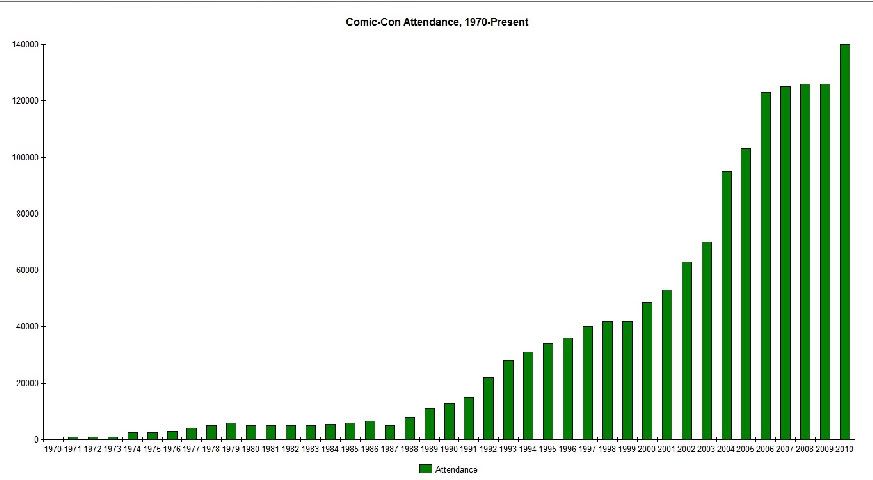
Photobucket
(CCI attendance 1970-present, Click to enlarge.)

The growth that the San Diego Comic-Con International has undergone since the Convention Center completed its first expansion in 2001 has been nothing short of mind-boggling. While you can correlate the growth to the expansion itself, keep in mind what else has exploded in popular culture: super-heroes and comic books have become Hollywood's darlings. True, Blade (1998) and the first X-Men film (2000) predated the explosion, but you can argue that 2002's Spider-Man truly broke the barrier and sent comics into that stratospheric next realm. Since then, Hollywood's optioned virtually every worthwhile comic book for a movie or TV show, and even some that are pretty worthless. And Hollywood took another look at this comic book convention that never attracted much of their attention before, and found they could gain a foothold and promote their comic-related projects. And their sci-fi projects. And their horror projects. And some other movies and shows that don't have a damn thing to do with comics? We'll throw them in there, too, and hope nobody notices.

Somewhere along the line, comics fell out of favor with Comic-Con, and the management of Comic-Con International decided they didn't really care so much. Sure, you'll find Marvel, DC, Image, and the other comic companies have a presence there, but they've been eclipsed by Warner Bros., New Line, Miramax, 20th Century Fox, Walt Disney, and various other movie studios. And yes, they draw the crowds and put the asses in the seats in the now-legendary Hall H. But is that really what Comic-Con is or should be about?

Now, the door was ajar for years. I've heard many stories about how some film craftspeople would use Comic-Con for their own personal soapbox, but never in the scope as in recent years. The last decade's worth of comic book movies has proven the catalyst for the Hollywood takeover of San Diego Comic-Con. And Comic-Con International (the company who runs the convention) seems all too happy to let Hollywood take over. Revenues have never been so good! Demand increases, prices for booth space go up, and CCI makes money hand over fist to spend on non-profit type stuff. It all comes out great for everyone, doesn't it?

I don't think it does. You see, there's also the flipside of the coin in so many ways. At first, the comics fans enjoy Hollywood as a presence because they're bringing to life their favorite heroes and related projects. Then you have the trickle of fans who come to Comic-Con because of the movies or TV they're seeing, and CCI maybe hoped that those fans would find something they enjoyed of what birthed those movies or TV shows. Only, that doesn't happen, or happens only rarely, and people continue to come for the popular media, the chance to touch Hollywood.

The convention floor now reflects this loss of ground from a primarily comics-centered event to one mainly devoted to Hollywood in its totality, nearly to the exclusion of the elements that founded the event. The comics pavilions have become smaller and smaller as New Hollywoodland is now the fulcrum about which Comic-Con revolves. Booth prices continue to rise meteorically, making it increasingly difficult, especially in the current economic climate, for the very same kinds of comics retailers who began the show to have any kind of presence there. I've had discussions on Twitter about this phenomenon, and the pro-San Diego faction stated something along the lines of, "Smart comics retailers find ways to cut their budgets to attend the convention, even splitting and/or sharing their spaces." (And this is if the space isn't already taken up by the studios.) I found those comments to be truly abhorrent. It's like living in the same place year after year, but when they put in those nice new spacious condos for the top one-half of one percent and property values up, you have to either move out, or start taking on boarders and give up what was previously your own space to "enjoy" your "home"--if you can either call it enjoyable or home anymore.

The dramatic increase in exposure for Comic-Con has translated to greater revenues for virtually all businesses in the area surrounding the Convention Center, including the various hotels at which the tens of thousands of visitors stay, plus the restaurants and other shops making up the Gaslamp Quarter and surrounding Downtown areas. The convention was estimated to bring in over $163 million in revenue to the city of San Diego in 2010. San Diego Mayor Jerry Sanders freely admitted in a cbs8.com article that "The convention center is a huge economic generator, but it could literally double that economic generation once we expand it," referring to the current plans to increase floor space by another 200,000 square feet in the next few years.

Can you see where I'm going with this? If not, here's a bit more. Per the San Diego Convention Center's website, no other event held at the locale even comes close to the annual attendance of Comic-Con. The event that comes closest according to their 18-month schedule is the "Rock 'n' Roll Marathon Health & Fitness Expo," at about 40,000 people--still not even a third of the crowd Comic-Con attracts annually. And I think to myself, this is the same Convention Center that has committed to the aforementioned expansion? Why else do they need the expansion if not to keep Comic-Con?

I might go so far as to suggest the city needs Comic-Con. With Hollywood largely driving it, and the huge revenues it currently provides only hinting at the even larger revenues that could be drawn from the upcoming Convention Center expansion, and the absolutely insane room rates that are part of that revenue stream, letting CCI take Comic-Con out of the city would be tantamount to dropping an economic bomb in Downtown San Diego. In different economic times, I'd really waffle on whether San Diego would let the convention go, but Comic-Con is that proven sure thing that the city can't do without. Simply put, San Diego Comic-Con has become akin to the big Wall Street banks you heard about the last two years. It's "Too big to move." And as in the banking world, I find this idea truly saddening, considering what the convention has become over the last decade.

So, how do we undo the damage Hollywood has done to Comic-Con? Assuming, of course, that it can be undone--and I'm not convinced at all this is a genie you can put back in the bottle. I think two things can level the playing field a fair bit, if CCI were to seriously consider them. Sadly, I don't think they would, because the demographic for Comic-Con is shifting into that which really wouldn't like the same kind of show that it was before the floodgates opened. Anything that could potentially upset the goldmine the city of San Diego has going is too radical an idea to be considered.

First, I think that the huge displays at Comic-Con, as extravagant as they are, must go. To maximize space and find room for as many retailers and craftspeople as can attend, there should be a limit as to the size of displays. Hollywood's booths are too huge, and they force out those who are just trying to get a corner booth, or some small space. Ten or more smaller booths can fit into just one of the larger studio booths! Bigger is not necessarily better (in fact, hardly ever!), and studios and other companies can most assuredly find better, more inventive ways to use the space they are given.

Second, I don't think it's enough to limit booth size. I think it's also worth apportioning space, which is done a bit with Artist's Alley (which is still too small!). It can be done gradually at first so it's barely noticed, but I think a nice balance can be struck between the different kinds of companies and individuals who attend Comic-Con. Imagine only so much space allocated to Hollywood's setups, so much given to comic companies, so much to small press, so much to Artist's Alley, so much to some specific kinds of vendors. I haven't heard of any such plan, and it would surprise me tremendously if it did exist. It would go a long way toward reversing the unfortunate trend of forcing those who don't have deep pockets (i.e. those who aren't major comic companies or movie studios) to the background or offsite entirely.

There are other options I've heard, each with their ups and downs. I know the idea of making the convention a week-long affair has been floated as a cost-managing or cost-recouping measure, and would allow more people to visit the show on a daily basis, but it would involve radically altering how special guests and talent attend the convention. There is also talk about extricating the "comics" part of Comic-Con from the popular media part and setting them months apart, which is a slippery slope, a prospect that suggests that the two can't rightly coexist.

Is Comic-Con as we knew it dead? It certainly is no longer the show Shel Dorf intended it to be when he organized the very first show in 1970, with Forrest J. Ackerman as its special guest, and a small handful of talent and attendees. It seems the show is stuck in San Diego, a town that will do just about whatever it has to do to keep it there and to keep or increase the extraordinary revenue stream it brings. It's gone mainstream, commercialist, "Hollywood," and the management seems locked into keeping it that way so long as they can shout CCI is a non-profit organization that proliferates the arts above everything else. To make changes--anything other than making the show bigger, making it "more"--would be admitting that somewhere in the intervening years, the show's purpose erred.

I'll be anxious to see what the new round of renovations to the San Diego Convention Center brings. Will the smaller retailers be given a new entry into Comic-Con, or will Hollywood gobble up the space as soon as it's made available? Will a bit of the old Comic-Con find its way back, or will it be pushed aside, buried forever, presuming it hasn't already been? At any rate, it's going to be interesting to see what CCI does over the next few years.

~G.