Today, I have a special treat for all my readers! Over at Jameson Lee's Daily P.O.P. website is my newest interview, with Silver Surfer writer GREG PAK! This one's been in development for a while, but it's well worth it. Not only will you see an in-depth look at Pak's love for the silver-skinned alien, but you'll also thrill to ALL-NEW EXCLUSIVE ART from the second issue by Harvey Tolibao!
Click on the picture above and go to the Daily P.O.P. now!
~G.
17.2.11
16.2.11
Down to Earth: Silver Surfer #1 - A Review
Big news! Very soon, you'll be thrilling to my brand-new interview with writer Greg Pak, who is busy up to his eyeballs in work, but not so much he couldn't chat it up with me about one of his many new projects. In the meantime, here's the review that's been, well, a few hours in the making, at least.

Silver Surfer #1
"Devolution"
Writer: Greg Pak
Artists: Stephen Segovia & Victor Olazaba
Colorist: Wil Quintana
Letterer: Dave Sharpe
Production: Mayela Gutierrez
Assistant Editor: John Denning
Editor: Mark Paniccia
Publisher: Marvel Comics
The Silver Surfer is one of Marvel Comics' most beloved heroes, rife with philosophical possibilities. After spending the first two decades of his creation marooned on Earth behind a barrier erected by his master, the planet-devouring Galactus, his adventures have spanned the cosmos entire. He's been a part of many crossover events, from Jim Starlin, George Perez and Ron Lim's Infinity Gauntlet (and its sequels, The Infinity War and The Infinity Crusade) to the Annihilation and Thanos Imperative series of more recent vintage. Most recently, he and his master helped save the whole universe from the Chaos King in Greg Pak, Fred Van Lente and Khoi Pham's epic Chaos War. In the aftermath, with Galactus depleted more than ever, the Surfer leaves him to heal in our Sun, and once more finds himself drawn toward the planet to which he'd previously been exiled. What surprises will await him there?
Having heard what an enormous Silver Surfer fan writer Greg Pak was, I'd been aching to see him land this gig for some time. It's telling that when Pak first started writing that other, emerald-green hero he so adores, the first big-name guest-star he brought in was the Surfer (in Incredible Hulk #95, and later again in Skaar, Son of Hulk #7-10). In addition, as the former owner of a huge Silver Surfer collection myself, well, I may be a bit more critical than most. I love the character and nothing would make me happier than to see him headline a new, regular series. But first, he must survive a trial--in more ways than one.
I'm quite pleased to say that upon first glance, Pak seems well-suited to telling tales of the alien Surfer. That's really what he is, too: an alien, an outsider, looking at humanity from another viewpoint, able to exist among them but never being one of them. Thanks to Galactus (and special kudos to Pak for bringing this point back to the surface), the Surfer is disconnected from the crippling emotions associated with leading his master to world after world upon which he would feed. He's also disconnected from humanity in that he does not possess our frailty, and in fact is possessed of incalculable power--power to rise above it all. Wisely, Pak involves the Surfer in a conflict between a young couple and a group of soldiers. The scene works to show the Surfer's benevolent personality even as Pak sets up the thrust of the entire arc with the arrival of a certain supervillain possessed of both amazing intellect and power. (And I don't have to tell you who it is if you've looked at the cover!) The Surfer and the villain have only met once before--back in the first Silver Surfer Annual--so it's going to be fascinating indeed how the two get on in future issues of this story. But if this issue's cliffhanger ending is any judge, I'd wager "not well."
Relative newcomer Stephen Segovia handles the art chores for this issue, and sadly I can't lavish nearly the number of compliments on his work. Although the few action scenes are frenetic with detail, the story falls apart in the quieter moments. Segovia's faces and figure work don't look nearly natural enough. The High Evolutionary's arrival late in the story is especially problematic, with the perspective and relative sizes of the other characters making him look absolutely gigantic. Most troublesome of all was the final page, which should look dramatic with its cliffhanger, but thanks to some strange anatomy it doesn't quite sell the mood Pak was likely hoping for. I do hope the artwork improves in future issues, and with the arrival of Harvey Tolibao to divide up the labor beginning next month, I believe it will.
So, what do we have in the latest first issue of the Silver Surfer? An intriguing start that rings true to the Surfer's world, brought to life with flourish by a creator who clearly loves the character. The art may not be perfect, but the story more than sells the book by itself. If you're a fan of cosmic-level superheroics, you could do a whole lot worse than checking out Greg Pak and Stephen Segovia's new adventure featuring the Sentinel of the Spaceways!
Silver Surfer #1 is now on sale at comic shops everywhere for the low, low price of $2.99 USD. To find a store near you, call 1-888-COMIC-BOOK or visit http://www.comicshoplocator.com.
~G.

Silver Surfer #1
"Devolution"
Writer: Greg Pak
Artists: Stephen Segovia & Victor Olazaba
Colorist: Wil Quintana
Letterer: Dave Sharpe
Production: Mayela Gutierrez
Assistant Editor: John Denning
Editor: Mark Paniccia
Publisher: Marvel Comics
The Silver Surfer is one of Marvel Comics' most beloved heroes, rife with philosophical possibilities. After spending the first two decades of his creation marooned on Earth behind a barrier erected by his master, the planet-devouring Galactus, his adventures have spanned the cosmos entire. He's been a part of many crossover events, from Jim Starlin, George Perez and Ron Lim's Infinity Gauntlet (and its sequels, The Infinity War and The Infinity Crusade) to the Annihilation and Thanos Imperative series of more recent vintage. Most recently, he and his master helped save the whole universe from the Chaos King in Greg Pak, Fred Van Lente and Khoi Pham's epic Chaos War. In the aftermath, with Galactus depleted more than ever, the Surfer leaves him to heal in our Sun, and once more finds himself drawn toward the planet to which he'd previously been exiled. What surprises will await him there?
Having heard what an enormous Silver Surfer fan writer Greg Pak was, I'd been aching to see him land this gig for some time. It's telling that when Pak first started writing that other, emerald-green hero he so adores, the first big-name guest-star he brought in was the Surfer (in Incredible Hulk #95, and later again in Skaar, Son of Hulk #7-10). In addition, as the former owner of a huge Silver Surfer collection myself, well, I may be a bit more critical than most. I love the character and nothing would make me happier than to see him headline a new, regular series. But first, he must survive a trial--in more ways than one.
I'm quite pleased to say that upon first glance, Pak seems well-suited to telling tales of the alien Surfer. That's really what he is, too: an alien, an outsider, looking at humanity from another viewpoint, able to exist among them but never being one of them. Thanks to Galactus (and special kudos to Pak for bringing this point back to the surface), the Surfer is disconnected from the crippling emotions associated with leading his master to world after world upon which he would feed. He's also disconnected from humanity in that he does not possess our frailty, and in fact is possessed of incalculable power--power to rise above it all. Wisely, Pak involves the Surfer in a conflict between a young couple and a group of soldiers. The scene works to show the Surfer's benevolent personality even as Pak sets up the thrust of the entire arc with the arrival of a certain supervillain possessed of both amazing intellect and power. (And I don't have to tell you who it is if you've looked at the cover!) The Surfer and the villain have only met once before--back in the first Silver Surfer Annual--so it's going to be fascinating indeed how the two get on in future issues of this story. But if this issue's cliffhanger ending is any judge, I'd wager "not well."
Relative newcomer Stephen Segovia handles the art chores for this issue, and sadly I can't lavish nearly the number of compliments on his work. Although the few action scenes are frenetic with detail, the story falls apart in the quieter moments. Segovia's faces and figure work don't look nearly natural enough. The High Evolutionary's arrival late in the story is especially problematic, with the perspective and relative sizes of the other characters making him look absolutely gigantic. Most troublesome of all was the final page, which should look dramatic with its cliffhanger, but thanks to some strange anatomy it doesn't quite sell the mood Pak was likely hoping for. I do hope the artwork improves in future issues, and with the arrival of Harvey Tolibao to divide up the labor beginning next month, I believe it will.
So, what do we have in the latest first issue of the Silver Surfer? An intriguing start that rings true to the Surfer's world, brought to life with flourish by a creator who clearly loves the character. The art may not be perfect, but the story more than sells the book by itself. If you're a fan of cosmic-level superheroics, you could do a whole lot worse than checking out Greg Pak and Stephen Segovia's new adventure featuring the Sentinel of the Spaceways!
Silver Surfer #1 is now on sale at comic shops everywhere for the low, low price of $2.99 USD. To find a store near you, call 1-888-COMIC-BOOK or visit http://www.comicshoplocator.com.
~G.
Breaking Rule #1 of Punisher Fans (Or, You Don't Talk About Franken-Castle)
I am not a Punisher fan.
At least, not in the traditional sense.
I don't expect the above statement to be a surprise to many of you, but I'll explain nonetheless. I enjoy my comic protagonists with a touch of the supernatural about them or their adventures, and with precious little exception, the Punisher has neither. To me, he's a guy with a huge arsenal, giving payback to criminals for killing his family, times a million. Oh, sure, I read a decent enough sampling of his stories to secure my opinion, from the Gerry Conway/Ross Andru Amazing Spider-Man stories that introduced him (as reprinted in Marvel Tales), to the Steven Grant/Mike Zeck limited series (reprinted in the short-lived B&W Marvel magazine), to the Mike Baron/Klaus Janson/Whilce Portacio regular series when I was a li'l comics fan. Of course, I've picked up "Welcome Back, Frank" and I've seen all three films. I even read the John Ostrander/Tom Lyle series from the mid-1990s. But really, the only times when I have truly enjoyed the character were when, well, he wasn't quite himself.
You Punisher fans out in the audience are rolling your eyes, right? You know what it means, and it doesn't start and end with Franken-Castle. It means I liked seeing Frank Castle shot full of too much melanin in the ridiculous "I Am Punisher (Black)" storyline (with apologies to Chris Sims and his blog for borrowing that title). It means when Marvel Knights started off with the Punisher committing suicide and being brought back to Earth as an angel with a gun, I was right there with bells on. (Please, Marvel trade department, if you're reading: it isn't too late to solicit a Premiere hardcover collecting both limited series featuring this pre-Ennis status quo!)
And I oh so loved the newest iteration of the Punisher in Franken-Castle, a fact for which I shall eternally curse the names of writer Rick Remender and his merry band of henchmen, er, artists, Tony Moore, Dan Brereton, Roland Boschi and Jefte Palo. (Okay, so I also have to give Dark Wolverine's Dan Way, Marjorie Liu, Stephen Segovia and Paco Diaz their due.)
When I first heard that the Punisher would be killed and brought back as a Frankenstein analogue, I had a good, hard belly laugh. Then I heard about how the Hood was bringing back all kinds of old bad guys to face Frank, and how Frank's wife and kids were brought back to life--right before he commanded one of those old bad guys, Firebrand, to "[t]orch 'em." It sounded so over-the-top, yet there were supernatural elements in play I couldn't resist. I pre-ordered all the "Dark Reign: The List" one-shots before this, but the Remender/Romita Jr. story sealed the deal in all its gory glory. There was just no way I wasn't ordering both the Dark Reign and Dead End collections, and then diving headlong into the monstrosity that was...well, you know.
The story is totally over-the-top in all the ways that count, and is truly all the better for it. You just know the shots of Daken hacking off Frank's body parts and kicking them over the side of a building would never have made it into a code-approved Marvel comic--heck, I'm not sure those images would have made it into any Marvel comic until recently. Yet here they are, and the story only gets more audacious from there. Frank gets stitched up by one of my favorite Marvel monsters, Morbius the Living Vampire (looking eerily emaciated, the truest weak spot in the book's otherwise terrific art design). He becomes as monstrous in appearance as others believe he is inside, learning as he begrudgingly becomes a protector for this legion of monsters under New York City that just because they may look like monsters, that doesn't mean they act like monsters. In particular, there's a touching moment in issue #12 between Frank and a little Moloid. (You can find an animated version of the sequence online, here.) What can I say, I'm a sucker for sentimentality.
Punisher Shorts from Kai Wang on Vimeo.
Along the journey, Rick Remender shows the breadth of his knowledge of monstrous things in the Marvel Universe, giving guest-shots not only to Morbius, but also Jack Russell, the Werewolf By Night; N'Kantu, the Living Mummy (from Supernatural Thrillers); the Manphibian (from the Legion of Monsters magazine); the Man-Thing; Vlad Dracula; and even some of the creatures from Monster Isle, including the Mole Man's creature off the cover to Fantastic Four #1. The monsters stand united against Captain Robert Hellsgaard, a 19th-Century man whose family had been turned by a werewolf. Hellsgaard had to kill his own family, but no one believed his reasons, so he went rogue, allying himself with the immortal monster hunter Ulysses Bloodstone until Dracula threw Hellsgaard into a portal to Limbo the hunter had created, ironically to send monsters there. Many decades later, Hellsgaard escaped and renewed his quest to rid the world of monsters by any means necessary. The hunter is in many ways an analogue to Frank himself and his attitude toward criminals. Thankfully, Frank doesn't see his current situation as black-and-white as Hellsgaard, and defeats him and his group of Japanese monster-killers, saving the Legion of Monsters nearly at the cost of his own life (again).
I don't want to spoil every surprise, so I'll just say that after the Hellsgaard story arc that runs in issues #11-16, Frank finds himself saved by the very same artifact Hellsgaard himself was after, the Bloodstone. The series returns to its crime roots, at the same time giving hints toward the future (or rather, the current Punisher arc, In the Blood). Of course, the storyline couldn't be complete without a rematch between Frank 2.0 and Daken, this time in a four-issue brawl that is well worth the price of admission. (Even if I think Daken really should have paid for what he did to Frank with his life, well, this is serial fiction, so he must live on. Boo.) The whole shebang concludes in a locale that is as remote as it is apt, in a one-off storyline with perhaps the best art of the entire arc. Dan Brereton of The Nocturnals fame does some incredibly rare Marvel work here, and together with his brief work on the origin of Hellsgaard in #14, it's just a revelation seeing him work. (Another note to Marvel: Brereton. Hulk. Now. Thanks.) The storyline ends doing something miraculous for the Frank Castle character, quite literally revitalizing him for a new generation. Those who wonder how a guy whose early life and origin is pretty firmly rooted in the Vietnam War can be as spry as Frank and can challenge the mobsters and super-villains he does, well, question henceforth answered.
So, those who like the Punisher? If you're a fan of the gritty realism that has become the character's trademark, you probably hate this storyline as much as, if not more than, Chris Golden and Tom Sniegoski's Angel Punisher arcs. If you like Frank Castle's core personality and are interested in how he adapts to an admittedly macabre situation, then this book might pique your interest. If you're like me and enjoy monsters of all sorts, and love when beloved characters are thrown in a blender and given a good, albeit temporary shake-up, you'll probably find Franken-Castle too good to pass up.
Punisher: Franken-Castle is now available in oversize hardcover from Marvel Comics. The softcover edition will be available April 27th, but why wait? Treat yourself. It's only five bucks more.
And for what it's worth, seeing that shiny new status quo at the end of this story makes me want to buy Punisher: In the Blood when the collected edition finally hits. Damn you, Remender. Damn you to...someplace warm and cozy,
~G.
10.2.11
Cracking the Internet in Half, Inside Out, Upside Down & Sideways: Incredible Hulks #622, Reviewed
Have I been blogging entirely too much? It's crazy that I actually have to shuffle things around and prioritize what I want to talk about. I love talking comics, although certainly other non-comics things are on their way. (What, you think I put that new image at the top of the blog for my health?) The Hulk, however, remains my bread and butter, so now, without further ado, my review of an issue which has ignited the fires in many a Hulk fan's breast (and yes, the fact "fan" is really short for "fanatic" is something I'm especially aware of granted the responses I've seen).

The Incredible Hulks #622
"God Smash," Conclusion
Writer: Greg Pak
Artists: Paul Pelletier, Danny Miki & Crimelab Studios
Colorist: Paul Mounts
Letterer: Simon Bowland
Production: Irene Lee
Assistant Editor: Jordan D. White
Editor: Mark Paniccia
Publisher: Marvel Comics
Well, here it is! The moment you've all been waiting for! In order to make perceived wrongs right, the Hulk takes the fight to the newly-reborn Greek Pantheon of gods. And because the Hulk is The Strongest One There Is, he won't be denied, and during a truly epic battle he pummels the Skyfather himself, Zeus, finally making him accede to his wishes. Zeus decides to see things the Hulk's way, returning Rick to human form and curing Betty of the insanity that afflicts her as Red She-Hulk. The only catch is he's cursed to be the Hulk forever. Bruce Banner exists no more.
I totally had you up to that heartbreaking idea of a cliffhanger, didn't I? Then again, if the story really did go anything like the above summary, Hulk fans wouldn't be in the middle of a Hulk-sized hissy fit, and Thor fans wouldn't be gloating like crazy while proclaiming their guy has better showings against higher gods. And yet, to this reader, the way the story went is pretty much the only way it could.
Writer Greg Pak took a lot of flak from much of the Marvel fanbase during World War Hulk, where many saw the Hulk and his Warbound companions' victories over various heroes as the result of "jobbing," which is to say Hulk & co. are made to look good at the expense of more skilled (which is to say, more popular) characters. Interviews, including those taken by this very blogger, indicate Pak certainly has a high opinion of the Hulk. He's loved the character for years and certainly knows his way around his history, with repeated references to Jarella and other oft-ignored bits of Hulkish trivia.
Pitting the Hulk against the Skyfather Zeus in this story, then, tests Pak's mettle as a true storyteller, as well as puts him between the proverbial rock and a hard place--at least, among fans who care about who's strongest and who can beat the excrement out of whom. If the Hulk beats Zeus, then, holy crap, the Hulk really must be the strongest one there is, and every other superhero out there can suck it. On the other hand, if the Hulk is beaten by Zeus, then there is just no justice in the world, and every Hulk fan assembled should scream bloody murder and call for the immediate replacement of Pak as Hulk writer, because that's not the way we roll.
Yeah, that was sarcasm. Could you tell?
The Hulk and Banner foolishly expect that Zeus would just grant them a boon, but Zeus has never been the most levelheaded of gods. He remembers their previous encounter (and say, is this book one of the only ones to use starred references to other issues anymore?) and decides to show the Hulk a lesson he won't soon forget. The battle that follows is brutal and bloody with a predestined end reminiscent of Peter David's Hulk: The End. Although engaging Zeus in battle, make no mistake: this Hulk would die if it meant happier times for his family. Unfortunately, the world doesn't work in such simplistic terms.
The story this outing works better than in the previous chapter in spite of the preordained outcome. Although many will argue the point, the Hulk just isn't in the same league as Zeus and shouldn't be treated as such. The Hulk's simplistic desires clash with Zeus' equally simplistic view of humanity, and both parties really come away as losers when the dust clears. Pak's script makes these developments clear, and to me at least, it's a relief that the winner wasn't the guy whose name is on the front of the book.
As strong as the ideas behind the story are sound, it's the art that is a small letdown this issue, and once again, just like in "Dark Son," I'm afraid I can only blame the stepped-up twice-a-month schedule of the book. Although Paul Pelletier's pencils are always a joy to see, and Danny Miki usually delivers some great inkwork, this issue's artwork seemed rushed in both line and color. Thankfully, the pages that needed the strongest visual "punch"--those showcasing the Hulk's battle with Zeus--are spot-on, but most of the rest, particularly the pages featuring the Hulk's family and their coming to his rescue, are lackluster. I hope to see a stronger effort next time we see Pelletier and Miki on board, whenever that may be. Perhaps shorter stints by the artists in question, or more lead time between arcs, would improve the finished product.
So, the psychological journey of the Hulk with his awesome responsibilities to his family continues. While not delivering a home run, Greg Pak and Paul Pelletier, et al, nonetheless provide another solid story arc with "God Smash." The Hulk must take the thornier path to salvation for his family after finding that he couldn't just punch and hit those more powerful than he into submission. I admit, I'm quite anxious to see what the humbled Hulk's next move will be, especially considering what metaphorical chickens are coming home to roost in this issue's epilogue that paves the way for the next arc, "Planet Savage."
A note in closing: I really must thank Marvel Comics this month, as for the first time since Christmas 2008, there's a Hulk book on the stands for $2.99USD. The backup stories may be gone, but I for one won't miss them. We're eight pages lighter, and the dollar back in our collective pockets is greatly appreciated. I hear Jeff Parker's Hulk series is next starting with issue #30.1 in March. I hope this confidence is reflected in forthcoming sales figures. (But, hey, how about a little advertising, Marvel? DC has their "Holding the Line" promotion. Put something big on the cover. Something!)
In two weeks: Welcome, Dale Eaglesham.
~G.

The Incredible Hulks #622
"God Smash," Conclusion
Writer: Greg Pak
Artists: Paul Pelletier, Danny Miki & Crimelab Studios
Colorist: Paul Mounts
Letterer: Simon Bowland
Production: Irene Lee
Assistant Editor: Jordan D. White
Editor: Mark Paniccia
Publisher: Marvel Comics
Well, here it is! The moment you've all been waiting for! In order to make perceived wrongs right, the Hulk takes the fight to the newly-reborn Greek Pantheon of gods. And because the Hulk is The Strongest One There Is, he won't be denied, and during a truly epic battle he pummels the Skyfather himself, Zeus, finally making him accede to his wishes. Zeus decides to see things the Hulk's way, returning Rick to human form and curing Betty of the insanity that afflicts her as Red She-Hulk. The only catch is he's cursed to be the Hulk forever. Bruce Banner exists no more.
I totally had you up to that heartbreaking idea of a cliffhanger, didn't I? Then again, if the story really did go anything like the above summary, Hulk fans wouldn't be in the middle of a Hulk-sized hissy fit, and Thor fans wouldn't be gloating like crazy while proclaiming their guy has better showings against higher gods. And yet, to this reader, the way the story went is pretty much the only way it could.
Writer Greg Pak took a lot of flak from much of the Marvel fanbase during World War Hulk, where many saw the Hulk and his Warbound companions' victories over various heroes as the result of "jobbing," which is to say Hulk & co. are made to look good at the expense of more skilled (which is to say, more popular) characters. Interviews, including those taken by this very blogger, indicate Pak certainly has a high opinion of the Hulk. He's loved the character for years and certainly knows his way around his history, with repeated references to Jarella and other oft-ignored bits of Hulkish trivia.
Pitting the Hulk against the Skyfather Zeus in this story, then, tests Pak's mettle as a true storyteller, as well as puts him between the proverbial rock and a hard place--at least, among fans who care about who's strongest and who can beat the excrement out of whom. If the Hulk beats Zeus, then, holy crap, the Hulk really must be the strongest one there is, and every other superhero out there can suck it. On the other hand, if the Hulk is beaten by Zeus, then there is just no justice in the world, and every Hulk fan assembled should scream bloody murder and call for the immediate replacement of Pak as Hulk writer, because that's not the way we roll.
Yeah, that was sarcasm. Could you tell?
The Hulk and Banner foolishly expect that Zeus would just grant them a boon, but Zeus has never been the most levelheaded of gods. He remembers their previous encounter (and say, is this book one of the only ones to use starred references to other issues anymore?) and decides to show the Hulk a lesson he won't soon forget. The battle that follows is brutal and bloody with a predestined end reminiscent of Peter David's Hulk: The End. Although engaging Zeus in battle, make no mistake: this Hulk would die if it meant happier times for his family. Unfortunately, the world doesn't work in such simplistic terms.
The story this outing works better than in the previous chapter in spite of the preordained outcome. Although many will argue the point, the Hulk just isn't in the same league as Zeus and shouldn't be treated as such. The Hulk's simplistic desires clash with Zeus' equally simplistic view of humanity, and both parties really come away as losers when the dust clears. Pak's script makes these developments clear, and to me at least, it's a relief that the winner wasn't the guy whose name is on the front of the book.
As strong as the ideas behind the story are sound, it's the art that is a small letdown this issue, and once again, just like in "Dark Son," I'm afraid I can only blame the stepped-up twice-a-month schedule of the book. Although Paul Pelletier's pencils are always a joy to see, and Danny Miki usually delivers some great inkwork, this issue's artwork seemed rushed in both line and color. Thankfully, the pages that needed the strongest visual "punch"--those showcasing the Hulk's battle with Zeus--are spot-on, but most of the rest, particularly the pages featuring the Hulk's family and their coming to his rescue, are lackluster. I hope to see a stronger effort next time we see Pelletier and Miki on board, whenever that may be. Perhaps shorter stints by the artists in question, or more lead time between arcs, would improve the finished product.
So, the psychological journey of the Hulk with his awesome responsibilities to his family continues. While not delivering a home run, Greg Pak and Paul Pelletier, et al, nonetheless provide another solid story arc with "God Smash." The Hulk must take the thornier path to salvation for his family after finding that he couldn't just punch and hit those more powerful than he into submission. I admit, I'm quite anxious to see what the humbled Hulk's next move will be, especially considering what metaphorical chickens are coming home to roost in this issue's epilogue that paves the way for the next arc, "Planet Savage."
A note in closing: I really must thank Marvel Comics this month, as for the first time since Christmas 2008, there's a Hulk book on the stands for $2.99USD. The backup stories may be gone, but I for one won't miss them. We're eight pages lighter, and the dollar back in our collective pockets is greatly appreciated. I hear Jeff Parker's Hulk series is next starting with issue #30.1 in March. I hope this confidence is reflected in forthcoming sales figures. (But, hey, how about a little advertising, Marvel? DC has their "Holding the Line" promotion. Put something big on the cover. Something!)
In two weeks: Welcome, Dale Eaglesham.
~G.
The Ever-Changing Lyra, Daughter of Hulk! (Among Other Things, a SHE-HULKS Review)
![]() |
| Hulk & Thundra in the shadow of their daughter, from All-New Savage She-Hulk. Art by Alex Garner. |
Unfortunately, with the market being what it is ("unhealthy" is a bit of an understatement--sort of like all of print media) the line is due for contraction. The first casualty in these matters appears to be Lyra, the Hulk's daughter from a future timeline. Since her introduction in Hulk: Raging Thunder, where the Hulk first met Thundra and she scraped his cheek for DNA, she's been featured prominently in no less than three limited series of no more than four issues apiece. She's had some jarring status quo changes, and now it appears, barring a real outpouring of fan support, she'll be relegated to Greg Pak's Incredible Hulks series (not that it's a bad place, necessarily), if not altogether forgotten. But is it a real shame to see Lyra's star falling, or is it more a mercy killing? Before fandom en masse attacks me for that last comment, let's examine her brief history:
Hulk: Raging Thunder - Hulk, as we know, is Marvel's original man-monster, "the strongest one there is." This fact attracts Thundra, a warrior-woman from a future matriarchal society. In her era, men and women live separately and war with each other. The men are sterile from radiation exposure, and both sexes only survive through human parthenogenesis. Thundra travels to our present with the intent of conceiving an heir. Only one born of superior stock, she rationalizes, can have a hope of succeeding her when she grows too old to ably serve the United Sisterhood Republic. This means a fundamental change from the last several generations, in that her daughter will have both a mother and a father.
In the back of the All-New Savage She-Hulk #1, writer Jeff Parker mentions that it was his original intention to have the Hulk and Thundra actually sleep together to create Lyra, but that this idea got "downgraded to scraping cells from [the Hulk's] cheek." Page twenty, without the dialogue in later panels, can even be interpreted with the former explanation. True, the change could have come because editors thought Thundra wouldn't "sully herself" by direct contact (even though, in main continuity, Thundra had been involved with Arkon, if indeed this was not a divergent Thundra). It's more likely the decision had something to do with Jeph Loeb's Ultimate Hulk Annual, in which the Ultimate universe's Hulk slept with the Squadron Supreme's Zarda.
![]() |
| The first appearance of the then-unnamed Lyra, from Hulk: Raging Thunder #1. |
"Daughter of Hulk" (from Hulk Family) - This brief vignette by Paul Tobin and Benton Jew showcases the again-unnamed Lyra in battle alongside her friend Nella, and explores the world of the men of the 23rd Century via Lyra's infiltration of one of their parthenogenesis facilities. The story also reinforces the dynamic that Lyra is different from her sisters in that she is the only one with a father. Just as she can be seen then as the inverse of a messianic figure, she can also then be seen as a devil of sorts, corrupted by the male species by virtue of her lineage. This story paves the way for what follows...
All-New Savage She-Hulk - After two stories, it's finally in the third story that writer Fred Van Lente gives our heroine a name. In the back pages of the first issue, Van Lente attributes the name to the protagonist in the 1971 story "The Femizons" from Savage Tales #1 by Stan Lee and John Romita Sr. He dramatically shifts the narrative of the Daughter of Hulk for the first time (but not the last) by having her follow her mother's path, time-traveling to "our" present during Marvel's "Dark Reign" umbrella event, wherein Norman Osborn rose to power and oversaw many security initatives like H.A.M.M.E.R. and A.R.M.O.R. The latter agency, the Alternate Reality Monitoring and Operational Response Agency, tracks Lyra's arrival on Earth-616 from Earth-9008. She abducts A.R.M.O.R. agent Alex Erde to use as a field guide on her mission to look for the time period's greatest hero, but soon encounters resistance in Jennifer Walters, the first She-Hulk, as well as Norman Osborn's officially sanctioned team, the Dark Avengers.
Van Lente makes some interesting alterations to Lyra beyond giving her a name, and the art, primarily by Peter Vale and Robert Atkins, provides the best vision of Lyra to date. She is charged with a mission by the Gynosure, ruler of Milago, to bring back technology that will allow them to again use the Cradle, the device that enables the parthenogenic processes that enable them to birth more women. To this end she is armed with Boudicca, an artificial intelligence she wears on her wrist like a watch. (Boudicca's commentary very often steals the show. It's a shame she's not still around...but I'm getting ahead of myself.) He also gives Lyra a weakness in, ironically enough, her anger, as the angrier Lyra becomes, the weaker she gets. Conversely, he also gives her "gamma vision," where she goes into a Zen-like trance and harnesses the gamma energy around her to perform superhuman feats.
![]() |
| Too much tongue? Lyra kisses Osborn, from All-New Savage She-Hulk #3. |
A few more Van Lente-penned adventures of Lyra appear in back-up stories in Greg Pak's Incredible Hulk series from #600 through 605. In them, Lyra encounters the fruits of her meeting with Osborn, as he used her information about the future to set up the Origins Corporation, chaired by the Hulk's foe General Ryker and specializing in commoditizing superhuman powers. While trying to find the missing Jennifer Walters, she and Alex Erde are attacked by women with the powers of Zzzax, the Abomination, and the Glob. (This marks the fourth such woman imbued with the Abomination's powers--but that's a tale for another article!) Erde's unrequited love is cut short as Axon (the Zzzax analogue) causes the crash that leads to his death. Lyra swears revenge and kills two of the three women, while after her failure, Ryker gives the kill order for the third. She appears to be coming into her own as a She-Hulk, but that's before she's brought into the...
![]() |
| Lyra, from Fall of the Hulks: Savage She-Hulks #1 by Jelena Kevic Djurdjevic. |
![]() |
| The Human Torch gets a fiery green eyeful. From Hulk #19, art by Ed McGuinness & Mark Farmer. |
Lyra loses her companion Boudicca, destroying it (her?) to prove her loyalty to the Intelligencia, but its central processing unit is restarted remotely by Bruce Banner, who for the first time makes contact with his daughter (after learning about her in Fall of the Hulks: Red Hulk #1-2, also by Parker). During the siege of the Intelligencia's Hellcarrier, she makes a three-panel cameo in Incredible Hulk #608, meeting her half-brother Skaar (to whom she refers as "little brother") before Banner blasts her up "at least four levels" to rescue Jennifer. Jen accosts her over her opinion that Thundra "ran away" from her and hid in the 21st Century, confronting her with the truth that she nearly jeopardized her chances of being born. She also tells Lyra that, once the battles are finished, she will show her "what a normal life is supposed to be...and how wonderful it is," the earliest allusion to the upcoming She-Hulks series. After uniting with the Red She-Hulk, the three of them fight the legions of AIMarines-turned-Hulks as well as the Hulked-out heroes. Lyra records a message on the barely-functioning Boudicca and leaves it for Thundra to find in the future, telling her mother she is the greatest woman she has known.
![]() |
| The four-issue She-Hulks limited series, with covers by Ed McGuinness. |
I'm going to loosely state, although I have no independent confirmation, that Lyra's supposed to be roughly sixteen years old during this series. The de-aging of Lyra to high school age creates some interesting problems in her treatment under previous writers, certainly--chief among them that whole "search for the greatest hero of the 21st Century so we can procure his seed, and oh, wait, I'm totally ovulating" storyline, which in revision nearly reaches a "Gwen Stacy in 'Sins Past'" level of yuck. That goes double for Johnny Storm, who burned Lyra's clothes off and then made juvenile comments while she was in the buff. These are the two most irritating examples, although there's certainly also the Stockholm Syndrome-esque developments between Alex Erde and Lyra in Incredible Hulk #601, all of which add up to the conclusion that Lyra wasn't originally intended to be, for want of a better term, Teen She-Hulk.
![]() |
| Mourning that perfect prom dress? Art by Ryan Stegman & Michael Babinski. |
Lyra has been stripped of much of the accoutrement she had since her first appearance, as well as much of the rest of what defined her in those earlier stories, right up to Fall of the Hulks: Savage She-Hulks. Her military bearing, which should be obvious as having grown up around Thundra and her soldiers, is almost wholly absent, as is her complex attitude toward the opposite sex from being raised in a society where men and women are literally at war. Furthermore, thanks to S.P.I.N. Tech (Super-Power Inhibiting Nanobots), Lyra no longer grows weaker when she gets angry, and she now has a smaller, pink-skinned form invented just for this narrative. The onslaught of changes made to Lyra in such a short time really makes it apparent that the powers-that-be don't really know what to do with her character. Here, it's like Wilcox took that aforementioned idea of "Teen She-Hulk," partnered her up with Jen Walters, and then sparsely fit bits of Lyra's prior history in the narrative where they could fit. The Lyra of She-Hulks bears little, if any, resemblance to all of her earlier appearances.
The dynamic of She-Hulks again really reads like, well, exactly what you'd think a series about a Teen She-Hulk would. Lyra is largely the center of the narrative, as we follow her time in school, her being coached by Jen, and the talks between Bruce Banner and Jen about her. Jen acts as an aunt of sorts to young Lyra, having her attend high school at Bruce Banner's urgings. (See? That pink-skinned form comes in handy!) The two of them live in a sweet Manhattan apartment, and Bruce has charged them with capturing the remaining free members of the Intelligencia, solving some very important loose ends from the "World War Hulks" story. In fact, Bruce Banner and the Hulk have a substantial supporting role in the series, headquartered at Gamma Base and using funds from the Olympus Group to finance the women's missions. The base also houses a detention facility where the villains are held once the She-Hulks capture them.
The book's lighter tone aids in Lyra's likability, and she certainly needed some lightening up in the wake of, let's face it, some rather dark showings in her first dozen appearances. (Often the Boudicca unit served as comic relief in the earlier series, as counterpoint to Lyra's "straight woman.") You might be thinking, "Having been transported to this new time period where she isn't surrounded by all the war and gender politics, why wouldn't Lyra lighten up?" It's a fair point, and one I'm sure the creators had in mind when developing this series. The original point of creating a second She-Hulk seemed to be making her different from the original, who had become something of a punchline in the Marvel Universe, with no one able to remove her from John Byrne's intimidating shadow. It becomes obvious why Lyra began as a warrior-woman. Apparently that paradigm didn't quite mesh, because now Lyra has lightened up and become absorbed into the first She-Hulk's world--humor, girl talk, boys and all. Again, quite literally, she's Teen She-Hulk, "Jen's li'l sis."
![]() |
| You're not the only one, Lyra. Art by Stegman & Babinski. |
And I hate it. And I love it.
I didn't mean to suggest that the Wilcox/Stegman series isn't any good. It's actually an intensely pleasurable read if taken out of context of Lyra's earlier appearances. Yes, I know I spent six paragraphs disparaging the changes made to Lyra in this four-issue limited series, but it works and I can't explain why. She-Hulks is just a fun ride. Harrison Wilcox writes a fun interplay between Jennifer and Lyra, and his Bruce Banner and Hulk are on point. In addition, he's nailed the voices for all the villains. True, the final issue features an abrupt, forced message about tolerance and fearing that which people don't understand that seems more at home in an X-Men book than a Hulk one. Overall, Wilcox hits more than he misses.
Furthermore, if one creator had a real "breakout moment" in this series, it must be Ryan Stegman. The man needs a high-profile gig, as his work here with inker Michael Babinski is just tremendous. He's grown by Hulk-sized leaps and bounds since working on the aforementioned Red She-Hulk backup stories. I mean, take a look at this:
![]() |
| Yes, I want to buy this page and frame it. Alas, a blogger's salary...! Stegman & Babinski FTW! |
This was only page two of the first issue, and the piece shows that Stegman just gets it. His pages are clear and action-packed. If he wasn't having fun drawing all four issues, he certainly fooled me. The fun factor comes through on nearly every page. Wilcox's script is filled with "big" moments and every time he's asked, Stegman delivers, whether it's the Hulk catching the She-Hulks' Gamma Jet, or the She-Hulks fleeing an avalanche, or fighting the Wizard in an awesome double-page spread filled with bikini-clad women. His facial expressions are a delight, as well. In short, Stegman's fun, energetic, and expressive style fits the She-Hulks to a T, and I'd really love to see him on another project--whether it be more She-Hulks or something else--in the not-too-distant future.
What are the chances of seeing a second volume of She-Hulks? I can see Marvel's cautiousness in this volatile market, in wondering if this series would truly find an audience. Initially solicited as an ongoing series, evidently orders weren't as high as Marvel had hoped, and news broke on Diamond's weekly shipping list that the book had been changed to four issues. (It wasn't until the last issue was solicited in Marvel Previews that the company publicly acknowledged the series was scaled back.) It didn't help that the first issue was priced at $3.99 (although subsequent issues were all $2.99). The backdoor cancellation announcement probably doomed the series in retailers' eyes, although luckily for fans, only the last issue showed any hint that the book was in fact a limited series. (Why luckily? Fans who don't read solicitations likely thought the series was ongoing, and somewhere in my messed-up mind, I like to think fans wanted to settle in for a long haul.) Sadly, the book received anemic pre-orders, with only 18,616 copies of the first issue distributed according to Diamond. Subsequent sales figures confirm that the series only fell from there, with a 21% drop in December, and another 12% in January, where orders were at an abysmal 12,926 copies. We can only hope that the book sells out at the retailer level, and the inevitable trade paperback collection is heavily ordered, otherwise we may never see another Hulk-based series that's this fun. Or, more likely, we'll see yet another revision of Lyra, and probably Jen Walters as well...again, not as fun.
After my initial resistance to the core concept of She-Hulks, I have to say I greatly enjoyed the finished product and hope more adventures of Lyra and Jen are on the horizon. It's a case of so-so ideas with incredible execution. However, it's going to take more than Jen's magic cure-all, a cup of hot cocoa, to get this duo to see another day...
![]() |
| Hot cocoa can cure a lot, but can it get us She-Hulks volume 2? More Stegman & Babinski. |
'Nuff said,
~G.
From the Marvel Vault: Dr. Strange!
![]() |
| Original art from Doctor Strange: From the Marvel Vault #1 by Neil Vokes & Jay Geldhof. |
The story by Roger Stern (with plot assist by Joe Edkin) is a real hoot, telling all about how Doc first found the spooky old house that would become his Sanctum Sanctorum at 177A Bleecker Street in Greenwich Village. (In reality, the address was that of an apartment shared in the 1960s by Marvel alums Roy Thomas and Gary Friedrich.) No self-respecting Doc fan should be without it. Pick it up today!
![]() |
| Cover by Mario Alberti. |
~G.
8.2.11
Apropos of nothing, some changes around here!
Howdy gang!
If you're visiting this site today, February 8th, or anytime thereafter, you're going to notice some changes around here--and what you see up on top of the page is just the beginning! At the risk of injury from patting myself on the back, the above graphic comes courtesy of yours truly. I thought it was time for a nice, dynamic logo instead of straight text. I think it says what this site is about rather ably, how about you? And yes, before you ask: the books, CDs, DVDs, comics--they're all mine. Every last one. I'm thinking of holding some kind of contest to give something really nifty to anybody who can identify every item in my new logo picture. Well, start those guesses rolling in, if you like. Meanwhile, hey, there's popular culture to be discussed! Onward!
~G.
If you're visiting this site today, February 8th, or anytime thereafter, you're going to notice some changes around here--and what you see up on top of the page is just the beginning! At the risk of injury from patting myself on the back, the above graphic comes courtesy of yours truly. I thought it was time for a nice, dynamic logo instead of straight text. I think it says what this site is about rather ably, how about you? And yes, before you ask: the books, CDs, DVDs, comics--they're all mine. Every last one. I'm thinking of holding some kind of contest to give something really nifty to anybody who can identify every item in my new logo picture. Well, start those guesses rolling in, if you like. Meanwhile, hey, there's popular culture to be discussed! Onward!
~G.
6.2.11
Captain. Frickin'. A.
'Nuff said.
Chris Evans IS Captain America.
Oh, and while you guys are at it: go to Marvel's website and download a FREE Captain America web comic by Fred Van Lente, Luke Ross & Richard Isanove!
~G.
Partying With The No-Longer-Incredible Herc: An Interview With Writer Fred Van Lente
Friends,
Today's bloggy goodness can be found at Jameson Lee's Daily P.O.P., an interview with Herc co-writer Fred Van Lente. Click the picture above or the link here!
Thanks for posting, Jameson! Everyone, enjoy!
~G.
Today's bloggy goodness can be found at Jameson Lee's Daily P.O.P., an interview with Herc co-writer Fred Van Lente. Click the picture above or the link here!
Thanks for posting, Jameson! Everyone, enjoy!
~G.
4.2.11
Scorched Earth: A Redemptive Moment for Red Hulk (HULK #26-29 4-in-1 Review)
Well, now, another day, and another promise from my list of New Year's Resolutions to fulfill. I must admit, in all the twice-a-month Incredible Hulks hoopla, I've been remiss in reviewing that other Hulk book that's been haunting the newssstands--you know, the one that, up until lately, had been Jeph Loeb and Ed McGuinness' personal toybox for all their Hulkish ideas and which had introduced the Red Hulk to the comic buying public. Well, as I reported before I went to New York Comic-Con, writer Jeff Parker, artist Gabriel Hardman, and colorista Bettie Breitweiser have lent their considerable talents to the Red Hulk's book upon Loeb & McGuinness' departure. A few months later, here I am finally reviewing the first story arc. Hopefully I'll bring to the fore some things you didn't see on the first pass.
(Note: I did review the first issue by the new creative team, Hulk #25, and you can find that review here. This entry, then, will briefly recap that issue but mainly focus on issues #26-29.)
Artists: Gabriel Hardman, Mark Robinson, Ben Oliver & Terry Pallot
Colorists: Bettie Breitweiser, Jim Charalampidis, Antonio Fabela & Frank Martin
Letterer: Ed Dukeshire
Production: Irene Lee
Associate Editors: Nathan Cosby & Jordan D. White
Editor: Mark Paniccia
Publisher: Marvel Comics
Alas, the first arc of the Parker/Hardman/Breitweiser Hulk era is finished. One arc into the Loeb/McGuinness run, people were upset about Red Hulk beating up all their favorite heroes, and upset because they didn't learn his real identity at the conclusion of that sixth story. So what's the dirt on this arc, "Scorched Earth"? I'm loath to admit at the risk of shooting my wad too early, but Hulk under the new team perfectly captures the old-school feel of the best Hulk epics of yesteryear while giving a modern spin. While showing echoes of Banner and the green Hulk, "Thunderbolt" Ross is his own monster, with his own methods, and in some ways, the book outperforms Greg Pak's companion title.
I know you want me to put my money where my mouth is, because granted, that's a pretty bold statement to make. I'll start with the fact that "Scorched Earth" is the most direct epilogue to the events of the last six months' worth of Hulk stories. The premise here is elegantly simple, in that M.O.D.O.K. and the Leader set in motion a "doomsday scenario," aptly titled "Scorched Earth," in case they were captured or killed during "World War Hulks." While Bruce Banner works from the converted former A.I.M. outpost at Gamma Base to isolate and stop the ongoing attacks, he and Steve Rogers send Ross on related missions alongside some of Earth's most powerful heroes. In the back-up tales throughout #25-27, Banner also sends his best friend Rick Jones, a.k.a. A-Bomb, on a mission which dovetails with the main storyline and leads to its inevitable conclusion.
While the storyline starts off as little more than an apparent means of having all the heroes Red Hulk beat throughout his run take their revenge shots, thankfully it proves to be more than that under writer Jeff Parker's capable hands. To be fair, the hero-versus-hero fights became formulaic by the time Namor cornered the Red Hulk deep under the sea at the end of issue #27. (In spite of the formula, the Red Hulk vs. Thor fight in issue #26 was a definite highlight, made better still by Thor's admission to Banner after its climax.) Parker wisely shifts focus for the last two parts of the storyline, unifying the story with the A-Bomb back-ups. The obligatory fight between Red Hulk and A-Bomb feels less like another revenge beating because, simply, it's not, instead relying on another tried-and-true trope, namely mind control. Again, the fight doesn't last long, but it leaves Red Hulk overheated and changing back to Ross. Hence we transition to the final conflict, wherein a big secret about the Red Hulk's powers is revealed.
I've had a bit of an argument with Ratchet from his Hulk Collection blog about the turn that occurred in the last issue (SPOILER goggles on for this paragraph!) It's first hinted at when, as soon as the Hulk appears on Monster Isle, Ross is able to overcome his weakness and immediately change back to the Red Hulk. The Hulk reveals that Banner lied to Ross, and that he never lost his energy-absorbing abilities. Later in the story, when confronted with his betrayal, Banner admits the lie but states he did it to save Ross. Parker smartly sets up a likely hook for an eventual Red Hulk power-down because if Ross continues to use those energy absorption abilities, he risks losing one of his two forms--and Banner doesn't know which one it will be. Now, whereas my fellow blogger thinks this development is awfully convenient, I'm of the mind that it's very smart, taking the decision that had in #25 been out of Ross' hands and putting it squarely back in them. Each time he uses that power that differentiates him from the original Hulk, he risks either being trapped as man or monster forever. Conceptually it is sound, and certainly makes more sense than saying Banner suddenly learned how to perform brain surgery overnight. Consequently, it does make Betty Banner's situation as Red She-Hulk more interesting if these same elements are indeed in play over in Pak's Incredible Hulks in months to come.
Along the way, "Scorched Earth" has differentiated Ross' Hulk from Banner's in a few key ways, and yet interestingly, as remnant of Loeb's conclusion, moved him toward a "Bizarro" version of the Hulk from the 1970s TV show. This Hulk is a military genius, a tactician, who analyzes his foes' behaviors. He also not only convinces Banner to interrogate Sam Sterns, the former Leader, and George Tarleton, the former M.O.D.O.K., to find out what they may know about how to shut down the initiative, believing that regardless of what they may consciously know (which is essentially nothing), they may--and do--give subconscious clues. Ross' Hulk is an ironic twist on a secret agent, a big crimson goliath who's easily spotted, who is Steve Rogers' trump card because of his military background. The world believes Ross dead, just like David Banner in the aforementioned TV program, whose creator Ken Johnson's ruminations likely led to the development of a red-skinned Hulk in the first place. The only way he can make amends is through being the Red Hulk, and ironically, in #30.1 that will bring him into conflict with another army general who will be after him because he believes he killed Ross. (Holy echoes of Jack McGee!)
I've been going on and on about the story and the subtle nuances amid the bombast that I nearly forgot to mention the tremendous artistic talents of both Gabriel Hardman, whom I had the pleasure of meeting in New York in October, and Bettie Breitweiser. Yes, Gabe's artwork is a 180-degree turn from the sleek, stylish quality of Ed McGuinness' (no doubt why McGuinness has stayed on board to provide covers, as a means of easing the transition). But the man can draw anything, and I do mean anything. And if his art wasn't dynamic all by itself, the added artistry of Bettie Breitweiser just completes the package. That's right, I said artistry, as she brings more to the table than virtually any colorist out there, stunningly finishing pages that looked damned gorgeous and complete in ordinary black-and-white! (I should know, as I've seen many of Gabe's inked pages in New York. You can, too, right here.) At times, it's incredibly hard to believe that these pages are colored on a computer and not by hand. Lofty praise indeed. (There are pages Gabe drew that Bettie didn't ink. They're in #29 and they stick out like a sore thumb.) Simply put, I hope the Hardman/Breitweiser team sticks together a long, long time.
My only complaints, honestly, have more to do with nitpicks than any actual story problems: The Leader's human self is routinely referred to as Sam Stearns, and the final issue's chapter five is mislabeled as four, while chapter two's credits were left out of the issue entirely. However, I'm sure Marvel can get this product under control swiftly.
So, what do we have in the total of "Scorched Earth"? A solid start to the next major era of the Red Hulk, with an impressive, meaty plot; a smart, savvy script; and breathtakingly gorgeous artwork befitting Marvel's foremost crimson rampager. Look closer, and you'll see the development of at least two villains soon to face off against ol' Thunderbolt. (One, the Omegex in #29, is obvious, while the other--Zero/One--is more subtly shown in issues #25-26.) There's enough story fodder here to keep things going for at least a year. Overall, Jeff Parker, Gabriel Hardman and Bettie Breitweiser are poised to steamroll forward past their inaugural collaborations on Atlas, and I for one can't wait to see what they do next.
Red Hulk: Scorched Earth may be coming in trade paperback to a comic shop near you in April 2011, but don't wait--pick these issues up now.
~G.
(Note: I did review the first issue by the new creative team, Hulk #25, and you can find that review here. This entry, then, will briefly recap that issue but mainly focus on issues #26-29.)
![]() |
| Covers to Hulk #26-29 by Ed McGuinness, easing the transition to interior artist Gabriel Hardman. |
Hulk #26-29
"Scorched Earth" Parts 2-5
Writer: Jeff ParkerArtists: Gabriel Hardman, Mark Robinson, Ben Oliver & Terry Pallot
Colorists: Bettie Breitweiser, Jim Charalampidis, Antonio Fabela & Frank Martin
Letterer: Ed Dukeshire
Production: Irene Lee
Associate Editors: Nathan Cosby & Jordan D. White
Editor: Mark Paniccia
Publisher: Marvel Comics
Alas, the first arc of the Parker/Hardman/Breitweiser Hulk era is finished. One arc into the Loeb/McGuinness run, people were upset about Red Hulk beating up all their favorite heroes, and upset because they didn't learn his real identity at the conclusion of that sixth story. So what's the dirt on this arc, "Scorched Earth"? I'm loath to admit at the risk of shooting my wad too early, but Hulk under the new team perfectly captures the old-school feel of the best Hulk epics of yesteryear while giving a modern spin. While showing echoes of Banner and the green Hulk, "Thunderbolt" Ross is his own monster, with his own methods, and in some ways, the book outperforms Greg Pak's companion title.
I know you want me to put my money where my mouth is, because granted, that's a pretty bold statement to make. I'll start with the fact that "Scorched Earth" is the most direct epilogue to the events of the last six months' worth of Hulk stories. The premise here is elegantly simple, in that M.O.D.O.K. and the Leader set in motion a "doomsday scenario," aptly titled "Scorched Earth," in case they were captured or killed during "World War Hulks." While Bruce Banner works from the converted former A.I.M. outpost at Gamma Base to isolate and stop the ongoing attacks, he and Steve Rogers send Ross on related missions alongside some of Earth's most powerful heroes. In the back-up tales throughout #25-27, Banner also sends his best friend Rick Jones, a.k.a. A-Bomb, on a mission which dovetails with the main storyline and leads to its inevitable conclusion.
While the storyline starts off as little more than an apparent means of having all the heroes Red Hulk beat throughout his run take their revenge shots, thankfully it proves to be more than that under writer Jeff Parker's capable hands. To be fair, the hero-versus-hero fights became formulaic by the time Namor cornered the Red Hulk deep under the sea at the end of issue #27. (In spite of the formula, the Red Hulk vs. Thor fight in issue #26 was a definite highlight, made better still by Thor's admission to Banner after its climax.) Parker wisely shifts focus for the last two parts of the storyline, unifying the story with the A-Bomb back-ups. The obligatory fight between Red Hulk and A-Bomb feels less like another revenge beating because, simply, it's not, instead relying on another tried-and-true trope, namely mind control. Again, the fight doesn't last long, but it leaves Red Hulk overheated and changing back to Ross. Hence we transition to the final conflict, wherein a big secret about the Red Hulk's powers is revealed.
I've had a bit of an argument with Ratchet from his Hulk Collection blog about the turn that occurred in the last issue (SPOILER goggles on for this paragraph!) It's first hinted at when, as soon as the Hulk appears on Monster Isle, Ross is able to overcome his weakness and immediately change back to the Red Hulk. The Hulk reveals that Banner lied to Ross, and that he never lost his energy-absorbing abilities. Later in the story, when confronted with his betrayal, Banner admits the lie but states he did it to save Ross. Parker smartly sets up a likely hook for an eventual Red Hulk power-down because if Ross continues to use those energy absorption abilities, he risks losing one of his two forms--and Banner doesn't know which one it will be. Now, whereas my fellow blogger thinks this development is awfully convenient, I'm of the mind that it's very smart, taking the decision that had in #25 been out of Ross' hands and putting it squarely back in them. Each time he uses that power that differentiates him from the original Hulk, he risks either being trapped as man or monster forever. Conceptually it is sound, and certainly makes more sense than saying Banner suddenly learned how to perform brain surgery overnight. Consequently, it does make Betty Banner's situation as Red She-Hulk more interesting if these same elements are indeed in play over in Pak's Incredible Hulks in months to come.
Along the way, "Scorched Earth" has differentiated Ross' Hulk from Banner's in a few key ways, and yet interestingly, as remnant of Loeb's conclusion, moved him toward a "Bizarro" version of the Hulk from the 1970s TV show. This Hulk is a military genius, a tactician, who analyzes his foes' behaviors. He also not only convinces Banner to interrogate Sam Sterns, the former Leader, and George Tarleton, the former M.O.D.O.K., to find out what they may know about how to shut down the initiative, believing that regardless of what they may consciously know (which is essentially nothing), they may--and do--give subconscious clues. Ross' Hulk is an ironic twist on a secret agent, a big crimson goliath who's easily spotted, who is Steve Rogers' trump card because of his military background. The world believes Ross dead, just like David Banner in the aforementioned TV program, whose creator Ken Johnson's ruminations likely led to the development of a red-skinned Hulk in the first place. The only way he can make amends is through being the Red Hulk, and ironically, in #30.1 that will bring him into conflict with another army general who will be after him because he believes he killed Ross. (Holy echoes of Jack McGee!)
I've been going on and on about the story and the subtle nuances amid the bombast that I nearly forgot to mention the tremendous artistic talents of both Gabriel Hardman, whom I had the pleasure of meeting in New York in October, and Bettie Breitweiser. Yes, Gabe's artwork is a 180-degree turn from the sleek, stylish quality of Ed McGuinness' (no doubt why McGuinness has stayed on board to provide covers, as a means of easing the transition). But the man can draw anything, and I do mean anything. And if his art wasn't dynamic all by itself, the added artistry of Bettie Breitweiser just completes the package. That's right, I said artistry, as she brings more to the table than virtually any colorist out there, stunningly finishing pages that looked damned gorgeous and complete in ordinary black-and-white! (I should know, as I've seen many of Gabe's inked pages in New York. You can, too, right here.) At times, it's incredibly hard to believe that these pages are colored on a computer and not by hand. Lofty praise indeed. (There are pages Gabe drew that Bettie didn't ink. They're in #29 and they stick out like a sore thumb.) Simply put, I hope the Hardman/Breitweiser team sticks together a long, long time.
My only complaints, honestly, have more to do with nitpicks than any actual story problems: The Leader's human self is routinely referred to as Sam Stearns, and the final issue's chapter five is mislabeled as four, while chapter two's credits were left out of the issue entirely. However, I'm sure Marvel can get this product under control swiftly.
So, what do we have in the total of "Scorched Earth"? A solid start to the next major era of the Red Hulk, with an impressive, meaty plot; a smart, savvy script; and breathtakingly gorgeous artwork befitting Marvel's foremost crimson rampager. Look closer, and you'll see the development of at least two villains soon to face off against ol' Thunderbolt. (One, the Omegex in #29, is obvious, while the other--Zero/One--is more subtly shown in issues #25-26.) There's enough story fodder here to keep things going for at least a year. Overall, Jeff Parker, Gabriel Hardman and Bettie Breitweiser are poised to steamroll forward past their inaugural collaborations on Atlas, and I for one can't wait to see what they do next.
Red Hulk: Scorched Earth may be coming in trade paperback to a comic shop near you in April 2011, but don't wait--pick these issues up now.
~G.
2.2.11
Storm Warning 3: Just When I Thought I Was Out...

So, I was out.
Oh, not out of comics, mind you--my habit has remained firmly in place, more or less, since 1982--but rather, 1989 through 1992 really are my "Marvel Zombie" years. Aside from my first real dipping in the "indie" comic pool with NOW Comics' Fright Night (adapting the film of the same name, following the two leads after), these years were filled with nothing but Marvel books. On the plus side, I learned to really pay attention to the credits in the interim, largely due to the artistry of Todd McFarlane and the hubbub surrounding his leaving Amazing Spider-Man for a Spidey book all his own in 1990. It wouldn't be until late 1992 when I came back to the DC fold. You all know the event, I'm sure: the death of Superman!
However, Firestorm was noticeably absent from the big funeral scenes. Why?
Not important, not important. But instead of following up, I read more Superman. And then some of Batman. And Green Lantern. And The Flash. And The Spectre (which I very much want to address in a future blog). Like it or don't, the big speculator boom of the early 1990s, together with DC's event-oriented storytelling, made me a DC fan for real--moreso than the countless Millennium tie-ins did a few years before. (Curiously, their over-reliance on events I don't really care about is making me drop book after book I used to enjoy nowadays. How's that for irony?)
But yes, this blog is about Firestorm--at least it is today--and that means I eventually found my way back to ol' 'Stormy. I'm not really sure, but I think I came back in the fold in late 1994. At the time, I was buying comics out in Boardman, Ohio, at Rainbow Comics & Cards. (Another place I'm not sure is even there anymore.) I remember buying the Advance Comics catalog--one of Previews' competitors, I'm sure--and one month the DC previews showed Extreme Justice #4, one of the Justice League of America spin-offs from those days. And Firestorm was back.
So the next few months--from the announcement of the book for pre-orders, on through the appearance of the actual book--were a firestorm (pun intended) of activity from me. (To this point, I'd only bought four back issues of Firestorm: the first issue from '78, the first issue from '82, and issues 51 and 52 because Firestorm fought some giant reptilian monster in them. Ironically, the latter informed my knowledge of Eddie Slick, the Sand Demon from my last entry.) I don't quite remember the order in which I assembled the majority of my Firestorm collection, but it occurs to me I started by picking up the remainder of John Ostrander's run; in fact, I remember buying back issues at New Dimension Comics in Cranberry Township. Specifically, I picked up the Svarozhich arc from #82-85 early on, as well as the finale, the triple-sized #100. I'd buy most of the rest at that same shop, with an excursion to Eide's Entertainment in downtown Pittsburgh to fill in the final gaps. As I remember buying those earliest, I'll review the end run before tracing everything back to the original Gerry Conway run in my fourth entry.
During the Invasion! crossover, one of the alien Dominators detonated a Gene Bomb, isolated from the human metagene, whose catastrophic effects were felt by every super-powered human on Earth. In Firestorm's case, his nuclear powers blazed out of control and resulted in many deaths before the Gene Bomb's effects were negated. Traumatized, Firestorm then refused to come out, and any attempt by Ron or Mikhail to initiate the merger would cause both of them intense pain. This unfortunate event was shown in #82, when in trying to save Lorraine "Firehawk" Reilly from the second Killer Frost, Ron ended up having to save her himself.
There would be no time to rest, however, as during the time Firestorm spent in Russia, Red Shadows, a branch of the K.G.B., secured a sample of the hero's DNA and used it to create a clone, codenamed Svarozhich ("destructive fire"). Devoid of humanity, the entity cut a swath of destruction until Serafina was able to talk to Firestorm and stay merged long enough to deal with it. However, Svarozhich turned the tables and made Ron and Mikhail fission, in so doing allowing the duo to meet for the first time, face-to-face on the streets of Russia. He also said he now possessed the "Soul of Fire." Hmm...
Unfortunately for them, Ron and Mikhail couldn't understand each other outside the Matrix (Mikhail only spoke Russian), so they had to rely on Serafina as a psychic interpreter. Upon meeting Gregori Eilovotich Rasputin ("perhaps" the Mad Monk of Russian legend; actually a substitute for John Constantine), the final pieces of who and more importantly what Firestorm was finally came together. In "Soul of Fire," Ostrander framed the improbability of Ron and Martin having survived a nuclear explosion and become Firestorm in the same vein as Alan Moore framed Alec Holland's absurd resurrection as Swamp Thing five years earlier in Saga of Swamp Thing #21's "The Anatomy Lesson." Without directly aping, he established that Firestorm's origin was truly the advent of a new Fire Elemental, as Swamp Thing's was the introduction of an Earth Elemental. The Matrix enveloped Ron Raymond, but it was Martin Stein who was the intended recipient of the elemental force! This was about the time where today I would say, "Mind=blown." How much sense it made to have Stein's mind as the template for the "new" Firestorm of issues #65 onward!
Firestorm #85 marks the maturation of the core concept of the character in a genre that is largely resistant to change, so I'm not altogether surprised when "purists" of the character condemn this period in the character's history. However, for something that according to Ostrander wasn't planned at the time of the "new" Firestorm's introduction twenty issues before, the new status quo of Firestorm as Fire Elemental fit like a glove. Along the way we did lose another key conceit of the original series in that, to create the new Elemental, Ron and Mikhail had to give up their individual identities and be entirely subsumed in Firestorm's new persona. It wouldn't be until the finale in #100 that we saw Ron or Mikhail again.
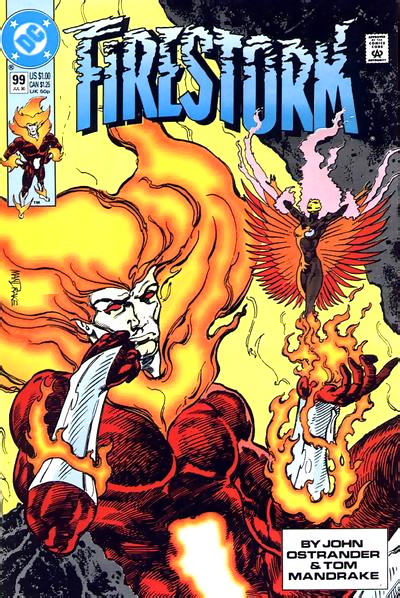
Over the next dozen-plus issues, the new Firestorm, in a totally new and altogether unrecognizable design by artists Tom Grindberg and Tom Mandrake, would find himself wrapped up in environmental issues, vacillating between his care for humanity and his elemental natures that would see the Earth wiped clean from pollutants (and evil corporations like Sunderland, in another echo of Moore's Swamp Thing). This conflict exploded in the "Elemental War" storyline, where just as Firestorm decided he was "humanity's friend," environmental activist Mai Miyazaki became Naiad, a new Water Elemental who teamed with the Air Elemental, Red Tornado, against humanity. To end the conflict, Firestorm allied himself with the Swamp Thing. This arc, in issues #90-93, was a visually arresting tour de force which was done a disservice on newsprint. I'd really like to see this arc--and much of Firestorm, to be honest--in a deluxe format. Someday, someway!
After an story (#94) in which Lorraine Reilly told Martin Stein of his connection with Firestorm (who saved the day, "Lassie"-style, when Martin found himself under fire from the Killer Frost), Firestorm journeyed back to East Africa, where Swamp Thing had previously revealed that his actions in #77-79 had made a hell out of paradise. He encountered Shango and other representatives from the Orishas, the African pantheon of gods, and became embroiled in their conflict against the Orish-Nla, their shadowy opposites. Although the conflict was resolved successfully, out of that war, those shadows gave birth to Shadowstorm, a negative-image opposite to Firestorm who unfortunately wouldn't have anything resembling a "final battle" with his progenitor. (I've heard stories that John Ostrander planned for the two to battle after #100, but after the book's cancellation, a version of the storyline instead saw print as the "Quantum Quest" in Captain Atom #54-57. The story also guest-starred Rasputin educating Atom about his place as another kind of elemental. The story--which I won't review here--could have been so, so much better with Firestorm than it was without. Especially with Mandrake on art duties.)
Did you think that the final metamorphosis of Firestorm was passed? Au contraire, mon frere!
The ramp-up to the final, hundredth issue actually has its roots two years hence in issue #76, the last battle between Firestorm and Brimstone, the gigantic creature who was first seen in the Ostrander-plotted Legends miniseries (that led to his getting the Firestorm gig in the first place, natch). The techno-seed that contained Brimstone's essence found its way into Earth's sun, and the creature was reborn in the most catastrophic place possible. Maser, a superhuman working for the Institute for Metahuman Studies in Pittsburgh, discovered Brimstone alive in the sun, and the duty fell to Martin Stein to find a solution. The problem with just sending Firestorm to the sun was that, issues prior, Firestorm tried to exit Earth's atmosphere and nearly died, finding that as one of the planet's elementals, his life force was tied to it. (Presumably as the "nuclear man" iteration of older times, he wasn't quite so tied to the planet, which explained his off-Earth excursions with the Justice League, especially Crisis on Infinite Earths. Can anyone else come up with a better explanation?)
Martin's plan tied into the fact that, as established in "Soul of Fire," he was to have been the original host to the Fire Elemental. In his words: "I propose we use one of these craft, equip it with oxygen tanks...and a quantity of explosives. Firehawk and Firestorm then supply sufficient thrust to put it--and me--into orbit. We detonate the explosive, ending my and Firestorm's lives...and hopefully, re-creating us both into a new Firestorm...who is then free to journey to the sun. In theory, anyway." Before Firestorm "died," however, he released his component halves, powerless, and they reunited with their families. Svarozhich then helped Martin complete the plan. The theory worked; not only did Svarozhich, possessed of the Fire Elemental, perish as it broke Earth's atmosphere and Martin become the new Firestorm, but Martin-as-Firestorm regained all his lost memories. This new Firestorm then defeated Brimstone, but found himself sucked into a singularity and into a "new universe" where he could not find a way home. He thanked the Earth-mother, Maya, for the experience and went off to parts unknown while Ron Raymond explored a new life with Lorraine, and Mikhail reunited with his wife Nina. One thing was sure: although he was nowhere near, they were sure Firestorm still lived!
I may have made a tiny tactical error in reading Firestorm #100 before issues #86-99, but that doesn't diminish my opinion of the final issue. The issue in many ways brought the saga of Firestorm full circle, summing up everything the character had come to mean since his introduction and tying up the plot thread that had been the through-line of Ostrander's entire tenure, summed up by Lorraine in the final story: "Funny, here they spend all kinds of money trying to determine if powers make one a hero. And the definitive answer [Martin Stein] is walking around on two feet...and most people never noticed him." Although for the longest time, Ron Raymond was the focus of the Firestorm series because his personality was ascendant, Martin was no less a hero, and with this issue he had his chance to prove just that. Interestingly, as the early Conway period would prove to be about the maturation of Ron Raymond, the Ostrander run framed the entire series as the maturation of the Firestorm entity, culminating in the eradication of the original dual-personality Firestorm and the coronation of Martin Stein as the "one, true" Firestorm. Not until the final issue was Ostrander done with his changes, which definitively established the Conway years as the character's larval stage, and the vast majority of his own tenure, kickstarted by the arc in #62-65, as his puberty. In "Soul of Fire," the "new" Firestorm may look different--certainly more like an adult as opposed to the garish costume seen before--but he wasn't fully mature until Martin took control. Even now, I'm awed at how well the whole story fits together, with organic change built upon organic change. Even if you don't like the finished product of Martin-as-Firestorm, you have to admire the method by which Ostrander slowly yet drastically changed the character.
As you can tell, the Ostrander run of Firestorm is one of my favorite comic eras of all time, and the letter columns in those last few dozen issues are filled with the opinions of the foremost letterhacks of the period, such as Jan C. Childress, "Uncle" Elvis Orten, T.M. Maple, and Charles J. Sperling, whose deep opinions speak to the high quality of the creators' efforts. It's entirely fitting that Ostrander's lasting legacy with the Firestorm character, for better or for worse, is the introduction of the Matrix. It has been used in nearly every Firestorm story or pitch that has been put forth since 1990, by subsequent writers like Joe Kelly, Mike Carey, Dan Jolley, Stuart Moore, and current Firestorm co-writer in Brightest Day, Geoff Johns. That alone speaks to the durability of Ostrander's concepts.
Next: Back to the beginning with Gerry Conway and friends.
~G.
28.1.11
God Smash, Puny Mortals! (Incredible Hulks #621 in Review)
Friends, Greeks, Countrymen--
Chaos War #5 arrived this Wednesday, bringing with it the conclusion to the storyline of the same name that prominently featured newly-minted skyfather Hercules and Amadeus Cho in mortal combat with Amatsu-Mikaboshi, the self-proclaimed Chaos King, who threatened to destroy all of reality. With the help of the incredible Hulks, Thor, a couple of (dead) Avengers, Galactus, the Silver Surfer, and the also-dead original members of Alpha Flight, the crisis was averted and reality restored. If you don't want to know specifics beyond the above, I strongly recommend you turn back now, as this review will feature two prominent spoilers about the conclusion of Chaos War.
Now, then, shall we indulge?

The Incredible Hulks #621
"God Smash" Part 1 of 2
Writer: Greg Pak
Artists: Paul Pelletier & Danny Miki
Colorist: Paul Mounts
Letterer: Simon Bowland
Production: Irene Lee
Assistant Editor: Jordan D. White
Editor: Mark Paniccia
Publisher: Marvel Comics
In the aftermath of the Chaos War, the incredible Hulk's family finds themselves in the middle of a city, surrounded by people just awakening from the sleep caused by the Chaos King. Briefly, they bemoan having helped save the world only to have the "puny humans" terrified by their presence. But this scene doesn't last long, and the remainder of this epilogue of sorts to Chaos War moves to the efforts of Bruce Banner to resolve his family's issues...by begging the indulgence of the Olympian gods, including the skyfather himself, who isn't exactly who we thought he'd be.
I'll say this for writer Greg Pak: he dreams big. It's interesting seeing how he positions Bruce Banner as the narrative focal point here, and at once I have to again question just whose decision it was to pluralize the title of this comic magazine. After all, the book has never, in the ten issues since becoming The Incredible Hulks, truly been an ensemble book. Rather, it's been about the Hulk, his son, and arguably the Red She-Hulk as a sort of post-nuclear family. The rest of the cast--Korg, A-Bomb, She-Hulk--has just been bit players in the ongoing drama, never really ascending to the same level as the main trio. Aside from the first three pages, this issue is entirely devoted to Bruce Banner and the Hulk, to the exclusion of the rest of the cast. Oh, sure--Banner makes it clear in talking with Hercules that this fool's errand is about them, but I get the feeling they won't figure much in the remainder of this two-part storyline.
(Interestingly, shortly before this issue became available it was announced in Marvel's April solicitations that the incredible one is going back to being a solo act with that month's issues. Think what you will, but I believe it's the right move, as the balancing act has proven untenable.)
So, after the events of Chaos War, Hercules is no longer empowered to the drastic degree he had to be in order to defeat the Chaos King; in fact, he's no longer super-powered at all, which lays to waste Banner's desperate plan to solve his family's ills. Is this the degree to which Banner feels utter guilt toward what his family's been through since "Fall of the Hulks"? He wants Rick to be healed from the wounds the Abomination inflicted upon him (in #618). He wants Betty to be cured of this "insanity" she suffers from as Red She-Hulk. (Denial, as they say, isn't just a river in Egypt, Dr. Banner.) He wants to ease his family's suffering, and maybe, superhuman as they are, he has to crawl before omnipotent forces, but something about the man of science begging the gods for help rings false. (So does the Hulk's slow healing in these issues, but there's a tale for another blog.)
On the other hand, the premise of this issue--that the Hulk challenges the gods so that his family may be relieved of their burdens, or perhaps that he may be relieved of them--allows for some truly awe-inspiring artwork from Paul Pelletier and Danny Miki. The Hulk smashes the Olympian gods on his way to encounter the newly-resurrected Zeus, and it's great fun seeing this indulgence and knowing through Zeus' narration that it's not going to end well next issue. "I hate spunk," says Zeus, his wife Hera by his side, a smoldering Hulk at their feet. The issue closes on a note that leaves no question as to what we're in for next month.
I'm somewhat unimpressed by the issue, on the whole. While there is something of a bond between the Hulk and Hercules, it's largely seemed artificial, an invention of Peter David (in his "Green Pieces" story teaming the Hulk and the Champions of L.A. in the second Giant-Size Hulk special, 2006) and Pak himself (throughout the "World War Hulk" crossover issues of The Incredible Hulk). The two-parter seems less an organic part of where the Hulk (er, Hulks) book was going, and more a way to bookend the character's involvement with Hercules that began in the aforementioned stories.
The one potential silver lining I see in this saga isn't even something that's directly referred to within this issue, but instead one plot point involved in the ending of Chaos War #5. Of all those resurrected to fight the Chaos King during the storyline, the Canadian super-group Alpha Flight remained alive at the end. This event occurred because, as Hercules himself tells Banner in #621, "When I grasped that power, I was guided by the wisdom beyond all our ken. And if you weren't healed...then perhaps that is as it should be." The way I like to read that comment from Hercules is that some others may have been resurrected when Hercules re-ordered reality and saved it from the Chaos King. If that's true, then potentially, one or more of those we saw in the last two issues of Incredible Hulks could again be alive. It doesn't matter who you choose, for each of the characters from the Hulk's past--Glenn Talbot, Hiroim, Doc Samson, and Jarella--could, as mentioned in my previous entry, have a full storyline devoted to even one of their returns. I hope Greg Pak realizes just what a golden nugget he has laid at the Hulk's feet.
So, what else is there to say about Incredible Hulks #621? After the flurry of activity in the last three issues, this issue certainly takes a break and slows the pace, but it's just a bit lacking, maybe because the story doesn't seem particularly fitting of the character. We'll see how it all bears out in next issue's finale, however.
What say you, sirs?
~G.
Chaos War #5 arrived this Wednesday, bringing with it the conclusion to the storyline of the same name that prominently featured newly-minted skyfather Hercules and Amadeus Cho in mortal combat with Amatsu-Mikaboshi, the self-proclaimed Chaos King, who threatened to destroy all of reality. With the help of the incredible Hulks, Thor, a couple of (dead) Avengers, Galactus, the Silver Surfer, and the also-dead original members of Alpha Flight, the crisis was averted and reality restored. If you don't want to know specifics beyond the above, I strongly recommend you turn back now, as this review will feature two prominent spoilers about the conclusion of Chaos War.
Now, then, shall we indulge?
The Incredible Hulks #621
"God Smash" Part 1 of 2
Writer: Greg Pak
Artists: Paul Pelletier & Danny Miki
Colorist: Paul Mounts
Letterer: Simon Bowland
Production: Irene Lee
Assistant Editor: Jordan D. White
Editor: Mark Paniccia
Publisher: Marvel Comics
In the aftermath of the Chaos War, the incredible Hulk's family finds themselves in the middle of a city, surrounded by people just awakening from the sleep caused by the Chaos King. Briefly, they bemoan having helped save the world only to have the "puny humans" terrified by their presence. But this scene doesn't last long, and the remainder of this epilogue of sorts to Chaos War moves to the efforts of Bruce Banner to resolve his family's issues...by begging the indulgence of the Olympian gods, including the skyfather himself, who isn't exactly who we thought he'd be.
I'll say this for writer Greg Pak: he dreams big. It's interesting seeing how he positions Bruce Banner as the narrative focal point here, and at once I have to again question just whose decision it was to pluralize the title of this comic magazine. After all, the book has never, in the ten issues since becoming The Incredible Hulks, truly been an ensemble book. Rather, it's been about the Hulk, his son, and arguably the Red She-Hulk as a sort of post-nuclear family. The rest of the cast--Korg, A-Bomb, She-Hulk--has just been bit players in the ongoing drama, never really ascending to the same level as the main trio. Aside from the first three pages, this issue is entirely devoted to Bruce Banner and the Hulk, to the exclusion of the rest of the cast. Oh, sure--Banner makes it clear in talking with Hercules that this fool's errand is about them, but I get the feeling they won't figure much in the remainder of this two-part storyline.
(Interestingly, shortly before this issue became available it was announced in Marvel's April solicitations that the incredible one is going back to being a solo act with that month's issues. Think what you will, but I believe it's the right move, as the balancing act has proven untenable.)
So, after the events of Chaos War, Hercules is no longer empowered to the drastic degree he had to be in order to defeat the Chaos King; in fact, he's no longer super-powered at all, which lays to waste Banner's desperate plan to solve his family's ills. Is this the degree to which Banner feels utter guilt toward what his family's been through since "Fall of the Hulks"? He wants Rick to be healed from the wounds the Abomination inflicted upon him (in #618). He wants Betty to be cured of this "insanity" she suffers from as Red She-Hulk. (Denial, as they say, isn't just a river in Egypt, Dr. Banner.) He wants to ease his family's suffering, and maybe, superhuman as they are, he has to crawl before omnipotent forces, but something about the man of science begging the gods for help rings false. (So does the Hulk's slow healing in these issues, but there's a tale for another blog.)
On the other hand, the premise of this issue--that the Hulk challenges the gods so that his family may be relieved of their burdens, or perhaps that he may be relieved of them--allows for some truly awe-inspiring artwork from Paul Pelletier and Danny Miki. The Hulk smashes the Olympian gods on his way to encounter the newly-resurrected Zeus, and it's great fun seeing this indulgence and knowing through Zeus' narration that it's not going to end well next issue. "I hate spunk," says Zeus, his wife Hera by his side, a smoldering Hulk at their feet. The issue closes on a note that leaves no question as to what we're in for next month.
I'm somewhat unimpressed by the issue, on the whole. While there is something of a bond between the Hulk and Hercules, it's largely seemed artificial, an invention of Peter David (in his "Green Pieces" story teaming the Hulk and the Champions of L.A. in the second Giant-Size Hulk special, 2006) and Pak himself (throughout the "World War Hulk" crossover issues of The Incredible Hulk). The two-parter seems less an organic part of where the Hulk (er, Hulks) book was going, and more a way to bookend the character's involvement with Hercules that began in the aforementioned stories.
The one potential silver lining I see in this saga isn't even something that's directly referred to within this issue, but instead one plot point involved in the ending of Chaos War #5. Of all those resurrected to fight the Chaos King during the storyline, the Canadian super-group Alpha Flight remained alive at the end. This event occurred because, as Hercules himself tells Banner in #621, "When I grasped that power, I was guided by the wisdom beyond all our ken. And if you weren't healed...then perhaps that is as it should be." The way I like to read that comment from Hercules is that some others may have been resurrected when Hercules re-ordered reality and saved it from the Chaos King. If that's true, then potentially, one or more of those we saw in the last two issues of Incredible Hulks could again be alive. It doesn't matter who you choose, for each of the characters from the Hulk's past--Glenn Talbot, Hiroim, Doc Samson, and Jarella--could, as mentioned in my previous entry, have a full storyline devoted to even one of their returns. I hope Greg Pak realizes just what a golden nugget he has laid at the Hulk's feet.
So, what else is there to say about Incredible Hulks #621? After the flurry of activity in the last three issues, this issue certainly takes a break and slows the pace, but it's just a bit lacking, maybe because the story doesn't seem particularly fitting of the character. We'll see how it all bears out in next issue's finale, however.
What say you, sirs?
~G.
27.1.11
A Word About Those Who Keep Their Comics in the Polybag...
The second and third books above were released at the height of the 1990s speculator boom. One's worth $20USD on a good day. The other you can find in dollar bins. The first? Well, that one's now on sale (although I have, ahem, doctored it a little). On eBay a first printing, unsigned and still in the polybag, has reached a price of $20.50. Soon to plummet as, you guessed it, the member of the FF who died in the issue eventually returns.
I'm not getting into how major characters in comics really . That argument's been done to death. If the public at large is gullible enough to believe DC would really kill Superman, or Marvel would really kill Captain America, well...like I said, so not going there. This is about the polybag.
They're comics. Read 'em. If you like 'em, recommend them to friends. Lend your books out. Donate them to your local library, or ask to put some at your local pediatrician's office waiting room for the kids there. Don't try to hoard 'em hoping one day they'll help you put your kids through college. Supply and demand, folks.
There are better ways to popularize the product than emphasizing death. Can we please find them? Soon?
~G.
Incredible Hulks #623 Preview
Folks,
While waiting for my Chaos War #5/Incredible Hulks #621 review (coming before the weekend, I swear!), here's a sumptuous feast of a page by Dale Eaglesham, Drew Hennessy & Dean White from the February 23-shipping Incredible Hulks #623:

If you click here or on the above link, you'll see more preview pages from the same issue. It looks like the Warbound will be having one last adventure with a very humbled Hulk. Elsewhere in the preview pages lurks No-Name of the Brood, but here in this page are the assembled Hulks plus Kate Waynesboro and Elloe Kaifi!
Great, great stuff by Dale, Drew and Dean, and I can't wait to see the finished issue. It looks like #625 is the end of the line for the Hulk family, and it all starts here with part one of the three-part "Planet Savage" storyline. This epic storyline guest-stars Ka-Zar and features the return of renegade Warbound member Miek, fresh from his appearance in the final two issues of Chaos War. Don't miss out!
Visit Dale Eaglesham's website here to see some process artwork from the arc. With five pages looking as good as this, can it be very long before he's asked to come back?
INCREDIBLE HULKS #623 (DEC100578)
Written by GREG PAK
Pencils and Cover by DALE EAGLESHAM
Rated A… $2.99
FOC – 1/31/11, On-Sale 2/23/11
~G.
While waiting for my Chaos War #5/Incredible Hulks #621 review (coming before the weekend, I swear!), here's a sumptuous feast of a page by Dale Eaglesham, Drew Hennessy & Dean White from the February 23-shipping Incredible Hulks #623:
Great, great stuff by Dale, Drew and Dean, and I can't wait to see the finished issue. It looks like #625 is the end of the line for the Hulk family, and it all starts here with part one of the three-part "Planet Savage" storyline. This epic storyline guest-stars Ka-Zar and features the return of renegade Warbound member Miek, fresh from his appearance in the final two issues of Chaos War. Don't miss out!
Visit Dale Eaglesham's website here to see some process artwork from the arc. With five pages looking as good as this, can it be very long before he's asked to come back?
INCREDIBLE HULKS #623 (DEC100578)
Written by GREG PAK
Pencils and Cover by DALE EAGLESHAM
Rated A… $2.99
FOC – 1/31/11, On-Sale 2/23/11
~G.
Subscribe to:
Posts (Atom)