Welcome back, my friends, to the show that never ends...
Tonight I've got something of a treat. In advance, I've got a very special review for everyone! Y'see, brand new regular artist Patch Zircher is on board Hulk alongside regular writer Jeff Parker as of issue #42. So not only will I be briefly looking back at issue #41, not only will I be glossing over Hulk Vs. Dracula, I'll also be giving you an advance peek at next week's book! (Hopefully, next week will also bring my DC "New 52" reviews. Remember, you can still catch my review of I, Vampire just one entry previous!)
So, where were we? Ah, yes!
HULK #41 - Marvel Comics, $2.99
By Jeff Parker, Gabriel Hardman & Bettie Breitweiser
It honestly feels like the end of the road.
Sixteen issues ago, Jeff Parker, Gabriel Hardman and Bettie Breitweiser came together and took the reins from Red Hulk creators Jeph Loeb and Ed McGuinness. However you looked at it, Loeb and McGuinness' successors had their work cut out for them. If you believed they were the team supreme and had made you enjoy the Hulk like none before, how could anyone measure up? If you didn't like Red Hulk at all, how could anyone else take over and change your mind?
It's truly a credit to this creative triad that they were able to take what the previous team did--love it or hate it--and build upon the legend, creating a more well-rounded Red Hulk with a multifaceted set of motivations and a varied league of villains. It's true that Loeb was only able to write the revealed Ross as Red Hulk for two whole issues (#23-24), so sure, take that into account. Even still, you can't discount the contributions made and the acknowledgments to previous continuity.
In Gabriel Hardman's final issue, Jeff Parker is wisely able to wrap up the cosmic-league threat of Omegex while at the same time giving both Red Hulk and his antagonist Zero/One new beginnings (of sorts). And we've got General Fortean out there, plotting and scheming for another day.
I've truly enjoyed the previous two segments of this storyline, and "Finality" here is no different. Although the physical battle here is between Red Hulk, who's been trapped in his super-powered form since his battle with Fortean in #31, and Omegex, who's been established as a threat since #28, it's the verbal chess match between Red Hulk and Zero/One that steals the show. The duo have had an unconventional team-up in the interests of defeating the world-ending threat, but it's always come back to the similarities and differences between the characters. Parker plays the characters off each other so well, and although I could tell how Zero/One would "help" Ross from early in this storyline, it was still a shock to see how much that assist had a bearing on the conclusion here. Kudos.
As for Gabriel Hardman and Bettie Breitweiser, what can I say? These two artistic titans have taken Parker's scripts and amped up the emotional content several notches. The battle scenes are emotional, and the scenes that were meant to be touching to begin with ended up so much deeper. The looks into Red Hulk's past were especially sumptuous, and his own reactions to Zero/One's take on that past were priceless.
It's hard saying goodbye to two terrific talents at once like this, but at the same time, I'm certain that new artist-in-residence Patch Zircher and colorist Rachelle Rosenberg will acquit themselves admirably in "Hulk of Arabia" and beyond.
But hey! You'll have to read about them below. As for this issue, it could hardly be better. Echoes of the seventies Hulk under Len Wein! Modern sensibilities! Emotionally rich storytelling! Buy It!
FEAR ITSELF: HULK VS. DRACULA #2 - Marvel Comics, $2.99
By Victor Gischler, Ryan Stegman, Mike Babinski & Antonio Fabela
Uhm, next?
When last we left the Hulk, he was possessed by the hammer of the Worthy that made him Nul, Breaker of Worlds. After crash-landing in Transylvania, he found himself besieged by all kinds of monsters. Meanwhile, Dracula and his vampire legions ran around wondering just what they could do about this threat in their midst.
At the conclusion of this issue, little has changed.
Maybe. A little bit. Truthfully, not much.
And that's the key complaint I have about this three-part miniseries. So far, it feels like a one-shot's worth of material needlessly spread across three issues for the sake of making nine dollars instead of three. (Or four, if a double-sized one-shot's your thing.) Ask yourself: where is the Hulk at the end of the first issue? The second? And what about Dracula and the majority of his ilk? Not only are they in virtually the same places, physically, they're in the same place in terms of characterization, too. Hulk is still smashing monsters and Dracula is still plotting to stop him. Oh, Dracula sent a few of his vampire soldiers against the Hulk and he beat them? He did that last month, too.
Ryan Stegman and Mike Babinski step out of the comfort zone they found in such emotionally and comedically rich stories as the recent She-Hulks and Amazing Spider-Man work they did, and their work also falls far short of the mark. After a promising start, the art just doesn't hold together, which seems almost as much of a critique on their strengths as it does an indictment of the story being told. Horror just doesn't suit this team.
Again, the key fault lies in the two sides here. You've got a brainwashed Hulk blindly smashing things without any emotional underpinning. Add to that a vampire nation of characters who just aren't very interesting, nor do they possess enough honorable attributes so one might root for them against the Hulk.
Guys, with one issue left, I'm trying, I really am. But with this issue virtually a regurgitation of the first, you should really Burn It.
HULK #42 - Marvel Comics, $2.99
By Jeff Parker, Patch Zircher & Rachelle Rosenberg
Thanks to James Sime of that great bastion of San Francisco comics goodness, The Isotope, I got a B&W preview of this book this week. (If anyone went to San Diego Comic Con this year, you know the preview of which I speak!) As mentioned above, it's the first regular issue for new artist Patch Zircher, an artist I've long admired since the days of Evan Skolnick's New Warriors in the mid-nineties. He illustrated a recent issue (#36), and I've hoped he'd return. Here he is!
Loosed from the threats of Zero/One, Black Fog and Omegex, Thad Ross finds himself once more at odds with General Fortean. While that's nothing new, the situation he finds himself in as result is. When he discovers an old friend has died at the hands of a terrorist in the Middle Eastern nation of Qatar, he decides to exact righteous red vengeance. Of course, that'll end up going so well, right?
After the tension of the previous storylines including "Omegex," the beginning of "Hulk of Arabia" feels tame by comparison. Don't get me wrong--it's still a solid story by Jeff Parker that plays to Ross' military strengths--but anything after those emotional heights is naturally going to feel lacking.
The story comes alive with artwork by the aforementioned Patch Zircher. After getting his feet wet in issue #36, he really comes to play this issue. His Red Hulk is appropriately big and mean, Thad Ross is determined, and every sequence is convincingly rendered. Keep in mind, this is in black-and-white; I haven't even glimpsed Rachelle Rosenberg's colors yet, and won't see them until next Wednesday. Still, as powerful as the linework is, the look can only improve with the addition of a quality color artist.
If you've been longing to see Thad Ross use more of his military history as the Red Hulk, then look no further. "Hulk of Arabia" looks to be another winner from Jeff Parker. It starts off on the ground floor and just keeps rolling. For now, Read It, but if it's anything like previous epics from Parker, I'll be upgrading that rating on successive issues!
~G.
30.9.11
26.9.11
Advance Review: "I, Vampire" #1
Yes, it's true! I've been remiss in my reviewing activities. If you must know, I'm writing a book here, and preparing for this year's New York Comic Con that hits in a few short weeks. In answer to your unspoken questions, I've been reading quite a few of DC Comics' "New 52" projects this last month. Why, you ask, have I not reviewed any of those books? Simply put, I haven't found any that have compelled me to put pen to paper (or, as the case may be, fingers to keyboard). But that's changed. Oh, ye gods, how that has changed...
Early on, it was the most derided of all the series DC announced. If it wasn't "DC, how could you try and cash in on the Twilight craze?" it was "DC, why in God's name did you bring that book back, out of all the old books that could've been relaunched?" People didn't "get" why they would bring back Andrew Bennett, who'd been on the scene in the horror anthology House of Mystery for all of two years prior to its 1983 cancellation. They thought, well, obviously we're going to get "emo" vampires, because they're so de rigueur today.
For those who've caught my previous references to this series, as far back as 2007, this one's for you. For those altogether unfamiliar with the first incarnation, this one's also for you. You want to be here for this. You really do...

I, Vampire #1
"Tainted Love"
By Joshua Hale Fialkov, Andrea Sorrentino, Marcelo Maiolo, Pat Brosseau,
Wil Moss, Matt Idelson & Jenny Frison
"Four hundred years ago my vampiric kiss transformed the woman I loved into a soulless thing called Mary, Queen of Blood! Today an unholy order follows her evil designs, and the blood they spill is on my hands! Thus I must stop her...I, Andrew Bennett...I...Vampire!"
Early on, it was the most derided of all the series DC announced. If it wasn't "DC, how could you try and cash in on the Twilight craze?" it was "DC, why in God's name did you bring that book back, out of all the old books that could've been relaunched?" People didn't "get" why they would bring back Andrew Bennett, who'd been on the scene in the horror anthology House of Mystery for all of two years prior to its 1983 cancellation. They thought, well, obviously we're going to get "emo" vampires, because they're so de rigueur today.
For those who've caught my previous references to this series, as far back as 2007, this one's for you. For those altogether unfamiliar with the first incarnation, this one's also for you. You want to be here for this. You really do...

I, Vampire #1
"Tainted Love"
By Joshua Hale Fialkov, Andrea Sorrentino, Marcelo Maiolo, Pat Brosseau,
Wil Moss, Matt Idelson & Jenny Frison
"Four hundred years ago my vampiric kiss transformed the woman I loved into a soulless thing called Mary, Queen of Blood! Today an unholy order follows her evil designs, and the blood they spill is on my hands! Thus I must stop her...I, Andrew Bennett...I...Vampire!"
19.9.11
An Open Letter to Netflix CEO Reed Hastings
Reed,
(I think we can dispense with officiousness, since I've been one of your treasured subscribers since 2006.)
Thanks for sending that mass e-mail to all the...is it still millions, or has it dropped to hundreds of thousands?...subscribers to your revolutionary Netflix service announcing, for the second time, the total dismantling of the service as we knew it. You know, we've been looking for something even more earth-shaking than July's announced split billing and drastic price increases for your company's DVD and streaming services. And it looks like now we've got it.
I have got to applaud a company brash enough to do what you've done. It feels like this decision was made by a bunch of drunken frat buddies late on Thursday after your new subscriber forecast went live and your stock prices took a dive. It's really refreshing to see this kind of immediate, frenzied, drastic reaction instead of the more measured, cautious approach that most big businesses in this day and age employ. If people didn't "get" your plan to totally divorce the two arms of the company, well, they sure as hell do now!
CHOP! One half of the company devoted to instant streaming via high-speed internet connections gets to keep that all-important Netflix name!
CHOP! The other half of the company devoted to DVDs, which is still the predominant method by which movies and television series are distributed, gets divorced and set up with a new name.
Of course, now you've decided to offer video games along with DVDs! This decision is even better than the first, because I have absolutely no interest in renting video games! Wow, what unparalleled value!
The centerpiece of your efforts--which is truly brilliant--is this new name you've given to the DVD and video game division. Qwikster! It just rolls right off the tongue, dunnit? In fact, it's something I honestly wouldn't have expected coming from a CEO of a high-tech mass media company. It's not even something I'd have thought would be thought up after a night of heavy drinking with frat boys who can take as much vacation as they want as long as they produce results at work. It's more along the lines of something a pothead living with his mommy and daddy would use for a nickname on Twitter. So go you!
I can't wait to see how all of these changes are implemented. I hear that you're not going to be linking the Netflix and Qwikster sites at all. It used to be so convenient, because when I added something to my DVD queue, and there was an instant version of the same thing, it got added to my instant queue, too! Also, there was that uncanny algorithm you held that competition to get. You know, the one that keeps track of my preferences based on what I've looked at and rented. I'm so glad you'll completely be getting rid of one easy tracking system. Why use one, when you can use two? And two charges under different names where once there was one? Awesomesauce!
So, yes, it's refreshing to see a name that didn't get vetted by focus groups or dwelt-upon for more than an hour or two. In fact, it didn't take me more than that same timeframe to decide I'm canceling the DVD part of your service, effective just as soon as my next billing cycle begins. Just as immediate and drastic! You see, I signed up for Netflix back in 2006, and Netflix is still where my loyalties lie. I can't be bothered with any pretenders. Full steam ahead Netflix! Who cares if more movies and television shows are available on DVD than for streaming? Not this guy. Not this guy.
In fact, other than those swell Marvel animated series you just put up on the streaming service, I've only interest in watching Doctor Who on there. So after that? Well, you'll probably lose me. Good show, chap! Good show!
Keep flying by the seat of your pants, Reed! After all, who needs a good PR firm when they've got you?
¡Viva la Revolución!
~G.
(I think we can dispense with officiousness, since I've been one of your treasured subscribers since 2006.)
Thanks for sending that mass e-mail to all the...is it still millions, or has it dropped to hundreds of thousands?...subscribers to your revolutionary Netflix service announcing, for the second time, the total dismantling of the service as we knew it. You know, we've been looking for something even more earth-shaking than July's announced split billing and drastic price increases for your company's DVD and streaming services. And it looks like now we've got it.
I have got to applaud a company brash enough to do what you've done. It feels like this decision was made by a bunch of drunken frat buddies late on Thursday after your new subscriber forecast went live and your stock prices took a dive. It's really refreshing to see this kind of immediate, frenzied, drastic reaction instead of the more measured, cautious approach that most big businesses in this day and age employ. If people didn't "get" your plan to totally divorce the two arms of the company, well, they sure as hell do now!
CHOP! One half of the company devoted to instant streaming via high-speed internet connections gets to keep that all-important Netflix name!
CHOP! The other half of the company devoted to DVDs, which is still the predominant method by which movies and television series are distributed, gets divorced and set up with a new name.
Of course, now you've decided to offer video games along with DVDs! This decision is even better than the first, because I have absolutely no interest in renting video games! Wow, what unparalleled value!
The centerpiece of your efforts--which is truly brilliant--is this new name you've given to the DVD and video game division. Qwikster! It just rolls right off the tongue, dunnit? In fact, it's something I honestly wouldn't have expected coming from a CEO of a high-tech mass media company. It's not even something I'd have thought would be thought up after a night of heavy drinking with frat boys who can take as much vacation as they want as long as they produce results at work. It's more along the lines of something a pothead living with his mommy and daddy would use for a nickname on Twitter. So go you!
I can't wait to see how all of these changes are implemented. I hear that you're not going to be linking the Netflix and Qwikster sites at all. It used to be so convenient, because when I added something to my DVD queue, and there was an instant version of the same thing, it got added to my instant queue, too! Also, there was that uncanny algorithm you held that competition to get. You know, the one that keeps track of my preferences based on what I've looked at and rented. I'm so glad you'll completely be getting rid of one easy tracking system. Why use one, when you can use two? And two charges under different names where once there was one? Awesomesauce!
So, yes, it's refreshing to see a name that didn't get vetted by focus groups or dwelt-upon for more than an hour or two. In fact, it didn't take me more than that same timeframe to decide I'm canceling the DVD part of your service, effective just as soon as my next billing cycle begins. Just as immediate and drastic! You see, I signed up for Netflix back in 2006, and Netflix is still where my loyalties lie. I can't be bothered with any pretenders. Full steam ahead Netflix! Who cares if more movies and television shows are available on DVD than for streaming? Not this guy. Not this guy.
In fact, other than those swell Marvel animated series you just put up on the streaming service, I've only interest in watching Doctor Who on there. So after that? Well, you'll probably lose me. Good show, chap! Good show!
Keep flying by the seat of your pants, Reed! After all, who needs a good PR firm when they've got you?
¡Viva la Revolución!
~G.
18.9.11
Quick Reviews: Hulk #40, Fear Itself: Hulk Vs. Dracula #1
Greetings, Hulk fans!
Many apologies for my absence these last weeks. Between family issues, health issues, and work-related stuff that couldn't be put off, it's been a rough time for the Delusionally Honest. The good news--that I can't really talk about--is that yours truly has decided to embark on an exciting new venture that will likely mean you'll see less of me around these parts for a while. On the plus side, the likely result will be that you'll see more of me than you've ever seen before! (How's that for a tease?)
Now then, two reviews for the price of one! Because I've been away, and these things are now weekly, ya know...
HULK #40 - Marvel Comics, $2.99
By Jeff Parker, Gabriel Hardman, Bettie Breitweiser & Jim Charalampidis
Gabriel Hardman's finale on art chores continues this issue with the climactic battle between Red Hulk and the cosmic threat Omegex. Along the way, writer Jeff Parker piles in various plot elements and characters from the previous fifteen issues of the series since the duo started on the book. General Fortean is here, blaming his old friend for the chaos. Dr. Kurinji, now better known as Zero/One,and the threat she created, Black Fog, are also on the scene...and helping the Red Hulk?!
With all the characters in this story, you'd think these twenty pages would be a cluttered mess. In fact, they're anything but. Parker uses the middle third of the Omegex saga to explore the dichotomy between Ross and Kurinji and their alter-egos, Red Hulk and Zero/One. He compares them with the question, "Are they better before or after their recent changes?" with Zero/One taking the side of cold logic while Ross addresses emotion. It makes sense, as Ross has always relied on his emotions, particularly toward his daughter Betty, whereas the original Hulk's alter-ego prided himself on logic. Can he convince Zero/One that there were advantages to her humanity? Whatever the case, this battle does give her a considerable depth and a fun little character arc.
The same can't be said for General Fortean, who through sheer brevity of his appearance here becomes a caricature of his former self, and by extension, a caricature of who Ross used to be. He's blinded by his desire to rid the world of the Red Hulk, to the point of ignoring the larger threat of Omegex. Unless we see some significant changes soon, I'm afraid Fortean will just be a sad echo: Ross 2.0.
With so many plates in the air here, the narrative momentum does slow to a crawl, with the only significant plot element being the conversation between Red Hulk and Zero/One. And that's fine, because it is truly important. But I do hope Parker is able to pull out a strong conclusion here. Will Ross again be able to change to his human self with the help of Zero/One? Will Fortean see that Red Hulk can do more than simply destroy? Such good questions deserve excellent answers.
An excellent plus, the artwork is as good as it's ever been thanks to Hardman, Bretiweiser and Charalampidis. The colorists' work blends together very well here, to the point I honestly couldn't separate one from the other. I said it before and I'll say it again: I'm going to miss Hardman's formidable talents on this book.
The verdict? Another issue, another instance where I gotta say Buy It.
FEAR ITSELF: HULK VS. DRACULA #1 - Marvel Comics, $2.99
By Victor Gischler, Ryan Stegman, Michael Babinski & Frank Martin Jr.
The book that would have been Incredible Hulk #636 arrives, transitioning the Green Goliath from Greg Pak's series through the first five issues of Fear Itself, Marvel's summer event, and on to this issue. For those not following that series, Bruce Banner and Betty Ross decided to escape to Brazil to sort out their relationship. However, a magical hammer fell from the sky, and when the Hulk picked it up he transformed into Nul, Breaker of Worlds, and swiftly went on a rampage through the rainforest. Neither Red She-Hulk nor the Avengers could stop him. He finally arrived in New York where he fought the mighty Thor alongside the Thing, a.k.a. Angrir, Breaker of Souls. Thor knocked him into orbit, but as we all know, what goes up must come down...
Victor Gischler is famous at Marvel for his recent involvement with the X-Men in "Curse of the Mutants," an event which brought the company's vampire nation in conflict with the mighty mutants. In those adventures, too, Marvel has shifted away from the previous depiction of vampires in books like Tomb of Dracula (itself taking cues from the classic depiction and Universal Studios' films). Now, Dracula appears as a white-haired, armored hybrid of several visions glimpsed in Francis Ford Coppola's Bram Stoker's Dracula. His history has been thrown in a blender, with his son Janus popping up again out of nowhere, and another son, Xarus, having figured in the earlier crossover.
The story here is straightforward: the possessed Hulk lands in the Carpathian Mountains, the homeland of Dracula and his assembled legions. Hulk smashes mindlessly, and the vampires mount their response. It's a very by-the-numbers response that reflects precious little of what is enticing about these two corners of the Marvel Universe. It's hard to root for Dracula and his ilk because of their infighting and their inhumanity; moreover, it's only slightly less difficult to root for the Hulk. Possessed, he's not really going to have any powerful character moments: as such, the only thrill can be had by seeing how much he can smash. In this issue, that's not much.
The story's sole saving grace so far is Ryan Stegman, who ably illustrates the Hulk's sheer power. I also really love the looks of the various monsters during the battle scenes. (Was that a Wendigo? What's it doing outside North America?) If this series is remarkable for nothing else, Stegman certainly brings his "A" game here.
Still, in spite of the energetic art, I can't see past the flat story. Unless you're a hardcore fan of Hulk or Dracula's legions, Skip It.
~G.
Many apologies for my absence these last weeks. Between family issues, health issues, and work-related stuff that couldn't be put off, it's been a rough time for the Delusionally Honest. The good news--that I can't really talk about--is that yours truly has decided to embark on an exciting new venture that will likely mean you'll see less of me around these parts for a while. On the plus side, the likely result will be that you'll see more of me than you've ever seen before! (How's that for a tease?)
Now then, two reviews for the price of one! Because I've been away, and these things are now weekly, ya know...
HULK #40 - Marvel Comics, $2.99
By Jeff Parker, Gabriel Hardman, Bettie Breitweiser & Jim Charalampidis
Gabriel Hardman's finale on art chores continues this issue with the climactic battle between Red Hulk and the cosmic threat Omegex. Along the way, writer Jeff Parker piles in various plot elements and characters from the previous fifteen issues of the series since the duo started on the book. General Fortean is here, blaming his old friend for the chaos. Dr. Kurinji, now better known as Zero/One,and the threat she created, Black Fog, are also on the scene...and helping the Red Hulk?!
With all the characters in this story, you'd think these twenty pages would be a cluttered mess. In fact, they're anything but. Parker uses the middle third of the Omegex saga to explore the dichotomy between Ross and Kurinji and their alter-egos, Red Hulk and Zero/One. He compares them with the question, "Are they better before or after their recent changes?" with Zero/One taking the side of cold logic while Ross addresses emotion. It makes sense, as Ross has always relied on his emotions, particularly toward his daughter Betty, whereas the original Hulk's alter-ego prided himself on logic. Can he convince Zero/One that there were advantages to her humanity? Whatever the case, this battle does give her a considerable depth and a fun little character arc.
The same can't be said for General Fortean, who through sheer brevity of his appearance here becomes a caricature of his former self, and by extension, a caricature of who Ross used to be. He's blinded by his desire to rid the world of the Red Hulk, to the point of ignoring the larger threat of Omegex. Unless we see some significant changes soon, I'm afraid Fortean will just be a sad echo: Ross 2.0.
With so many plates in the air here, the narrative momentum does slow to a crawl, with the only significant plot element being the conversation between Red Hulk and Zero/One. And that's fine, because it is truly important. But I do hope Parker is able to pull out a strong conclusion here. Will Ross again be able to change to his human self with the help of Zero/One? Will Fortean see that Red Hulk can do more than simply destroy? Such good questions deserve excellent answers.
An excellent plus, the artwork is as good as it's ever been thanks to Hardman, Bretiweiser and Charalampidis. The colorists' work blends together very well here, to the point I honestly couldn't separate one from the other. I said it before and I'll say it again: I'm going to miss Hardman's formidable talents on this book.
The verdict? Another issue, another instance where I gotta say Buy It.
FEAR ITSELF: HULK VS. DRACULA #1 - Marvel Comics, $2.99
By Victor Gischler, Ryan Stegman, Michael Babinski & Frank Martin Jr.
The book that would have been Incredible Hulk #636 arrives, transitioning the Green Goliath from Greg Pak's series through the first five issues of Fear Itself, Marvel's summer event, and on to this issue. For those not following that series, Bruce Banner and Betty Ross decided to escape to Brazil to sort out their relationship. However, a magical hammer fell from the sky, and when the Hulk picked it up he transformed into Nul, Breaker of Worlds, and swiftly went on a rampage through the rainforest. Neither Red She-Hulk nor the Avengers could stop him. He finally arrived in New York where he fought the mighty Thor alongside the Thing, a.k.a. Angrir, Breaker of Souls. Thor knocked him into orbit, but as we all know, what goes up must come down...
Victor Gischler is famous at Marvel for his recent involvement with the X-Men in "Curse of the Mutants," an event which brought the company's vampire nation in conflict with the mighty mutants. In those adventures, too, Marvel has shifted away from the previous depiction of vampires in books like Tomb of Dracula (itself taking cues from the classic depiction and Universal Studios' films). Now, Dracula appears as a white-haired, armored hybrid of several visions glimpsed in Francis Ford Coppola's Bram Stoker's Dracula. His history has been thrown in a blender, with his son Janus popping up again out of nowhere, and another son, Xarus, having figured in the earlier crossover.
The story here is straightforward: the possessed Hulk lands in the Carpathian Mountains, the homeland of Dracula and his assembled legions. Hulk smashes mindlessly, and the vampires mount their response. It's a very by-the-numbers response that reflects precious little of what is enticing about these two corners of the Marvel Universe. It's hard to root for Dracula and his ilk because of their infighting and their inhumanity; moreover, it's only slightly less difficult to root for the Hulk. Possessed, he's not really going to have any powerful character moments: as such, the only thrill can be had by seeing how much he can smash. In this issue, that's not much.
The story's sole saving grace so far is Ryan Stegman, who ably illustrates the Hulk's sheer power. I also really love the looks of the various monsters during the battle scenes. (Was that a Wendigo? What's it doing outside North America?) If this series is remarkable for nothing else, Stegman certainly brings his "A" game here.
Still, in spite of the energetic art, I can't see past the flat story. Unless you're a hardcore fan of Hulk or Dracula's legions, Skip It.
~G.
15.9.11
Double Shot O' Sketches: Spider-Man & One Of His Forgotten Foes!
Regular blog entries will resume as early as tomorrow if this cold doesn't keep me down. Meantime, I have two sketches for you! Both inspired by events from the fabled "Clone Saga" (soon to be discussed on an upcoming Spectacular Spider-Cast)!
First up: Rob Jones draws Ben Reilly, the amazing Spider-Man! From Pittsburgh Comicon 2011.
Rob was the protege of late DC Comics great Dick Giordano, and is currently working under the tutelage of Marvel and Valiant's own Bob Layton. You can reach Rob for commissions via his website, Perfect Storm Publishing! (Tell 'im I sent you!)
Next up is a forgotten Spidey villain from the same era. From New York Comic-Con 2010, here's artist Brian Shearer's take on Doc Ock's very own muscle goddess, Stunner!
Brian can be found online at the GravyBoy website. From there, you can see his comic projects including Vex and Deputy Witch as well as see if he's got any commission spots open. Well worth it!
Thanks, guys! More sketches and miscellany soon...
~G.
First up: Rob Jones draws Ben Reilly, the amazing Spider-Man! From Pittsburgh Comicon 2011.
Rob was the protege of late DC Comics great Dick Giordano, and is currently working under the tutelage of Marvel and Valiant's own Bob Layton. You can reach Rob for commissions via his website, Perfect Storm Publishing! (Tell 'im I sent you!)
Next up is a forgotten Spidey villain from the same era. From New York Comic-Con 2010, here's artist Brian Shearer's take on Doc Ock's very own muscle goddess, Stunner!
Brian can be found online at the GravyBoy website. From there, you can see his comic projects including Vex and Deputy Witch as well as see if he's got any commission spots open. Well worth it!
Thanks, guys! More sketches and miscellany soon...
~G.
6.9.11
From the Vault: Comixfan Reviews & Interviews
Welcome back!
I'm going to be a bit busy this week, so I thought I'd regale you with tales from my illustrious past...which is to say, here are all the reviews, interviews & articles I contributed to ComiX-Fan, the website where I cut my interviewing and reviewing teeth in late 2005! The website was moved but all the links work all over again. Who cares if there are no pictures? Now you can see how diverse my comics tastes really are! Entries are sorted by type of feature and date. Dig in!
Enjoy, and I'll be back later this week with more fun stuff!
Reviews:
5/20/2005: Batman: Dark Detective #2 Review
5/22/2005: Manhunter #10 Review
5/25/2005: DC Special: The Return of Donna Troy #1 Review
5/25/2005: Incredible Hulk #81 Review
5/26/2005: Adventures of Superman #640 Review
5/28/2005: The Flash #222 Review
5/28/2005: The OMAC Project #2 Review
5/29/2005: Green Lantern #1 Review
6/2/2005: Firestorm #14 Review
6/2/2005: Incredible Hulk #82 Review
6/3/2005: Last Hero Standing #1 Review
6/3/2005: Dracula Vs. King Arthur #1 Review
6/9/2005: JLA #115 Review
6/13/2005: Batman: Dark Detective #3 Review
6/16/2005: Manhunter #11 Review
6/18/2005: Batman Begins Movie Review
6/19/2005: Day of Vengeance #3 Review
6/25/2005: Captain America #7 Review
6/25/2005: Spider-Man: House of M #1 Review
7/4/2005: New Avengers Guest Starring The Fantastic Four (Military Special) #1 Review
7/7/2005: Incredible Hulk #83 Review
7/21/2005: JSA Classified #1 Review
7/23/2005: Red Sonja #1 Review
7/28/2005: Hulk: Destruction #1 Review
7/28/2005: Wonder Woman #219 Review
7/30/2005: Giant-Size Spider-Woman #1 Review
8/6/2005: Spider-Girl #89 Review
8/12/2005: Captain America #8 Review
8/19/2005: Ultimate Spider-Man Annual #1 Review
8/21/2005: Defenders #2 Review
8/27/2005: Spike: Old Times Review
8/28/2005: Black Panther #7 Review
8/28/2005: Hulk: Destruction #2 Review
9/3/2005: The Flash #225 Review
9/5/2005: Daredevil: Father #2 Review
9/11/2005: Ghost Rider #1 Review
10/14/2005: Villains United #6 Review
11/10/2005: Infinite Crisis #2 Review
11/12/2005: Exiles #72 Review
11/12/2005: Incredible Hulk #88 Review
12/17/2005: Five Men Went To Moan: X-Factor #1 Group Review
12/22/2005: Fantastic Four #533 Review
12/24/2005: Spider-Woman: Origin #1 Review
1/1/2006: Spider-Man/Black Cat: The Evil That Men Do #5 Review
Interviews:
8/19/2005: Stuart Moore: Infinite Firestorm
8/25/2005: Exiles Creator Tour I: Tony Bedard
9/28/2005: Exiles Creator Tour II: Paul Pelletier
10/19/2005: Exiles Creator Tour III: Jim Calafiore
11/6/2005: Jeff Marriotte: Hanging Out With Old Friends (Angel: Old Friends)
11/24/2005: Maneuvering the Maze: A Mike W. Barr Interview (Maze Agency)
1/19/2006: Writer of (More) Stuff: Peter David on the Comics Industry (Title & intro only)
Miscellaneous:
11/27/2005: Top Ten Extraterrestrials in Comics (Mar-Vell entry)
3/21/2006: Top Ten Alien Races in Comics (Kree, Skrull entries)
3/29/2006: Top Ten Cosmic Objects in Comics (Cosmic Cube, Mjolnir, Ultimate Nullifier entries)
~G.
I'm going to be a bit busy this week, so I thought I'd regale you with tales from my illustrious past...which is to say, here are all the reviews, interviews & articles I contributed to ComiX-Fan, the website where I cut my interviewing and reviewing teeth in late 2005! The website was moved but all the links work all over again. Who cares if there are no pictures? Now you can see how diverse my comics tastes really are! Entries are sorted by type of feature and date. Dig in!
Enjoy, and I'll be back later this week with more fun stuff!
Reviews:
5/20/2005: Batman: Dark Detective #2 Review
5/22/2005: Manhunter #10 Review
5/25/2005: DC Special: The Return of Donna Troy #1 Review
5/25/2005: Incredible Hulk #81 Review
5/26/2005: Adventures of Superman #640 Review
5/28/2005: The Flash #222 Review
5/28/2005: The OMAC Project #2 Review
5/29/2005: Green Lantern #1 Review
6/2/2005: Firestorm #14 Review
6/2/2005: Incredible Hulk #82 Review
6/3/2005: Last Hero Standing #1 Review
6/3/2005: Dracula Vs. King Arthur #1 Review
6/9/2005: JLA #115 Review
6/13/2005: Batman: Dark Detective #3 Review
6/16/2005: Manhunter #11 Review
6/18/2005: Batman Begins Movie Review
6/19/2005: Day of Vengeance #3 Review
6/25/2005: Captain America #7 Review
6/25/2005: Spider-Man: House of M #1 Review
7/4/2005: New Avengers Guest Starring The Fantastic Four (Military Special) #1 Review
7/7/2005: Incredible Hulk #83 Review
7/21/2005: JSA Classified #1 Review
7/23/2005: Red Sonja #1 Review
7/28/2005: Hulk: Destruction #1 Review
7/28/2005: Wonder Woman #219 Review
7/30/2005: Giant-Size Spider-Woman #1 Review
8/6/2005: Spider-Girl #89 Review
8/12/2005: Captain America #8 Review
8/19/2005: Ultimate Spider-Man Annual #1 Review
8/21/2005: Defenders #2 Review
8/27/2005: Spike: Old Times Review
8/28/2005: Black Panther #7 Review
8/28/2005: Hulk: Destruction #2 Review
9/3/2005: The Flash #225 Review
9/5/2005: Daredevil: Father #2 Review
9/11/2005: Ghost Rider #1 Review
10/14/2005: Villains United #6 Review
11/10/2005: Infinite Crisis #2 Review
11/12/2005: Exiles #72 Review
11/12/2005: Incredible Hulk #88 Review
12/17/2005: Five Men Went To Moan: X-Factor #1 Group Review
12/22/2005: Fantastic Four #533 Review
12/24/2005: Spider-Woman: Origin #1 Review
1/1/2006: Spider-Man/Black Cat: The Evil That Men Do #5 Review
Interviews:
8/19/2005: Stuart Moore: Infinite Firestorm
8/25/2005: Exiles Creator Tour I: Tony Bedard
9/28/2005: Exiles Creator Tour II: Paul Pelletier
10/19/2005: Exiles Creator Tour III: Jim Calafiore
11/6/2005: Jeff Marriotte: Hanging Out With Old Friends (Angel: Old Friends)
11/24/2005: Maneuvering the Maze: A Mike W. Barr Interview (Maze Agency)
1/19/2006: Writer of (More) Stuff: Peter David on the Comics Industry (Title & intro only)
Miscellaneous:
11/27/2005: Top Ten Extraterrestrials in Comics (Mar-Vell entry)
3/21/2006: Top Ten Alien Races in Comics (Kree, Skrull entries)
3/29/2006: Top Ten Cosmic Objects in Comics (Cosmic Cube, Mjolnir, Ultimate Nullifier entries)
~G.
3.9.11
Farewell, Greg Pak (An 'Incredible Hulks' #635 Review)
Yes, due to family issues, and other stuff, I haven't been able to post my overview of the work that's gone unreviewed (Skaar: Son of Hulk and Incredible Hulk #601-609). But at the very least, I owed it to you guys to make the review of Incredible Hulks #635 as timely as I could. And I've failed at that, too! Alas, good things come to those who beg, snivel and cajole. Without further ado...
The Incredible Hulks #635
"Heart of the Monster" Part 6
Writer: Greg Pak
Artists: Paul Pelletier, Tom Grummett, Danny Miki, Cory Hamscher & Scott Hanna
Colorists: Morry Hollowell & Jesus Aburtov
Letterer: Simon Bowland
Production: Irene Y. Lee
Assistant Editor: Jake Thomas
Editor: Mark Paniccia
Publisher: Marvel Comics
"It hurts to set you free
But you'll never follow me
The end of laughter and soft lies
The end of nights we tried to die
This is the end."
--The Doors, "The End" (1967)
After five-and-a-half years and eighty-six issues (excluding variant covers), writer Greg Pak has left the building. He's written more of the Hulk's adventures than any other writer save Peter David. That he'll be missed goes without saying. But did he go out on a high note? That is the question.
After reading issue #635 on Wednesday evening, I think the answer has to be a resounding "yes!" The finale of the six-part storyline, "Heart of the Monster," is about as fulfilling a story as there could be given the circumstances. We already know, for example, that Bruce and Betty were seen together in Marvel's Fear Itself event, wherein the Hulk becomes Nul, Breaker of Worlds and begins a rampage not even Red She-Hulk can stop. We also know that Jennifer Walters, aka She-Hulk, appears live and well in the Fear Itself: Fearsome Four limited series, so she must regain her lost powers before this series' end. And news broke last week of Fred Van Lente and Kyle Hotz's miniseries event Destroyers, which will feature both She-Hulk and A-Bomb, indicating Rick Jones wouldn't be cured, either. But really, are any of the above facts a surprise, given that Marvel and Disney are developing Hulk and the Agents of S.M.A.S.H., starring all of the gamma-irradiated heroes so prevalent in the last two years, as an animated series for 2012?
Alas, I've gotten ahead of myself. This issue features two related stories: the twenty-page, actual sixth part of "Heart" by Pak and the regular art team of Pelletier, Miki and Hollowell; and the ten-page epilogue by Pak and his "Spy Who Smashed Me" art team of Grummett and Hamscher (with Scott Hanna) that caps not only the current storyline but serves as a coda for everything since Incredible Hulk #92. Pak contributes an afterword dedicated to eighties Hulk writer Bill Mantlo, and the book ends with a pair of bonuses including a five-page "exit interview" and a cover gallery including almost every Hulk-related story Pak's ever written.
The lead story picks up where the previous issue left off, with Hulk and Red She-Hulk locked in battle in Umar's Dark Dimension. No sooner do they kill each other and everything else there with their power than is everything reincarnated so they can live to punch and hit anew. It's the Hulk's dream come true, inadvertently brought him by the enemies that wished him harm. The "Wishing War" begun when A.I.M. Scientist Supreme Monica Rappaccini turned Tyrannus' Fountain of Youth into a literal wishing well has reached its apex, and nobody is safe. That the Hulk is so at home, where he needs not worry about harming anyone, least of all the woman he loves, is awfully telling of the character's psychology. As one of this blog's readers noted, the Hulk seems to make a correlation between sex and violence--first with Caiera and now with Betty--and it all comes back to how his father used to abuse his mother. When you take that aspect into consideration, the relationship between Bruce/Hulk and Betty/Red She-Hulk becomes especially creepy, no?
Of course, an eternity of the Hulks smashing each other would quickly become repetitive, so Tyrannus must escape the Dark Dimension with Fin Fang Foom to begin the end run. They arrive at the government's not-so-secret stash of Gamma Bombs in Yuma, AZ, long ago thought destroyed in the wake of "Gammagate" during Peter David's epic "Ground Zero" storyline of 1988. Ol' Foomy munches as many as he can, and soon he can launch them out his mouth at his foes. Guess who has to return to Earth to save the day?
The story carries to an epic conclusion all of the Silver-Age silliness that Greg Pak has ably handled since he and Jeph Loeb teamed up on the uber-events "Fall of the Hulks" and "World War Hulks." "Heart" in particular--with its physics-defying wishes, impossible displays of power, and villains from across the Green Goliath's storied history--acts as an refreshing, insane counterpoint to all the "serious" Hulk tales out there that have cropped up ever since Bill Mantlo revealed the Hulk as victim of child abuse. What's more, Greg Pak accomplishes all this while acknowledging the character's terrifying history, his tragic self-loathing, and his propensity for emotional extremes. For, as the writer notes, when the emotional stakes are at their highest, that's when Hulk smashing is most satisfying.
Particularly, I loved the way in which the Hulk's final wish echoed Banner's, but at the same time highlighted a key distinction between the two. While Banner wanted his "family" to be cured only because he didn't want them to be monsters like him, the Hulk's wish (and I won't spoil it here) showed a surprising selflessness that was touching. It made Betty's realization afterward, about the nature of Banner and Hulk's relationship, all the more poignant.
A few points just seemed to fall through the cracks this issue, and that's unfortunately to be expected when dealing with the larger, more important through-arc that concludes here. Tyrannus' defeat was glossed over, Fin Fang Foom was more a generic force of nature than an actual character, and we never do quite learn what happens to all of the bad guys left (or so it appears) in the Dark Dimension from last issue. Still, the emphasis is where it must be: on the Hulk and his relationship with Betty and the remainder of his "family." Is the main story perfect? No, of course not. But with the following ten pages, it doesn't need to be.
In "Hulk Out," Pak and Grummett use a conversation between Banner and Pak stand-in Amadeus Cho to put an exclamation point on the last five-and-a-half years. Cho says what many a fan has likely wanted to tell Banner for years. The results are engaging, but in the last few pages the tide turns again. Pak shows he's a big ol' romantic at heart, and gives Banner and his emerald alter-ego an honest-to-gosh happy ending that's quietly evocative of Peter David's Incredible Hulk #372. And while we know the happiness won't last, the last page--you'll know it when you get there--made me smile. And laugh. And maybe a tear dribbled down my cheek.
Quite the counterpoint to "The Lone and Level Sands" (in Incredible Hulk #467), that's for damn sure.
As for the artistic chores, I thought Paul Pelletier and Tom Grummett served admirably in this finale. While nowhere near the heights of, say, Incredible Hulk #611 (still the high water mark for art since the book's most recent relaunch), Pelletier hit most of the right notes here, his layouts full of dynamism and power. On the other hand, Grummett's chapter relied heavily on emotion and body language. His was a quieter power, but the work was no less solid.
So, now that it's done, what does everyone think of The Incredible Hulks #635? Was it worth the hype? Was it all a final issue from one of the best Hulk writers could be? Sound off, Hulkophiles!
~G.
(P.S.: No, I didn't do an "exit interview" with Greg Pak, but that's because Comics Alliance columnist Chris Sims beat me to the punch. Check it out here! Alas, if I have my way, you'll see more about another new project coming soon. Stay tuned!)
"Heart of the Monster" Part 6
Writer: Greg Pak
Artists: Paul Pelletier, Tom Grummett, Danny Miki, Cory Hamscher & Scott Hanna
Colorists: Morry Hollowell & Jesus Aburtov
Letterer: Simon Bowland
Production: Irene Y. Lee
Assistant Editor: Jake Thomas
Editor: Mark Paniccia
Publisher: Marvel Comics
"It hurts to set you free
But you'll never follow me
The end of laughter and soft lies
The end of nights we tried to die
This is the end."
--The Doors, "The End" (1967)
After five-and-a-half years and eighty-six issues (excluding variant covers), writer Greg Pak has left the building. He's written more of the Hulk's adventures than any other writer save Peter David. That he'll be missed goes without saying. But did he go out on a high note? That is the question.
After reading issue #635 on Wednesday evening, I think the answer has to be a resounding "yes!" The finale of the six-part storyline, "Heart of the Monster," is about as fulfilling a story as there could be given the circumstances. We already know, for example, that Bruce and Betty were seen together in Marvel's Fear Itself event, wherein the Hulk becomes Nul, Breaker of Worlds and begins a rampage not even Red She-Hulk can stop. We also know that Jennifer Walters, aka She-Hulk, appears live and well in the Fear Itself: Fearsome Four limited series, so she must regain her lost powers before this series' end. And news broke last week of Fred Van Lente and Kyle Hotz's miniseries event Destroyers, which will feature both She-Hulk and A-Bomb, indicating Rick Jones wouldn't be cured, either. But really, are any of the above facts a surprise, given that Marvel and Disney are developing Hulk and the Agents of S.M.A.S.H., starring all of the gamma-irradiated heroes so prevalent in the last two years, as an animated series for 2012?
Alas, I've gotten ahead of myself. This issue features two related stories: the twenty-page, actual sixth part of "Heart" by Pak and the regular art team of Pelletier, Miki and Hollowell; and the ten-page epilogue by Pak and his "Spy Who Smashed Me" art team of Grummett and Hamscher (with Scott Hanna) that caps not only the current storyline but serves as a coda for everything since Incredible Hulk #92. Pak contributes an afterword dedicated to eighties Hulk writer Bill Mantlo, and the book ends with a pair of bonuses including a five-page "exit interview" and a cover gallery including almost every Hulk-related story Pak's ever written.
The lead story picks up where the previous issue left off, with Hulk and Red She-Hulk locked in battle in Umar's Dark Dimension. No sooner do they kill each other and everything else there with their power than is everything reincarnated so they can live to punch and hit anew. It's the Hulk's dream come true, inadvertently brought him by the enemies that wished him harm. The "Wishing War" begun when A.I.M. Scientist Supreme Monica Rappaccini turned Tyrannus' Fountain of Youth into a literal wishing well has reached its apex, and nobody is safe. That the Hulk is so at home, where he needs not worry about harming anyone, least of all the woman he loves, is awfully telling of the character's psychology. As one of this blog's readers noted, the Hulk seems to make a correlation between sex and violence--first with Caiera and now with Betty--and it all comes back to how his father used to abuse his mother. When you take that aspect into consideration, the relationship between Bruce/Hulk and Betty/Red She-Hulk becomes especially creepy, no?
Of course, an eternity of the Hulks smashing each other would quickly become repetitive, so Tyrannus must escape the Dark Dimension with Fin Fang Foom to begin the end run. They arrive at the government's not-so-secret stash of Gamma Bombs in Yuma, AZ, long ago thought destroyed in the wake of "Gammagate" during Peter David's epic "Ground Zero" storyline of 1988. Ol' Foomy munches as many as he can, and soon he can launch them out his mouth at his foes. Guess who has to return to Earth to save the day?
The story carries to an epic conclusion all of the Silver-Age silliness that Greg Pak has ably handled since he and Jeph Loeb teamed up on the uber-events "Fall of the Hulks" and "World War Hulks." "Heart" in particular--with its physics-defying wishes, impossible displays of power, and villains from across the Green Goliath's storied history--acts as an refreshing, insane counterpoint to all the "serious" Hulk tales out there that have cropped up ever since Bill Mantlo revealed the Hulk as victim of child abuse. What's more, Greg Pak accomplishes all this while acknowledging the character's terrifying history, his tragic self-loathing, and his propensity for emotional extremes. For, as the writer notes, when the emotional stakes are at their highest, that's when Hulk smashing is most satisfying.
Particularly, I loved the way in which the Hulk's final wish echoed Banner's, but at the same time highlighted a key distinction between the two. While Banner wanted his "family" to be cured only because he didn't want them to be monsters like him, the Hulk's wish (and I won't spoil it here) showed a surprising selflessness that was touching. It made Betty's realization afterward, about the nature of Banner and Hulk's relationship, all the more poignant.
A few points just seemed to fall through the cracks this issue, and that's unfortunately to be expected when dealing with the larger, more important through-arc that concludes here. Tyrannus' defeat was glossed over, Fin Fang Foom was more a generic force of nature than an actual character, and we never do quite learn what happens to all of the bad guys left (or so it appears) in the Dark Dimension from last issue. Still, the emphasis is where it must be: on the Hulk and his relationship with Betty and the remainder of his "family." Is the main story perfect? No, of course not. But with the following ten pages, it doesn't need to be.
In "Hulk Out," Pak and Grummett use a conversation between Banner and Pak stand-in Amadeus Cho to put an exclamation point on the last five-and-a-half years. Cho says what many a fan has likely wanted to tell Banner for years. The results are engaging, but in the last few pages the tide turns again. Pak shows he's a big ol' romantic at heart, and gives Banner and his emerald alter-ego an honest-to-gosh happy ending that's quietly evocative of Peter David's Incredible Hulk #372. And while we know the happiness won't last, the last page--you'll know it when you get there--made me smile. And laugh. And maybe a tear dribbled down my cheek.
Quite the counterpoint to "The Lone and Level Sands" (in Incredible Hulk #467), that's for damn sure.
As for the artistic chores, I thought Paul Pelletier and Tom Grummett served admirably in this finale. While nowhere near the heights of, say, Incredible Hulk #611 (still the high water mark for art since the book's most recent relaunch), Pelletier hit most of the right notes here, his layouts full of dynamism and power. On the other hand, Grummett's chapter relied heavily on emotion and body language. His was a quieter power, but the work was no less solid.
So, now that it's done, what does everyone think of The Incredible Hulks #635? Was it worth the hype? Was it all a final issue from one of the best Hulk writers could be? Sound off, Hulkophiles!
~G.
(P.S.: No, I didn't do an "exit interview" with Greg Pak, but that's because Comics Alliance columnist Chris Sims beat me to the punch. Check it out here! Alas, if I have my way, you'll see more about another new project coming soon. Stay tuned!)
30.8.11
DCnU: The Coming of The Anti-Crisis! Continuity's Last Stand (5)
(DCnU Continuity Series: Part 1 | Part 2 | Part 3 | Part 4 | Part 5)
The end is nigh! The skies have turned red! Worlds will live! Worlds will die! Nothing will ever be the same again!
No, it's not another post about Crisis on Infinite Earths, which I covered two entries ago. It's true, it keeps popping up, and with very good reason. No, this is the fifth and, swear-to-God, final part of my discussion of continuity in comic books prior to the midnight launch of DC Comics' "New 52" initiative with the one-two punch of Flashpoint #5 and Justice League #1. Herein, I'm going to try my best to tie together all the disparate ideas I've brought up in previous sections. If you need a refresher course before we begin, well, that's what the links at the top of the page are for!
The end is nigh! The skies have turned red! Worlds will live! Worlds will die! Nothing will ever be the same again!
No, it's not another post about Crisis on Infinite Earths, which I covered two entries ago. It's true, it keeps popping up, and with very good reason. No, this is the fifth and, swear-to-God, final part of my discussion of continuity in comic books prior to the midnight launch of DC Comics' "New 52" initiative with the one-two punch of Flashpoint #5 and Justice League #1. Herein, I'm going to try my best to tie together all the disparate ideas I've brought up in previous sections. If you need a refresher course before we begin, well, that's what the links at the top of the page are for!
28.8.11
Fred Van Lente on "Untold Tales of the New Universe: Nightmask"
***CAUTION!!! You are entering a TIME WARP!***
The year is 2006 and Marvel Comics has just announced a number of one-shot specials centered around the New Universe, an initiative begun by editor-in-chief Jim Shooter twenty years prior, to celebrate that anniversary. Many intriguing creators signed up to tell the stories, and a writer by the name of Fred Van Lente was among them. Being a reporter for Comixfan at the time and a New Uniphile besides, I jumped at the chance to interview the talents involved. Bless his heart, Mr. Van Lente was one of the few who agreed to be interviewed. I took him through the wringer over this dinky little one-shot! Alas, he did give it his all, and I could not let this lengthy interview languish in my Yahoo! Mail inbox forever. Only five years and change after it was conducted, I bring you Fred Van Lente talking about his one-shot special, Untold Tales of the New Universe: Nightmask! (Say, whatever happened to ol' Fred, anyway...?)
26.8.11
A Whole New World Of Hurt (Finally: 'Planet Hulk')
And I do mean finally! After all, I've interviewed writer Greg Pak about it, but until now I've never really written, longform, about the Hulk story of a generation.
Now's the time. You guys deserve a big bonus, on account of August being a record-breaking month for Delusional Honesty. The little blog that could has just passed 50,000 hits--most of which have come in the last year alone! What's more, the site's enjoyed continuing growth, and tomorrow will likely pull ahead of March 2011's record-best month so far. In a crowded blogosphere, Delusional Honesty is rising to the challenge. Not bad for a homespun little one-man endeavor. Thank you, thank you, thank you.
Back in September 2005, Marvel announced their plans for the coming year at the Diamond Retailer Summit in Baltimore, MD. I remember seeing the news that the next summer's event would be "Planet Hulk," "the seeds of which are planted in November's Hulk issue." They provided the above graphic, that didn't give anything away. What was "Planet Hulk"? Did some catastrophe involving gamma bombs occur, making a bunch of characters into Hulks? (Yeah, yeah, I know. It happened later.) Nobody knew quite what to expect.
Now's the time. You guys deserve a big bonus, on account of August being a record-breaking month for Delusional Honesty. The little blog that could has just passed 50,000 hits--most of which have come in the last year alone! What's more, the site's enjoyed continuing growth, and tomorrow will likely pull ahead of March 2011's record-best month so far. In a crowded blogosphere, Delusional Honesty is rising to the challenge. Not bad for a homespun little one-man endeavor. Thank you, thank you, thank you.
Back in September 2005, Marvel announced their plans for the coming year at the Diamond Retailer Summit in Baltimore, MD. I remember seeing the news that the next summer's event would be "Planet Hulk," "the seeds of which are planted in November's Hulk issue." They provided the above graphic, that didn't give anything away. What was "Planet Hulk"? Did some catastrophe involving gamma bombs occur, making a bunch of characters into Hulks? (Yeah, yeah, I know. It happened later.) Nobody knew quite what to expect.
25.8.11
DCnU: The New Continuity - Crisis Of Infinite Events (4)
(DCnU Continuity Series: Part 1 | Part 2 | Part 3 | Part 4 | Part 5)
This article is the fourth in a series analyzing a concept that has been one of the major underpinnings of comic books since Stan and Jack decided to have each series in their new line of Marvel Comics build on the others before. Here, I'm going to transition from the continuity craziness of the nineties...to the continuity craziness of the 2000s. And you'll see special attention paid to crossover events, a throughline from the last few entries. We're running a bit long, so within the next few days I promise to bring it all home with how DC Comics' "New 52" figures into the mix.
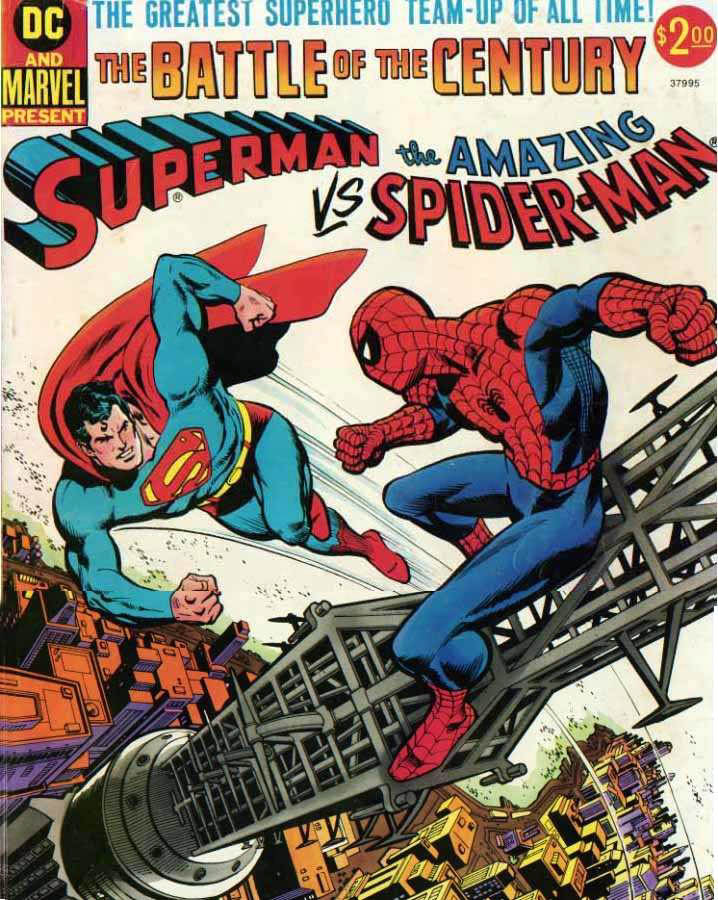
Before the sixties, comics stories only rarely referenced each other, but with a new breed of comic came a new breed of comics fan interested in seeing how disparate elements in the universe connected. While Marvel developed their own, at first tightly-knit continuity, DC experimented with alternate realities across which their adventures took place. In the seventies, when comics' direct market took shape, the shared universe concepts especially took root as did a more fan-centric atmosphere. This was the age of the Omniverse fanzine and the Superman Vs. The Amazing Spider-Man tabloid-size crossover. The crossovers between companies stopped in the eighties, with companies finding value in having their own characters all team-up in line-wide events that haven't stopped to this day. In Crisis on Infinite Earths DC sought to do away with their Multiverse concept in favor of a streamlined, more "realistic" lineup, but only created more problems that would plague them for decades.
This article is the fourth in a series analyzing a concept that has been one of the major underpinnings of comic books since Stan and Jack decided to have each series in their new line of Marvel Comics build on the others before. Here, I'm going to transition from the continuity craziness of the nineties...to the continuity craziness of the 2000s. And you'll see special attention paid to crossover events, a throughline from the last few entries. We're running a bit long, so within the next few days I promise to bring it all home with how DC Comics' "New 52" figures into the mix.
Before the sixties, comics stories only rarely referenced each other, but with a new breed of comic came a new breed of comics fan interested in seeing how disparate elements in the universe connected. While Marvel developed their own, at first tightly-knit continuity, DC experimented with alternate realities across which their adventures took place. In the seventies, when comics' direct market took shape, the shared universe concepts especially took root as did a more fan-centric atmosphere. This was the age of the Omniverse fanzine and the Superman Vs. The Amazing Spider-Man tabloid-size crossover. The crossovers between companies stopped in the eighties, with companies finding value in having their own characters all team-up in line-wide events that haven't stopped to this day. In Crisis on Infinite Earths DC sought to do away with their Multiverse concept in favor of a streamlined, more "realistic" lineup, but only created more problems that would plague them for decades.
23.8.11
Guest Blog: Samurai Comics Steps Up In AZ With A New Mesa Store
Considering all the big news coming out of Phoenix this week with the closing of Mike Malve's Atomic Comics chain of stores, I thought it was important to give all the news and insight I can. To that end, tonight I'm turning my blog over to Harold "Ole' Greenskin" Kayser, a good friend who's been following the ongoing drama. He and I both thought it necessary to correct some of the erroneous stories that have been published today. Please read the following and spread the word. At Delusional Honesty, we're the little engine that could, and I like to get the full picture. Thanks for reading.
"Bleeding Cool Gets it Wrong...."
The comic world was rocked by the closing of Atomic Comics, the largest retailer in the southwestern US, on Sunday. That's all I'm going to say about the closing specifically, as I can't add anything else that hasn't already been covered by numerous sites. Atomic Comics customers and the East Valley especially faced a proverbial black hole with the sudden closure.
Mike Banks, owner of Samurai Comics, talked with his Diamond Comic Distributors representatives about the situation and feverishly tried to work out a deal to help fill the void. They were successful, and Samurai Comics received the entire Atomic Comics shipment today. He's in the process of getting the product set up and ready for distribution on Wednesday. Also, Mike and his wife Morhya struck a deal late today to open a "pop-up" Samurai Comics directly adjacent to the Atomic Comics location on South Country Club Drive in Mesa. Fret not, Atomic Comics customers! You can go to almost the same location and get your new comics on Wednesday starting at 9:00am.
Now, I feel the need to set the record straight regarding the postings on Bleeding Cool, a comics news site run by Rich Johnston.
![]() |
| Samurai's Camelback location, with boxes & boxes of Atomic's shipment. |
"Bleeding Cool Gets it Wrong...."
The comic world was rocked by the closing of Atomic Comics, the largest retailer in the southwestern US, on Sunday. That's all I'm going to say about the closing specifically, as I can't add anything else that hasn't already been covered by numerous sites. Atomic Comics customers and the East Valley especially faced a proverbial black hole with the sudden closure.
Mike Banks, owner of Samurai Comics, talked with his Diamond Comic Distributors representatives about the situation and feverishly tried to work out a deal to help fill the void. They were successful, and Samurai Comics received the entire Atomic Comics shipment today. He's in the process of getting the product set up and ready for distribution on Wednesday. Also, Mike and his wife Morhya struck a deal late today to open a "pop-up" Samurai Comics directly adjacent to the Atomic Comics location on South Country Club Drive in Mesa. Fret not, Atomic Comics customers! You can go to almost the same location and get your new comics on Wednesday starting at 9:00am.
Now, I feel the need to set the record straight regarding the postings on Bleeding Cool, a comics news site run by Rich Johnston.
Unlimited Alpha Flight?
Very interesting post courtesy of a news tidbit submitted me by The Daily P.O.P.'s own Jameson Lee. Did anyone else catch this comment on Formspring? Should we take the question asker's observation with a grain of salt? Will there be more to Marvel's "Pint O' CB" panel at this weekend's FanExpo Canada than an announcement regarding the recent "Destroy" promo that has the #FVL hashtag attached?
Stay tuned...
~G.
Stay tuned...
~G.
22.8.11
Eve Of Destruction
Marvel Comics is now hyping an event set for 2012 with the tagline, "Destroy!" featuring a number of their more monstrous characters. I have a preview image, but due to SPOILERS mainly for Incredible Hulks #635, you'll have to click to see it after the jump!
No Delusions: Atomic Comics Has Closed
The rumors are true. As of last night, August 21, Atomic Comics, the largest comics chain retailer in the southwestern United States, is no more. Owner Mike Malve verified the chain's closing in a statement issued early this morning, citing the current financial climate as primary reason for his stores' collapse.
This wasn't the first sign of trouble for Malve and his stores. A car crashed into the Mesa Superstore location in late 2006, causing incredible damage including a water main break that damaged over a million dollars in inventory. The store closed for five months, after which much of the clientele never returned. Add the current economic downturn to the precipitating event, and it isn't hard to see it was all a perfect storm that led to Atomic's collapse.
21.8.11
Head To Head: Fright Night 1985 Vs. Fright Night 2011
Greetings, horror-fans!
I hoped you'd forgive me for not posting a "Hammer Horror" feature this Thursday last, because I knew what was coming. This weekend, Dreamworks Pictures released "Fright Night," a remake of the 1985 "cult classic" vampire film. What you might not have known (other than the mere fact the film was being released, which, the box office figures suggest, was a distinct possibility) was that I have an intense fascination for the original film.
"Fright Night," starring William Ragsdale, Roddy McDowall and Chris Sarandon, nearly scared this little kid to death way back when. In fact, I couldn't make it past the first scene where master vampire Jerry Dandridge "vamps out" to deliver a threatening warning in teenager Charley Brewster's bedroom. A year or so later, I happened upon a comic book adaptation of the film, which led to being able to sit through the whole movie. That in turn led to following the monthly Now Comics series throughout its 22-issue run (some of which was drawn by artists like Neil Vokes and Kevin West). And the rest is history, as I've long since gained a healthy appreciation of the horror genre in general and vampire films in particular.
I hoped you'd forgive me for not posting a "Hammer Horror" feature this Thursday last, because I knew what was coming. This weekend, Dreamworks Pictures released "Fright Night," a remake of the 1985 "cult classic" vampire film. What you might not have known (other than the mere fact the film was being released, which, the box office figures suggest, was a distinct possibility) was that I have an intense fascination for the original film.
"Fright Night," starring William Ragsdale, Roddy McDowall and Chris Sarandon, nearly scared this little kid to death way back when. In fact, I couldn't make it past the first scene where master vampire Jerry Dandridge "vamps out" to deliver a threatening warning in teenager Charley Brewster's bedroom. A year or so later, I happened upon a comic book adaptation of the film, which led to being able to sit through the whole movie. That in turn led to following the monthly Now Comics series throughout its 22-issue run (some of which was drawn by artists like Neil Vokes and Kevin West). And the rest is history, as I've long since gained a healthy appreciation of the horror genre in general and vampire films in particular.
19.8.11
Quick Reviews: Daredevil #2, Hulk #39
Just a few reviews whilst I ring in the weekend! You'll be seeing some different things coming up--no, really--including more than likely, a review of Fright Night this weekend. I've got at least one more Comic Book Revolution article in the pipeline if everything proceeds apace. A brand-new Hammer film is on my shelf just nagging, "Watch me!" And I find I'm again bitten by the bug called Whedonitis (roughly translated: a strong desire to re-watch all the glory that is Joss). I'll be throwing things your way and as always, it's up to you to decide what sticks. Aren't you the lucky ones? (Hint: if you do decide something's stick-worthy, then by all means tell somebody! Unlike the big boys at Comic Book Resources or Newsarama or all those other ginchy spots, I'm entirely homespun! (Psst--if you find yourself jazzed out of your mind about one of my pieces, you may consider dropping a few dimes in the handy Paypal tip jar on the right hand side of this page. Just a thought.)
Now that the shilling's done, where was I? Ah, yes. Reviews!
18.8.11
Hammer Thursday--Wha--?! (Fun with 'Fear Itself' & 'Planet Hulk')
We now interrupt the "Delusional Honesty" "Hammer Thursday" segment (featuring nearly-weekly reviews of Hammer Films) to bring you a different manner of "Hammer Thursday." Were Skadi, the Serpent's herald, and Caiera, the Hulk's wife, separated at birth? Click for bigger versions.
Same hairdo? Check. Similar armors? Check. And they both love their big-ass weapons, so, check. Okay, maybe not sisters, but seems like they got a hot lead on the same stylist! Make your own judgments here, kiddies.
Thanks to 'Ole Greenskin' for suggesting this post.
More tomorrow!
~G.
Same hairdo? Check. Similar armors? Check. And they both love their big-ass weapons, so, check. Okay, maybe not sisters, but seems like they got a hot lead on the same stylist! Make your own judgments here, kiddies.
Thanks to 'Ole Greenskin' for suggesting this post.
More tomorrow!
~G.
17.8.11
DCnU: Comic Books Are Really, Really Great (For Continuity P0rn!) (3)
(DCnU Continuity Series: Part 1 | Part 2 | Part 3 | Part 4 | Part 5)
Welcome back, comics compatriots!
Springing forth from the September relaunch of DC Comics like Athena busting out fully-formed from Zeus' noggin, here's yet another in a series of discussions of various facets of the comics medium. This is the third part of my very complex discussion of comics continuity. In the first part, I discussed the development of Marvel Comics' shared universe and DC's development of their Multiverse. In the second, I addressed how DC's attention to combining all their universes into one "New Earth" during Crisis on Infinite Earths actually created logistical problems that grew to rival any inconsistencies with the previous "Multiverse" system. I don't think it's overstating the case to suggest Crisis gave birth to the continuity-obsessed comics culture of the present day. And that brings us to this section, where I'll explore continuity gone wild.
Out of the Crisis, several characters' histories were "rebooted"--which is to say their prior histories were to be ignored as if they had never occurred. While writer Marv Wolfman intended for the conclusion of Crisis to result in a "new," composite DC Universe whose history we would see unfurl from that point forward, the editorial regime headed by Jenette Kahn, Dick Giordano and Paul Levitz nixed the idea. (More on this point as we race to the conclusion of this series!) Only Superman, Wonder Woman and the Justice League really enjoyed true "reboots," while the vast majority of the DC line pushed forward as before. Never mind that Superman had just appeared in an issue of Hawkman only a few months before, for Superman was just being introduced to the city of Metropolis over in Man of Steel. Nevermind that Wonder Woman had been fighting crime since the forties, for that was really Hippolyta, Diana of Themyscira's mother. And please, oh please oh please oh please, don't get me started about the hideous mess DC made when they relaunched Hawkman's continuity with Hawkworld in 1990!
On top of that, by very virtue of there being only one Earth when previously there were many, all kinds of bits of history were reshuffled. Earth-2's heroes, the Justice Society of America, were now part of the history of this new Earth, but neither Superman nor Batman were their contemporaries. (Wonder Woman? See above.) And most certainly, Batman and Catwoman never married and never had a daughter, Helena Wayne, that became the Huntress. Although there would be a Huntress, her origin was dramatically rewritten. Power Girl? Now, there was a question that wouldn't definitively be resolved until Infinite Crisis in 2005.
Hand in hand with the concept of a "reboot" or "relaunch" is the "retcon," short for "retroactive continuity," wherein previously established facts are changed. In-story facts can be changed to facilitate new stories being told (as you'll see in my explanations of certain Spider-Man storylines below) or to resolve apparent discrepancies in continuity that have arisen for any number of reasons (as you'll see in the below story about Superboy and the Legion of Super-Heroes). Some retcons only added "previously-unknown" details that cast a character's present in new light, such as when Alan Moore posited that the Swamp Thing was only a plant creature that thought it was Alec Holland (in "The Anatomy Lesson," from Saga of the Swamp Thing #21), or when Barry Allen, the second Flash, was revealed to have a twin brother (Cobalt Blue, as revealed in The Life Story of the Flash and Flash [vol. 2] #144). Other stories used retcons to substantially alter characters' histories, or eliminate them altogether, such as the aforementioned Crisis on Infinite Earths. As you can imagine, retconning, no matter how well done, has come to have a negative connotation and it's easy to understand why. Retcons, retcons, everywhere!
With all that DC had done in the previous fifty years, the current generation of DC's writers took it upon themselves to stitch together a continuity that was utterly fractured by the company's own hand. And the more they drew attention to the problems they created, the worse in turn those problems became. I mentioned the relationship between Superboy and the Legion of Super-Heroes in my last post. This relationship became an easy target because, well, in post-Crisis continuity, Clark Kent never became Superboy!
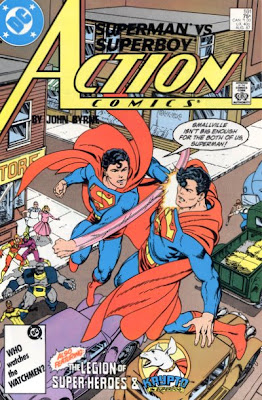
To address the issue--perhaps the earliest incidence of continuity porn to spin out of Crisis--John Byrne and Paul Levitz concocted a byzantine plot whereby the Legion's arch-enemy, the Time Trapper, created a "pocket universe" and populated it with Earth and Krypton. (Told in Action Comics #591, Superman #8 and Legion of Super-Heroes #37-38, 1987.) He then manipulated events that resulted in Superboy's creation, and whenever the Legion traveled to the past, it was really the Trapper's pocket universe they visited. The explanation gets loopier from there, with every plot contrivance underscoring the fact the story wasn't being told because somebody thought it would make a good story, but rather, because they needed some explanation in place! (A few months later, the same pocket universe would give birth to the first post-Crisis iteration of General Zod and his fellow criminals, as well as a "good" Lex Luthor who sent his creation Matrix, imprinted with the mental engrams of that universe's Lana Lang, to Earth. There, Matrix became the first post-Crisis Supergirl, who fell in love with Lex Luthor's clone, merged with the post-Crisis Linda Danvers, and eventually became an angel. But, I'm digressing!)
Eventually, DC's continuity problems continued to grow, which led to ever more drastic measures to "fix" them. The first major, whole-house attempt was Dan Jurgens' Zero Hour: A Crisis in Time, which endeavored to fix not only Crisis but also an earlier summer crossover, Armageddon 2001, whose ending had been mishandled after fans figured out the ending months ahead of release. A time-traveling villain named Extant acted as servant for hero-gone-bad Hal Jordan, Earth's second Green Lantern, who took ever more drastic measures to bring back his hometown Coast City, which had been decimated in the "Reign of the Supermen" storyline the previous year. The series, which started at issue #4 and "counted down" toward the finale in the aptly-numbered #0, ended in a drastic re-ordering of time that was supposed to magically fix everything that came before. They even included a fold-out timeline that included events from the distant past to the far future to prove their point that everything was nearly addressed!
It wasn't, of course, but in the meantime, we got a quasi-reboot with a month full of special issues of every DC title, all numbered #0 and their covers printed with metallic ink highlights. Some new series arrived, the most noteworthy of which was Starman under the aegis of James Robinson and Tony Harris. Meanwhile the Legion of Super-Heroes was relaunched with all evidence of Superboy's involvement in their origins erased, while the biggest change to Batman was re-establishing that his parents' killer was a nameless crook (and not Joe Chill, a fact true in both pre-Crisis continuity and in the post-Crisis "Batman: Year Two").
At the same time as DC dealt with their second big event centered around a "Crisis," Marvel initiated perhaps the most notorious example of using continuity as a weapon. To attempt to follow DC's lead with such events as "The Death of Superman" and "Knightfall," they concocted (there's that word again!) a storyline in which a clone of Spider-Man, who'd appeared in a series of stories in the seventies, had never died. The character, who renamed himself Ben Reilly (itself a continuity nugget, combining Spidey's uncle's first name with his aunt's maiden name), went on the road for many years but came back when he heard of Aunt May's sudden illness. His return between 1994-1996 also prompted the return of the villain that created him, the nefarious Jackal, who brought with him a host of half-baked clones including one of Gwen Stacy, Spidey's lost love. All along the way, the writers constantly refuted previous stories about the clones, bridging the gaps outside the Spider-Man group of titles.
In theory, the clone's return was meant to be a return to form for Spider-Man, who was seen as increasingly alienated from his fanbase by virtue of his marriage to Mary Jane Watson, then a successful supermodel. Marvel re-characterized Peter Parker as a "dark" character, and even a villain, in the hopes that Ben Reilly would be accepted as the one, true Spider-Man. They even exploited a decades-old plot point whereby Peter could be the clone, and Ben the real one. Peter left New York with a pregnant Mary Jane, and Ben Reilly became a Spider-Man who lost track of which heroes and villains he knew from the point his memories diverged from Peter's. Eventually Marvel opened up an even bigger can of worms by resurrecting Mendel Stromm and Norman Osborn to solve the narrative, kill off Ben, and restore Peter as the one, true Spider-Man. (Don't worry--Marvel would again try, more successfully, to divest themselves of the Spider-marriage. Keep reading.)
Worse, once the "Clone Saga" was complete, writer Roger Stern returned to Spider-Man to rewrite years of continuity since he left the book, with the express aim of providing the "real" identity of the Hobgoblin. He'd already been unmasked years before as Daily Bugle reporter Ned Leeds, but that didn't stop Stern from reopening a dead case and providing his own answer to the puzzle as he originally intended. The three-issue series, Spider-Man: Hobgoblin Lives, contained references to back issues on the back covers, a sure-fire sign that continuity had been taken too far. And, of course, Stern revealed the Hobgoblin to be one of his own creations who hadn't been seen for over a decade. And an evil twin! Le sigh.
Back at DC, writer Mark Waid and artist Alex Ross' Kingdom Come told a dystopic version of events from DC's future. The four-issue series, published in 1996, continued a special-event line of comics called "Elseworlds," which weren't tales from alternate realities because, well, alternate realities didn't exist anymore at DC, right? Still, on the strength of the storyline, Waid helmed another event series in 1999, The Kingdom, as a sequel of sorts, during which he revealed that the Multiverse was alive and well and part of a concept now called "Hypertime." Hypertime supposed that reality was like a river whose paths could randomly converge and diverge, allowing for different versions of Superman or any other character to coexist or team up as circumstances dictated. It also encompassed the original Multiverse plus all the Elseworlds realities. Most notably, Waid used the Hypertime concept himself at great length during the end of his tenure on The Flash when Walter West, the Flash of an alternate reality, briefly took the place of the mainstream DC Flash, Wallace West. For a while, there was talk of Grant Morrison using the concepts introduced in The Kingdom in a new crossover event to be called Hypercrisis, but the project was shelved.
Writer Kurt Busiek, who rose to prominence through his work on the revolutionary Marvels project with Alex Ross, was that unique breed of writer who endeavored in ways similar to Roy Thomas to link Marvel's past with its present. He never met a continuity reference he didn't like, and if there's one man who embodies the essence of "continuity gone wild" for better or worse, 'tis he. Marvels was filled with references both in the story itself, or in poses of characters, or really, any old thing. They may not have been intrusive to the degree they were in others' work, but there they were all the same. Busiek's intense detail toward continuity minutiae became a driving force behind two of his most well-known projects: Avengers Forever, itself a scrutinous examination of Avengers continuity through the eyes of villain Kang the Conqueror; and the DC/Marvel co-publication JLA/Avengers, itself rummaging through years of unusual continuity to tell a story that spanned the full length of both teams' histories. While demonstrating Busiek's obsessive attention to detail, both series were impenetrable to all but the most fervent fans.
DC's own answer to Kurt Busiek hit the ground running as writer of niche book Stars and S.T.R.I.P.E. and co-writer of James Robinson's JSA revival. In some ways, Geoff Johns could make Busiek look positively amateur by comparison. He sifted through years of complex continuity to return Hawkman from permanent "damaged goods" status in JSA and his own book. He's worked on various "event series" including Day of Judgment, Identity Crisis, Green Lantern: Rebirth, Infinite Crisis, Final Crisis, Flash: Rebirth, Blackest Night, Brightest Day and the currently-running Flashpoint. Each of the company's recent event series has been predicated on older continuity for maximum effect, from Brad Meltzer's Identity Crisis' reworking of the JLA's "Satellite Era" to Infinite Crisis as direct sequel to Crisis on Infinite Earths, to Grant Morrison's Final Crisis as a love letter to Jack Kirby's "Fourth World" tales, to Blackest Night as an ultimate extension of decades of "Green Lantern" mythos.
Infinite Crisis in particular poked fun of the conventions of intense scrutiny of continuity when in its Secret Files & Origins special, writer Marv Wolfman revealed that since Crisis on Infinite Earths, Superboy-Prime punched at the walls of reality from the "paradise" he shared with Earth-2's Superman and Lois, with each punch causing disruptions to continuity. Those disruptions included the resurrection of Jason Todd (Robin II), the changing origins of Superman, and the various incarnations of Hawkman and the Legion of Super-Heroes. If there was an apparent continuity mistake, DC could say that Superboy-Prime made it that way. (And when he was released during Infinite Crisis, he continued the trend of messing everything up. Rimshot!)
Infinite Crisis also brought back the Multiverse in a big way, and for enthusiasts of that brand of storytelling, writer Johns "revealed" (using quotes because it was his own made-up history, not from prior precedent) that legacy characters like the Kyle Rayner Green Lantern and the Jason Rusch Firestorm were really the heroes from another, heretofore unknown Earth ("Earth-8") that was merged into the "new Earth" during the original Crisis on Infinite Earths. Yes, the writers just had to cater to the original spirit of the Crisis-that-was. But Johns kept pushing the envelope further...
His work on Final Crisis: Legion of 3 Worlds in particular was hugely evocative of the continuity-heavy stories that Crisis on Infinite Earths spawned, relying on the reader's knowledge of three distinct alternate versions of the Legion of Super-Heroes to assist in comprehension of the narrative (not to mention the returns of several non-Legion characters). Johns catered to his artist, George Perez of 1985's Crisis fame, allowing him to draw dozens or even hundreds of characters in incredible detail such as Perez has become well-known for doing. Lovers of DC's often labyrinthine continuity gobbled the series up, but it often left more casual fans cold--as did, for that matter, Final Crisis itself.
Not to be outdone, Marvel has done some selective continuity editing of their own, almost establishing a sort of "anti-continuity" with Spider-Man's infamous "One More Day" storyline. In it, Spider-Man made a deal with Mephisto, Marvel's representation of the devil, to save his aunt from certain death and to ensure his identity (revealed to the world in a then-recent storyline) became a secret again. Suddenly and without explanation, Spidey's marriage to Mary Jane was edited out of continuity. So ingrained into fans' minds was the idea that some additional explanation was required, that the fans were owed the details as to exactly what changes were made in history to arrive at this point. They couldn't simply accept that "they never got married" because, well, what about Mary Jane's pregnancy during the "Clone Saga"? Didn't that mean their beloved hero was having sex out of wedlock and thus was immoral and unclean? (They seemed to gloss over that part where Spidey made a deal with a bad guy, satanic or otherwise.) The "mystery" went on for nearly a hundred issues until only the points directly raised by "One More Day" were addressed, and no more, in "One Moment in Time." Of course, since then, they've moved on, content to never, ever address the finer points of Spidey's relationship with MJ again.
Continuity continues to prove a slippery slope, a double-edged sword, a (insert cliche of your choice here). I get the desire to make order out of the chaos, and to show that more or less, fictional realities have similar physical rules to our own. However, the more changes that are done, the less "real" the reality of the comics becomes. Also, continuity creates an insular subdivision of fandom, so engrossed in the "reality" of the characters that they will cry foul on any deviations from previously established events. (Really, the mentality that gave birth to the concept of the "No-Prize," writ large.) Ultimately, one may even see an expansive continuity as one more reason that comic circulation has slowly dwindled, as fewer and fewer people can make sense of these universes the bigger companies have created.
Was DC in danger of collapsing under its own weight when they announced the grand reboot that spins out of the Flashpoint miniseries this month? That's a good and fair question, but it'll have to wait until my fourth and final part of this little (heh) essay.
Next: Grand Guignol
(DCnU Continuity Series: Part 1 | Part 2 | Part 3 | Part 4 | Part 5)
~G.
Welcome back, comics compatriots!
Springing forth from the September relaunch of DC Comics like Athena busting out fully-formed from Zeus' noggin, here's yet another in a series of discussions of various facets of the comics medium. This is the third part of my very complex discussion of comics continuity. In the first part, I discussed the development of Marvel Comics' shared universe and DC's development of their Multiverse. In the second, I addressed how DC's attention to combining all their universes into one "New Earth" during Crisis on Infinite Earths actually created logistical problems that grew to rival any inconsistencies with the previous "Multiverse" system. I don't think it's overstating the case to suggest Crisis gave birth to the continuity-obsessed comics culture of the present day. And that brings us to this section, where I'll explore continuity gone wild.
![]() |
| Silly season begins at DC: Tim Truman's Hawkworld. |
On top of that, by very virtue of there being only one Earth when previously there were many, all kinds of bits of history were reshuffled. Earth-2's heroes, the Justice Society of America, were now part of the history of this new Earth, but neither Superman nor Batman were their contemporaries. (Wonder Woman? See above.) And most certainly, Batman and Catwoman never married and never had a daughter, Helena Wayne, that became the Huntress. Although there would be a Huntress, her origin was dramatically rewritten. Power Girl? Now, there was a question that wouldn't definitively be resolved until Infinite Crisis in 2005.
![]() |
| Retconning 101: The revised origin of the Swamp Thing by Alan Moore. |
With all that DC had done in the previous fifty years, the current generation of DC's writers took it upon themselves to stitch together a continuity that was utterly fractured by the company's own hand. And the more they drew attention to the problems they created, the worse in turn those problems became. I mentioned the relationship between Superboy and the Legion of Super-Heroes in my last post. This relationship became an easy target because, well, in post-Crisis continuity, Clark Kent never became Superboy!
![]() |
| "If there was never a Superboy, who the hell is fighting Superman?" |
Eventually, DC's continuity problems continued to grow, which led to ever more drastic measures to "fix" them. The first major, whole-house attempt was Dan Jurgens' Zero Hour: A Crisis in Time, which endeavored to fix not only Crisis but also an earlier summer crossover, Armageddon 2001, whose ending had been mishandled after fans figured out the ending months ahead of release. A time-traveling villain named Extant acted as servant for hero-gone-bad Hal Jordan, Earth's second Green Lantern, who took ever more drastic measures to bring back his hometown Coast City, which had been decimated in the "Reign of the Supermen" storyline the previous year. The series, which started at issue #4 and "counted down" toward the finale in the aptly-numbered #0, ended in a drastic re-ordering of time that was supposed to magically fix everything that came before. They even included a fold-out timeline that included events from the distant past to the far future to prove their point that everything was nearly addressed!
![]() |
| Everything ends, and begins again. Zero Hour: A Crisis in Time #1. |
At the same time as DC dealt with their second big event centered around a "Crisis," Marvel initiated perhaps the most notorious example of using continuity as a weapon. To attempt to follow DC's lead with such events as "The Death of Superman" and "Knightfall," they concocted (there's that word again!) a storyline in which a clone of Spider-Man, who'd appeared in a series of stories in the seventies, had never died. The character, who renamed himself Ben Reilly (itself a continuity nugget, combining Spidey's uncle's first name with his aunt's maiden name), went on the road for many years but came back when he heard of Aunt May's sudden illness. His return between 1994-1996 also prompted the return of the villain that created him, the nefarious Jackal, who brought with him a host of half-baked clones including one of Gwen Stacy, Spidey's lost love. All along the way, the writers constantly refuted previous stories about the clones, bridging the gaps outside the Spider-Man group of titles.
![]() |
| Silly season begins at Marvel: The Spider-Clone returns. |
Worse, once the "Clone Saga" was complete, writer Roger Stern returned to Spider-Man to rewrite years of continuity since he left the book, with the express aim of providing the "real" identity of the Hobgoblin. He'd already been unmasked years before as Daily Bugle reporter Ned Leeds, but that didn't stop Stern from reopening a dead case and providing his own answer to the puzzle as he originally intended. The three-issue series, Spider-Man: Hobgoblin Lives, contained references to back issues on the back covers, a sure-fire sign that continuity had been taken too far. And, of course, Stern revealed the Hobgoblin to be one of his own creations who hadn't been seen for over a decade. And an evil twin! Le sigh.
![]() |
| The book that led to the revival of the Multive--um, Hypertime: Kingdom Come. |
Writer Kurt Busiek, who rose to prominence through his work on the revolutionary Marvels project with Alex Ross, was that unique breed of writer who endeavored in ways similar to Roy Thomas to link Marvel's past with its present. He never met a continuity reference he didn't like, and if there's one man who embodies the essence of "continuity gone wild" for better or worse, 'tis he. Marvels was filled with references both in the story itself, or in poses of characters, or really, any old thing. They may not have been intrusive to the degree they were in others' work, but there they were all the same. Busiek's intense detail toward continuity minutiae became a driving force behind two of his most well-known projects: Avengers Forever, itself a scrutinous examination of Avengers continuity through the eyes of villain Kang the Conqueror; and the DC/Marvel co-publication JLA/Avengers, itself rummaging through years of unusual continuity to tell a story that spanned the full length of both teams' histories. While demonstrating Busiek's obsessive attention to detail, both series were impenetrable to all but the most fervent fans.
![]() |
| Continuity pr0n for Earth's Mightiest Heroes. |
Infinite Crisis in particular poked fun of the conventions of intense scrutiny of continuity when in its Secret Files & Origins special, writer Marv Wolfman revealed that since Crisis on Infinite Earths, Superboy-Prime punched at the walls of reality from the "paradise" he shared with Earth-2's Superman and Lois, with each punch causing disruptions to continuity. Those disruptions included the resurrection of Jason Todd (Robin II), the changing origins of Superman, and the various incarnations of Hawkman and the Legion of Super-Heroes. If there was an apparent continuity mistake, DC could say that Superboy-Prime made it that way. (And when he was released during Infinite Crisis, he continued the trend of messing everything up. Rimshot!)
Infinite Crisis also brought back the Multiverse in a big way, and for enthusiasts of that brand of storytelling, writer Johns "revealed" (using quotes because it was his own made-up history, not from prior precedent) that legacy characters like the Kyle Rayner Green Lantern and the Jason Rusch Firestorm were really the heroes from another, heretofore unknown Earth ("Earth-8") that was merged into the "new Earth" during the original Crisis on Infinite Earths. Yes, the writers just had to cater to the original spirit of the Crisis-that-was. But Johns kept pushing the envelope further...
![]() |
| Did someone mention "continuity pr0n"? Geoff Johns goes overboard with the Legion. |
Not to be outdone, Marvel has done some selective continuity editing of their own, almost establishing a sort of "anti-continuity" with Spider-Man's infamous "One More Day" storyline. In it, Spider-Man made a deal with Mephisto, Marvel's representation of the devil, to save his aunt from certain death and to ensure his identity (revealed to the world in a then-recent storyline) became a secret again. Suddenly and without explanation, Spidey's marriage to Mary Jane was edited out of continuity. So ingrained into fans' minds was the idea that some additional explanation was required, that the fans were owed the details as to exactly what changes were made in history to arrive at this point. They couldn't simply accept that "they never got married" because, well, what about Mary Jane's pregnancy during the "Clone Saga"? Didn't that mean their beloved hero was having sex out of wedlock and thus was immoral and unclean? (They seemed to gloss over that part where Spidey made a deal with a bad guy, satanic or otherwise.) The "mystery" went on for nearly a hundred issues until only the points directly raised by "One More Day" were addressed, and no more, in "One Moment in Time." Of course, since then, they've moved on, content to never, ever address the finer points of Spidey's relationship with MJ again.
![]() |
| 1st rule of Spidey continuity: You don't talk about Spidey continuity. |
Was DC in danger of collapsing under its own weight when they announced the grand reboot that spins out of the Flashpoint miniseries this month? That's a good and fair question, but it'll have to wait until my fourth and final part of this little (heh) essay.
Next: Grand Guignol
(DCnU Continuity Series: Part 1 | Part 2 | Part 3 | Part 4 | Part 5)
~G.
15.8.11
Mantlegacy: The Man-Brute Called Woodgod!
If anyone's been following me for any length of time, you'll know that Bill Mantlo has long been one of my favorite writers, in spite of, well, things that have come into focus recently (and which will soon be the topic of a blog entry). He wrote many, many Marvel comics in the seventies and eighties, including my perennial favorites Rom, Spaceknight; Peter Parker, the Spectacular Spider-Man; and of course The Incredible Hulk (which I've reviewed here, here and here). I thought it was high time I introduced those of you who might not be as familiar with the esteemed Mr. Mantlo's work to one of my favorite of his creations: the man-brute called Woodgod!
The character who would later become most closely associated with the writer's work on the Hulk, Woodgod actually starred in his own inaugural adventure in Marvel Premiere #31 (August, 1976) by Mantlo and then-neophyte Marvel artist Keith Giffen, who was also illustrating David Anthony Kraft's Defenders stories at the time. Noteworthy is the fact this story was not Mantlo and Giffen's sole collaboration: they also created the "Sword in the Star" series the same year in Marvel Preview (which introduced another obscure character by the name of Rocket Raccoon...hey, whatever happened to him?).
And to top it all off, Marvel somehow got superstar artist Jack "King" Kirby to draw the story's cover. How d'you like them apples?
At first, Woodgod seemed like an animal-human hybrid who could've stepped forth from the High Evolutionary's wicked world of Wundagore, but thankfully, Mantlo kept his creation isolated in that first story. "Birthday!" tells the story of David and Ellen Pace, two geneticists who created Woodgod, a humanoid creature whose appearance echoed that of Pan, the Greek god of the wild. He had dark skin, the barest hint of horns on his head, and the feet of a goat. Why exactly the Paces chose this visage for the one they would treat as their son remains unknown, but Woodgod did enjoy accelerated mental growth to match his adult body. Months passed until the townspeople of Liberty happened upon young Woodgod. Instead of being understanding, they only saw a monster, and laid siege to the Paces' farm, inadvertently releasing an experimental nerve gas that killed everyone in the town but Woodgod. The shrieks the townspeople made as they died caused young Woodgod to connect the two. Henceforth, "the scream" had killed his parents and the townspeople. Major Tremens, Pace's superior at Vertigo Base, sent a team to investigate and found a howling-mad Woodgod.
Woodgod's next appearance was in Marvel Team-Up #53-55, scripted by Mantlo and drawn by superstar artist John Byrne. The Hulk happened upon the young Woodgod on the same day as the previous issue's events. The two fought until Spider-Man arrived after having heard of the Green Goliath's arrival, at which time they teamed up and fought Spidey instead! Eventually Major Tremens captured all three and brought them to Tranquility Base (!), planning to shoot Woodgod into space and blame Spider-Man and the Hulk for the tragedy in Liberty. The heroes escaped and Woodgod killed Tremens before hiding anew.
Eventually Woodgod resurfaced in Incredible Hulk #252-253, where we discovered that Woodgod had salvaged his parents' research and traveled to a remote area of Colorado. Teaching himself to read and write, he soon used his advanced intelligence to carry on his father's work, creating a race of humanoid animals he dubbed the Changelings. First Doc Samson and General Ross encountered them, followed by Fred Sloan, Rick Jones, Betty Ross and the Hulk himself. They found themselves caught in the middle of a war between rival factions of the Changelings, with Woodgod's own creation, Leoninus. At the end of the battle, Woodgod renounced his leadership of the group, saying that they should lead themselves, and perhaps one day they could reveal themselves to the public without fear.
After Bill Mantlo left Marvel, the character was sadly nearly forgotten, popping up here and there but never for more than a bit role. Shortly after his last appearance with the Changelings, Woodgod had been captured by the Stranger, an enigmatic alien prone to collecting specimens for his laboratory world. The superhero Quasar helped free him and others the Stranger had captured during a battle with the Overmind, after which the sometime Avenger transported the whole lot back to Earth (Quasar #13-16, 19-20).
Sadly, no sooner did he reunite with his fellow Changelings (and enjoy an adventure with them in Marvel Comics Presents #76) than the armed forces of Trinity Base (!!) killed them all, claiming they were private property created with their financing. Woodgod survived but the trauma of seeing his brethren executed caused him to regress to his earlier, more hostile persona. Nick Fury and his S.H.I.E.L.D. agents helped Woodgod escape, faking his death and promising to shut down Trinity. Check Nick Fury, Agent of S.H.I.E.L.D. #37 for the details.
After the death of his Changelings, Woodgod was again captured, this time by the newly-malevolent Department H, shown in a cameo in Alpha Flight (1997 series) #13. At some point, he escaped their clutches, only to again be brought off-Earth and mutated even further by Xemnu the Titan, who returned him to battle the Red Hulk in Hulk #30, a scant few months ago (as reviewed here).
Who knows where Woodgod will appear next? He doesn't appear to be all that popular, and no writers save Mantlo seem to have a decent enough handle on what makes him tick. They all enjoy using him as a prop, or walking back Mantlo's later characterization as leader of a race of beings like himself. True, it may be that he and the Changelings are seen as knock-offs of the High Evolutionary's New Men concept, and perhaps that reputation's deserved. Still, I long for the return of the more textured characterization of this character who's unjustly ignored. After five substantial, promising appearances in the Bronze Age, Woodgod has become a footnote in Marvel history when his pedigree indicates he's deserving of more. Now, I'm not asking for him to be made part of the next Avengers team, but a little respect is due, no?
~G.
Recommended Reading: Marvel Premiere #31; Marvel Team-Up #53-55; The Incredible Hulk #251-253; Quasar #14, 19-20; Marvel Comics Presents #76; Nick Fury, Agent of S.H.I.E.L.D. #37; Alpha Flight (1997 series) #13; Hulk (2008 series) #30.
The character who would later become most closely associated with the writer's work on the Hulk, Woodgod actually starred in his own inaugural adventure in Marvel Premiere #31 (August, 1976) by Mantlo and then-neophyte Marvel artist Keith Giffen, who was also illustrating David Anthony Kraft's Defenders stories at the time. Noteworthy is the fact this story was not Mantlo and Giffen's sole collaboration: they also created the "Sword in the Star" series the same year in Marvel Preview (which introduced another obscure character by the name of Rocket Raccoon...hey, whatever happened to him?).
And to top it all off, Marvel somehow got superstar artist Jack "King" Kirby to draw the story's cover. How d'you like them apples?
At first, Woodgod seemed like an animal-human hybrid who could've stepped forth from the High Evolutionary's wicked world of Wundagore, but thankfully, Mantlo kept his creation isolated in that first story. "Birthday!" tells the story of David and Ellen Pace, two geneticists who created Woodgod, a humanoid creature whose appearance echoed that of Pan, the Greek god of the wild. He had dark skin, the barest hint of horns on his head, and the feet of a goat. Why exactly the Paces chose this visage for the one they would treat as their son remains unknown, but Woodgod did enjoy accelerated mental growth to match his adult body. Months passed until the townspeople of Liberty happened upon young Woodgod. Instead of being understanding, they only saw a monster, and laid siege to the Paces' farm, inadvertently releasing an experimental nerve gas that killed everyone in the town but Woodgod. The shrieks the townspeople made as they died caused young Woodgod to connect the two. Henceforth, "the scream" had killed his parents and the townspeople. Major Tremens, Pace's superior at Vertigo Base, sent a team to investigate and found a howling-mad Woodgod.
Woodgod's next appearance was in Marvel Team-Up #53-55, scripted by Mantlo and drawn by superstar artist John Byrne. The Hulk happened upon the young Woodgod on the same day as the previous issue's events. The two fought until Spider-Man arrived after having heard of the Green Goliath's arrival, at which time they teamed up and fought Spidey instead! Eventually Major Tremens captured all three and brought them to Tranquility Base (!), planning to shoot Woodgod into space and blame Spider-Man and the Hulk for the tragedy in Liberty. The heroes escaped and Woodgod killed Tremens before hiding anew.
Eventually Woodgod resurfaced in Incredible Hulk #252-253, where we discovered that Woodgod had salvaged his parents' research and traveled to a remote area of Colorado. Teaching himself to read and write, he soon used his advanced intelligence to carry on his father's work, creating a race of humanoid animals he dubbed the Changelings. First Doc Samson and General Ross encountered them, followed by Fred Sloan, Rick Jones, Betty Ross and the Hulk himself. They found themselves caught in the middle of a war between rival factions of the Changelings, with Woodgod's own creation, Leoninus. At the end of the battle, Woodgod renounced his leadership of the group, saying that they should lead themselves, and perhaps one day they could reveal themselves to the public without fear.
After Bill Mantlo left Marvel, the character was sadly nearly forgotten, popping up here and there but never for more than a bit role. Shortly after his last appearance with the Changelings, Woodgod had been captured by the Stranger, an enigmatic alien prone to collecting specimens for his laboratory world. The superhero Quasar helped free him and others the Stranger had captured during a battle with the Overmind, after which the sometime Avenger transported the whole lot back to Earth (Quasar #13-16, 19-20).
Sadly, no sooner did he reunite with his fellow Changelings (and enjoy an adventure with them in Marvel Comics Presents #76) than the armed forces of Trinity Base (!!) killed them all, claiming they were private property created with their financing. Woodgod survived but the trauma of seeing his brethren executed caused him to regress to his earlier, more hostile persona. Nick Fury and his S.H.I.E.L.D. agents helped Woodgod escape, faking his death and promising to shut down Trinity. Check Nick Fury, Agent of S.H.I.E.L.D. #37 for the details.
After the death of his Changelings, Woodgod was again captured, this time by the newly-malevolent Department H, shown in a cameo in Alpha Flight (1997 series) #13. At some point, he escaped their clutches, only to again be brought off-Earth and mutated even further by Xemnu the Titan, who returned him to battle the Red Hulk in Hulk #30, a scant few months ago (as reviewed here).
Who knows where Woodgod will appear next? He doesn't appear to be all that popular, and no writers save Mantlo seem to have a decent enough handle on what makes him tick. They all enjoy using him as a prop, or walking back Mantlo's later characterization as leader of a race of beings like himself. True, it may be that he and the Changelings are seen as knock-offs of the High Evolutionary's New Men concept, and perhaps that reputation's deserved. Still, I long for the return of the more textured characterization of this character who's unjustly ignored. After five substantial, promising appearances in the Bronze Age, Woodgod has become a footnote in Marvel history when his pedigree indicates he's deserving of more. Now, I'm not asking for him to be made part of the next Avengers team, but a little respect is due, no?
~G.
Recommended Reading: Marvel Premiere #31; Marvel Team-Up #53-55; The Incredible Hulk #251-253; Quasar #14, 19-20; Marvel Comics Presents #76; Nick Fury, Agent of S.H.I.E.L.D. #37; Alpha Flight (1997 series) #13; Hulk (2008 series) #30.
Subscribe to:
Posts (Atom)